air condition Ram 2500 2019 Owner's Guide
[x] Cancel search | Manufacturer: RAM, Model Year: 2019, Model line: 2500, Model: Ram 2500 2019Pages: 696, PDF Size: 13.89 MB
Page 228 of 696

226 SAFETY
Tire Pressure Monitoring Low Pressure Warnings
When a tire pressure low in one or more of the active road
tires is detected a chime will sound. In addition, the instru-
ment cluster will display a graphic showing the pressure
values of each tire with the low tire pressure values in a
different color. An “Inflate to XXX” message will also be
displayed.
NOTE:
"XXX" = TPM trailer tire target pressure value programmed
by the customer
Should this occur, you should stop as soon as possible and
inflate the tires with a low pressure condition (those in a
different color in the instrument cluster graphic) to the
customer programmed target tire pressure value as shown in
the “Inflate to XXX” message. Once the system receives the
updated tire pressures, the system will automatically update
the graphic display in the instrument cluster will return to
it’s original color. The vehicle may need to be driven for up
to 10 minutes above 15 mph (24 km/h) in order for the
TTPMS to receive the updated information.Service TTPMS Warning
If a system fault is detected, the system fault will sound a
chime and the instrument cluster will display a “Trailer Tire
Pressure System Service Required” message for a minimum
of five seconds and then display dashes (- -) in place of the
pressure value to indicate which sensor is not being received.
Once the system fault is corrected the "Trailer Tire Pressure
System Service Required" message will no longer be
displayed and the dashes will be replaced by pressure
values. The vehicle may need to be driven for up to
10 minutes above 15 mph (24 km/h) in order for the TTPMS
to receive the updated information.
Trailer Tire Pressure System Not Configured
A “Trailer Tire Pressure System Not Configured” message
will be displayed in the Instrument Cluster when a trailer
number is selected that does not have configuration values
entered for the (Number of Tires, Number of Axles, SET
Target Tire Pressure, trailer TPM sensor ID's).
To correct this condition the (Number of Tires, Number of
Axles, and SET Target Tire Pressure) values must be entered
in the radio for the trailer number selected. The trailer
sensors must also be paired to the trailer. Refer to the “Ucon -
nect Settings” in “Multimedia” for further information.
Page 229 of 696

SAFETY 227
Trailer Sensors Detected Do Not Match Active Trailer
The “Trailer Sensors Detected Do Not Match Active Trailer”
message will be displayed in the Instrument Cluster when
the trailer sensors being received by the TTPM module do
match the trailer sensors paired to the current trailer number
selected. This message will be displayed when the sensors
being received completely match the sensors paired to
another trailer number configured in the TTPM module.
To correct this condition, the correct trailer number must be
selected in the radio. Refer to the “Uconnect Settings” in
“Multimedia” for further information.
Tire Fill Alert
This feature notifies the user when the placard tire pressure
is attained while inflating or deflating the tire.
The customer may choose to disable or enable the Tire Fill
Alert feature through use of the customer settings in the
radio.
NOTE:
• Only one tire can be filled at a time when using the Tire FillAlert system. • The Tire Fill Alert feature cannot be entered if an existing
TPM system fault is set to “active” or if the system is in
deactivation mode (if equipped).
The system will be activated when the TPM receiver module
detects a change in tire pressure. The ignition must be in the
RUN mode, with the transmission in PARK (P).
NOTE:
It is not required to have the engine running to enter Tire Fill
Alert mode.
The hazard lamps will come on to confirm the vehicle is in
Tire Fill Alert mode.
When Tire Fill Alert Mode is entered, the tire pressure
display screen will be displayed in the instrument cluster.
Operation:
• The horn will chirp to let the user know when to stop filling the tire, when it reaches recommended pressure.
• The horn will chirp three times if the tire is over filled and will continue to chirp every five seconds if the user
continues to inflate the tire.
4
Page 232 of 696

230 SAFETY
General Information
This device complies with Part 15 of the FCC rules and RSS
210 of Industry Canada. Operation is subject to the following
conditions:
1. This device may not cause harmful interference.
2. This device must accept any interference received,including interference that may cause undesired opera -
tion.
NOTE:
Changes or modifications not expressly approved by the
party responsible for compliance could void the user’s
authority to operate the equipment.
OCCUPANT RESTRAINT SYSTEMS
Some of the most important safety features in your vehicle
are the restraint systems:
Occupant Restraint Systems Features
• Seat Belt Systems
• Supplemental Restraint Systems (SRS) Air Bags
• Child Restraints Some of the safety features described in this section may be
standard equipment on some models, or may be optional
equipment on others. If you are not sure, ask an authorized
dealer.
Important Safety Precautions
Please pay close attention to the information in this section.
It tells you how to use your restraint system properly, to
keep you and your passengers as safe as possible.
Here are some simple steps you can take to minimize the risk
of harm from a deploying air bag:
1. Children 12 years old and under should always ride
buckled up in the rear seat of a vehicle with a rear seat.
2. A child who is not big enough to wear the vehicle seat belt properly (Refer to “Child Restraints” in this section for
further information) must be secured in the appropriate
child restraint or belt-positioning booster seat in a rear
seating position.
3. If a child from 2 to 12 years old (not in a rear-facing child restraint) must ride in the front passenger seat, move the
seat as far back as possible and use the proper child
restraint (Refer to “Child Restraints” in this section for
further information).
Page 235 of 696

SAFETY 233
(Continued)
Change Of Status
If the driver or outboard front seat passenger (if equipped
with outboard front passenger seat BeltAlert) unbuckles
their seat belt while the vehicle is traveling, the BeltAlert
warning sequence will begin until the seat belts are buckled
again.
The outboard front passenger seat BeltAlert is not active
when the outboard front passenger seat is unoccupied.
BeltAlert may be triggered when an animal or other items are
placed on the outboard front passenger seat or when the seat
is folded flat (if equipped). It is recommended that pets be
restrained in the rear seat (if equipped) in pet harnesses or
pet carriers that are secured by seat belts, and cargo is prop-
erly stowed.
BeltAlert can be activated or deactivated by an authorized
dealer. FCA US LLC does not recommend deactivating
BeltAlert.
NOTE:
If BeltAlert has been deactivated and the driver or outboard
front seat passenger (if equipped with outboard front
passenger seat BeltAlert) is unbuckled the Seat Belt
Reminder Light will turn on and remain on until the driver
and outboard front seat passenger seat belts are buckled. Lap/Shoulder Belts
All seating positions except the Mega Cab and Crew Cab
front center seating position have combination lap/shoulder
belts.
The seat belt webbing retractor will lock only during very
sudden stops or collisions. This feature allows the shoulder
part of the seat belt to move freely with you under normal
conditions. However, in a collision the seat belt will lock and
reduce your risk of striking the inside of the vehicle or being
thrown out of the vehicle.
WARNING!
• Relying on the air bags alone could lead to more severe injuries in a collision. The air bags work with your seat
belt to restrain you properly. In some collisions, the air
bags won’t deploy at all. Always wear your seat belt
even though you have air bags.
• In a collision, you and your passengers can suffer much greater injuries if you are not properly buckled up. You
can strike the interior of your vehicle or other passen -
gers, or you can be thrown out of the vehicle. Always be
sure you and others in your vehicle are buckled up
properly.
4
Page 248 of 696

246 SAFETY
The ORC also includes diagnostics that will illuminate the
instrument panel Air Bag Warning Light if a malfunction is
detected that could affect the air bag system. The diagnostics
also record the nature of the malfunction. While the air bag
system is designed to be maintenance free, if any of the
following occurs, have an authorized dealer service the air
bag system immediately.
• The Air Bag Warning Light does not come on during thefour to eight seconds when the ignition switch is first in the
ON/RUN position.
• The Air Bag Warning Light remains on after the four to eight-second interval.
• The Air Bag Warning Light comes on intermittently or remains on while driving. NOTE:
If the speedometer, tachometer, or any engine related gauges
are not working, the Occupant Restraint Controller (ORC)
may also be disabled. In this condition the air bags may not
be ready to inflate for your protection. Have an authorized
dealer service the air bag system immediately.
WARNING!
Ignoring the Air Bag Warning Light in your instrument
panel could mean you won’t have the air bag system to
protect you in a collision. If the light does not come on as
a bulb check when the ignition is first turned on, stays
on after you start the vehicle, or if it comes on as you
drive, have an authorized dealer service the air bag
system immediately.
Page 259 of 696

SAFETY 257
Event Data Recorder (EDR)
This vehicle is equipped with an event data recorder (EDR).
The main purpose of an EDR is to record, in certain crash or
near crash-like situations, such as an air bag deployment or
hitting a road obstacle, data that will assist in understanding
how a vehicle’s systems performed. The EDR is designed to
record data related to vehicle dynamics and safety systems
for a short period of time, typically 30 seconds or less. The
EDR in this vehicle is designed to record such data as:
• How various systems in your vehicle were operating;• Whether or not the driver and passenger safety belts were
buckled/fastened;
• How far (if at all) the driver was depressing the accelerator and/or brake pedal; and,
• How fast the vehicle was traveling.
These data can help provide a better understanding of the
circumstances in which crashes and injuries occur.
NOTE:
EDR data are recorded by your vehicle only if a non-trivial
crash situation occurs; no data are recorded by the EDR
under normal driving conditions and no personal data (e.g.,
name, gender, age, and crash location) are recorded.
However, other parties, such as law enforcement, could
combine the EDR data with the type of personally identi -
fying data routinely acquired during a crash investigation.
To read data recorded by an EDR, special equipment is
required, and access to the vehicle or the EDR is needed. In
addition to the vehicle manufacturer, other parties, such as
law enforcement, that have the special equipment, can read
the information if they have access to the vehicle or the EDR.
• Do not attempt to modify any part of your air bag
system. The air bag may inflate accidentally or may not
function properly if modifications are made. Take your
vehicle to an authorized dealer for any air bag system
service. If your seat, including your trim cover and
cushion, needs to be serviced in any way (including
removal or loosening/tightening of seat attachment
bolts), take the vehicle to an authorized dealer. Only
manufacturer approved seat accessories may be used. If
it is necessary to modify the air bag system for persons
with disabilities, contact an authorized dealer.
WARNING! (Continued)
4
Page 289 of 696

SAFETY 287
Whenever a change is noticed in the sound of the exhaust
system, when exhaust fumes can be detected inside the
vehicle, or when the underside or rear of the vehicle is
damaged, have a competent mechanic inspect the complete
exhaust system and adjacent body areas for broken,
damaged, deteriorated, or mispositioned parts. Open seams
or loose connections could permit exhaust fumes to seep into
the passenger compartment. In addition, inspect the exhaust
system each time the vehicle is raised for lubrication or oil
change. Replace as required.
Safety Checks You Should Make Inside The Vehicle
Seat Belts
Inspect the seat belt system periodically, checking for cuts,
frays, and loose parts. Damaged parts must be replaced
immediately. Do not disassemble or modify the system.
Front seat belt assemblies must be replaced after a collision.
Rear seat belt assemblies must be replaced after a collision if
they have been damaged (i.e., bent retractor, torn webbing,
etc.). If there is any question regarding seat belt or retractor
condition, replace the seat belt.Air Bag Warning Light
The Air Bag warning light will turn on for four to eight
seconds as a bulb check when the ignition switch is first
turned to ON/RUN. If the light is either not on during
starting, stays on, or turns on while driving, have the system
inspected at an authorized dealer as soon as possible. After
the bulb check, this light will illuminate with a single chime
when a fault with the Air Bag System has been detected. It
will stay on until the fault is removed. If the light comes on
intermittently or remains on while driving, have an autho
-
rized dealer service the vehicle immediately.
Refer to “Occupant Restraint Systems” in “Safety” for
further information.
Defroster
Check operation by selecting the defrost mode and place the
blower control on high speed. You should be able to feel the
air directed against the windshield. See an authorized dealer
for service if your defroster is inoperable.
4
Page 319 of 696
STARTING AND OPERATING 317
shift completion to occur. The preferred method is with the
vehicle rolling 2 to 3 mph (3 to 5 km/h). Avoid attempting
to engage or disengage 4L with the vehicle moving faster
than 2 to 3 mph (3 to 5 km/h).
• Do not attempt to shift into or out of 4L while the transmis -
sion is in gear.
Transfer Case Position Indicator Light
The “Transfer Case Position Indicator Light” in the instru-
ment cluster is used to alert the driver that the front axle is
fully engaged and all four wheels are driving.
AIR SUSPENSION SYSTEM (2500/3500 MODELS) — IF
EQUIPPED
Description
This air suspension system is a rear leveling ride height
system. The main purpose of this system is to maintain the
truck’s rear ride height level. There are two selectable heights
that can be chosen based on your operating conditions.
The system requires that the ignition be in ON/RUN posi -
tion or the engine running with zero vehicle speed for all
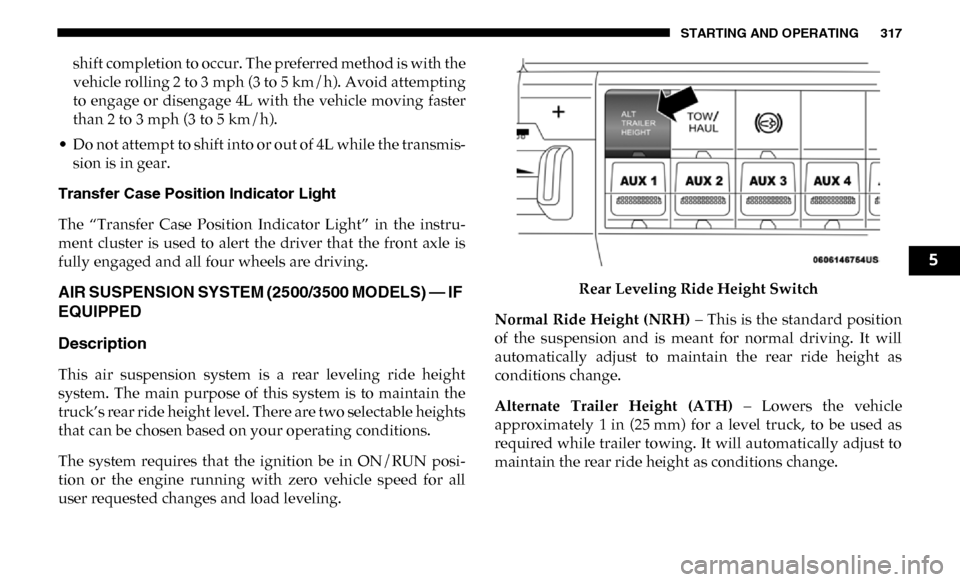
user requested changes and load leveling. Rear Leveling Ride Height Switch
Normal Ride Height (NRH) – This is the standard position
of the suspension and is meant for normal driving. It will
automatically adjust to maintain the rear ride height as
conditions change.
Alternate Trailer Height (ATH) – Lowers the vehicle
approximately 1 in (25 mm) for a level truck, to be used as
required while trailer towing. It will automatically adjust to
maintain the rear ride height as conditions change.
5
Page 333 of 696

STARTING AND OPERATING 331
the brakes are required to control vehicle speed, apply
them lightly and avoid locking or skidding the tires.
Driving Through Water
Extreme care should be taken crossing any type of water.
Water crossings should be avoided if possible and only be
attempted when necessary, in a safe responsible manner.
You should only drive through areas which are designated
and approved. You should tread lightly and avoid damage
to the environment. You should know your vehicle's abilities
and be able to recover it if something goes wrong. You
should never stop or shut a vehicle off when crossing deep
water unless you ingested water into the engine air intake. If
the engine stalls do not attempt to restart it. Determine if it
has ingested water first. The key to any crossing is low andslow. You want to use first gear in 4L (Low Range) and
proceed very slowly with a constant slow speed (3-5 mph
[5–8 km/h] maximum) and light throttle. Keep the vehicle
moving; do not try to accelerate through the crossing. After
crossing any water higher than the bottom of the axle differ
-
entials, you should inspect all of the vehicle fluids for signs
of water ingestion.
• Before You Cross Any Type Of Water – As you approach
any type of water you need to determine if you can cross it
safely and responsibly. If necessary, get out and walk
through the water or probe it with a stick. You need to be
sure of its depth, approach angle, current and bottom
condition. Be careful of murky or muddy waters, check for
hidden obstacles. Make sure you will not be intruding on
any wildlife and you can recover the vehicle if necessary.
The key to a safe crossing is the water depth, current and
bottom conditions. On soft bottoms the vehicle will sink in,
WARNING!
If the engine stalls or you lose headway or cannot make
it to the top of a steep hill or grade, never attempt to turn
around. To do so may result in tipping and rolling the
vehicle, which may result in severe injury. Always back
carefully straight down a hill in REVERSE. Never back
down a hill in NEUTRAL using only the vehicle brakes.
Never drive diagonally across a hill, always drive
straight up or down.
CAUTION!
Water ingestion into the axles, transmission, transfer
case, engine or vehicle interior can occur if you drive too
fast or through too deep of water. Water can cause
permanent damage to engine, driveline or other vehicle
components and your brakes will be less effective once
wet and/or muddy.
5
Page 334 of 696

332 STARTING AND OPERATING
effectively increasing the water level on the vehicle. Be
sure to consider this when determining the depth and the
ability to safely cross.
• Crossing Puddles, Pools, Flooded Areas Or Other Standing
Water – Puddles, pools, flooded or other standing water areas
normally contain murky or muddy waters. These water types
normally contain hidden obstacles and make it difficult to
determine an accurate water depth, approach angle, and
bottom condition. Murky or muddy water holes are where
you want to hook up tow straps prior to entering. This makes
for a faster, cleaner and easier vehicle recovery. If you are able
to determine you can safely cross, than proceed using the low
and slow method.
• Crossing Ditches, Streams, Shallow Rivers Or Other
Flowing Water – Flowing water can be extremely dangerous.
Never attempt to cross a fast running stream or river even in
shallow water. Fast moving water can easily push your
vehicle downstream sweeping it out of control. Even in very
shallow water, a high current can still wash the dirt out from
around your tires putting you and your vehicle in jeopardy.
There is still a high risk of personal injury and vehicle damage with slower water currents in depths greater than the
vehicle's running ground clearance. You should never
attempt to cross flowing water which is deeper than the
vehicle's running ground clearance. Even the slowest current
can push the heaviest vehicle downstream out of control if the
water is deep enough to push on the large surface area of the
vehicle's body. Before you proceed determine the speed of the
current, the water's depth, approach angle, bottom condition
and if there are any obstacles, then cross at an angle heading
slightly upstream using the low and slow technique.
Airing Down For Off-Road Driving
Running lower tire pressure off-road can improve your ride
comfort and vehicle traction. Reducing the tire air pressure
allows the tire to bulge slightly, improving its surface area
for better flotation and ability to mold or form to the ground
contour. Different terrain, tires, and vehicles require
different tire pressure. Hard surfaces like rock and heavier
vehicles require higher pressures than softer surfaces such as
CAUTION!
Muddy waters can reduce the cooling system
effectiveness by depositing debris onto the radiator.
WARNING!
Never drive through fast moving deep water. It can push
your vehicle downstream, sweeping it out of control.
This could put you and your passengers at risk of injury
or drowning.