exhaust Ram 2500 2019 Owner's Guide
[x] Cancel search | Manufacturer: RAM, Model Year: 2019, Model line: 2500, Model: Ram 2500 2019Pages: 696, PDF Size: 13.89 MB
Page 328 of 696

326 STARTING AND OPERATING
When To Use Low Range
When driving off-road, shift into 4LO (Low Range) for addi-
tional traction or to improve handling and control on slip -
pery or difficult terrain. Due to the lower gearing, low range
will allow the engine to operate in a higher power range.
This will allow you to idle over obstacles and down hills,
with improved control and less effort. Also, use 4LO (Low
Range) in rain, ice, snow, mud, sand, to get heavy loads
rolling, improve traction, or whenever 4HI (High Range)
traction will not do the job.
Driving In Snow, Mud And Sand
There is a drastic reduction in traction when driving in snow,
mud or sand. The vehicle will be less responsive to steering,
acceleration and braking inputs. Therefore you should accel -
erate slowly, leave greater stopping distances and avoid
abrupt vehicle maneuvers. You want to keep a slow constant
steady pace. The key is to maintain the vehicle's momentum. •
Snow – In heavy snow or for additional control and trac -
tion at slower speeds, shift the transmission to a low gear
and shift the transfer case to 4LO (Low Range) if necessary.
Do not shift to a lower gear than necessary to maintain
headway. Over-revving the engine can spin the wheels
and traction will be lost. If you start to slow to a stop, try
turning your steering wheel no more than a ¼ turn quickly
back and forth, while still applying throttle. This will allow
the tires to get a fresh "bite" and help maintain your
momentum.
• Mud – Deep mud creates a great deal of suction around
the tires and is very difficult to get through. You should
use 4LO (Low Range) with a gear low enough to maintain
your momentum without shifting. If you start to slow to a
stop, try turning your steering wheel no more than a ¼
turn quickly back and forth for additional traction. Mud
holes pose an increased threat of vehicle damage and
getting stuck. They are normally full of debris from
previous vehicles getting stuck. As a good practice before
CAUTION!
Never park your vehicle over dry grass or other
combustible materials. The heat from your vehicle
exhaust system could cause a fire.
CAUTION!
On icy or slippery roads, do not downshift at high
engine RPMs or vehicle speeds because engine braking
may cause skidding and loss of control.
Page 338 of 696

336 STARTING AND OPERATING
After Driving Off-Road
Off-road operation puts more stress on your vehicle than
does most on-road driving. After going off-road, it is always
a good idea to check for damage. That way you can get any
problems taken care of right away and have your vehicle
ready when you need it.
• Completely inspect the underbody of your vehicle. Checktires, body structure, steering, suspension, and exhaust
system for damage.
• Inspect the radiator for mud and debris and clean as required.
• Check threaded fasteners for looseness, particularly on the chassis, drivetrain components, steering, and suspension.
Retighten them, if required, and torque to the values spec -
ified in the Service Manual.
• Check for accumulations of plants or brush. These things could be a fire hazard. They might hide damage to fuel
lines, brake hoses, axle pinion seals, and propeller shafts. • After extended operation in mud, sand, water, or similar
dirty conditions, have the radiator, fan, brake rotors,
wheels, brake linings, and axle yokes inspected and
cleaned as soon as possible.
• If you experience unusual vibration after driving in mud, slush or similar conditions, check the wheels for impacted
material. Impacted material can cause a wheel imbalance
and freeing the wheels of it will correct the situation.
WARNING!
Abrasive material in any part of the brakes may cause
excessive wear or unpredictable braking. You might not
have full braking power when you need it to prevent a
collision. If you have been operating your vehicle in
dirty conditions, get your brakes checked and cleaned as
necessary.
Page 441 of 696

STARTING AND OPERATING 439
After Driving Off-Road
Off-road operation puts more stress on your vehicle than
does most on-road driving. After going off-road, it is always
a good idea to check for damage. That way you can get any
problems taken care of right away and have your vehicle
ready when you need it.
• Completely inspect the underbody of your vehicle. Checktires, body structure, steering, suspension, and exhaust
system for damage.
• Inspect the radiator for mud and debris and clean as required.
• Check threaded fasteners for looseness, particularly on the chassis, drivetrain components, steering, and suspension.
Retighten them, if required, and torque to the values spec -
ified in the Service Manual.
• Check for accumulations of plants or brush. These things could be a fire hazard. They might hide damage to fuel
lines, brake hoses, axle pinion seals, and propeller shafts. • After extended operation in mud, sand, water, or similar
dirty conditions, have the radiator, fan, brake rotors,
wheels, brake linings, and axle yokes inspected and
cleaned as soon as possible.
• If you experience unusual vibration after driving in mud, slush or similar conditions, check the wheels for impacted
material. Impacted material can cause a wheel imbalance
and freeing the wheels of it will correct the situation.
WARNING!
Abrasive material in any part of the brakes may cause
excessive wear or unpredictable braking. You might not
have full braking power when you need it to prevent a
collision. If you have been operating your vehicle in
dirty conditions, get your brakes checked and cleaned as
necessary.
5
Page 502 of 696

500 SERVICING AND MAINTENANCE
Once A Month Or Before A Long Trip:
• Check engine oil level
• Check windshield washer fluid level
• Check tire pressure and look for unusual wear or damage.Rotate tires at the first sign of irregular wear, even if it
occurs before the oil indicator system turns on. • Check the fluid levels of the coolant reservoir, brake
master cylinder, power steering and automatic transmis -
sion (six-speed only) and fill as needed
• Check function of all interior and exterior lights
Maintenance Plan
Required Maintenance
Refer to the Maintenance Plan on the following pages for required maintenance.
At Every Oil Change Interval As Indicated By Oil Change Indicator System:
• Change oil and filter.
• Rotate the tires. Rotate at the first sign of irregular wear, even if it occurs before the oil indicator system turns on.
• Inspect battery and clean and tighten terminals as required.
• Inspect brake pads, shoes, rotors, drums, hoses and park brake.
• Inspect engine cooling system protection and hoses.
• Inspect exhaust system.
• Inspect engine air cleaner if using in dusty or off-road conditions. If required, replace air cleaner filter.
Page 522 of 696
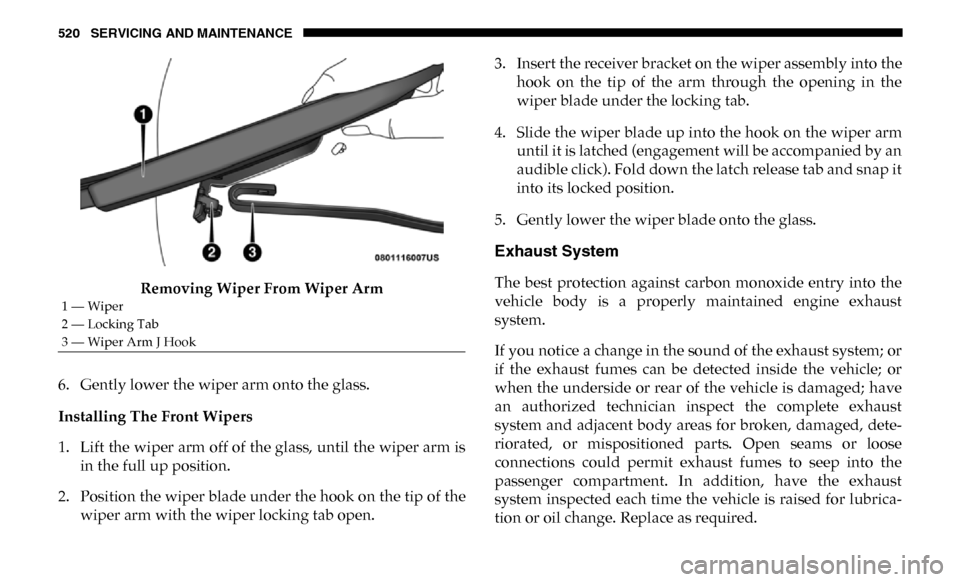
520 SERVICING AND MAINTENANCE
Removing Wiper From Wiper Arm
6. Gently lower the wiper arm onto the glass.
Installing The Front Wipers
1. Lift the wiper arm off of the glass, until the wiper arm is in the full up position.
2. Position the wiper blade under the hook on the tip of the wiper arm with the wiper locking tab open. 3. Insert the receiver bracket on the wiper assembly into the
hook on the tip of the arm through the opening in the
wiper blade under the locking tab.
4. Slide the wiper blade up into the hook on the wiper arm until it is latched (engagement will be accompanied by an
audible click). Fold down the latch release tab and snap it
into its locked position.
5. Gently lower the wiper blade onto the glass.
Exhaust System
The best protection against carbon monoxide entry into the
vehicle body is a properly maintained engine exhaust
system.
If you notice a change in the sound of the exhaust system; or
if the exhaust fumes can be detected inside the vehicle; or
when the underside or rear of the vehicle is damaged; have
an authorized technician inspect the complete exhaust
system and adjacent body areas for broken, damaged, dete -
riorated, or mispositioned parts. Open seams or loose
connections could permit exhaust fumes to seep into the
passenger compartment. In addition, have the exhaust
system inspected each time the vehicle is raised for lubrica -
tion or oil change. Replace as required.
1 — Wiper
2 — Locking Tab
3 — Wiper Arm J Hook
Page 523 of 696

SERVICING AND MAINTENANCE 521
(Continued)
Under normal operating conditions, the catalytic converter
will not require maintenance. However, it is important to
keep the engine properly tuned to assure proper catalyst
operation and prevent possible catalyst damage.
NOTE:
Intentional tampering with emissions control systems can
result in civil penalties being assessed against you.
In unusual situations involving grossly malfunctioning
engine operation, a scorching odor may suggest severe and
abnormal catalyst overheating. If this occurs, stop the
vehicle, turn off the engine and allow it to cool. Service,
including a tune-up to manufacturer's specifications, should
be obtained immediately.
WARNING!
• Exhaust gases can injure or kill. They contain carbon monoxide (CO), which is colorless and odorless.
Breathing it can make you unconscious and can eventu -
ally poison you. To avoid breathing CO, refer to “Safety
Tips” in “Safety” for further information.
• A hot exhaust system can start a fire if you park over materials that can burn. Such materials might be grass
or leaves coming into contact with your exhaust system.
Do not park or operate your vehicle in areas where your
exhaust system can contact anything that can burn.
CAUTION!
• The catalytic converter requires the use of unleaded fuel only. Leaded gasoline will destroy the effective -
ness of the catalyst as an emissions control device and
may seriously reduce engine performance and cause
serious damage to the engine.
• Damage to the catalytic converter can result if your vehicle is not kept in proper operating condition. In the
event of engine malfunction, particularly involving
engine misfire or other apparent loss of performance,
have your vehicle serviced promptly. Continued opera -
tion of your vehicle with a severe malfunction could
cause the converter to overheat, resulting in possible
damage to the converter and vehicle. CAUTION!
(Continued)
7
Page 572 of 696

570 TECHNICAL SPECIFICATIONS
Fuel System Cautions
NOTE:
Intentional tampering with the emissions control system can
result in civil penalties being assessed against you.
Carbon Monoxide Warnings
CAUTION!
Follow these guidelines to maintain your vehicle’s
performance:
• The use of leaded gasoline is prohibited by Federal law. Using leaded gasoline can impair engine perfor -
mance and damage the emissions control system.
• An out-of-tune engine or certain fuel or ignition malfunctions can cause the catalytic converter to over -
heat. If you notice a pungent burning odor or some
light smoke, your engine may be out of tune or
malfunctioning and may require immediate service.
Contact an authorized dealer for service assistance.
• The use of fuel additives, which are now being sold as octane enhancers, is not recommended. Most of these
products contain high concentrations of methanol. Fuel
system damage or vehicle performance problems
resulting from the use of such fuels or additives is not the
responsibility of the manufacturer and may void or not
be covered under the New Vehicle Limited Warranty.
WARNING!
Carbon monoxide (CO) in exhaust gases is deadly.
Follow the precautions below to prevent carbon
monoxide poisoning:
• Do not inhale exhaust gases. They contain carbon monoxide, a colorless and odorless gas, which can kill.
Never run the engine in a closed area, such as a garage,
and never sit in a parked vehicle with the engine
running for an extended period. If the vehicle is
stopped in an open area with the engine running for
more than a short period, adjust the ventilation system
to force fresh, outside air into the vehicle.
• Guard against carbon monoxide with proper mainte -
nance. Have the exhaust system inspected every time
the vehicle is raised. Have any abnormal conditions
repaired promptly. Until repaired, drive with all side
windows fully open.
Page 678 of 696

676 CUSTOMER ASSISTANCE
WARRANTY INFORMATION
See the Warranty Information Booklet for the terms and
provisions of FCA US LLC warranties applicable to this
vehicle and market.
MOPAR PARTS
Mopar fluids, lubricants, parts, and accessories are available
from an authorized dealer. They are recommended for your
vehicle in order to help keep the vehicle operating at its best.
REPORTING SAFETY DEFECTS
In The 50 United States And Washington, D.C.
If you believe that your vehicle has a defect that could
cause a crash or cause injury or death, you should imme-
diately inform the National Highway Traffic Safety
Administration (NHTSA) in addition to notifying FCA
US LLC.
If NHTSA receives similar complaints, it may open an
investigation, and if it finds that a safety defect exists in a
group of vehicles, it may order a recall and remedy
campaign. However, NHTSA cannot become involved in
individual problems between you, an authorized dealer
or FCA US LLC.
To contact NHTSA, you may call the Vehicle Safety Hotline
toll free at 1-888-327-4236 (TTY: 1-800-424-9153); or go to
http://www.safercar.gov ; or write to: Administrator,
NHTSA, 1200 New Jersey Avenue, SE., West Building,
Washington, D.C. 20590. You can also obtain other informa -
tion about motor vehicle safety from http://
www.safercar.gov .
WARNING!
Engine exhaust (internal combustion engines only),
some of its constituents, and certain vehicle components
contain, or emit, chemicals known to the State of
California to cause cancer and birth defects, or other
reproductive harm. In addition, certain fluids contained
in vehicles and certain products of component wear
contain, or emit, chemicals known to the State of
California to cause cancer and birth defects, or other
reproductive harm.
Page 683 of 696

681
Differential, Limited Slip ....................................................... 337
Disabled Vehicle Towing ....................................................... 495
Disposal Antifreeze (Engine Coolant) .............................................. 525
Do Not Disturb ........................................................................ 668
Door Ajar.................................................................................. 183
Door Ajar Light ....................................................................... 183
Door Locks Automatic ............................................................................... 39
Doors........................................................................................... 33
Drag And Drop Menu ............................................................ 575
Driver’s Seat Back Tilt .............................................................. 40
Driving Off-Pavement....................................................................... 324Off-Road ............................................................................... 324
Through Flowing, Rising, Or Shallow Standing Water ..... 437
Dual Rear Wheels ........................................................... 554, 565 E
Electric Brake Control System ............................................... 196 Anti-Lock Brake System ..................................................... 195
Electronic Roll Mitigation .......................................... 200, 204
Electrical Power Outlets......................................................... 124
Electronic Range Select (ERS)................................................ 307
Electronic Stability Control (ESC) ........................................ 200
Electronic Throttle Control Warning Light ......................... 182
Electronically Shifted Transfer Case .................................... 309 Emergency Braking.................................................................298
Emergency, In Case Of Freeing Vehicle When Stuck ..............................................494Hazard Warning Flasher ....................................................440
Jump Starting .......................................................................488
Emission Control System Maintenance ...............................193
Engine .......................................................................................504 Air Cleaner ...........................................................................509
Block Heater .........................................................................297
Break-In Recommendations...............................................297Compartment Identification ..............................................504Coolant (Antifreeze)............................................................ 572
Exhaust Gas Caution................................................... 286, 570Fails To Start.........................................................................295
Flooded, Starting .................................................................295
Fuel Requirements ......................................................567, 571
Jump Starting .......................................................................488Oil ..........................................................................507, 571, 572
Oil Filler Cap ................................................................504, 508
Oil Filter ................................................................................509Oil Reset ................................................................................167Oil Selection .................................................................507, 571
Oil Synthetic .........................................................................508
Overheating..........................................................................493
Starting..................................................................................292
Engine Oil Viscosity................................................................508
11
Page 684 of 696

682
Enhanced Accident Response Feature ......................... 255, 498
Entry System, Illuminated ....................................................... 76
Ethanol...................................................................................... 568
Exhaust Gas Cautions .................................................... 286, 570
Exhaust System ............................................................... 286, 520
Exterior Lighting ....................................................................... 67 Exterior Lights ................................................................... 67, 289 F
Filters Air Cleaner ........................................................................... 509Air Conditioning ........................................................... 93, 512
Engine Oil..................................................................... 509, 572
Engine Oil Disposal ............................................................ 508
Flashers Turn Signals ........................................................... 71, 191, 289
Flash-To-Pass ............................................................................. 69
Flat Tire Changing .................................................. 469, 531, 548
Flat Tire Stowage .................................................... 483, 531, 548
Fluid Capacities ....................................................................... 571
Fluid Leaks ............................................................................... 289
Fluid Level Checks Brake ..................................................................................... 527
Fluid, Brake .............................................................................. 574
Fluids And Lubricants ........................................................... 572
Fog Lights........................................................................... 71, 451
Fold Flat Load Floor ............................................................... 119 Fold-Flat Seats ...........................................................................40
Forward Collision Warning................................................... 216
Four Wheel Drive .................................................................... 309
Four-Way Hazard Flasher .....................................................440
Freeing A Stuck Vehicle .........................................................494
Front Axle (Differential) .........................................................529
Fuel ............................................................................................567 Adding ..................................................................................408
Additives ..............................................................................568
Clean Air...............................................................................568
Ethanol ..................................................................................568
Filler Cap (Gas Cap)............................................................ 410
Gasoline ................................................................................567Light ...................................................................................... 186
Materials Added ..................................................................568
Methanol...............................................................................568
Octane Rating...............................................................567, 572Requirements ...............................................................567, 571Tank Capacity ......................................................................571
Fuses..........................................................................................457 G
Garage Door Opener (HomeLink) ........................................104
Gas Cap (Fuel Filler Cap) .......................................................410
Gasoline, Clean Air .................................................................568
Gasoline, Reformulated..........................................................568
General Information ...............................................................230