weight Ram 2500 2019 Owner's Guide
[x] Cancel search | Manufacturer: RAM, Model Year: 2019, Model line: 2500, Model: Ram 2500 2019Pages: 696, PDF Size: 13.89 MB
Page 416 of 696

414 STARTING AND OPERATING
Without Weight-Distributing Hitch (Incorrect)With Weight-Distributing Hitch (Correct)
WARNING!
• An improperly adjusted weight distributing hitch system may reduce handling, stability and braking
performance and could result in a collision.
• Weight distributing systems may not be compatible with surge brake couplers. Consult with your hitch and
trailer manufacturer or a reputable Recreational
Vehicle dealer for additional information.
Page 417 of 696
STARTING AND OPERATING 415
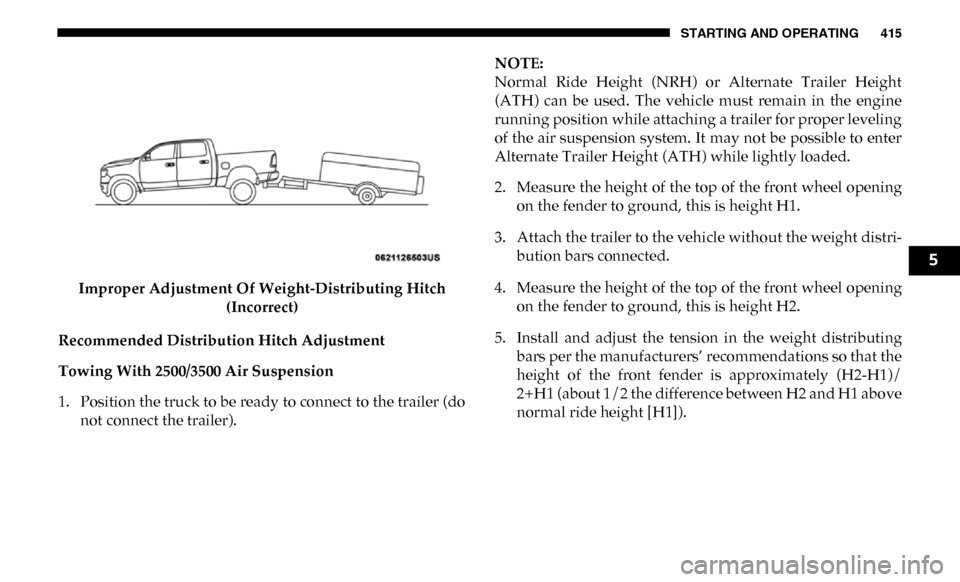
Improper Adjustment Of Weight-Distributing Hitch (Incorrect)
Recommended Distribution Hitch Adjustment
Towing With 2500/3500 Air Suspension
1. Position the truck to be ready to connect to the trailer (do not connect the trailer). NOTE:
Normal Ride Height (NRH) or Alternate Trailer Height
(ATH) can be used. The vehicle must remain in the engine
running position while attaching a trailer for proper leveling
of the air suspension system. It may not be possible to enter
Alternate Trailer Height (ATH) while lightly loaded.
2. Measure the height of the top of the front wheel opening
on the fender to ground, this is height H1.
3. Attach the trailer to the vehicle without the weight distri -
bution bars connected.
4. Measure the height of the top of the front wheel opening on the fender to ground, this is height H2.
5. Install and adjust the tension in the weight distributing bars per the manufacturers’ recommendations so that the
height of the front fender is approximately (H2-H1)/
2+H1 (about 1/2 the difference between H2 and H1 above
normal ride height [H1]).
5
Page 418 of 696

416 STARTING AND OPERATING
6. Perform a visual inspection of the trailer and weightdistributing hitch to confirm manufacturers’ recommen -
dations have been met.
NOTE:
For all towing conditions, we recommend towing with tow
haul mode engaged.
Towing With All Other 2500/3500 (Non-Air Suspension)
1. Position the truck to be ready to connect to the trailer (do not connect the trailer).
2. Measure the height of the top of the front wheel opening on the fender to ground, this is height H1.
3. Attach the trailer to the vehicle without the weight distri -
bution bars connected. 4. Measure the height of the top of the front wheel opening
on the fender to ground, this is height H2.
5. Install and adjust the tension in the weight distributing bars per the manufacturers’ recommendations so that the
height of the front fender is approximately (H2-H1)/
2+H1 (about 1/2 the difference between H2 and H1 above
normal ride height [H1]).
6. Perform a visual inspection of the trailer and weight distributing hitch to confirm manufacturers’ recommen -
dations have been met.
NOTE:
For all towing conditions, we recommend towing with tow
haul mode engaged.
Measurement Example
Example 2500/3500
Height (mm)
H1 1030
H2 1058
H2-H1 28
(H2-H1)/2 14
(H2-H1)/2 + H1 1044
Measurement ExampleExample 2500/3500
Height (mm)
H1 1030
H2 1058
H2-H1 28
(H2-H1)/2 14
(H2-H1)/2 + H1 1044
Page 419 of 696

STARTING AND OPERATING 417
Fifth-Wheel Hitch
The fifth-wheel hitch is a special high platform with a
coupling that mounts over the rear axle of the tow vehicle in
the truck bed. It connects a vehicle and fifth-wheel trailer
with a coupling king pin.
Your truck may be equipped with a 5th wheel hitch option.
Refer to the separately provided 5th wheel hitch safety, care,
assembly, and operating instructions.Gooseneck Hitch
The gooseneck hitch employs a pivoted coupling arm which
attaches to a ball mounted in the bed of a pickup truck. The
coupling arm connects to the hitch mounted over the rear
axle in the truck bed.
Trailer Hitch Type and Maximum Trailer Weight
The following chart provides the maximum trailer weight a
given factory equipped trailer hitch type can tow and should
be used to assist you in selecting the correct trailer hitch for
your intended towing condition.
All trailer hitches should be professionally installed on your vehicle. Trailer Hitch Type and Maximum Trailer Weight
Hitch Type Max. Trailer Weight / Max. Tongue Weight
Class V - 2500 Models 20,000 lbs (9,071 kg) / 2000 lbs (907 kg)
Class V - 3500 Models 23,000 lbs (10,432 kg) / 2300 lbs (1043 kg)
Fifth Wheel - 2500 Models 25,000 lbs (11,339 kg) / 2500 lbs (1,133 kg)
Fifth Wheel - 3500 Models 30,000 lbs (13,607 kg) / 3000 lbs (1,360 kg)
Gooseneck - 2500 Models 20,000 lbs (9,071 kg) / 2000 lbs (907 kg)
Gooseneck - 3500 Models 35,000 lbs (15,875 kg) / 3500 lbs (1,587 kg)
Refer to the “Trailer Towing Weights (Maximum Trailer Weight Ratings)” for the Maximum Gross Trailer Weight (GTW)
towable for your given drivetrain.
5
Page 420 of 696

418 STARTING AND OPERATING
(Continued)
Trailer Towing Weights (Maximum Trailer Weight
Ratings)
NOTE:
For trailer towing information (maximum trailer weight
ratings) refer to the following website addresses:
•ramtrucks.com/en/towing_guide/
• ramtruck.ca (Canada)
• rambodybuilder.com
Trailer And Tongue Weight
Weight Distribution Consider the following items when computing the weight on
the rear axle of the vehicle:
• The tongue weight of the trailer.
• The weight of any other type of cargo or equipment put in
or on your vehicle.
• The weight of the driver and all passengers.
NOTE:
Remember that everything put into or on the trailer adds to
the load on your vehicle. Also, additional factory-installed
options or dealer-installed options must be considered as
part of the total load on your vehicle. Refer to the “Tire And
Loading Information” placard for the maximum combined
weight of occupants and cargo for your vehicle.
Towing Requirements
To promote proper break-in of your new vehicle drivetrain
components, the following guidelines are recommended.
CAUTION!
• Do not tow a trailer at all during the first 500 miles (805 km) the new vehicle is driven. The engine, axle or
other parts could be damaged.
Page 421 of 696

STARTING AND OPERATING 419
(Continued)
Perform the maintenance listed in the “Scheduled
Servicing”. Refer to “Scheduled Servicing” in “Servicing
And Maintenance” for the proper maintenance intervals.
When towing a trailer, never exceed the GAWR or GCWR
ratings.• Then, during the first 500 miles (805 km) that a trailer is
towed, do not drive over 50 mph (80 km/h) and do not
make starts at full throttle. This helps the engine and
other parts of the vehicle wear in at the heavier loads.
WARNING!
• Make certain that the load is secured in the trailer and will not shift during travel. When trailering cargo that
is not fully secured, dynamic load shifts can occur that
may be difficult for the driver to control. You could lose
control of your vehicle and have a collision.
• When hauling cargo or towing a trailer, do not overload your vehicle or trailer. Overloading can cause a loss of
control, poor performance or damage to brakes, axle,
engine, transmission, steering, suspension, chassis
structure or tires. CAUTION!
(Continued)
• Safety chains must always be used between your
vehicle and trailer. Always connect the chains to the
hook retainers of the vehicle hitch. Cross the chains
under the trailer tongue and allow enough slack for
turning corners.
• Vehicles with trailers should not be parked on a grade. When parking, apply the parking brake on the tow
vehicle. Put the tow vehicle transmission in PARK. For
four-wheel drive vehicles, make sure the transfer case
is not in NEUTRAL. Always, block or "chock" the
trailer wheels.
• GCWR must not be exceeded.
• Total weight must be distributed between the tow vehicle and the trailer such that the following four
ratings are not exceeded:
1. GVWR
2. GTW
3. GAWR
4. Tongue weight rating for the trailer hitch utilized.
WARNING! (Continued)
5
Page 430 of 696

428 STARTING AND OPERATING
Snowplow Prep Package Model Availability
For Information about snowplow applications visit
www.ramtrucks.com or refer to the current Body Builders
Guide.
1. The maximum number of occupants in the truck shouldnot exceed two.
2. The total GVWR or the Front GAWR or the Rear GAWR should never be exceeded.
3. Cargo capacity will be reduced by the addition of options or passengers, etc. The loaded vehicle weight, including the snowplow system,
all aftermarket accessories, driver, passengers, options, and
cargo, must not exceed either the Gross Vehicle Weight
(GVWR) or Gross Axle Weight (GAWR) ratings. These
weights are specified on the Safety Compliance Certification
Label on the driver's side door opening.
NOTE:
Detach the snowplow when transporting passengers.
Vehicle front end wheel alignment was set to specifications
at the factory without consideration for the weight of the
plow. Front end toe-in should be checked and reset if neces
-
sary at the beginning and end of the snowplow season. This
will help prevent uneven tire wear.
The blade should be lowered whenever the vehicle is parked.
Maintain and operate your vehicle and snowplow equip -
ment following the recommendations provided by the
specific snowplow manufacturer.
Page 540 of 696

538 SERVICING AND MAINTENANCE
Tire And Loading Information PlacardTire And Loading Information Placard
This placard tells you important information about the:
1. Number of people that can be carried in the vehicle.
2. Total weight your vehicle can carry.
3. Tire size designed for your vehicle.
4. Cold tire inflation pressures for the front, rear, and spare tires. Loading
The vehicle maximum load on the tire must not exceed the
load carrying capacity of the tire on your vehicle. You will
not exceed the tire's load carrying capacity if you adhere to
the loading conditions, tire size, and cold tire inflation pres
-
sures specified on the Tire and Loading Information placard
in “Vehicle Loading” in the “Starting And Operating”
section of this manual.
NOTE:
Under a maximum loaded vehicle condition, gross axle
weight ratings (GAWRs) for the front and rear axles must not
be exceeded.
For further information on GAWRs, vehicle loading, and
trailer towing, refer to “Vehicle Loading” in the “Starting
And Operating” section of this manual.
To determine the maximum loading conditions of your
vehicle, locate the statement “The combined weight of occu-
pants and cargo should never exceed XXX kg or XXX lbs” on
the Tire and Loading Information placard. The combined
weight of occupants, cargo/luggage and trailer tongue
weight (if applicable) should never exceed the weight refer -
enced here.
Page 541 of 696

SERVICING AND MAINTENANCE 539
Steps For Determining Correct Load Limit—
(1) Locate the statement “The combined weight of occu-
pants and cargo should never exceed XXX kg or XXX lbs.”
on your vehicle's placard.
(2) Determine the combined weight of the driver and
passengers that will be riding in your vehicle.
(3) Subtract the combined weight of the driver and
passengers from XXX kg or XXX lbs.
(4) The resulting figure equals the available amount of
cargo and luggage load capacity. For example, if “XXX”
amount equals 1400 lbs. and there will be five 150 lb
passengers in your vehicle, the amount of available cargo
and luggage load capacity is 650 lbs. (1400-750 (5x150) =
650 lbs.)
(5) Determine the combined weight of luggage and cargo
being loaded on the vehicle. That weight may not safely
exceed the available cargo and luggage load capacity
calculated in Step 4. (6) If your vehicle will be towing a trailer, load from your
trailer will be transferred to your vehicle. Consult this
manual to determine how this reduces the available cargo
and luggage load capacity of your vehicle.
Metric Example For Load Limit
For example, if “XXX” amount equals 635 kg and there will
be five 68 kg passengers in your vehicle, the amount of avail
-
able cargo and luggage load capacity is 295 kg (635-340
(5x68) = 295 kg) as shown in step 4.
NOTE:
• If your vehicle will be towing a trailer, load from your trailer will be transferred to your vehicle. The following
table shows examples on how to calculate total load,
cargo/luggage, and towing capacities of your vehicle with
varying seating configurations and number and size of
occupants. This table is for illustration purposes only and
may not be accurate for the seating and load carry capacity
of your vehicle.
• For the following example, the combined weight of occu -
pants and cargo should never exceed 865 lbs (392 kg).
7
Page 563 of 696

SERVICING AND MAINTENANCE 561
Repairing The Spray-On Bedliner
While extremely tough, it is possible to damage a Spray-On
Bedliner. One common condition is when loading a heavy
pallet and dragging that pallet across the floor of the bed. If
a nail or sharp point is exposed under the weight of the pallet
a scratch or tear is possible. While not covered by your new
vehicle warranty, a cosmetic fix to cover the metal exposed
by the scratch is required. To repair a tear or gouge, follow
the directions provided in the Mopar Quick Repair Kit.
INTERIORS
Seats And Fabric Parts
Use Mopar Total Clean to clean fabric upholstery and
carpeting.Stain Repel Fabric Cleaning Procedure — If Equipped
Stain Repel seats may be cleaned in the following manner:
• Remove as much of the stain as possible by blotting with a
clean, dry towel.
• Blot any remaining stain with a clean, damp towel.
• For tough stains, apply Mopar Total Clean, or a mild soap solution to a clean, damp cloth and remove stain. Use a
fresh, damp towel to remove soap residue.
• For grease stains, apply Mopar Multi-Purpose Cleaner to a clean, damp cloth and remove stain. Use a fresh, damp
towel to remove soap residue.
• Do not use any harsh solvents or any other form of protectants on Stain Repel products.
WARNING!
Do not use volatile solvents for cleaning purposes. Many
are potentially flammable, and if used in closed areas
they may cause respiratory harm.
7