oil temperature Ram 2500 2020 Owner's Guide
[x] Cancel search | Manufacturer: RAM, Model Year: 2020, Model line: 2500, Model: Ram 2500 2020Pages: 553, PDF Size: 21.99 MB
Page 361 of 553

IN CASE OF EMERGENCY359
F68 –10 Amp Red AEB RACAM HTR – If Equipped (HD Only)
F69 –15 Amp Blue SCR Module – If Equipped (HD Only)
F70 –30 Amp GreenFuel Pump Motor / K09 RLY Coil Feed (Cummins Diesel) –
If Equipped
F71 –25 Amp ClearAmplifier / Active Noise Cancelation – If Equipped (HD
Only)
F72 –10 Amp RedPCM / DC/DC Converter Voltage– If Equipped (DS 1500
Only)
F73 –20 Amp Yellow Fuel Transfer Pump (Rear Tank) – If Equipped (HD Only)
F74 –20 Amp Yellow Brake Vacuum Pump Gas/Diesel – If Equipped (DS 1500
Only)
F74 –10 Amp Red Backup Alarm – If Equipped (HD Only)
F75 –10 Amp RedATMM / Coil-SCR Module RLY– If Equipped (HD Only)
Coolant Temperature Valve – If Equipped (DS 1500 Only)
F76 –10 Amp RedElectronic Stability Control (HD Only)
Brake System Module / Stop Lamp Switch / Electric Park
Brake / Clutch Pedal Switch (DS 1500 Only)
F77 –10 Amp RedDrivetrain Control Module / Front Axle Disconnect Module
/ TCM/ STOM (HD Only)
Drivetrain Control Module / ELSD / Front Axle Disconnect
Module / Transmission Control Relay / RDM / Power Take
Off Unit – If Equipped (DS 1500 Only)
Cavity
Cartridge Fuse Micro Fuse Description
6
20_DJD2_OM_EN_USC_t.book Page 359
Page 382 of 553
380
SERVICING AND MAINTENANCE
SCHEDULED SERVICING — GAS ENGINE
Your vehicle is equipped with an automatic oil
change indicator system. The oil change indi-
cator system will remind you that it is time to
take your vehicle in for scheduled maintenance.
Based on engine operation conditions, the oil
change indicator message will illuminate. This
means that service is required for your vehicle.
Operating conditions such as frequent
short-trips, trailer tow, extremely hot or cold
ambient temperatures, and E85 fuel usage will
influence when the “Oil Change Required”
message is displayed. Severe Operating Condi-
tions can cause the change oil message to illu -
minate as early as 3,500 miles (5,600 km)
since last reset. Have your vehicle serviced as
soon as possible, within the next 500 miles
(805 km).
Your authorized dealer will reset the oil change
indicator message after completing the sched -
uled oil change.
If a scheduled oil change is performed by
someone other than your authorized dealer, the
message can be reset by referring to the steps described under “Instrument Cluster Display” in
“Getting To Know Your Instrument Panel”.
NOTE:
Under no circumstances should oil change
intervals exceed 8,000 miles (13,000 km),
12 months or 350 hours of engine run time,
whichever comes first. The 350 hours of engine
run or idle time is generally only a concern for
fleet customers.
Severe Duty All Models
NOTE:
Change Engine Oil at 4,000 miles (6,500 km) or
350 hours of engine run time if the vehicle is
operated in a dusty and off road environment or
is operated predominantly at idle, or only very
low engine RPM. This type of vehicle use is
considered Severe Duty.
Once A Month Or Before A Long Trip:
Check engine oil level
Check windshield washer fluid level
Check tire pressure and look for unusual
wear or damage. Rotate tires at the first sign
of irregular wear, even if it occurs before the
oil indicator system turns on.
Check the fluid levels of the coolant reservoir,
brake master cylinder, power steering and
automatic transmission (six-speed only) and
fill as needed
Check function of all interior and exterior
lights
Maintenance Plan — Gasoline Engine
Required Maintenance
Refer to the Maintenance Plan on the following
pages for required maintenance. More frequent
maintenance may be needed in severe condi
-
tions, such as dusty areas and very short trip
driving. In some extreme conditions, additional
maintenance not specified in the maintenance
schedule may be required.
20_DJD2_OM_EN_USC_t.book Page 380
Page 396 of 553
394SERVICING AND MAINTENANCE
Checking Oil Level — Gas Engine
To ensure proper lubrication of your vehicle's
engine, the engine oil must be maintained at
the correct level. Check the oil level at regular
intervals, such as every fuel stop. The best time
to check the engine oil level is about five
minutes after a fully warmed up engine is shut
off.
Checking the oil while the vehicle is on level
ground will improve the accuracy of the oil level
readings. Always maintain the oil level within
the SAFE zone on the dipstick. Adding one quart
of oil when the reading is at the bottom of the
SAFE zone will result in a reading at the top of
the safe zone on these engines.
Checking Oil Level — Diesel Engine
To ensure proper lubrication of your vehicle's
engine, the engine oil must be maintained at
the correct level. Check the oil level at regular
intervals. The best time to check the oil level is
before starting the engine after it has been parked overnight. When checking oil after oper
-
ating the engine, first ensure the engine is at full
operating temperature, then wait for
30 minutes after engine shutdown to check the
oil.
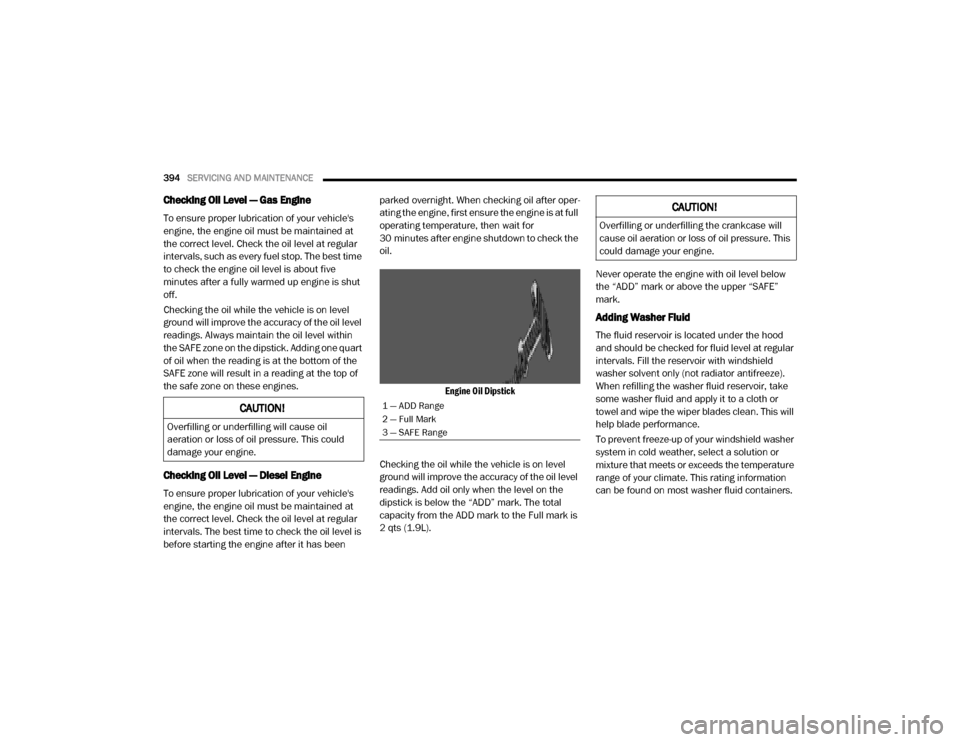
Engine Oil Dipstick
Checking the oil while the vehicle is on level
ground will improve the accuracy of the oil level
readings. Add oil only when the level on the
dipstick is below the “ADD” mark. The total
capacity from the ADD mark to the Full mark is
2 qts (1.9L). Never operate the engine with oil level below
the “ADD” mark or above the upper “SAFE”
mark.
Adding Washer Fluid
The fluid reservoir is located under the hood
and should be checked for fluid level at regular
intervals. Fill the reservoir with windshield
washer solvent only (not radiator antifreeze).
When refilling the washer fluid reservoir, take
some washer fluid and apply it to a cloth or
towel and wipe the wiper blades clean. This will
help blade performance.
To prevent freeze-up of your windshield washer
system in cold weather, select a solution or
mixture that meets or exceeds the temperature
range of your climate. This rating information
can be found on most washer fluid containers.
CAUTION!
Overfilling or underfilling will cause oil
aeration or loss of oil pressure. This could
damage your engine.
1 — ADD Range
2 — Full Mark
3 — SAFE Range
CAUTION!
Overfilling or underfilling the crankcase will
cause oil aeration or loss of oil pressure. This
could damage your engine.
20_DJD2_OM_EN_USC_t.book Page 394
Page 399 of 553

SERVICING AND MAINTENANCE397
American Petroleum Institute (API) Engine Oil
Identification Symbol — Diesel Engine
This symbol means that the oil has
been certified by the American Petro -
leum Institute (API). The manufac -
turer only recommends API Certified
engine oils.
Oils with a high ash content may produce
damaging deposits on cylinder head valves
and/or aftertreatment system damage. A
maximum sulfated ash content of 1.00 mass %
is recommended for all oil used in the engine.
The same oil change interval is to be followed
for synthetic oil as for petroleum based oil. Also,
synthetic oil must meet the same performance
specifications as petroleum oil.
Engine Oil Viscosity — Gas Engine
Use Mopar SAE 0W-40 engine oil approved to
FCA Material Standard MS-12633 such as
Pennzoil Ultra equivalent is recommended for
all operating temperatures.
The engine oil filler cap also shows the recom -
mended engine oil viscosity for your engine. For
information on engine oil filler cap location,
refer to the “Engine Compartment” illustration
in this section.
Lubricants which do not have both the engine
oil certification mark and the correct SAE
viscosity grade number should not be used.
Engine Oil Viscosity — Diesel Engine
In ambient temperatures above 0°F (-18°C),
we recommend you use SAE 10W-30 engine oil
such as Mopar, Shell Rotella and Shell Rimula
that meets FCA Material Standard MS-10902
and the API CK-4 engine oil category is required.
Products meeting Cummins CES 20081 may also be used. The identification of these engine
oils is typically located on the back of the oil
container.
In ambient temperatures below 0°F (-18°C), we
recommend you use SAE 5W-40
synthetic
engine oil such as Mopar, Shell Rotella and
Shell Rimula that meets FCA Material Standard
MS-10902 and the API CK-4 engine oil category
is required.
Engine oil not designated by the FCA or
Cummins Material Standards and API CK-4
should not be used, as engine and exhaust
system durability may be compromised. The
CAUTION!
Do not use chemical flushes in your engine oil
as the chemicals can damage your engine.
Such damage is not covered by the New
Vehicle Limited Warranty.
CAUTION!
Do not use chemical flushes in your engine oil
as the chemicals can damage your engine.
Such damage is not covered by the New
Vehicle Limited Warranty.
CAUTION!
Failure to use SAE 5W-40 synthetic engine oil
in ambient temperatures below 0°F (-18°C)
could result in severe engine damage.
7
20_DJD2_OM_EN_USC_t.book Page 397
Page 419 of 553

SERVICING AND MAINTENANCE417
checked. Operating the vehicle with an
improper fluid level can cause severe transmis -
sion damage.
Fluid Level Check — Six-Speed Transmission
It is best to check the fluid level when the trans -
mission is at normal operating temperature
(158-176°F / 70-80°C). This normally occurs
after at least 15 miles (25 km) of driving. At normal operating temperature the fluid cannot
be held comfortably between the fingertips. You
can read the transmission sump temperature in
the instrument cluster screen refer to “Instru -
ment Cluster Display” in “Getting To Know Your
Instrument Panel” for further information.
Use the following procedure to check the trans -
mission fluid level properly:
1. Monitor the transmission temperature using the instrument cluster display, and
operate the vehicle as required to reach the normal operating temperature. If the
transmission is not functioning properly, or
the vehicle cannot be driven, see the NOTE
and CAUTION below about checking the
fluid level at colder temperatures.
2. Park the vehicle on level ground.
3. Run the engine at normal idle speed for at least 60 seconds, and leave the engine
running for the rest of this procedure.
4. Fully apply the parking brake, and press the brake pedal.
5. Place the gear selector momentarily into each gear position (allowing time for the
transmission to fully engage in each posi -
tion), ending with the transmission in PARK.
6. Remove the dipstick, wipe it clean and rein -
sert it until seated.
7. Remove the dipstick again and note the fluid level on both sides. The fluid level
reading is only valid if there is a solid
coating of oil on both sides of the dipstick.
Note that the holes in the dipstick will be full
of fluid if the actual level is at or above the
hole. The fluid level should be between the
“HOT” (upper) reference holes on the dipstick at normal operating temperature. If
the fluid level is low, add fluid through the
dipstick tube to bring it to the proper level.
Do not overfill.
Use ONLY the specified fluid
refer to "Fluids And Lubricants" in “Tech -
nical Specifications” for fluid specifications.
After adding any quantity of oil through the
dipstick tube, wait a minimum of two
minutes for the oil to fully drain into the
transmission before rechecking the fluid
level.
NOTE:
If it is necessary to check the transmission
below the operating temperature, the fluid level
should be between the two “COLD” (lower)
holes on the dipstick with the fluid at 60-70°F /
16-21°C. Only use the COLD region of the
dipstick as a rough reference when setting the
fluid level after a transmission service or fluid
change. Re-check the fluid level, and adjust as
required, once the transmission reaches
normal operating temperature.
CAUTION!
If a transmission fluid leak occurs, visit an
authorized dealer immediately. Severe
transmission damage may occur. An
authorized dealer has the proper tools to
adjust the fluid level accurately.
7
20_DJD2_OM_EN_USC_t.book Page 417
Page 420 of 553

418SERVICING AND MAINTENANCE
8. Reinsert the dipstick. Check for leaks.
Release the parking brake.
NOTE:
If it is necessary to check the transmission
below the operating temperature, the fluid level
should be between the two COLD (lower) holes
on the dipstick with the fluid at 68-86°F /
20-30°C. Only use the COLD region of the
dipstick as a rough reference when setting the
fluid level after a transmission service or fluid
change. Re-check the fluid level, and adjust as
required, once the transmission reaches
normal operating temperature.Fluid And Filter Changes — Eight-Speed
Transmission
Under normal operating conditions, the fluid
installed at the factory will provide satisfactory
lubrication for the life of the vehicle.
Routine fluid and filter changes are not
required. However, change the fluid and filter if
the fluid becomes contaminated (with water,
etc.), or if the transmission is disassembled for
any reason.
Fluid And Filter Changes — Six Speed
Transmission
Refer to the “Maintenance Plan” for the proper
maintenance intervals.
In addition, change the fluid and filters if the
fluid becomes contaminated (with water, etc.),
or if the transmission is disassembled for any
reason.
Rear Axle And 4x4 Front Driving Axle Fluid
Level
For normal service, periodic fluid level checks
are not required. When the vehicle is serviced
for other reasons the exterior surfaces of the
axle assembly should be inspected. If gear oil
leakage is suspected inspect the fluid level.
Refer to “Fluids And Lubricants” in “Technical
Specifications” for further information. This
inspection should be made with the vehicle in a
level position.
For all 2500/3500 Model axles, the fluid level
should be 1/4 in ± 1/4 in (6.4 mm ± 6.4 mm)
below the fill hole on the 9.25 in front, 11.5 in
rear axle, and 12.0 in rear axle.
Drain And Refill
Refer to the “Maintenance Plan” for the proper
maintenance intervals.
Lubricant Selection
Refer to “Fluids And Lubricants” in “Technical
Specifications” for further information.
NOTE:
The presence of water in the gear lubricant will
result in corrosion and possible failure of differ -
ential components. Operation of the vehicle in
CAUTION!
If the fluid temperature is below 50°F (10°C)
it may not register on the dipstick. Do not add
fluid until the temperature is elevated enough
to produce an accurate reading. Run the
engine at idle, in PARK, to warm the fluid.
CAUTION!
If the fluid temperature is below 50°F (10°C)
it may not register on the dipstick. Do not add
fluid until the temperature is elevated enough
to produce an accurate reading. Run the
engine at idle, in PARK, to warm the fluid.
20_DJD2_OM_EN_USC_t.book Page 418
Page 446 of 553
444
TECHNICAL SPECIFICATIONS
IDENTIFICATION DATA
Vehicle Identification Number
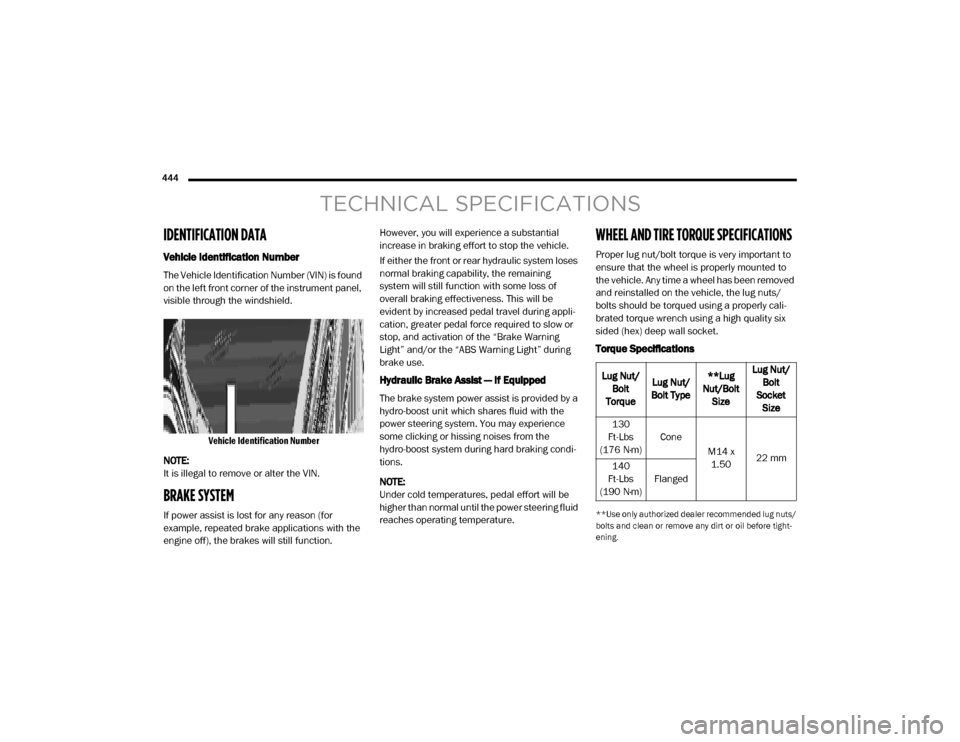
The Vehicle Identification Number (VIN) is found
on the left front corner of the instrument panel,
visible through the windshield.
Vehicle Identification Number
NOTE:
It is illegal to remove or alter the VIN.
BRAKE SYSTEM
If power assist is lost for any reason (for
example, repeated brake applications with the
engine off), the brakes will still function. However, you will experience a substantial
increase in braking effort to stop the vehicle.
If either the front or rear hydraulic system loses
normal braking capability, the remaining
system will still function with some loss of
overall braking effectiveness. This will be
evident by increased pedal travel during appli
-
cation, greater pedal force required to slow or
stop, and activation of the “Brake Warning
Light” and/or the “ABS Warning Light” during
brake use.
Hydraulic Brake Assist — If Equipped
The brake system power assist is provided by a
hydro-boost unit which shares fluid with the
power steering system. You may experience
some clicking or hissing noises from the
hydro-boost system during hard braking condi -
tions.
NOTE:
Under cold temperatures, pedal effort will be
higher than normal until the power steering fluid
reaches operating temperature.
WHEEL AND TIRE TORQUE SPECIFICATIONS
Proper lug nut/bolt torque is very important to
ensure that the wheel is properly mounted to
the vehicle. Any time a wheel has been removed
and reinstalled on the vehicle, the lug nuts/
bolts should be torqued using a properly cali -
brated torque wrench using a high quality six
sided (hex) deep wall socket.
Torque Specifications
**Use only authorized dealer recommended lug nuts/
bolts and clean or remove any dirt or oil before tight -
ening.
Lug Nut/ Bolt
Torque Lug Nut/
Bolt Type **Lug
Nut/Bolt Size Lug Nut/
Bolt
Socket Size
130
Ft-Lbs
(176 N·m) Cone
M14 x 1.50 22 mm
140
Ft-Lbs
(190 N·m) Flanged
20_DJD2_OM_EN_USC_t.book Page 444
Page 452 of 553

450TECHNICAL SPECIFICATIONS
Bio-Diesel Fuel Properties — Low Ambient
Temperatures
Biodiesel fuel may gel or solidify at low ambient
temperatures, which may pose problems for
both storage and operation. Precautions can be
necessary at low ambient temperatures, such
as storing the fuel in a heated building or a
heated storage tank, or using cold temperature
additives.
Fuel In Oil Dilution — Must Adhere To
Required Oil Change Interval
Fuel dilution of lubricating oil has been
observed with the use of biodiesel fuel. Fuel in
oil must not exceed 5%. To ensure this limit is
met your oil change interval must be main -
tained to the following schedule:
Ram PickUp 2500/3500 Only — 15,000 Miles*
(*unless otherwise notified with a oil service
message)
CAUTION!
Under no circumstances should oil change
intervals exceed 15,000 miles (24 000 km)
pickup or 12,500 miles (20 000 km)
chassis cab if operation occurs with greater
than 5% biodiesel blends. Oil change inter -
vals should not exceed 6 months in either
case. Failure to comply with these Oil
Change requirements for vehicles operating
on biodiesel blends up to B20 may result in
premature engine wear. Such wear is not
covered by the New Vehicle Limited
Warranty.
B20 Biodiesel capable: The engine may
suffer severe damage if operated with
concentrations of Biodiesel higher than
20%.
20_DJD2_OM_EN_USC_t.book Page 450
Page 453 of 553

TECHNICAL SPECIFICATIONS451
FLUID CAPACITIES — GAS ENGINE
FLUID CAPACITIES — DIESEL ENGINE
USMetric
Fuel (Approximate)
2500/3500 Shortbed Models 31 Gallons117 Liters
2500/3500 Longbed Models 32 Gallons121 Liters
2500/3500 Crew Cab Longbed Models — If Equipped 50 Gallons189 Liters
Engine Oil With Filter
6.4L Engine (We recommend you use SAE 0W-40 engine oil meeting the requirements of
FCA Material Standard MS-12633 for use in all operating temperatures.) 7 Quarts
6.6 Liters
Cooling System
6.4L Engine – (We recommend you use Mopar® Antifreeze/Coolant 10 Year/
150,000 Mile Formula that meets the requirements of FCA Material Standard
MS.90032.) 16.6 Quarts
15.7 Liters
USMetric
Fuel (Approximate)
2500/3500 Standard Cab Longbed Models 28 Gallons106 Liters
2500/3500 Crew/Mega Cab Shortbed Models 31 Gallons117 Liters
2500/3500 Crew Cab Longbed Models 32 Gallons121 Liters
2500/3500 Crew Cab Longbed Models — If Equipped 50 Gallons189 Liters
8
20_DJD2_OM_EN_USC_t.book Page 451
Page 454 of 553

452TECHNICAL SPECIFICATIONS
FLUIDS AND LUBRICANTS — GAS ENGINE
Engine
Diesel Exhaust Fluid Tank 5.7 Gallons21 Liters
Engine Oil With Filter
6.7L Turbo Diesel Engine 12 Quarts11.4 Liters
Cooling System
6.7L Turbo Diesel Engine with 68RFE (Mopar Engine Coolant/Antifreeze 10 Year/
150,000 Mile Formula) 22.0 Quarts
20.8 Liters
USMetric
Component Fluid, Lubricant, or Genuine Part
Engine Coolant We recommend you use Mopar Antifreeze/Coolant 10 Year/
150,000 Mile Formula OAT (Organic Additive Technology).
Engine Oil – 6.4L For best performance and maximum protection under all types of
operating conditions, the manufacturer only recommends full synthetic
engine oils that meet the American Petroleum Institute (API) categories of
SN. The manufacturer recommends the use of Pennzoil Ultra 0W-40 or
equivalent Mopar engine oil meeting the requirements of FCA Material
Standard MS-12633 for use in all operating temperatures.
Engine Oil Filter We recommend you use Mopar brand Engine Oil Filters.
Spark Plugs We recommend you use Mopar Spark Plugs.
Fuel Selection – 6.4L Engines 89 Octane Recommended - 87 Octane Acceptable (R+M)/2, 0-15% Ethanol
(Do not use E-85).
20_DJD2_OM_EN_USC_t.book Page 452