air condition Ram 2500 2020 Repair Manual
[x] Cancel search | Manufacturer: RAM, Model Year: 2020, Model line: 2500, Model: Ram 2500 2020Pages: 553, PDF Size: 21.99 MB
Page 421 of 553
SERVICING AND MAINTENANCE419
water, as may be encountered in some
off-highway types of service, will require
draining and refilling the axle to avoid damage.
Limited-Slip Differentials DO REQUIRE limited
slip oil additive (friction modifiers).
NOTE:
Slight noise and mild shuddering may be
evident while turning a vehicle with limited slip
differential on concrete or dry pavement. These
conditions should be considered normal opera -
tion of the limited slip differential.
Transfer Case
Selection Of Lubricant
Use only the manufacturer's recommended
fluid. Refer to “Fluids And Lubricants” in “Tech -
nical Specifications” for further information.
Fluid Level Check
This fluid level can be checked by removing the
filler plug. The fluid level should be to the
bottom edge of the filler plug hole with the
vehicle in a level position.
Drain And Refill
Refer to the “Maintenance Plan” in this section
for the proper maintenance intervals.
Noise Control System Required
Maintenance & Warranty
All vehicles built over 10,000 lbs. (4,535 kg)
Gross Vehicle Weight Rating and manufactured
for sale and use in the United States are
required to comply with the Federal Govern -
ment's Exterior Noise Regulations. These vehi -
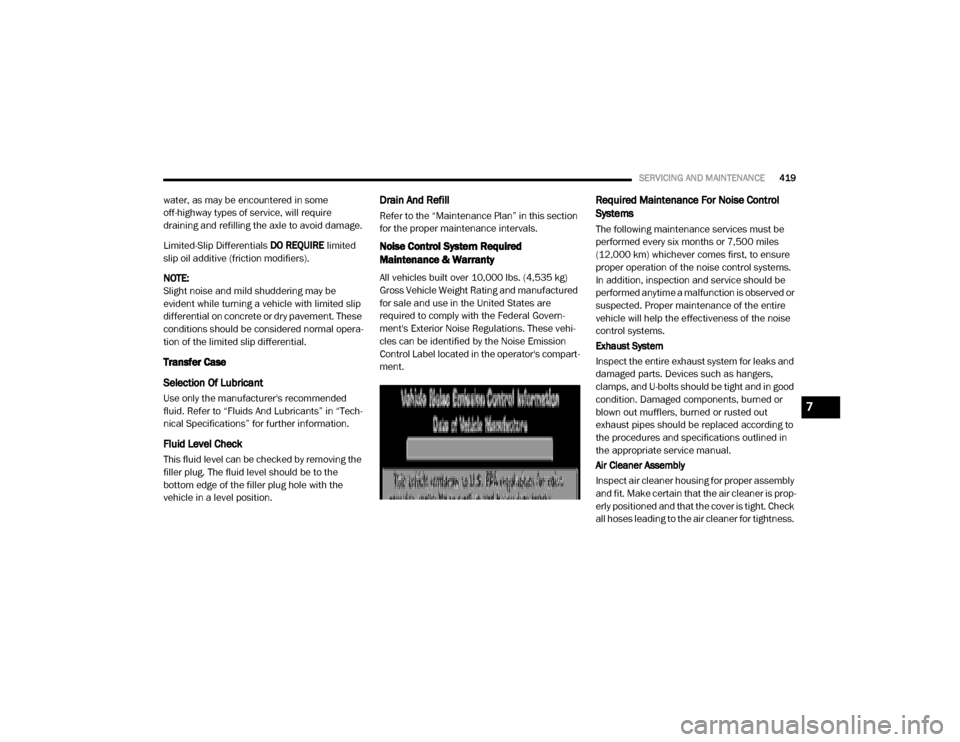
cles can be identified by the Noise Emission
Control Label located in the operator's compart -
ment.
Required Maintenance For Noise Control
Systems
The following maintenance services must be
performed every six months or 7,500 miles
(12,000 km) whichever comes first, to ensure
proper operation of the noise control systems.
In addition, inspection and service should be
performed anytime a malfunction is observed or
suspected. Proper maintenance of the entire
vehicle will help the effectiveness of the noise
control systems.
Exhaust System
Inspect the entire exhaust system for leaks and
damaged parts. Devices such as hangers,
clamps, and U-bolts should be tight and in good
condition. Damaged components, burned or
blown out mufflers, burned or rusted out
exhaust pipes should be replaced according to
the procedures and specifications outlined in
the appropriate service manual.
Air Cleaner Assembly
Inspect air cleaner housing for proper assembly
and fit. Make certain that the air cleaner is prop -
erly positioned and that the cover is tight. Check
all hoses leading to the air cleaner for tightness.
7
20_DJD2_OM_EN_USC_t.book Page 419
Page 431 of 553

SERVICING AND MAINTENANCE429
Tire Inflation Pressures
The proper cold tire inflation pressure is listed
on the driver's side B-Pillar or rear edge of the
driver's side door.
At least once a month:
Check and adjust tire pressure with a good
quality pocket-type pressure gauge. Do not
make a visual judgement when determining
proper inflation. Tires may look properly
inflated even when they are under-inflated.
Inspect tires for signs of tire wear or visible
damage.
Inflation pressures specified on the placard are
always “cold tire inflation pressure”. Cold tire
inflation pressure is defined as the tire pressure
after the vehicle has not been driven for at least
three hours, or driven less than 1 mile (1.6 km) after sitting for a minimum of three hours. The cold tire inflation pressure must not exceed the
maximum inflation pressure molded into the
tire sidewall.
Check tire pressures more often if subject to a
wide range of outdoor temperatures, as tire
pressures vary with temperature changes.
Tire pressures change by approximately 1 psi
(7 kPa) per 12°F (7°C) of air temperature
change. Keep this in mind when checking tire
pressure inside a garage, especially in the
Winter.
Example: If garage temperature = 68°F (20°C)
and the outside temperature = 32°F (0°C) then
the cold tire inflation pressure should be
increased by 3 psi (21 kPa), which equals 1 psi
(7 kPa) for every 12°F (7°C) for this outside
temperature condition.
Tire pressure may increase from 2 to 6 psi
(13 to 40 kPa) during operation. DO NOT reduce
this normal pressure build up or your tire pres
-
sure will be too low.
Tire Pressures For High Speed Operation
The manufacturer advocates driving at safe
speeds and within posted speed limits. Where
speed limits or conditions are such that the
vehicle can be driven at high speeds, main -
taining correct tire inflation pressure is very important. Increased tire pressure and reduced
vehicle loading may be required for high-speed
vehicle operation. Refer to an authorized tire
dealer or original equipment vehicle dealer for
recommended safe operating speeds, loading
and cold tire inflation pressures.
Radial Ply Tires
CAUTION!
After inspecting or adjusting the tire pressure,
always reinstall the valve stem cap. This will
prevent moisture and dirt from entering the
valve stem, which could damage the valve
stem.
WARNING!
High speed driving with your vehicle under
maximum load is dangerous. The added
strain on your tires could cause them to fail.
You could have a serious collision. Do not
drive a vehicle loaded to the maximum
capacity at continuous speeds above 75 mph
(120 km/h).
WARNING!
Combining radial ply tires with other types of
tires on your vehicle will cause your vehicle to
handle poorly. The instability could cause a
collision. Always use radial ply tires in sets of
four. Never combine them with other types of
tires.
7
20_DJD2_OM_EN_USC_t.book Page 429
Page 432 of 553

430SERVICING AND MAINTENANCE
Tire Repair
If your tire becomes damaged, it may be
repaired if it meets the following criteria:
The tire has not been driven on when flat.
The damage is only on the tread section of
your tire (sidewall damage is not repairable).
The puncture is no greater than a ¼ of an
inch (6 mm).
Consult an authorized tire dealer for tire repairs
and additional information.
Damaged Run Flat tires, or Run Flat tires that
have experienced a loss of pressure should be
replaced immediately with another Run Flat tire
of identical size and service description (Load
Index and Speed Symbol). Replace the tire pres -
sure sensor as well as it is not designed to be
reused.
Run Flat Tires — If Equipped
Run Flat tires allow you the capability to drive
50 miles (80 km) at 50 mph (80 km/h) after a rapid loss of inflation pressure. This rapid loss
of inflation is referred to as the Run Flat mode.
A Run Flat mode occurs when the tire inflation
pressure is of/or below 14 psi (96 kPa). Once a
Run Flat tire reaches the run flat mode it has limited driving capabilities and needs to be
replaced immediately. A Run Flat tire is not
repairable. When a run flat tire is changed after
driving with underinflated tire condition, please
replace the TPM sensor as it is not designed to
be reused when driven under run flat mode 14
psi (96 kPa) condition.
NOTE:
TPM Sensor must be replaced after driving the
vehicle on a flat tire condition.
It is not recommended driving a vehicle loaded
at full capacity or to tow a trailer while a tire is in
the run flat mode.
See the tire pressure monitoring section for
more information.
Tire Spinning
When stuck in mud, sand, snow, or ice condi
-
tions, do not spin your vehicle's wheels above
30 mph (48 km/h) or for longer than 30
seconds continuously without stopping.
Refer to “Freeing A Stuck Vehicle” in “In Case Of
Emergency” for further information.
Tread Wear Indicators
Tread wear indicators are in the original equip -
ment tires to help you in determining when your
tires should be replaced.
Tire Tread
WARNING!
Fast spinning tires can be dangerous. Forces
generated by excessive wheel speeds may
cause tire damage or failure. A tire could
explode and injure someone. Do not spin your
vehicle's wheels faster than 30 mph (48 km/h)
for more than 30 seconds continuously when
you are stuck, and do not let anyone near a
spinning wheel, no matter what the speed.
1 — Worn Tire
2 — New Tire
20_DJD2_OM_EN_USC_t.book Page 430
Page 441 of 553

SERVICING AND MAINTENANCE439
Standard No. 109. Grades B and A repre -
sent higher levels of performance on the
laboratory test wheel, than the minimum
required by law.
STORING THE VEHICLE
If you are storing your vehicle for more than
21 days, we recommend that you take the
following steps to minimize the drain on your
vehicle's battery:
Disconnect the negative cable from battery.
Any time you store your vehicle or keep it out
of service (i.e., vacation) for two weeks or
more, run the air conditioning system at idle
for about five minutes in the fresh air and high blower setting. This will ensure
adequate system lubrication to minimize the
possibility of compressor damage when the
system is started again.
BODYWORK
Protection From Atmospheric Agents
Vehicle body care requirements vary according
to geographic locations and usage. Chemicals
that make roads passable in snow and ice and
those that are sprayed on trees and road
surfaces during other seasons are highly corro
-
sive to the metal in your vehicle. Outside
parking, which exposes your vehicle to airborne
contaminants, road surfaces on which the
vehicle is operated, extreme hot or cold weather
and other extreme conditions will have an
adverse effect on paint, metal trim, and under -
body protection.
The following maintenance recommendations
will enable you to obtain maximum benefit from
the corrosion resistance built into your vehicle.
What Causes Corrosion?
Corrosion is the result of deterioration or
removal of paint and protective coatings from
your vehicle. The most common causes are:
Road salt, dirt and moisture accumulation.
Stone and gravel impact.
Insects, tree sap and tar.
Salt in the air near seacoast localities.
Atmospheric fallout/industrial pollutants.
Body And Underbody Maintenance
Cleaning Headlights
Your vehicle is equipped with plastic headlights
and fog lights that are lighter and less suscep
-
tible to stone breakage than glass headlights.
Plastic is not as scratch resistant as glass and
therefore different lens cleaning procedures
must be followed.
To minimize the possibility of scratching the
lenses and reducing light output, avoid wiping
with a dry cloth. To remove road dirt, wash with
a mild soap solution followed by rinsing.
Do not use abrasive cleaning components,
solvents, steel wool or other aggressive mate -
rial to clean the lenses.
WARNING!
The temperature grade for this tire is
established for a tire that is properly inflated
and not overloaded. Excessive speed,
under-inflation, or excessive loading, either
separately or in combination, can cause heat
buildup and possible tire failure.
7
20_DJD2_OM_EN_USC_t.book Page 439
Page 443 of 553

SERVICING AND MAINTENANCE441
If you detect any stone chips or scratches in
the paint, touch them up immediately. The
cost of such repairs is considered the respon -
sibility of the owner.
If your vehicle is damaged due to a collision
or similar cause that destroys the paint and
protective coating, have your vehicle repaired
as soon as possible. The cost of such repairs
is considered the responsibility of the owner.
If you carry special cargo such as chemicals,
fertilizers, de-icer salt, etc., be sure that such
materials are well packaged and sealed.
If a lot of driving is done on gravel roads,
consider mud or stone shields behind each
wheel.
Use Mopar Touch Up Paint on scratches as
soon as possible. An authorized dealer has
touch up paint to match the color of your
vehicle.
Spray-On Bedliner – If Equipped
During ownership, the shine and luster of the
Spray-On Bedliner can fade from oxidation, road
dirt, heavy-duty hauling and hard water stains. Weathering and UV exposure will lead to fading,
dulling, and loss of gloss over time.
To help maintain the appearance of your
Spray-On Bedliner, the manufacturer recom
-
mends you periodically rinse all loose dirt from
your truck bed and clean your truck at least
twice per year using the Mopar Spray-On
Bedliner Conditioner available at a local autho -
rized dealer.
To Help Maintain The Appearance Of Your
Spray-On Bedliner, Follow The Steps Below:
1. Rinse your truck bed out with water to remove any loose dirt and debris.
2. Mix a mild soap or detergent with water with a soft cloth or brush.
3. Rinse bedliner with water.
4. Once dry, apply a small amount of Mopar Spray-On Bedliner Conditioner to a moist
towel or sponge and wipe over the entire
surface of the truck bedliner. Spray-On Bedliners are chemically-resistant to
many different types of chemicals (including
gasoline, oil, hydraulic fluids) for short periods
of time. If a spill occurs on your Spray-On
Bedliner, rinse the truck out as soon as possible
to avoid permanent damage.
Repairing The Spray-On Bedliner
While extremely tough, it is possible to damage
a Spray-On Bedliner. One common condition is
when loading a heavy pallet and dragging that
pallet across the floor of the bed. If a nail or
sharp point is exposed under the weight of the
pallet a scratch or tear is possible. While not
covered by your new vehicle warranty, a
cosmetic fix to cover the metal exposed by the
scratch is required. To repair a tear or gouge,
follow the directions provided in the Mopar
Quick Repair Kit.
WARNING!
Do not use silicon-based protection products
to clean your bedliner. Silicon-based products
can become slippery and may result in
personal injury.
7
20_DJD2_OM_EN_USC_t.book Page 441
Page 450 of 553

448TECHNICAL SPECIFICATIONS
NOTE:
Intentional tampering with the emissions
control system can result in civil penalties being
assessed against you.
Carbon Monoxide Warnings
FUEL REQUIREMENTS – DIESEL ENGINE
Use good quality diesel fuel from a reputable
supplier in your vehicle. Federal law requires
that you must fuel this vehicle with Ultra Low
Sulfur Highway Diesel fuel (15 ppm Sulfur
maximum) and prohibits the use of Low Sulfur
Highway Diesel fuel (500 ppm Sulfur maximum)
to avoid damage to the emissions control
system.
For most year-round service, No. 2 diesel fuel
meeting ASTM (formerly known as the American
Society for Testing and Materials) specification
D-975 Grade S15 will provide good perfor -
mance. If the vehicle is exposed to extreme cold
(below 20°F or -7°C), or is required to operate
at colder-than-normal conditions for prolonged
periods, use climatized No. 2 diesel fuel or
dilute the No. 2 diesel fuel with 50% No. 1 diesel
fuel. This will provide better protection from fuel
gelling or wax-plugging of the fuel filters. Diesel fuel is seldom completely free of water.
To prevent fuel system trouble, drain the accu
-
mulated water from the fuel/water separator
using the fuel/water separator drain provided
on both fuel filters. If you buy good quality fuel
and follow the cold weather advice above, fuel
conditioners should not be required in your
vehicle. If available in your area, a high cetane
“premium” diesel fuel may offer improved
cold-starting and warm-up performance.
Fuel Specifications
The Cummins® Turbo Diesel engine has been
developed to take advantage of the high energy
content and generally lower cost No. 2 Ultra Low
Sulfur diesel fuel or No. 2 Ultra Low Sulfur clima-
tized diesel fuels. Experience has shown that it
also operates on No. 1 Ultra Low Sulfur diesel
fuels or other fuels within specification.
WARNING!
Carbon monoxide (CO) in exhaust gases is
deadly. Follow the precautions below to
prevent carbon monoxide poisoning:
Do not inhale exhaust gases. They contain
carbon monoxide, a colorless and odorless
gas, which can kill. Never run the engine in
a closed area, such as a garage, and never
sit in a parked vehicle with the engine
running for an extended period. If the
vehicle is stopped in an open area with the
engine running for more than a short
period, adjust the ventilation system to
force fresh, outside air into the vehicle.
Guard against carbon monoxide with
proper maintenance. Have the exhaust
system inspected every time the vehicle is
raised. Have any abnormal conditions
repaired promptly. Until repaired, drive with
all side windows fully open.WARNING!
Do not use alcohol or gasoline as a fuel
blending agent. They can be unstable under
certain conditions and hazardous or
explosive when mixed with diesel fuel.
CAUTION!
If the “Water in Fuel Indicator Light” remains
on, DO NOT START engine before you drain
the water from the fuel filter(s) to avoid
engine damage. Refer to “Draining Fuel/
Water Separator Filter” in “Servicing And
Maintenance” for further information.
20_DJD2_OM_EN_USC_t.book Page 448
Page 530 of 553

528MULTIMEDIA
The radio manufacturer believes the internal
wireless radio is safe for use by consumers. The
level of energy emitted is far less than the elec -
tromagnetic energy emitted by wireless devices
such as mobile phones. However, the use of
wireless radios may be restricted in some situa-
tions or environments, such as aboard
airplanes. If you are unsure of restrictions, you
are encouraged to ask for authorization before
turning on the wireless radio.
The following regulatory statement applies to all
Radio Frequency (RF) devices equipped in this
vehicle:
This device complies with Part 15 of the FCC
Rules and with Innovation, Science and
Economic Development Canada license-exempt
RSS standard(s). Operation is subject to the
following two conditions:
1. This device may not cause harmful interfer -
ence, and
2. This device must accept any interference received, including interference that may
cause undesired operation. Le présent appareil est conforme aux CNR
d`Innovation, Science and Economic Develop
-
ment applicables aux appareils radio exempts
de licence. L'exploitation est autorisée aux deux
conditions suivantes:
1. l'appareil ne doit pas produire de brouil -
lage, et
2. l'utilisateur de l'appareil doit accepter tout brouillage radioélectrique subi, même si le
brouillage est susceptible d'en comprom -
ettre le fonctionnement.
La operación de este equipo está sujeta a las
siguientes dos condiciones:
1. es posible que este equipo o dispositivo no cause interferencia perjudicial y
2. este equipo o dispositivo debe aceptar cual -
quier interferencia, incluyendo la que
pueda causar su operación no deseada.
NOTE:
Changes or modifications not expressly
approved by the party responsible for compli -
ance could void the user’s authority to operate
the equipment. NOTE:
This equipment has been tested and found to
comply with the limits for a Class B digital
device, pursuant to Part 15 of the FCC Rules.
These limits are designed to provide reason -
able protection against harmful interference
in a residential installation. This equipment
generates, uses and can radiate radio
frequency energy and, if not installed and
used in accordance with the instructions,
may cause harmful interference to radio
communications. However, there is no guar -
antee that interference will not occur in a
particular installation.
If this equipment does cause harmful inter -
ference to radio or television reception,
which can be determined by turning the
equipment off and on, the user is encour -
aged to try to correct the interference by one
or more of the following measures:
a. Increase the separation between the equipment and receiver.
b. Consult an authorized dealer or an expe -
rienced radio technician for help.
20_DJD2_OM_EN_USC_t.book Page 528
Page 542 of 553

540
INDEX
A
Adaptive Cruise Control (ACC) (Cruise
Control)
.......................................................... 275
Adding Engine Coolant (Antifreeze)............... 413
Adding Fuel.......................................... 312, 313
Additives, Fuel............................................... 446AdjustDown
........................................................... 34
Forward....................................................... 34
Rearward..................................................... 34
Up................................................................ 34
Adjustable Pedals............................................ 43
Air BagAir Bag Operation
...................................... 184
Air Bag Warning Light................................ 181Enhanced Accident Response......... 189, 371
Event Data Recorder (EDR)....................... 371
If Deployment Occurs................................ 188Knee Impact Bolsters................................ 184
Maintaining Your Air Bag System.............. 189
Maintenance............................................. 189Redundant Air Bag Warning Light.............182
Transporting Pets...................................... 208
Air Bag Light............................... 130, 181, 209
Air Cleaner, Engine (Engine Air Cleaner
Filter)
................................................... 398, 419
Air Conditioner Maintenance........................ 400
Air Conditioner Refrigerant........................... 400
Air Conditioner System................................. 400
Air Conditioning......................................... 57, 68
Air Conditioning Filter..............................70, 401
Air Conditioning System................................... 68Air Conditioning, Operating Tips....................... 69
Air Filter........................................................ 398
Air PressureTires
......................................................... 429
AlarmPanic
........................................................... 15
Security Alarm....................................25, 131
Alterations/ModificationsVehicle
......................................................... 12Android Auto................................................. 533
Antifreeze (Engine Coolant)................. 412, 451
Capacites................................................. 451Disposal................................................... 414
Anti-Lock Brake System (ABS)...................... 144
Anti-Lock Warning Light................................ 136Apple CarPlay................................................ 533
Assist, Hill Start............................................. 151
Audio Systems (Radio).................................. 458
Auto Down Power Windows............................. 71
Automatic Door Locks...................................... 31
Automatic Headlights.......................................51
Automatic Tailgate Release.............................75
Automatic Temperature Control (ATC)..............68
Automatic Transmission....................... 233, 418
Adding Fluid.............................................. 418
Fluid And Filter Change............................. 418Fluid Change............................................. 418
Fluid Level Check............................. 416, 417
Fluid Type...............................416, 454, 457
Shifting..................................................... 237
Special Additives...................................... 416
Automatic Transmission Limp Home Mode... 236
AUX Camera......................................... 304, 311
Auxiliary Driving Systems.............................. 153
Axle Fluid.....................................418, 454, 457Axle Lubrication............................................ 418
B
Back-Up
......................................................... 302
Back-Up Camera........................................... 302
Bar, Stabilizer/Sway System......................... 253Battery................................................. 132, 395
Blanket..................................................... 223
Charging System Light.............................. 132Keyless Key Fob Replacement....................15
Battery Saver Feature......................................53
20_DJD2_OM_EN_USC_t.book Page 540
Page 544 of 553

542
Differential, Limited Slip
................................ 264
Disabled Vehicle Towing................................ 369
Disposal Antifreeze (Engine Coolant)
....................... 414
Do Not Disturb............................................... 532
Door Ajar........................................................ 133
Door Ajar Light............................................... 133Door LocksAutomatic
.................................................... 31
Doors............................................................... 27Draining Fuel/Water Separator Filter............ 403
Driver’s Seat Back Tilt..................................... 32
DrivingOff-Pavement
............................................ 255
Off-Road.................................................... 255Through Flowing, Rising, Or Shallow Standing Water
..................................... 335
Dual Rear Wheels................................ 437, 444
E
Electric Brake Control System
....................... 145
Anti-Lock Brake System............................. 144
Electronic Roll Mitigation................. 149, 153
Electrical Power Outlets................................... 88Electronic Range Select (ERS)............. 236, 241
Electronic Stability Control (ESC)...................146
Electronic Throttle Control Warning Light...... 132
Electronically Shifted Transfer Case.............. 244
Emergency Braking........................................ 229
Emergency, In Case OfFreeing Vehicle When Stuck
..................... 367
Hazard Warning Flasher........................... 338
Jump Starting........................................... 362
Emission Control System Maintenance........ 142
Engine......................................... 391, 392, 393
Air Cleaner................................................ 398Block Heater.................................... 218, 227
Break-In Recommendations..................... 228
Compartment.................................. 392, 393Compartment Identification...................... 391
Coolant (Antifreeze)......................... 452, 454
Exhaust Gas Caution....................... 208, 448
Fails To Start............................................ 214
Flooded, Starting...................................... 214Fuel Requirements.......................... 446, 451
Identifcation.................................... 392, 393
Idling........................................................ 224
Jump Starting........................................... 362Oil..................................396, 451, 452, 454
Oil Filler Cap.................................... 391, 397
Oil Filter.................................................... 398
Oil Reset................................................... 119
Oil Selection.................................... 396, 451
Oil Synthetic............................................. 398
Overheating.............................................. 367
Runaway................................................... 312
Starting..................................................... 212
Engine Oil Viscosity....................................... 397
Enhanced Accident Response
Feature
................................................ 189, 371
Entry System, Illuminated................................55
Ethanol.......................................................... 446
Exhaust Brake............................................... 230
Exhaust Gas Cautions.......................... 208, 448
Exhaust System..........................208, 410, 419Exterior Lighting...............................................49
Exterior Lights........................................ 49, 210
F
FiltersAir Cleaner
................................................ 398
Air Conditioning................................. 70, 401
Engine Fuel............................................... 403
Engine Oil...............................398, 452, 454
Engine Oil Disposal................................... 398
FlashersTurn Signals
.............................. 52, 140, 210
Flash-To-Pass...................................................51
Flat Tire Stowage.......................................... 350
Fluid Capacities............................................ 451
Fluid Leaks.................................................... 210
Fluid Level ChecksBrake........................................................ 415
Fluid, Brake................................................... 454
Fluids And Lubricants........................... 452, 454
Fog Lights.............................................. 52, 376
Fold Flat Load Floor.........................................86
Fold-Flat Seats.................................................32
20_DJD2_OM_EN_USC_t.book Page 542