child restraint Ram 3500 2014 Owner's Guide
[x] Cancel search | Manufacturer: RAM, Model Year: 2014, Model line: 3500, Model: Ram 3500 2014Pages: 790, PDF Size: 5.79 MB
Page 108 of 790
strap. Refer to “Installing Child Restraints Using The
Top Tether Anchorage” for directions to attach a tether
anchor.
6. Test that the child restraint is installed tightly by pulling back and forth on the child seat at the belt
path. It should not move more than 1 inch (25 mm) in
any direction.
Any seat belt system will loosen with time, so check the
belt occasionally, and pull it tight if necessary.
If the buckle or the cinching latch plate is too close to the
belt path opening of the child restraint, you may have
trouble tightening the seat belt. If this happens, discon-
nect the latch plate from the buckle and twist the short
buckle-end belt up to three full turns to shorten it. Insert
the latch plate into the buckle with the release button
facing out, away from the child restraint. Repeat steps 4
to 6, above, to complete the installation of the child
restraint. If the belt still cannot be tightened after you shorten the
buckle, disconnect the latch plate from the buckle, turn
the buckle around one half turn, and insert the latch plate
into the buckle again. If you still cannot make the child
restraint installation tight, try a different seating position.
Installing Child Restraints Using The Top Tether
Anchorage
Regular and Mega Cab® Trucks:
In the regular cab
truck, the top tether anchorages are located behind the
center and right passenger seats. In the mega cab truck,
the top tether anchorages are located behind each rear
seating position. There is a plastic cover over each an-
chorage. To attach the tether strap of the child restraint:
1. Place the child restraint on the seat and adjust the tether strap so that it will reach over the seat back,
under the head restraint and to the tether anchor
directly behind the seat.
106 THINGS TO KNOW BEFORE STARTING YOUR VEHICLE
Page 109 of 790
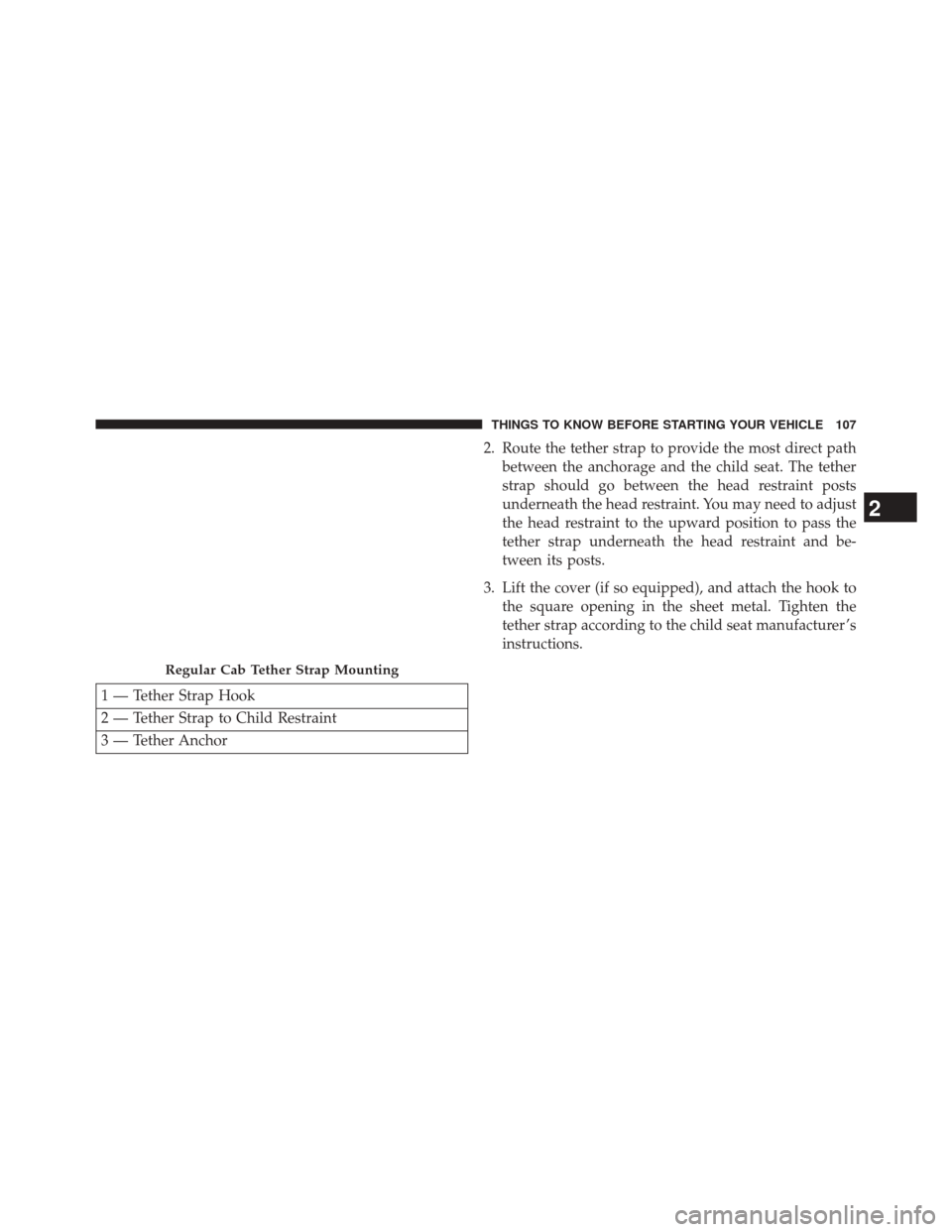
1 — Tether Strap Hook
2 — Tether Strap to Child Restraint
3 — Tether Anchor2. Route the tether strap to provide the most direct path
between the anchorage and the child seat. The tether
strap should go between the head restraint posts
underneath the head restraint. You may need to adjust
the head restraint to the upward position to pass the
tether strap underneath the head restraint and be-
tween its posts.
3. Lift the cover (if so equipped), and attach the hook to the square opening in the sheet metal. Tighten the
tether strap according to the child seat manufacturer ’s
instructions.
Regular Cab Tether Strap Mounting
2
THINGS TO KNOW BEFORE STARTING YOUR VEHICLE 107
Page 110 of 790
WARNING!
Never place a rear facing infant seat in front of an air
bag. A deploying Passenger Advanced Front Air Bag
can cause death or serious injury to a child 12 years or
younger, including a child in a rearward facing infant
seat.
Quad Cab® or Crew Cab Trucks: The top tether an-
chorages in this vehicle are tether strap loops located
between the rear glass and the back of the rear seat.
There is a tether strap loop located behind each seating
position. Follow the steps below to attach the tether
strap of the child restraint.
Right or Left Outboard Seats:
1. Raise the head restraint and reach between the rear seat and rear glass to access the tether strap loop.
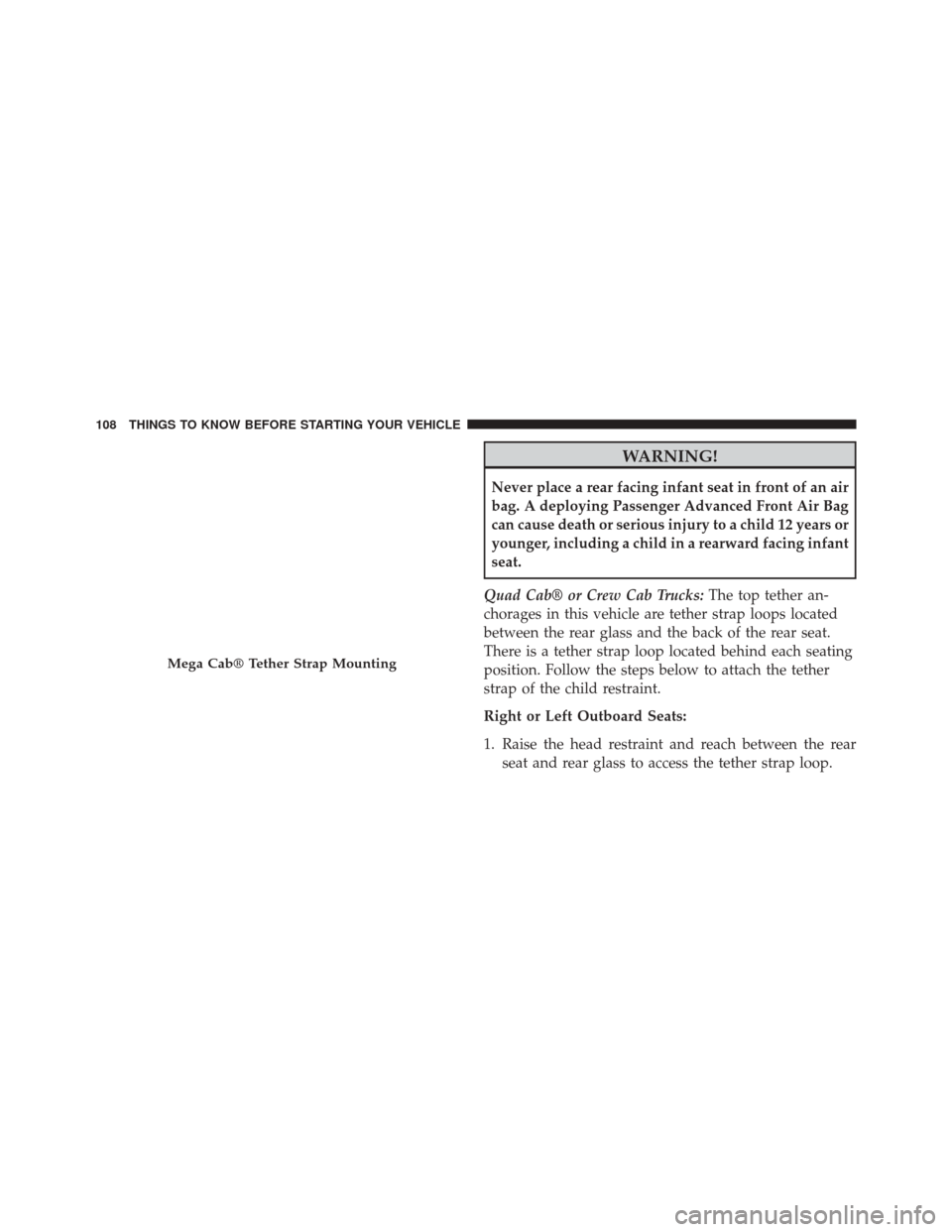
Mega Cab® Tether Strap Mounting
108 THINGS TO KNOW BEFORE STARTING YOUR VEHICLE
Page 111 of 790
2. Place a child restraint on the seat and adjust the tetherstrap so that it will reach over the seat back, under the
head restraint, through the tether strap loop behind
the seat and over to the tether strap loop behind the
center seat.
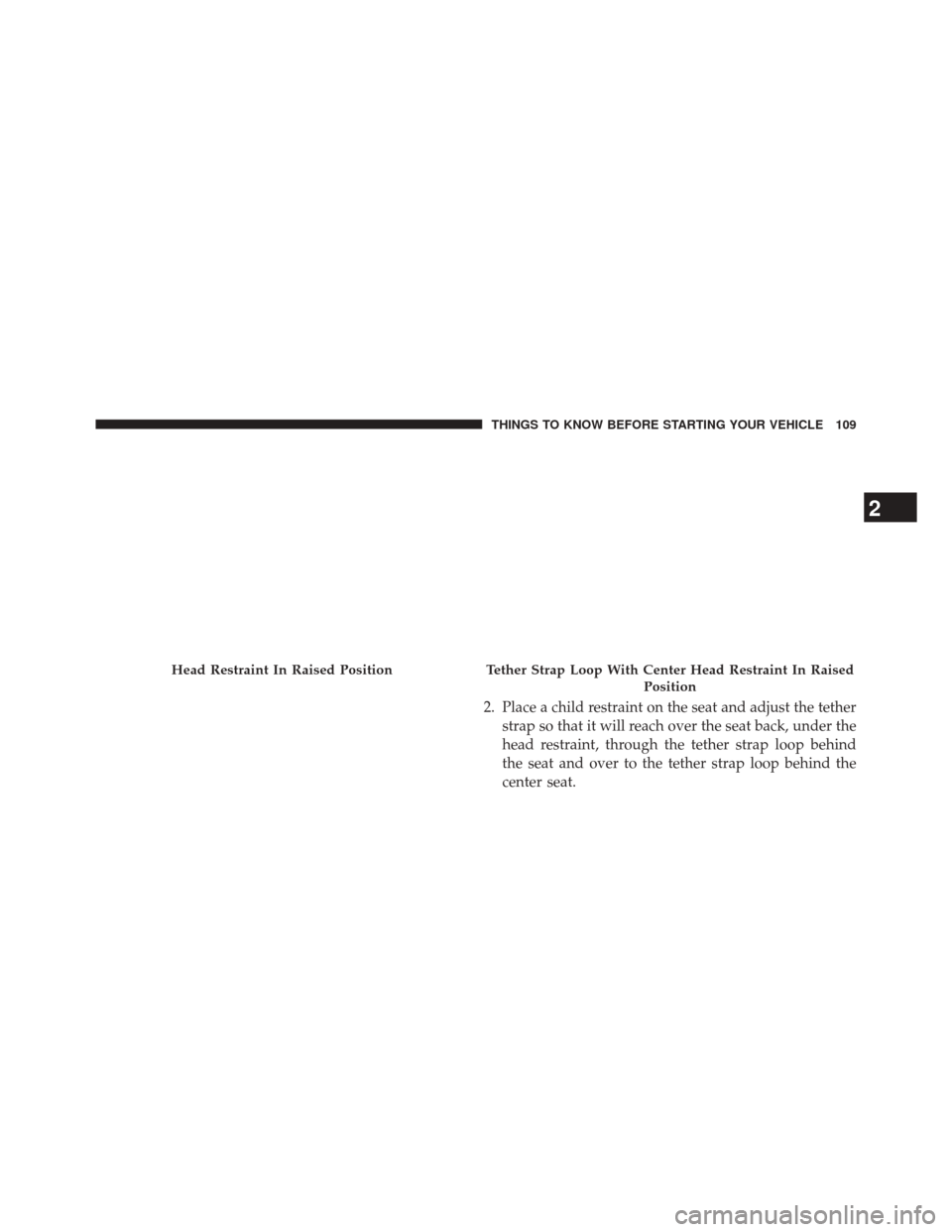
Head Restraint In Raised PositionTether Strap Loop With Center Head Restraint In Raised
Position
2
THINGS TO KNOW BEFORE STARTING YOUR VEHICLE 109
Page 112 of 790

3. Pass the tether strap hook under the head restraintbehind the child seat, though the tether strap loop
behind the seat and over to the center tether strap
loop. 4. Attach the hook to the center tether strap loop (see
diagram). Tighten the tether strap according to the
child seat manufacturer ’s instructions.
Tether Strap Through Outboard Tether Strap Loop
Tether Strap Through Outboard Tether Strap Loop And
Attached To Center Tether Strap Loop
110 THINGS TO KNOW BEFORE STARTING YOUR VEHICLE
Page 113 of 790
NOTE:If there are child seats in both of the outboard (left
and right) seating positions, the tether strap hooks of
both child seats should be connected to the center tether
strap loop. This is the correct way to tether two outboard
child seats.
Center Seat:
1. Raise the head restraint and reach between the rear seat and rear glass to access the tether strap loop.
2. Place a child restraint on the seat and adjust the tetherstrap so that it will reach over the seat back, under the
head restraint, through the tether strap loop behind
the seat and over to the tether strap loop behind either
the right or left outboard seat.
Tether Strap Loop With Head Restraint In Raised
Position
2
THINGS TO KNOW BEFORE STARTING YOUR VEHICLE 111
Page 114 of 790

3. Pass the tether strap hook under the head restraintbehind the child seat, though the tether strap loop
behind the seat and over to the right or left outboard
tether strap loop. 4. Attach the hook to the outboard tether strap loop (see
diagram). Tighten the tether strap according to the
child seat manufacturer ’s instructions.
Tether Strap Through Center Tether Strap Loop
Tether Strap Through Center Tether Strap Loop And
Attached To Outboard Tether Strap Loop
112 THINGS TO KNOW BEFORE STARTING YOUR VEHICLE
Page 115 of 790
Installing Three Child Restraints:
1. Place a child restraint on each outboard rear seat.Route the tether straps following the directions for
right and left seating positions, above.
2. Attach both hooks to the center tether strap loop, but do not tighten the straps yet.
3. Place a child restraint on the center rear seat. Route the tether strap following the directions for the center
seating position, above.
4. Attach the hook to the outboard tether strap loop.
5. Tighten the tether straps according to the child seat manufacturer ’s instructions, tightening the right and
left tether straps before the center tether strap.
Left Outboard And Center Seating Position Shown
2
THINGS TO KNOW BEFORE STARTING YOUR VEHICLE 113
Page 116 of 790
WARNING!
•An incorrectly anchored tether strap could lead to
increased head motion and possible injury to the
child. Use only the anchorage position directly
behind the child seat to secure a child restraint top
tether strap.
• If your vehicle is equipped with a split rear seat,
make sure the tether strap does not slip into the
opening between the seatbacks as you remove
slack in the strap.
Transporting Pets
Air Bags deploying in the front seat could harm your pet.
An unrestrained pet will be thrown about and possibly
injured, or injure a passenger during panic braking or in
a collision.
Pets should be restrained in the rear seat in pet harnesses
or pet carriers that are secured by seat belts.
ENGINE BREAK-IN RECOMMENDATIONS
A long break-in period is not required for the engine and
drivetrain (transmission and axle) in your vehicle.
Drive moderately during the first 300 miles (500 km).
After the initial 60 miles (100 km), speeds up to 50 or
55 mph (80 or 90 km/h) are desirable.
While cruising, brief full-throttle acceleration within the
limits of local traffic laws contributes to a good break-in.
Wide-open throttle acceleration in low gear can be detri-
mental and should be avoided.
The engine oil installed in the engine at the factory is a
high-quality energy conserving type lubricant. Oil changes
should be consistent with anticipated climate conditions
under which vehicle operations will occur. For the recom-
mended viscosity and quality grades, refer to “Maintenance
Procedures” in “Maintaining Your Vehicle”.
114 THINGS TO KNOW BEFORE STARTING YOUR VEHICLE
Page 156 of 790
2. Fold the seatback down and push the seat forward.
3. Lift the seatback, to return the seat to the uprightposition. Be sure the seat is locked in place.WARNING!
An improperly latched seat could cause serious in-
jury or death. Make sure that the seatback is securely
locked into position. If the seatback in not securely
locked into position the seat will not provide the
proper stability for child seats and/or passengers.
Head Restraints
Head restraints are designed to reduce the risk of injury
by restricting head movement in the event of a rear
impact. Head restraints should be adjusted so that the top
of the head restraint is located above the top of your ear.
Rear Passenger Fold-Flat Seats
154 UNDERSTANDING THE FEATURES OF YOUR VEHICLE