steering Ram 3500 2016 Diesel Supplement
[x] Cancel search | Manufacturer: RAM, Model Year: 2016, Model line: 3500, Model: Ram 3500 2016Pages: 338, PDF Size: 1.63 MB
Page 161 of 338
ELECTRONIC VEHICLE INFORMATION CENTER
(EVIC)
The Electronic Vehicle Information Center (EVIC) fea-
tures a driver-interactive display that is located in the
instrument cluster.This system conveniently allows the driver to select a
variety of useful information by pushing the switches
mounted on the steering wheel.
Refer to “Electronic Vehicle Information Center – If
Equipped” in the Owner’s Manual for further informa-
tion.
Instrument Cluster Messages
When the appropriate conditions exist, the Instrument
Cluster Displays the following messages:
•
System Setup Unavailable – Vehicle Not in Park
• System Setup Unavailable – Vehicle in Motion
• Service Air Filter
• Perform Service
• Exhaust Filter XX% Full Safely Drive at Highway
Speeds To Remedy — If Equipped
Electronic Vehicle Information Center (EVIC)
4
UNDERSTANDING YOUR INSTRUMENT PANEL 159
Page 172 of 338
NOTE:When this message is displayed, the engine can
still be started. However, the vehicle will only operate at
a maximum speed of 5 MPH.
RAM Active Air System
Your vehicle is equipped with an advanced Ram Active
Air system that provides enhanced performance, espe-
cially when towing under demanding hot or high alti-
tude conditions. If the EVIC/DID displays the message
“Active Airbox Service Required See Dealer”, vehicle
performance may be reduced until service is performed
by an authorized RAM dealer.
Fuel Filter Life Reset
The cluster will display the “Service Fuel Filter” message
when the fuel filter maintenance life is less than 5%. To
check the remaining fuel filter life, go to the “Fuel Filter
Life” screen in the “Vehicle Info” menu. When this
message appears, dealers should replace both frame
mounted and engine mounted fuel filters. NOTE:
Use the steering wheel EVIC controls for the
following procedure(s)
Vehicles Equipped With Passive Entry
1. Without pressing the brake pedal, press the ENGINE START/STOP button and cycle the ignition to the
ON/RUN position (do not start the engine.)
2. Press and release the DOWN
arrow button to scroll
downward through the main menu to “Vehicle Info”.
3. Press and release the RIGHT
arrow button to
access the ”Fuel Filter Life” screen.
4. Press and release the DOWN
arrow button
to select “Reset”, then press and release the
RIGHT
arrow button to select reset of the Fuel
Filter Life to 100%.
5. Press and release the UP
arrow button to exit the
EVIC screen.
170 UNDERSTANDING YOUR INSTRUMENT PANEL
Page 173 of 338
Vehicles Not Equipped With Passive Entry
1. Without pressing the brake pedal, cycle the ignition tothe ON/RUN position (do not start the engine.)
2. Press and release the DOWN
arrow button to scroll
downward through the main menu to “Vehicle Info”.
3. Press and release the RIGHT
arrow button to
access the ”Fuel Filter Life” screen.
4. Press and release the DOWN
arrow button
to select “Reset”, then press and release the
RIGHT
arrow button to select reset of the Fuel
Filter Life to 100%.
5. Press and release the UP
arrow button to exit the
EVIC screen.
NOTE: If the indicator message illuminates when you
start the vehicle, the Fuel Filter indicator system did not
reset. If necessary, repeat this procedure.
Oil Life Reset
Your vehicle is equipped with an engine oil change
indicator system. The “Oil Change Required” message
will display in the EVIC after a single chime has sounded,
to indicate the next scheduled oil change interval. The
engine oil change indicator system is duty cycle based,
which means the engine oil change interval may fluctu-
ate, dependent upon your personal driving style.
NOTE: Use the steering wheel EVIC controls for the
following procedure(s).
Vehicles Equipped With Passive Entry
1. Without depressing the brake pedal, push the EN- GINE START/STOP button and place the ignition to
the ON/RUN position (do not start the engine).
2. Push and release the DOWN
arrow button to scroll
downward through the main menu to “Vehicle Info.”
4
UNDERSTANDING YOUR INSTRUMENT PANEL 171
Page 185 of 338
be continuously displayed. The message will be ac-
companied by a single chime. Your Malfunction Indi-
cator Light will be continuously illumined. We highly
recommend you drive to your nearest authorized
dealer if the message appears while engine is running.
NOTE: When this message is displayed, the engine can
still be started. However, the vehicle will only operate at
a maximum speed of 5 MPH.
RAM Active Air System
Your vehicle is equipped with an advanced Ram Active
Air system that provides enhanced performance, espe-
cially when towing under demanding hot or high alti-
tude conditions. If the DID displays the message “Active
Airbox Service Required See Dealer”, vehicle perfor-
mance may be reduced until service is performed by an
authorized RAM dealer.
Fuel Filter Life Reset
The cluster will display the “Service Fuel Filter” message
when the fuel filter maintenance life is less than 5%. To
check the remaining fuel filter life, go to the “Fuel Filter
Life” screen in the “Vehicle Info” menu. When this
message appears, dealers should replace both frame
mounted and engine mounted fuel filters.
NOTE: Use the steering wheel EVIC controls for the
following procedure(s)
Vehicles Equipped With Passive Entry
1. Without pressing the brake pedal, press the ENGINE START/STOP button and place the ignition in the
ON/RUN position (do not start the engine.)
2. Press and release the DOWN
arrow button to scroll
downward through the main menu to “Vehicle Info”.
4
UNDERSTANDING YOUR INSTRUMENT PANEL 183
Page 192 of 338
Oil Life Reset
Your vehicle is equipped with an engine oil change
indicator system. The “Oil Change Required” message
will flash in the DID display for approximately 10
seconds after a single chime has sounded, to indicate the
next scheduled oil change interval. The engine oil change
indicator system is duty cycle based, which means the
engine oil change interval may fluctuate, dependent
upon your personal driving style.
NOTE:Use the steering wheel DID controls for the
following procedure(s)
Vehicles Equipped With Passive Entry
1. Without Pushing the brake pedal, push the ENGINE START/STOP button and cycle the ignition to the
ON/RUN position (do not start the engine.)
2. Push and release the DOWN
arrow button to scroll
downward through the main menu to “Vehicle Info”. 3. Push and release the
RIGHT
arrow button to
access the ”Oil Life” screen.
4. Push and hold the RIGHT
arrow button for one
second to access the ”Oil Life Reset” screen.
5. Push and release the DOWN
arrow button to select
“Yes”, then push and release the RIGHT
arrow
button to select reset of the Oil Life.
6. Push and release the UP
arrow button to exit the
DID screen.
Vehicles Not Equipped With Passive Entry
1. Without pushing the brake pedal, cycle the ignition to the ON/RUN position (do not start the engine.)
2. Push and release the DOWN
arrow button to scroll
downward through the main menu to “ Vehicle Info”.
3. Push and release the RIGHT
arrow button to
access the ” Oil Life” screen.
190 UNDERSTANDING YOUR INSTRUMENT PANEL
Page 224 of 338
Key Ignition Park Interlock
This vehicle is equipped with a Key Ignition Park Inter-
lock which requires the transmission to be in PARK
before the ignition switch can be turned to the LOCK/
OFF (key removal) position. The key fob can only be
removed from the ignition when the ignition is in the
LOCK/OFF position, and the transmission is locked in
PARK whenever the ignition switch is in the LOCK/OFF
position.
Brake/Transmission Shift Interlock System
This vehicle is equipped with a Brake Transmission Shift
Interlock System (BTSI) that holds the shift lever in PARK
unless the brakes are applied. To shift the transmission
out of PARK, the ignition switch must be turned to the
ON/RUN position (engine running or not) and the brake
pedal must be pressed.
Six-Speed Automatic Transmission — If Equipped
Chassis Cab models (with automatic transmission) use
the AS69RC transmission (which is equipped with a
Power Take-Off [PTO] access cover on the side of the
transmission case). Pickup models may use either the
AS69RC transmission, or the 68RFE transmission (which
has no PTO access cover).
The transmission gear position display (located in the
instrument cluster) indicates the transmission gear range.
The shift lever is mounted on the right side of the steering
column. You must press the brake pedal to move the shift
lever out of PARK (refer to “Brake/Transmission Shift
Interlock System” in this section). To drive, move the shift
lever from PARK or NEUTRAL to the DRIVE position.
Pull the shift lever toward you when shifting into RE-
VERSE or PARK, or when shifting out of PARK.
The electronically-controlled transmission provides a
precise shift schedule. The transmission electronics are
222 STARTING AND OPERATING
Page 271 of 338
ENGINE COMPARTMENT — 6.7L DIESEL — SIX-SPEED 68RFE (2500/3500 Models)
1 — Battery7 — Washer Fluid Reservoir
2 — Engine Coolant Reservoir 8 — Power Steering Fluid Reservoir
3 — Automatic Transmission Dipstick 9 — Power Distribution Center
4 — Brake Fluid Reservoir 10 — Engine Oil Dipstick
5 — Battery 11 — Engine Oil Fill
6 — Aux Power Distribution Center 12 — Air Cleaner Filter
7
MAINTAINING YOUR VEHICLE 269
Page 272 of 338
ENGINE COMPARTMENT — 6.7L DIESEL — SIX-SPEED AS69RC HD (3500/CHASSIS CAB MODELS)
1 — Battery7 — Washer Fluid Reservoir
2 — Engine Coolant Reservoir 8 — Power Steering Fluid Reservoir
3 — Automatic Transmission Dipstick 9 — Power Distribution Center
4 — Brake Fluid Reservoir 10 — Engine Oil Dipstick
5 — Battery 11 — Engine Oil Fill
6 — Aux Power Distribution Center 12 — Air Cleaner Filter
270 MAINTAINING YOUR VEHICLE
Page 273 of 338
MAINTENANCE PROCEDURES
The pages that follow contain therequiredmaintenance
services determined by the engineers who designed your
vehicle.
Besides those maintenance items specified in the fixed
maintenance schedule, there are other components which
may require servicing or replacement in the future.
CAUTION!
• Failure to properly maintain your vehicle or per-
form repairs and service when necessary could
result in more costly repairs, damage to other
components or negatively impact vehicle perfor-
mance. Immediately have potential malfunctions
examined by an authorized dealership or qualified
repair center.
(Continued)
CAUTION! (Continued)
•Your vehicle has been built with improved fluids
that protect the performance and durability of your
vehicle and also allow extended maintenance inter-
vals. Do not use chemical flushes in these compo-
nents as the chemicals can damage your engine,
transmission, power steering or air conditioning.
Such damage is not covered by the New Vehicle
Limited Warranty. If a flush is needed because of
component malfunction, use only the specified
fluid for the flushing procedure.
Engine Oil
Checking Oil Level
To assure proper lubrication of your vehicle’s engine, the
engine oil must be maintained at the correct level. Check
the oil level at regular intervals. The best time to check
the oil level is before starting the engine after it has been
7
MAINTAINING YOUR VEHICLE 271
Page 324 of 338
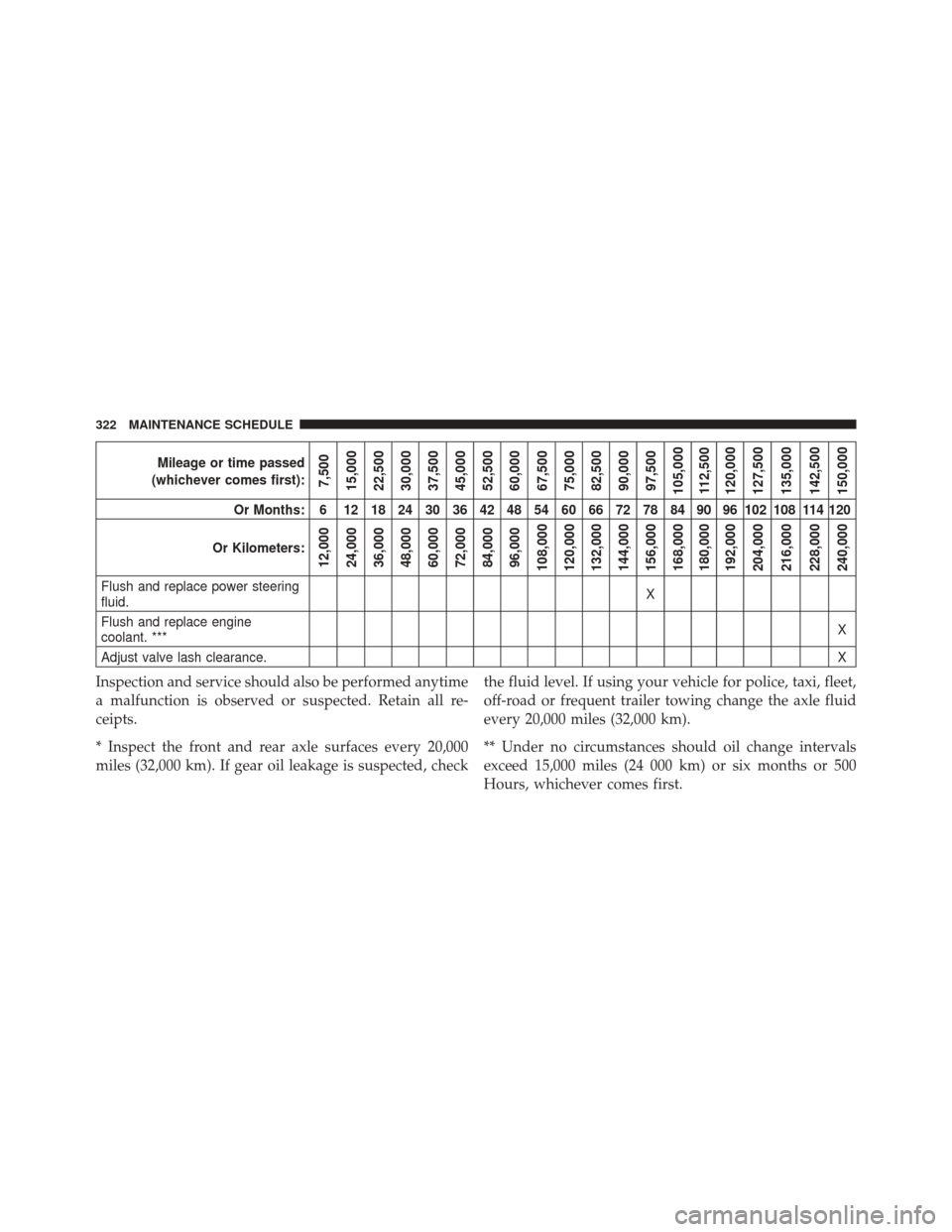
Mileage or time passed
(whichever comes first):
7,500
15,000
22,500
30,000
37,500
45,000
52,500
60,000
67,500
75,000
82,500
90,000
97,500
105,000 112,500
120,000
127,500
135,000
142,500
150,000
Or Months: 6 12 18 24 30 36 42 48 54 60 66 72 78 84 90 96 102 108 114 120
Or Kilometers:
12,000
24,000
36,000
48,000
60,000
72,000
84,000
96,000
108,000
120,000
132,000
144,000
156,000
168,000
180,000
192,000
204,000
216,000
228,000
240,000
Flush and replace power steering
fluid. X
Flush and replace engine
coolant. *** X
Adjust valve lash clearance. X
Inspection and service should also be performed anytime
a malfunction is observed or suspected. Retain all re-
ceipts.
* Inspect the front and rear axle surfaces every 20,000
miles (32,000 km). If gear oil leakage is suspected, checkthe fluid level. If using your vehicle for police, taxi, fleet,
off-road or frequent trailer towing change the axle fluid
every 20,000 miles (32,000 km).
** Under no circumstances should oil change intervals
exceed 15,000 miles (24 000 km) or six months or 500
Hours, whichever comes first.
322 MAINTENANCE SCHEDULE