fuel cap Ram 3500 2016 Diesel Supplement
[x] Cancel search | Manufacturer: RAM, Model Year: 2016, Model line: 3500, Model: Ram 3500 2016Pages: 338, PDF Size: 1.63 MB
Page 256 of 338
Adding Diesel Exhaust Fluid
The DEF gauge (located on the instrument cluster) will
display the level of DEF remaining in the tank. Refer to
“Instrument Cluster” and “Instrument Cluster Descrip-
tions” in “Understanding Your Instrument Panel” for
further information.
NOTE:Driving conditions (altitude, vehicle speed, load,
etc.) will effect the amount of DEF that is used in your
vehicle.
Another factor is that outside temperature can affect DEF
consumption. In cold conditions, 12° F (-11° C) and
below, the DEF gauge needle can stay on a fixed position
and may not move for extended periods of time. This is
a normal function of the system.
DEF Fill Procedure
NOTE: Refer to “Fluids, Lubricants, and Genuine Parts”
in “Maintaining Your Vehicle” for the correct fluid type. 1. Remove cap from DEF tank (located on drivers side of
the vehicle or in fuel door).
DEF Filler Cap Chassis Cab Models
254 STARTING AND OPERATING
Page 257 of 338
1 — Diesel Exhaust Fluid Fill Location
2 — Diesel Fuel Fill Location
2. Insert DEF fill adapter/nozzle into DEF tank fillerneck.
CAUTION!
•To avoid DEF spillage, and possible damage to the
DEF tank from overfilling, do not “top off” the DEF
tank after filling.
(Continued)
DEF Filler Cap And Fuel Fill 1500/2500/3500 ModelsFilling The DEF Tank
5
STARTING AND OPERATING 255
Page 289 of 338
CAUTION!
Do not engage the starter motor for more than 15 sec-
onds at a time. Allow two minutes between the
cranking intervals.
NOTE: The engine may run rough until the air is forced
from all the fuel lines.
WARNING!
Do not use alcohol or gasoline as a fuel blending
agent. They can be unstable under certain conditions
and be hazardous or explosive when mixed with
diesel fuel.
CAUTION!
Due to lack of lubricants in alcohol or gasoline, the
use of these fuels can cause damage to the fuel
system.
NOTE:
• A maximum blend of 5% biodiesel, meeting ASTM
specification D-975 may be used with your Cummins
diesel engine. (Chassis Cab models not configured
with B20 capability.)
• A maximum blend of 20% biodiesel, meeting ASTM
specification D-7467 may be used with your Cummins
diesel engine. (Pickup models and Chassis Cab models
configured with B20 capability.)
7
MAINTAINING YOUR VEHICLE 287
Page 298 of 338
•Do not change the thermostat for Summer or Winter
operation. If replacement is ever necessary, install
ONLY the correct type thermostat. Other designs may
result in unsatisfactory engine coolant (antifreeze)
performance, poor gas mileage, and increased emis-
sions.
Charge Air Cooler — Inter-Cooler
The charge air cooler is positioned below the radiator and
the air conditioner condenser. Air enters the engine
through the air cleaner and passes through the turbo-
charger, where it is pressurized. This pressurized air
rapidly reaches high temperature. The air is then directed
through a hose to the charge air cooler and through
another hose to the intake manifold of the engine. The air
entering the engine has been cooled by about 50° to 100°F
(10° to 38°C). This cooling process enables more efficient
burning of fuel resulting in fewer emissions. To guarantee optimum performance of the system, keep
the surfaces of the charge air cooler, condenser and
radiator clean and free of debris. Periodically check the
hoses leading to and from the charge air cooler for cracks
or loose clamps resulting in loss of pressure and reduced
engine performance.
Brake System
Brake Master Cylinder — Brake Fluid Level Check
The fluid level of the master cylinder should be checked
when performing under the hood service, or immedi-
ately if the “Brake System Warning Light” indicates
system failure.
The brake master cylinder has a translucent plastic
reservoir. On the outboard side of the reservoir, there is a
“MAX” mark and a “MIN” mark. The fluid level must be
kept within these two marks. Do not add fluid above the
full mark because leakage may occur at the cap.
296 MAINTAINING YOUR VEHICLE
Page 310 of 338
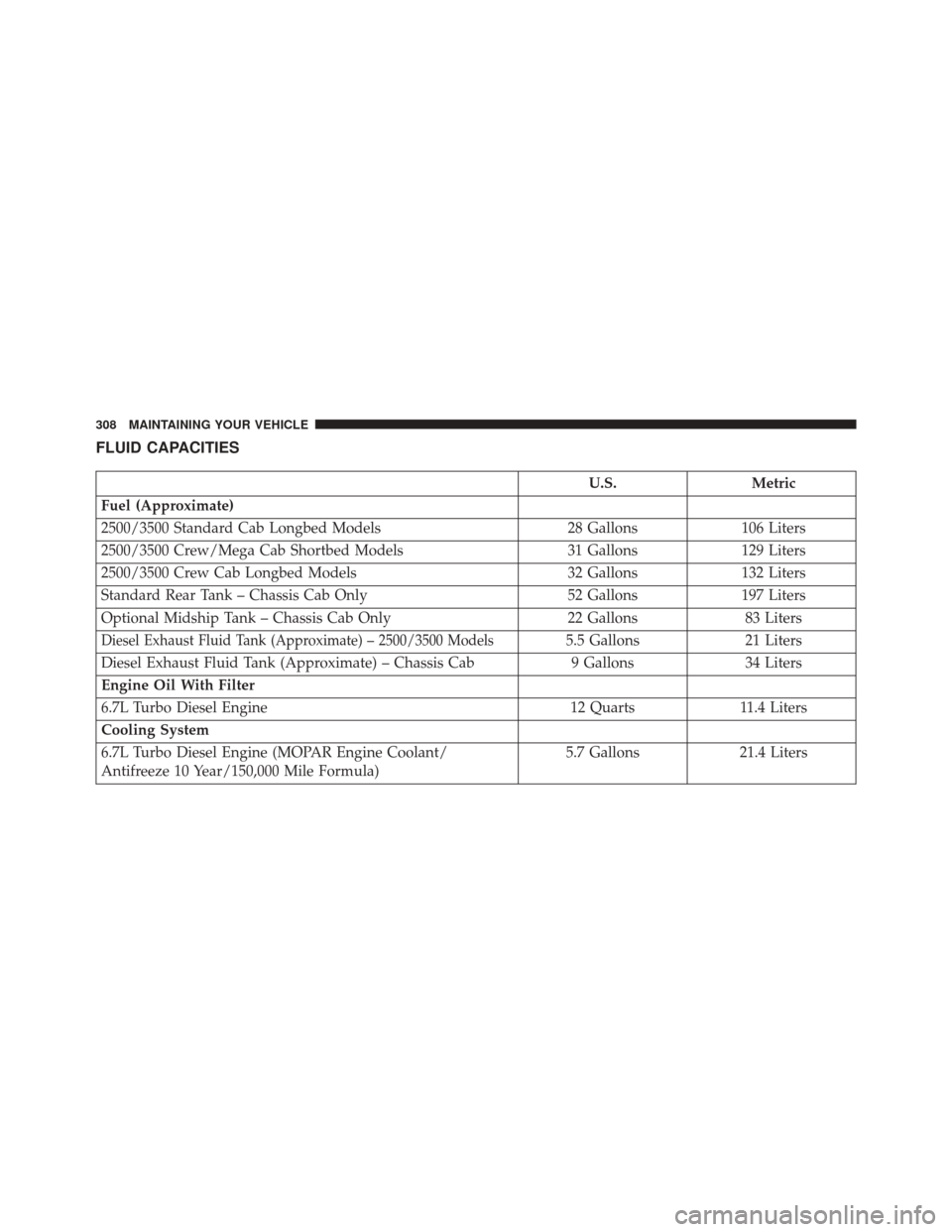
FLUID CAPACITIES
U.S.Metric
Fuel (Approximate)
2500/3500 Standard Cab Longbed Models 28 Gallons106 Liters
2500/3500 Crew/Mega Cab Shortbed Models 31 Gallons129 Liters
2500/3500 Crew Cab Longbed Models 32 Gallons132 Liters
Standard Rear Tank – Chassis Cab Only 52 Gallons197 Liters
Optional Midship Tank – Chassis Cab Only 22 Gallons83 Liters
Diesel Exhaust Fluid Tank (Approximate) – 2500/3500 Models5.5 Gallons 21 Liters
Diesel Exhaust Fluid Tank (Approximate) – Chassis Cab 9 Gallons34 Liters
Engine Oil With Filter
6.7L Turbo Diesel Engine 12 Quarts11.4 Liters
Cooling System
6.7L Turbo Diesel Engine (MOPAR Engine Coolant/
Antifreeze 10 Year/150,000 Mile Formula) 5.7 Gallons
21.4 Liters
308 MAINTAINING YOUR VEHICLE
Page 312 of 338
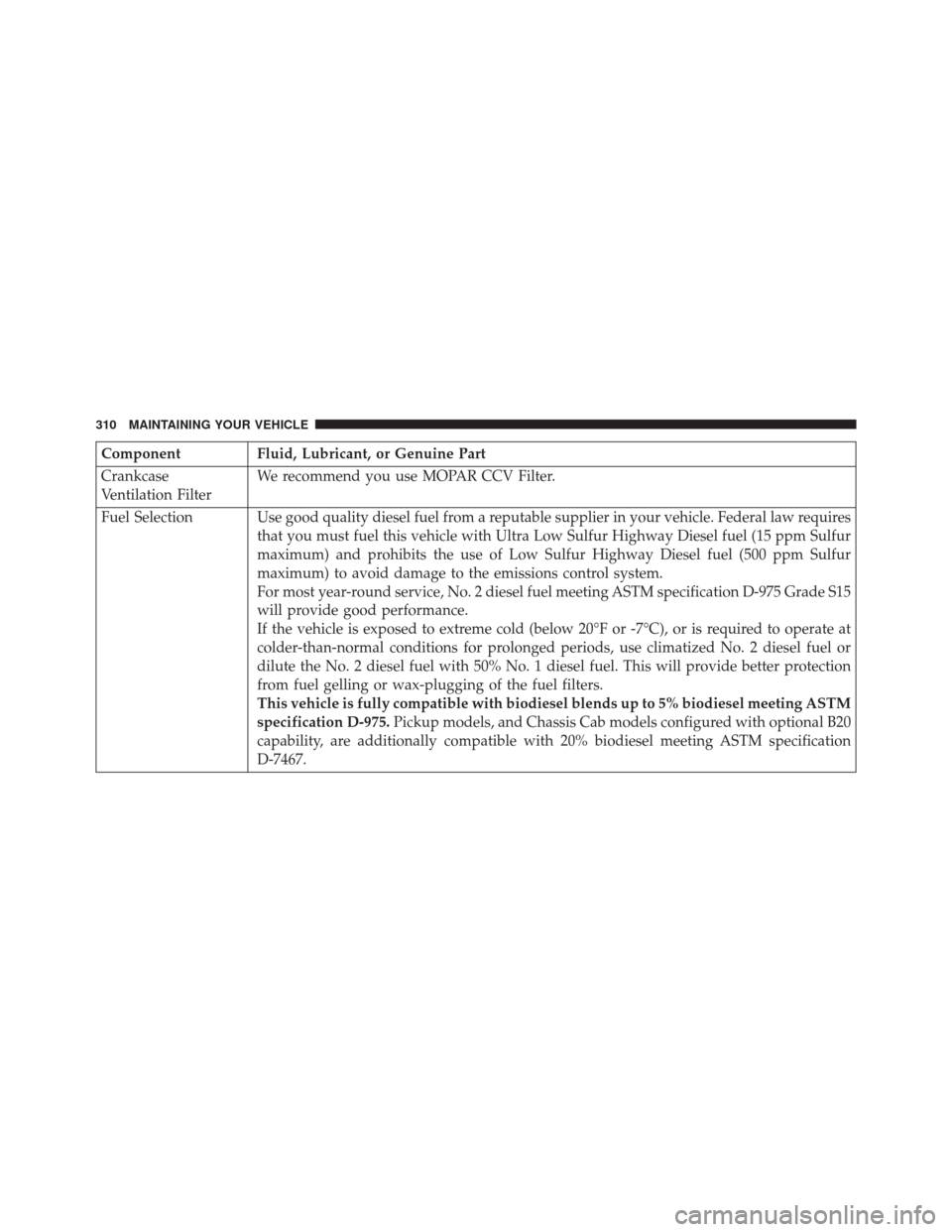
ComponentFluid, Lubricant, or Genuine Part
Crankcase
Ventilation Filter We recommend you use MOPAR CCV Filter.
Fuel Selection Use good quality diesel fuel from a reputable supplier in your vehicle. Federal law requires that you must fuel this vehicle with Ultra Low Sulfur Highway Diesel fuel (15 ppm Sulfur
maximum) and prohibits the use of Low Sulfur Highway Diesel fuel (500 ppm Sulfur
maximum) to avoid damage to the emissions control system.
For most year-round service, No. 2 diesel fuel meeting ASTM specification D-975 Grade S15
will provide good performance.
If the vehicle is exposed to extreme cold (below 20°F or -7°C), or is required to operate at
colder-than-normal conditions for prolonged periods, use climatized No. 2 diesel fuel or
dilute the No. 2 diesel fuel with 50% No. 1 diesel fuel. This will provide better protection
from fuel gelling or wax-plugging of the fuel filters.
This vehicle is fully compatible with biodiesel blends up to 5% biodiesel meeting ASTM
specification D-975.Pickup models, and Chassis Cab models configured with optional B20
capability, are additionally compatible with 20% biodiesel meeting ASTM specification
D-7467.
310 MAINTAINING YOUR VEHICLE
Page 317 of 338
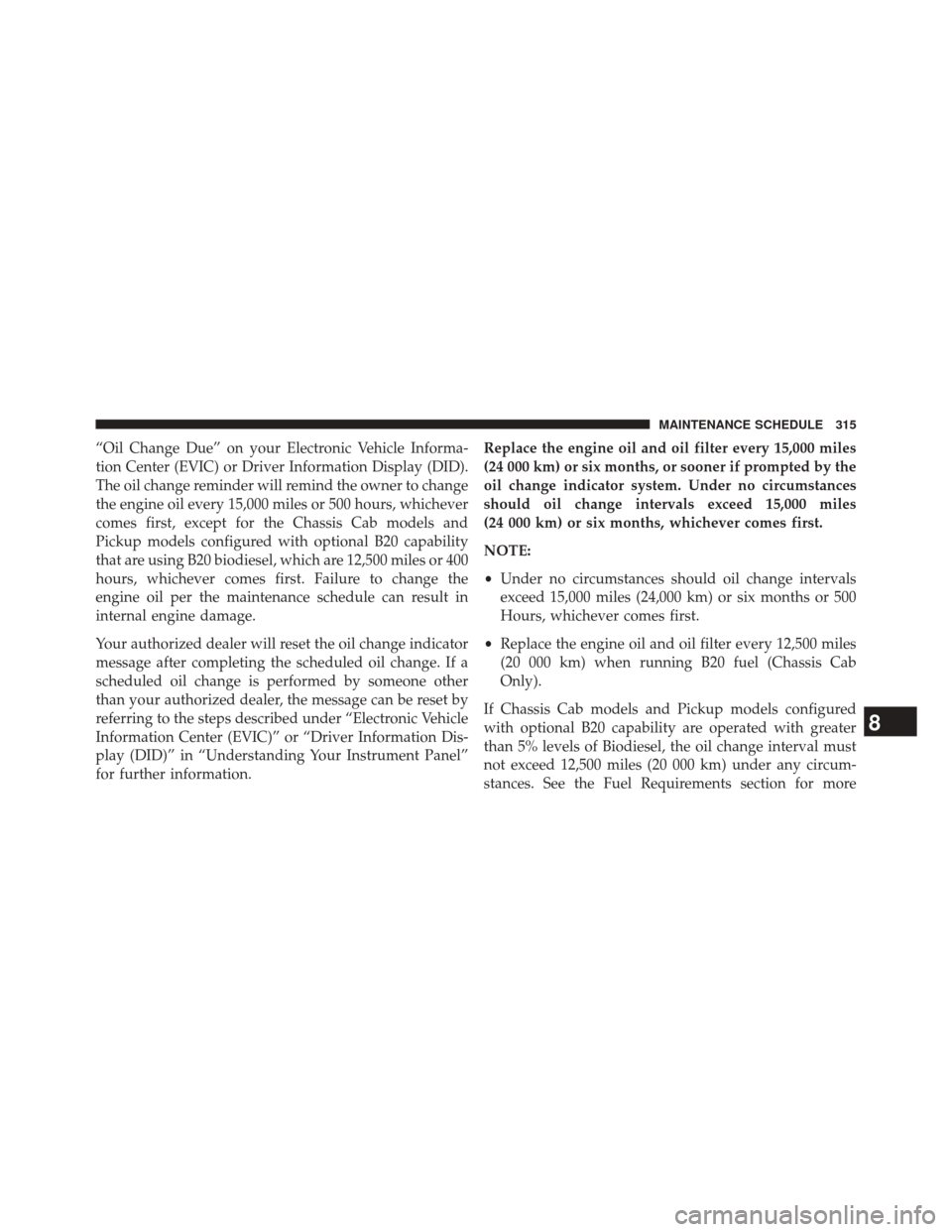
“Oil Change Due” on your Electronic Vehicle Informa-
tion Center (EVIC) or Driver Information Display (DID).
The oil change reminder will remind the owner to change
the engine oil every 15,000 miles or 500 hours, whichever
comes first, except for the Chassis Cab models and
Pickup models configured with optional B20 capability
that are using B20 biodiesel, which are 12,500 miles or 400
hours, whichever comes first. Failure to change the
engine oil per the maintenance schedule can result in
internal engine damage.
Your authorized dealer will reset the oil change indicator
message after completing the scheduled oil change. If a
scheduled oil change is performed by someone other
than your authorized dealer, the message can be reset by
referring to the steps described under “Electronic Vehicle
Information Center (EVIC)” or “Driver Information Dis-
play (DID)” in “Understanding Your Instrument Panel”
for further information.Replace the engine oil and oil filter every 15,000 miles
(24 000 km) or six months, or sooner if prompted by the
oil change indicator system. Under no circumstances
should oil change intervals exceed 15,000 miles
(24 000 km) or six months, whichever comes first.
NOTE:
•
Under no circumstances should oil change intervals
exceed 15,000 miles (24,000 km) or six months or 500
Hours, whichever comes first.
• Replace the engine oil and oil filter every 12,500 miles
(20 000 km) when running B20 fuel (Chassis Cab
Only).
If Chassis Cab models and Pickup models configured
with optional B20 capability are operated with greater
than 5% levels of Biodiesel, the oil change interval must
not exceed 12,500 miles (20 000 km) under any circum-
stances. See the Fuel Requirements section for more
8
MAINTENANCE SCHEDULE 315
Page 328 of 338
Adding Engine Coolant (Antifreeze)............106
Adding Fuel ..............................80
Air Cleaner, Engine (Engine Air Cleaner Filter) .....94
Antifreeze (Engine Coolant) ..................105
Capacities .............................113
Disposal ............................. .108
Automatic Transmission Fluid Type ............................118
Axle Fluid ..............................118
Battery ................................ .103
Brake Fluid ..............................118
Brake System ............................110
Fluid Check ...........................110
Master Cylinder ........................110
Capacities, Antifreeze (Engine Coolant) ..........113
Capacities, Fluid ..........................113 Caps, Filler
Oil (Engine) ............................93
Radiator (Coolant Pressure) ................108
Charge Air Cooler .........................110
Coolant Pressure Cap (Radiator Cap) ...........108
Cooling System .......................... .104
Adding Coolant (Antifreeze) ...............106
Coolant Capacity .......................113
Coolant Level ......................... .104
Disposal Of Used Coolant .................108
Drain, Flush, And Refill ...................105
Points To Remember .....................109
Pressure Cap ......................... .108
Radiator Cap ......................... .108
Selection Of Coolant (Antifreeze) ........105 , 114
Diesel Fuel ...............................73
Diesel Fuel Requirements ....................73
Bulk Storage Of .........................83
326 INDEX - RAM 1500
Page 329 of 338
Diesel Fuel System, Re-Priming...............101
Disposal Antifreeze (Engine Coolant) ................108
Draining Fuel/Water Separator Filter ............97
Electronic Vehicle Information Center (EVIC) ......25
Engine ..................................90
Air Cleaner ............................94
Block Heater ........................66,73
Break-In Recommendations .................13
Compartment ...........................90
Coolant (Antifreeze) .....................114
Identification ...........................90
Idling ................................70
Oil...............................92,114
Oil Filler Cap ...........................93
Filters Air Cleaner ............................94
Engine Fuel ............................97 Engine Oil
.........................94,114
Engine Oil Disposal ......................94
Fluid Capacities ..........................113
Fluid Level Checks Brake ................................110
Fluid, Brake .............................118
Fluids, Lubricants And Genuine Parts ...........114
Fuel ...................................73
Adding ...............................80
Diesel ............................73,114
Filter .................................97
Requirements ...........................73
Specifications ...........................74
Tank Capacity ..........................113
Fueling .................................80
Gauges Voltmeter ..............................68
8
INDEX - RAM 1500 327
Page 332 of 338
Adding Engine Coolant (Antifreeze)............292
Adding Fuel ............................ .248
Air Cleaner, Engine (Engine Air Cleaner Filter) . . . .276
Air Filter .............................. .276
Antifreeze (Engine Coolant) ..................291
Capacities ........................... .308
Disposal ............................. .294
Automatic Transmission Adding Fluid ......................... .301
Fluid Level Check ...................... .300
Fluid Type ............................311
Shifting ............................. .222
Axle Fluid ..............................311
Battery ................................ .289
Blanket ...........................211,290
Emergency Starting ..................... .262
Brake System ........................... .296Fluid Check
.......................... .296
Master Cylinder ....................... .296
Brake/Transmission Interlock .................222
Capacities, Antifreeze (Engine Coolant) ..........308
Capacities, Fluid ......................... .308
Caps, Filler Oil (Engine) .......................... .274
Radiator (Coolant Pressure) ................294
Charge Air Cooler ........................ .296
Coolant Pressure Cap (Radiator Cap) ...........294
Cooling System .......................... .290
Adding Coolant (Antifreeze) ...............292
Coolant Capacity ...................... .308
Coolant Level ......................... .290
Disposal Of Used Coolant .................294
Drain, Flush, And Refill ...................291
Points To Remember .....................295
Pressure Cap ......................... .294
330 INDEX - RAM 2500 / 3500 / 4500 / 5500