coolant temperature Ram 3500 2018 User Guide
[x] Cancel search | Manufacturer: RAM, Model Year: 2018, Model line: 3500, Model: Ram 3500 2018Pages: 700, PDF Size: 8.87 MB
Page 553 of 700

Checking Coolant Level — 6.4L Engine
The level of the coolant in the pressurized coolant bottle
should be between the “MIN” and “MAX” range on the
bottle when the engine is cold.
The radiator normally remains completely full, so there is
no need to remove the cap unless checking for coolant
freeze point or replacing engine coolant (antifreeze). Ad-
vise your service attendant of this. As long as the engine
operating temperature is satisfactory, the coolant bottle
need only be checked once a month. When additional
engine coolant (antifreeze) is needed to maintain the
proper level, it should be added to the coolant bottle. Do
not overfill.
Points To Remember
NOTE:When the vehicle is stopped after a few miles/
kilometers of operation, you may observe vapor coming
from the front of the engine compartment. This is normally
a result of moisture from rain, snow, or high humidity
accumulating on the radiator and being vaporized when
the thermostat opens, allowing hot engine coolant (anti-
freeze) to enter the radiator. If an examination of your engine compartment shows no
evidence of radiator or hose leaks, the vehicle may be
safely driven. The vapor will soon dissipate.
•
Do not overfill the coolant expansion bottle.
• Check the coolant freeze point in the radiator and in the
coolant expansion bottle. If engine coolant (antifreeze)
needs to be added, the contents of the coolant expansion
bottle must also be protected against freezing.
• If frequent engine coolant (antifreeze) additions are
required, the cooling system should be pressure tested
for leaks.
• Maintain engine coolant (antifreeze) concentration at a
minimum of 50% OAT coolant (conforming to
MS.90032) and distilled water for proper corrosion pro-
tection of your engine which contains aluminum com-
ponents.
• Make sure that the coolant expansion bottle overflow
hoses are not kinked or obstructed.
• Keep the front of the radiator clean. If your vehicle is
equipped with air conditioning, keep the front of the
condenser clean.
• Do not change the thermostat for Summer or Winter
operation. If replacement is ever necessary, install ONLY
8
SERVICING AND MAINTENANCE 551
Page 554 of 700
the correct type thermostat. Other designs may result in
unsatisfactory engine coolant (antifreeze) performance,
poor gas mileage, and increased emissions.
Brake System
In order to assure brake system performance, all brake
system components should be inspected periodically. Refer
to the “Maintenance Plan” in this section for the proper
maintenance intervals.
WARNING!
Riding the brakes can lead to brake failure and possi-
bly a collision. Driving with your foot resting or riding
on the brake pedal can result in abnormally high brake
temperatures, excessive lining wear, and possible
brake damage. You would not have your full braking
capacity in an emergency.
Fluid Level Check — Brake Master Cylinder
The fluid level of the master cylinder should be checked
when performing under the hood service or immediately if
the brake system warning lamp indicates system failure.
The brake master cylinder has a translucent plastic reser-
voir. On the outboard side of the reservoir, there is a“MAX” mark and a “MIN” mark. The fluid level must be
kept within these two marks. Do not add fluid above the
MAX mark because leakage may occur at the cap.
With disc brakes the fluid level can be expected to fall as
the brake linings wear. However, an unexpected drop in
fluid level may be caused by a leak and a system check
should be conducted.
Refer to “Fluids And Lubricants” in “Technical Specifica-
tions” for further information.
WARNING!
•
Use only manufacturer’s recommended brake fluid.
Refer to “Fluids And Lubricants” in “Technical
Specifications” for further information. Using the
wrong type of brake fluid can severely damage your
brake system and/or impair its performance. The
proper type of brake fluid for your vehicle is also
identified on the original factory installed hydraulic
master cylinder reservoir.
• To avoid contamination from foreign matter or mois-
ture, use only new brake fluid or fluid that has been
(Continued)
552 SERVICING AND MAINTENANCE
Page 605 of 700
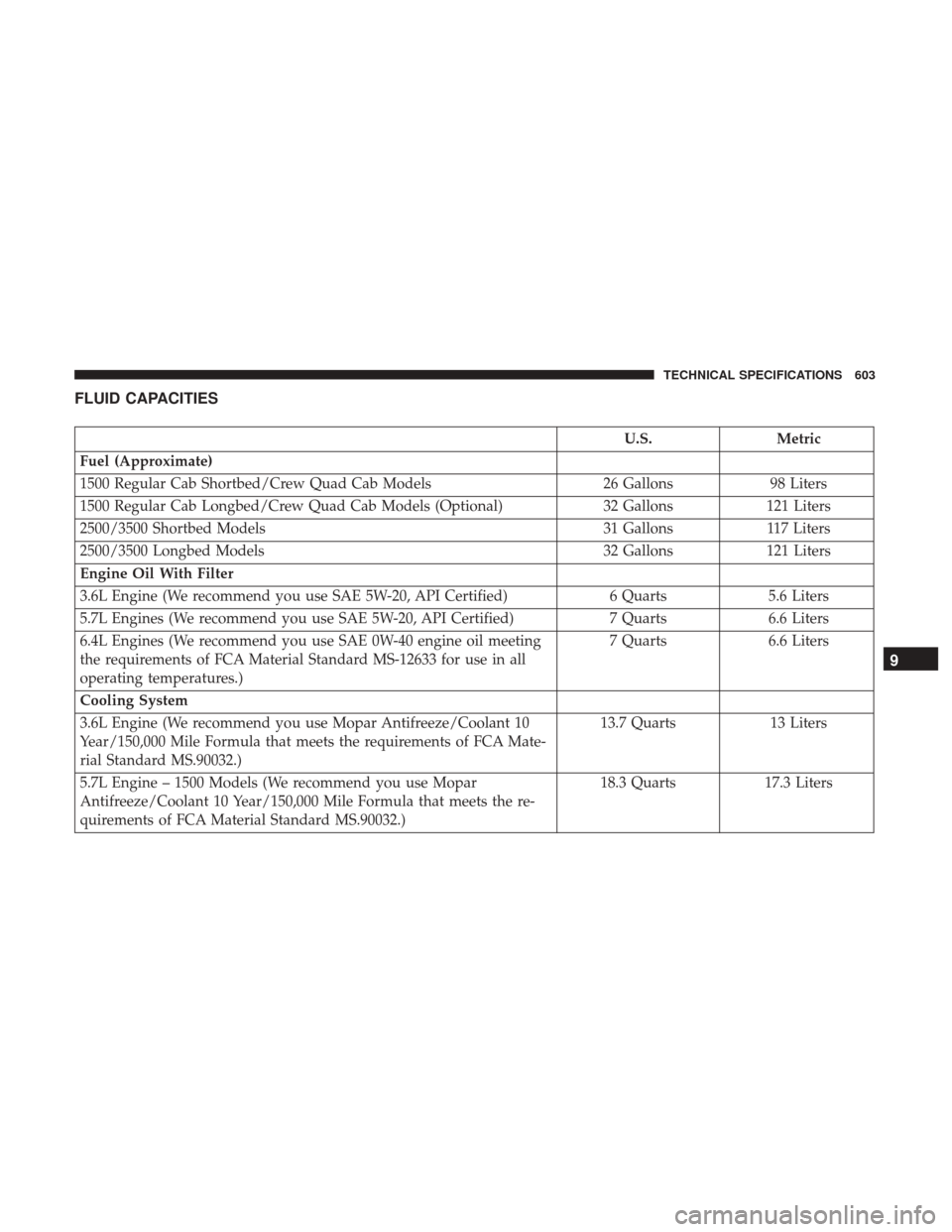
FLUID CAPACITIES
U.S.Metric
Fuel (Approximate)
1500 Regular Cab Shortbed/Crew Quad Cab Models 26 Gallons98 Liters
1500 Regular Cab Longbed/Crew Quad Cab Models (Optional) 32 Gallons121 Liters
2500/3500 Shortbed Models 31 Gallons117 Liters
2500/3500 Longbed Models 32 Gallons121 Liters
Engine Oil With Filter
3.6L Engine (We recommend you use SAE 5W-20, API Certified) 6 Quarts5.6 Liters
5.7L Engines (We recommend you use SAE 5W-20, API Certified) 7 Quarts6.6 Liters
6.4L Engines (We recommend you use SAE 0W-40 engine oil meeting
the requirements of FCA Material Standard MS-12633 for use in all
operating temperatures.) 7 Quarts
6.6 Liters
Cooling System
3.6L Engine (We recommend you use Mopar Antifreeze/Coolant 10
Year/150,000 Mile Formula that meets the requirements of FCA Mate-
rial Standard MS.90032.) 13.7 Quarts
13 Liters
5.7L Engine – 1500 Models (We recommend you use Mopar
Antifreeze/Coolant 10 Year/150,000 Mile Formula that meets the re-
quirements of FCA Material Standard MS.90032.) 18.3 Quarts
17.3 Liters
9
TECHNICAL SPECIFICATIONS 603
Page 684 of 700

Adding Engine Coolant (Antifreeze).............548
Adding Fuel ............................. .413
Additives, Fuel ............................597
Adjust Down ...............................47, 49
Forward ............................ .47, 48
Rearward ............................47, 48
Up .................................47, 49
Adjustable Pedals ...........................62
Air Bag Air Bag Operation ........................240
Air Bag Warning Light .....................237
Enhanced Accident Response .............250, 514
Event Data Recorder (EDR) .................514
If A Deployment Occurs ....................249
Knee Impact Bolsters ..................... .241
Maintaining Your Air Bag System .............251
Transporting Pets ........................278
Air Bag Light .......................189, 237, 279
Air Bag Maintenance ........................251
Air Cleaner, Engine (Engine Air Cleaner Filter) ......531
Air Conditioner Maintenance ..................533
Air Conditioning ............................86
Air Conditioning Filter ...................105, 534
Air Conditioning, Operating Tips ...............104Air Conditioning Refrigerant
...............533, 534
Air Conditioning System ..................104, 533
Air Filter ............................... .531
Air Pressure, Tires ..........................569
Air Suspension ........................ .344, 350
Alarm, Panic ...............................23
Alarm (Security Alarm) ....................35, 191
Alarm System (Security Alarm) .................35
Alterations/Modifications, Vehicle ................7
Antifreeze (Engine Coolant) ................547, 603
Disposal ...............................549
Anti-Lock Brake System (ABS) .................204
Anti-Lock Warning Light .....................196
Ashtray .................................137
Assist, Hill
Start.......................... .206
Audio Systems (Radio) .......................611
Auto Down Power Windows ..................107
Automatic Door Locks ........................42
Automatic Headlights ........................76
Automatic High Beams .......................75
Automatic Temperature Control (ATC) ...........104
Automatic Transmission ..................299, 556
Adding Fluid ........................554, 556
Fluid And Filter Changes ...................556
Fluid Change .......................... .556
682 INDEX