Exhaust brake Ram 3500 2019 Owner's Manual
[x] Cancel search | Manufacturer: RAM, Model Year: 2019, Model line: 3500, Model: Ram 3500 2019Pages: 696, PDF Size: 13.89 MB
Page 7 of 696

5
GETTING TO KNOW YOUR INSTRUMENT
PANEL
BASE / MIDLINE INSTRUMENT CLUSTER .............. 160
Base / Midline Instrument Cluster Descriptions.... 161
PREMIUM INSTRUMENT CLUSTER ........................... 163
Premium Instrument Cluster Descriptions ............. 164
INSTRUMENT CLUSTER DISPLAY ............................. 165
Instrument Cluster Display Controls ....................... 165
Oil Life Reset ............................................................... 167
Display Menu Items .................................................... 169
Battery Saver On/Battery Saver Mode Message —
Electrical Load Reduction Actions —
If Equipped ................................................................ 177
WARNING LIGHTS AND MESSAGES ........................ 179
Red Warning Lights .................................................... 179
Yellow Warning Lights............................................... 184
Yellow Indicator Lights .............................................. 188
Green Indicator Lights ................................................ 190
White Indicator Lights ................................................ 191
Blue Indicator Lights ................................................... 192
ONBOARD DIAGNOSTIC SYSTEM — OBD II ........ 192
Onboard Diagnostic System (OBD II)
Cybersecurity ............................................................... 193
EMISSIONS INSPECTION AND MAINTENANCE
PROGRAMS ..................................................................... 193
SAFETY
SAFETY FEATURES .........................................................195
Anti-Lock Brake System (ABS) ................................. 195
Electronic Brake Control System ..............................196
AUXILIARY DRIVING SYSTEMS ..................................208
Blind Spot Monitoring (BSM) — If Equipped ........208
Forward Collision Warning (FCW) With Mitigation —
If Equipped ...................................................................216
Tire Pressure Monitoring System (TPMS) ..............220
OCCUPANT RESTRAINT SYSTEMS ...........................230
Occupant Restraint Systems Features ......................230
Important Safety Precautions.....................................230
Seat Belt Systems .........................................................231
Supplemental Restraint Systems (SRS).....................245
Child Restraints ..........................................................258
Transporting Pets ......................................................286
SAFETY TIPS ...................................................................286
Transporting Passengers ............................................286
Exhaust Gas ..............................................................286
Safety Checks You Should Make Inside The
Vehicle ..........................................................................287
Periodic Safety Checks You Should Make Outside
The Vehicle ...................................................................289
Page 12 of 696

10
DEALER SERVICE ........................................................... 506
Engine Oil — Gas Engine .......................................... 507
Engine Oil Filter ......................................................... 509
Engine Air Cleaner Filter ......................................... 509
Air Conditioner Maintenance ................................. 511
Accessory Drive Belt Inspection ................................ 516
Body Lubrication ....................................................... 517
Windshield Wiper Blades ......................................... 517
Exhaust System ........................................................... 520
Cooling System ........................................................... 522
Brake System ............................................................... 527
Automatic Transmission ............................................ 528
Rear Axle And 4x4 Front Driving Axle Fluid
Level .......................................................................... 529
Transfer Case ............................................................... 530
HOISTING ......................................................................... 531
TIRES ..................................................................................531
Tire Safety Information ............................................531
Tires — General Information ...................................541
Tire Types .....................................................................547
Spare Tires — If Equipped .....................................548
Wheel And Wheel Trim Care ..................................551
Tire Chains (Traction Devices) ................................. 552
Tire Rotation Recommendations ..............................553
DEPARTMENT OF TRANSPORTATION UNIFORM
TIRE QUALITY GRADES ...............................................555
Treadwear .....................................................................556
Traction Grades............................................................ 556
Temperature Grades ................................................... 556
STORING THE VEHICLE .............................................557
BODYWORK ......................................................................557
Protection From Atmospheric Agents ....................557
Body And Underbody Maintenance .........................558
Preserving The Bodywork .......................................... 558
INTERIORS .......................................................................561
Seats And Fabric Parts ................................................561
Plastic And Coated Parts ............................................562
Leather Parts.................................................................563
Glass Surfaces ..............................................................563
Page 29 of 696
GETTING TO KNOW YOUR VEHICLE 27
(Continued)
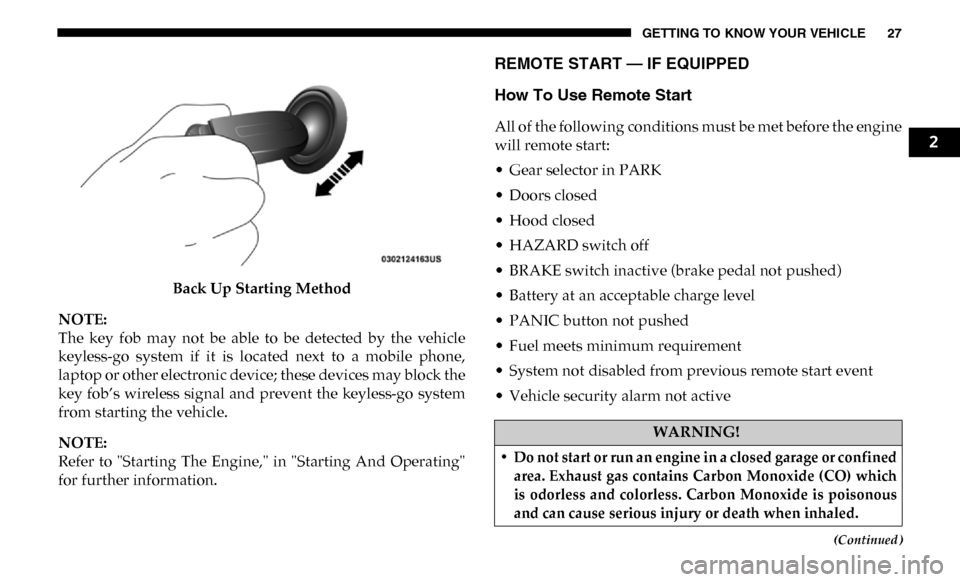
Back Up Starting Method
NOTE:
The key fob may not be able to be detected by the vehicle
keyless-go system if it is located next to a mobile phone,
laptop or other electronic device; these devices may block the
key fob’s wireless signal and prevent the keyless-go system
from starting the vehicle.
NOTE:
Refer to "Starting The Engine," in "Starting And Operating"
for further information.
REMOTE START — IF EQUIPPED
How To Use Remote Start
All of the following conditions must be met before the engine
will remote start:
• Gear selector in PARK
• Doors closed
• Hood closed
• HAZARD switch off
• BRAKE switch inactive (brake pedal not pushed)
• Battery at an acceptable charge level
• PANIC button not pushed
• Fuel meets minimum requirement
• System not disabled from previous remote start event
• Vehicle security alarm not active
WARNING!
• Do not start or run an engine in a closed garage or confined area. Exhaust gas contains Carbon Monoxide (CO) which
is odorless and colorless. Carbon Monoxide is poisonous
and can cause serious injury or death when inhaled.
2
Page 171 of 696

GETTING TO KNOW YOUR INSTRUMENT PANEL 169
Display Menu Items
Push and release the up or down arrow button until the
desired selectable menu icon is highlighted in the instrument
cluster display.
Speedometer
Push and release the up or down arrow button until the
speedometer menu item is highlighted in the instrument
cluster display. Push and release the right arrow button to
cycle the display between mph and km/h.
Vehicle Info
Push and release the up or down arrow button until the
Vehicle Info menu item is highlighted in the instrument
cluster display. Push and release the right arrow button to
enter the submenus items of Vehicle Info. Follow the direc -
tional prompts to access or reset any of the following Vehicle
Info submenu items:
• Tire Pressure
• Coolant Temperature — If Equipped
• Transmission Temperature — If Equipped
• Oil Temperature — If Equipped
• Oil Pressure • Exhaust Brake — If Equipped
• Turbo Boost — If Equipped
• Oil Life
• Fuel Filter Life — If Equipped
• Battery Voltage
• Gauge Summary — If Equipped
• Engine Hours
Driver Assist — If Equipped
The Driver Assist menu displays the status of the ACC
system.
Push and release the
up or down arrow button until the
Driver Assist menu is displayed in the instrument cluster
display.
Adaptive Cruise Control (ACC) Feature
The instrument cluster display displays the current ACC
system settings. The information displayed depends on ACC
system status.
3
Page 175 of 696

GETTING TO KNOW YOUR INSTRUMENT PANEL 173
Upper Left
• None
• Compass (Default Setting) — If Equipped
• Outside Temp — If Equipped
• Time
• Range To Empty
• Average MPG
• Current MPG
• Trip A Distance
• Trip B Distance
• Trailer Trip — If Equipped
• Trailer Brake — If Equipped
• Oil Pressure — If Equipped
• Coolant Temperature — If Equipped
• Oil Temperature — If Equipped
• Battery Voltage — If Equipped
• Transmission Temperature — If Equipped
• Oil Life — If Equipped• Exhaust Brake — If Equipped
• Turbo Boost — If Equipped
• Fuel Filter Life — If Equipped
Upper Center
• None
• Compass
• Outside Temp
• Time
• Range To Empty
• Average MPG
• Current MPG
• Trip A Distance
• Trip B Distance
• Trailer Trip
• Audio
• Speedometer (Default Setting)
• Menu Title
3
Page 176 of 696

174 GETTING TO KNOW YOUR INSTRUMENT PANEL
Upper Right
• None
• Compass — If Equipped
• Outside Temp (Default Setting) — If Equipped
• Time
• Range To Empty
• Average MPG
• Current MPG
• Trip A Distance
• Trip B Distance
• Trailer Trip — If Equipped
• Trailer Brake — If Equipped
• Oil Pressure — If Equipped
• Coolant Temperature — If Equipped
• Oil Temperature — If Equipped
• Battery Voltage — If Equipped• Transmission Temperature — If Equipped
• Oil Life — If Equipped
• Exhaust Brake — If Equipped
• Turbo Boost — If Equipped
• Fuel Filter Life — If Equipped
Left Side — If Equipped
• None
• Range
• Average MPG
• Menu Icon (Default Setting)
• Coolant Temperature
• Oil Temperature
• Transmission Temperature
• Oil Life
• Fuel Filter Life — If Equipped
Page 177 of 696

GETTING TO KNOW YOUR INSTRUMENT PANEL 175
Right Side — If Equipped
• None
• Range (Default Setting)
• Average MPG
• Menu Icon
• Coolant Temperature
• Oil Temperature
• Transmission Temperature
• Oil Life
• Fuel Filter Life — If Equipped
Lower Left — If Equipped
• None
• Compass
• Outside Temp
• Time
• Range To Empty• Average MPG
• Current MPG
• Trip A Distance
• Trip B Distance
• Trailer Trip
• Trailer Brake
• Oil Pressure
• Coolant Temperature
• Oil Temperature
• Battery Voltage (Default Setting)
• Transmission Temperature
• Oil Life
• Exhaust Brake — If Equipped
• Turbo Boost — If Equipped
• Fuel Filter Life — If Equipped
3
Page 178 of 696

176 GETTING TO KNOW YOUR INSTRUMENT PANEL
Lower Right — If Equipped
• None
• Compass
• Outside Temp
• Time
• Range To Empty
• Average MPG
• Current MPG
• Trip A Distance
• Trip B Distance
• Trailer Trip
• Trailer Brake
• Oil Pressure (Default Setting)• Coolant Temperature
• Oil Temperature
• Battery Voltage
• Transmission Temperature
• Oil Life
• Exhaust Brake — If Equipped
• Turbo Boost — If Equipped
• Fuel Filter Life — If Equipped
Restore Defaults
• Cancel (Default Setting)
• Ok
Page 185 of 696
GETTING TO KNOW YOUR INSTRUMENT PANEL 183
— Electric Power Steering Fault Warning Light
This warning light will turn on when there's a fault with the
EPS (Electric Power Steering) system. Refer to “Power
Steering” in “Starting And Operating” for further informa -
tion.
— Trailer Brake Disconnected Warning Light
This warning light will illuminate when the Trailer Brake has
been disconnected.
— Transmission Temperature Warning Light — If
Equipped
This warning light will illuminate to warn of a high transmis -
sion fluid temperature. This may occur with strenuous usage
such as trailer towing. If this light turns on, stop the vehicle
and run the engine at idle or slightly faster, with the trans -
mission in PARK or NEUTRAL, until the light turns off.
Once the light turns off, you may continue to drive normally. — Door Open Warning Light
This indicator will illuminate when a door is ajar/open and
not fully closed.
NOTE:
If the vehicle is moving there will also be a single chime.
WARNING!
Continued operation with reduced assist could pose a
safety risk to yourself and others. Service should be
obtained as soon as possible.
WARNING!
If you continue operating the vehicle when the
Transmission Temperature Warning Light is illuminated
you could cause the fluid to boil over, come in contact
with hot engine or exhaust components and cause a fire.
CAUTION!
Continuous driving with the Transmission Temperature
Warning Light illuminated will eventually cause severe
transmission damage or transmission failure.
3
Page 338 of 696

336 STARTING AND OPERATING
After Driving Off-Road
Off-road operation puts more stress on your vehicle than
does most on-road driving. After going off-road, it is always
a good idea to check for damage. That way you can get any
problems taken care of right away and have your vehicle
ready when you need it.
• Completely inspect the underbody of your vehicle. Checktires, body structure, steering, suspension, and exhaust
system for damage.
• Inspect the radiator for mud and debris and clean as required.
• Check threaded fasteners for looseness, particularly on the chassis, drivetrain components, steering, and suspension.
Retighten them, if required, and torque to the values spec -
ified in the Service Manual.
• Check for accumulations of plants or brush. These things could be a fire hazard. They might hide damage to fuel
lines, brake hoses, axle pinion seals, and propeller shafts. • After extended operation in mud, sand, water, or similar
dirty conditions, have the radiator, fan, brake rotors,
wheels, brake linings, and axle yokes inspected and
cleaned as soon as possible.
• If you experience unusual vibration after driving in mud, slush or similar conditions, check the wheels for impacted
material. Impacted material can cause a wheel imbalance
and freeing the wheels of it will correct the situation.
WARNING!
Abrasive material in any part of the brakes may cause
excessive wear or unpredictable braking. You might not
have full braking power when you need it to prevent a
collision. If you have been operating your vehicle in
dirty conditions, get your brakes checked and cleaned as
necessary.