check oil Ram 3500 2019 Owner's Manual
[x] Cancel search | Manufacturer: RAM, Model Year: 2019, Model line: 3500, Model: Ram 3500 2019Pages: 696, PDF Size: 13.89 MB
Page 7 of 696

5
GETTING TO KNOW YOUR INSTRUMENT
PANEL
BASE / MIDLINE INSTRUMENT CLUSTER .............. 160
Base / Midline Instrument Cluster Descriptions.... 161
PREMIUM INSTRUMENT CLUSTER ........................... 163
Premium Instrument Cluster Descriptions ............. 164
INSTRUMENT CLUSTER DISPLAY ............................. 165
Instrument Cluster Display Controls ....................... 165
Oil Life Reset ............................................................... 167
Display Menu Items .................................................... 169
Battery Saver On/Battery Saver Mode Message —
Electrical Load Reduction Actions —
If Equipped ................................................................ 177
WARNING LIGHTS AND MESSAGES ........................ 179
Red Warning Lights .................................................... 179
Yellow Warning Lights............................................... 184
Yellow Indicator Lights .............................................. 188
Green Indicator Lights ................................................ 190
White Indicator Lights ................................................ 191
Blue Indicator Lights ................................................... 192
ONBOARD DIAGNOSTIC SYSTEM — OBD II ........ 192
Onboard Diagnostic System (OBD II)
Cybersecurity ............................................................... 193
EMISSIONS INSPECTION AND MAINTENANCE
PROGRAMS ..................................................................... 193
SAFETY
SAFETY FEATURES .........................................................195
Anti-Lock Brake System (ABS) ................................. 195
Electronic Brake Control System ..............................196
AUXILIARY DRIVING SYSTEMS ..................................208
Blind Spot Monitoring (BSM) — If Equipped ........208
Forward Collision Warning (FCW) With Mitigation —
If Equipped ...................................................................216
Tire Pressure Monitoring System (TPMS) ..............220
OCCUPANT RESTRAINT SYSTEMS ...........................230
Occupant Restraint Systems Features ......................230
Important Safety Precautions.....................................230
Seat Belt Systems .........................................................231
Supplemental Restraint Systems (SRS).....................245
Child Restraints ..........................................................258
Transporting Pets ......................................................286
SAFETY TIPS ...................................................................286
Transporting Passengers ............................................286
Exhaust Gas ..............................................................286
Safety Checks You Should Make Inside The
Vehicle ..........................................................................287
Periodic Safety Checks You Should Make Outside
The Vehicle ...................................................................289
Page 11 of 696

9
IN CASE OF EMERGENCY
HAZARD WARNING FLASHERS ............................. 440
ASSIST AND SOS SYSTEM — IF EQUIPPED .............. 441
BULB REPLACEMENT ................................................... 446
Replacement Bulbs ..................................................... 446
Replacing Exterior Bulbs ............................................ 447
FUSES.................................................................................. 457
Power Distribution Center ......................................... 458
JACKING AND TIRE CHANGING .......................... 469
Jack Location ................................................................ 470
Removal Of Jack And Tools ....................................... 470
Removing The Spare Tire ........................................... 473
Preparations For Jacking ............................................ 476
Jacking Instructions ..................................................... 477
To Stow The Flat Or Spare ...................................... 483
Reinstalling The Jack And Tools ............................... 485
Hub Caps/Wheel Covers — If Equipped .............. 487
JUMP STARTING ............................................................ 488
Preparations For Jump Start ...................................... 489
Jump Starting Procedure ............................................ 490
MANUAL PARK RELEASE — 8–SPEED
TRANSMISSION ............................................................... 492
IF YOUR ENGINE OVERHEATS ..................................493
FREEING A STUCK VEHICLE ......................................494
TOWING A DISABLED VEHICLE ...............................495
Two-Wheel Drive Models .......................................... 497
Four-Wheel Drive Models .......................................... 497
Emergency Tow Hooks — If Equipped....................498
ENHANCED ACCIDENT RESPONSE
SYSTEM (EARS) ...............................................................498
EVENT DATA RECORDER (EDR)................................. 498
SERVICING AND MAINTENANCE
SCHEDULED SERVICING ............................................499
Maintenance Plan ........................................................500
Heavy Duty Use Of The Vehicle ...............................503
ENGINE COMPARTMENT .......................................... 504
6.4L Engine ..................................................................504
Checking Oil Level — Gas Engine ...........................505
Adding Washer Fluid ................................................505
Maintenance-Free Battery .......................................... 506
Page 184 of 696
182 GETTING TO KNOW YOUR INSTRUMENT PANEL
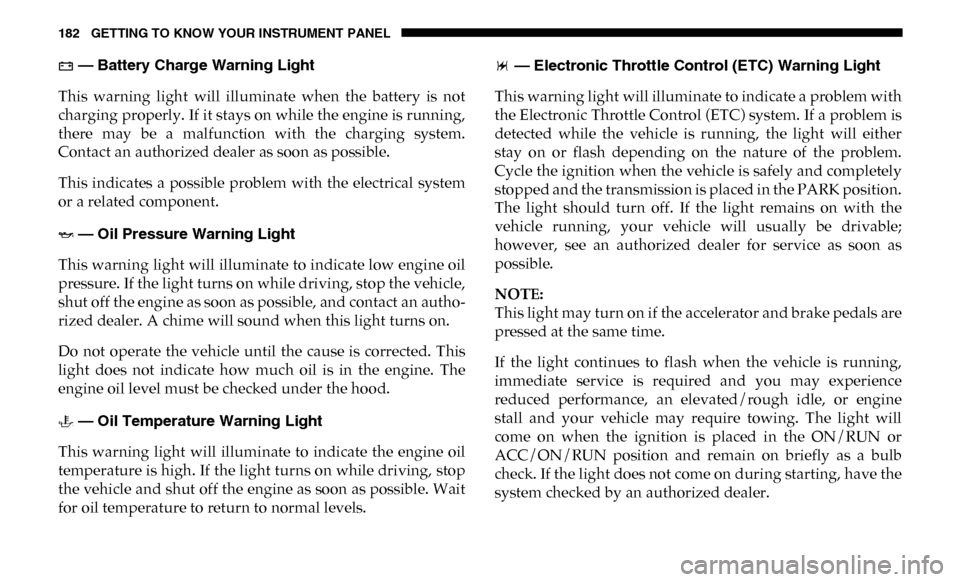
— Battery Charge Warning Light
This warning light will illuminate when the battery is not
charging properly. If it stays on while the engine is running,
there may be a malfunction with the charging system.
Contact an authorized dealer as soon as possible.
This indicates a possible problem with the electrical system
or a related component.
— Oil Pressure Warning Light
This warning light will illuminate to indicate low engine oil
pressure. If the light turns on while driving, stop the vehicle,
shut off the engine as soon as possible, and contact an autho -
rized dealer. A chime will sound when this light turns on.
Do not operate the vehicle until the cause is corrected. This
light does not indicate how much oil is in the engine. The
engine oil level must be checked under the hood.
— Oil Temperature Warning Light
This warning light will illuminate to indicate the engine oil
temperature is high. If the light turns on while driving, stop
the vehicle and shut off the engine as soon as possible. Wait
for oil temperature to return to normal levels. — Electronic Throttle Control (ETC) Warning Light
This warning light will illuminate to indicate a problem with
the Electronic Throttle Control (ETC) system. If a problem is
detected while the vehicle is running, the light will either
stay on or flash depending on the nature of the problem.
Cycle the ignition when the vehicle is safely and completely
stopped and the transmission is placed in the PARK position.
The light should turn off. If the light remains on with the
vehicle running, your vehicle will usually be drivable;
however, see an authorized dealer for service as soon as
possible.
NOTE:
This light may turn on if the accelerator and brake pedals are
pressed at the same time.
If the light continues to flash when the vehicle is running,
immediate service is required and you may experience
reduced performance, an elevated/rough idle, or engine
stall and your vehicle may require towing. The light will
come on when the ignition is placed in the ON/RUN or
ACC/ON/RUN position and remain on briefly as a bulb
check. If the light does not come on during starting, have the
system checked by an authorized dealer.
Page 289 of 696

SAFETY 287
Whenever a change is noticed in the sound of the exhaust
system, when exhaust fumes can be detected inside the
vehicle, or when the underside or rear of the vehicle is
damaged, have a competent mechanic inspect the complete
exhaust system and adjacent body areas for broken,
damaged, deteriorated, or mispositioned parts. Open seams
or loose connections could permit exhaust fumes to seep into
the passenger compartment. In addition, inspect the exhaust
system each time the vehicle is raised for lubrication or oil
change. Replace as required.
Safety Checks You Should Make Inside The Vehicle
Seat Belts
Inspect the seat belt system periodically, checking for cuts,
frays, and loose parts. Damaged parts must be replaced
immediately. Do not disassemble or modify the system.
Front seat belt assemblies must be replaced after a collision.
Rear seat belt assemblies must be replaced after a collision if
they have been damaged (i.e., bent retractor, torn webbing,
etc.). If there is any question regarding seat belt or retractor
condition, replace the seat belt.Air Bag Warning Light
The Air Bag warning light will turn on for four to eight
seconds as a bulb check when the ignition switch is first
turned to ON/RUN. If the light is either not on during
starting, stays on, or turns on while driving, have the system
inspected at an authorized dealer as soon as possible. After
the bulb check, this light will illuminate with a single chime
when a fault with the Air Bag System has been detected. It
will stay on until the fault is removed. If the light comes on
intermittently or remains on while driving, have an autho
-
rized dealer service the vehicle immediately.
Refer to “Occupant Restraint Systems” in “Safety” for
further information.
Defroster
Check operation by selecting the defrost mode and place the
blower control on high speed. You should be able to feel the
air directed against the windshield. See an authorized dealer
for service if your defroster is inoperable.
4
Page 291 of 696
SAFETY 289
Periodic Safety Checks You Should Make Outside
The Vehicle
Tires
Examine tires for excessive tread wear and uneven wear
patterns. Check for stones, nails, glass, or other objects
lodged in the tread or sidewall. Inspect the tread for cuts and
cracks. Inspect sidewalls for cuts, cracks, and bulges. Check
the wheel bolts for tightness. Check the tires (including
spare) for proper cold inflation pressure.
Lights
Have someone observe the operation of brake lights and
exterior lights while you work the controls. Check turn
signal and high beam indicator lights on the instrument
panel.
Door Latches
Check for proper closing, latching, and locking.
Fluid Leaks
Check area under the vehicle after overnight parking for
fuel, coolant, oil, or other fluid leaks. Also, if gasoline fumes
are detected or if fuel, or brake fluid leaks are suspected. The
cause should be located and corrected immediately.
• ALWAYS make sure objects cannot fall or slide into the
driver’s side floor area when the vehicle is moving.
Objects can become trapped under accelerator, brake,
or clutch pedals and could cause a loss of vehicle
control.
• NEVER place any objects under the floor mat (e.g., towels, keys, etc.). These objects could change the posi -
tion of the floor mat and may cause interference with
the accelerator, brake, or clutch pedals.
• If the vehicle carpet has been removed and re-installed, always properly attach carpet to the floor and check the
floor mat fasteners are secure to the vehicle carpet.
Fully depress each pedal to check for interference with
the accelerator, brake, or clutch pedals then re-install
the floor mats.
• It is recommended to only use mild soap and water to clean your floor mats. After cleaning, always check
your floor mat has been properly installed and is
secured to your vehicle using the floor mat fasteners by
lightly pulling mat.
WARNING! (Continued)
4
Page 299 of 696

STARTING AND OPERATING 297
ENGINE BLOCK HEATER — IF EQUIPPED
The engine block heater warms the engine, and permits
quicker starts in cold weather. Connect the cord to a stan-
dard 110-115 Volt AC electrical outlet with a grounded,
three-wire extension cord.
The engine block heater cord is routed through the grille by
the right front tow hook.
It includes a removable cap that is secured by a tethered
strap. It also has a c-clip that is used for storage when not in
use for the winter months. During winter months, remove
the heater cord wiring assembly from itself on the c-clip.
The engine block heater must be plugged in at least one hour
to have an adequate warming effect on the engine.
ENGINE BREAK-IN RECOMMENDATIONS
A long break-in period is not required for the engine and
drivetrain (transmission and axle) in your vehicle. Drive moderately during the first 300 miles (500 km). After
the initial 60 miles (100 km), speeds up to 50 or 55 mph (80 or
90 km/h) are desirable.
While cruising, brief full-throttle acceleration within the
limits of local traffic laws contributes to a good break-in.
Wide-open throttle acceleration in low gear can be detri
-
mental and should be avoided.
The engine oil installed in the engine at the factory is a
high-quality energy conserving type lubricant. Oil changes
should be consistent with anticipated climate conditions
under which vehicle operations will occur. For the recom -
mended viscosity and quality grades, refer to “Fluids And
Lubricants” in “Technical Specifications”.
NOTE:
A new engine may consume some oil during its first few thou -
sand miles (kilometers) of operation. This should be considered
a normal part of the break-in and not interpreted as a problem.
Please check your oil level with the engine oil indicator often
during the break in period. Add oil as required.
WARNING!
Remember to disconnect the engine block heater cord
before driving. Damage to the 110-115 Volt electrical
cord could cause electrocution.
CAUTION!
Never use Non-Detergent Oil or Straight Mineral Oil in
the engine or damage may result.
5
Page 484 of 696

482 IN CASE OF EMERGENCY
Dual Rear Wheel Jack Placement
6. Finish tightening the lug nuts. Push down on the lug wrench while at the end of the handle for increased
leverage. Tighten the lug nuts in a star pattern until each
nut has been tightened twice. For the correct lug nut
torque refer to “Torque Specifications” in “Technical
Specifications”. If in doubt about the correct tightness,
have them checked with a torque wrench by an autho -
rized dealer or service station. 7. Install the wheel center cap and remove the wheel blocks.
Do not install chrome or aluminum wheel center caps on
the spare wheel. This may result in cap damage.
8. Lower the jack to its fully closed position. Stow the replaced tire, jack, and tools as previously described.
NOTE:
The bottle jack will not lower by turning the dial (thumb -
wheel) by hand, it may be necessary to use the jack driver in
order to lower the jack
9. Adjust the tire pressure when possible.
NOTE:
Do not oil wheel studs. For chrome wheels, do not substitute
with chrome plated lug nuts.
WARNING!
A loose tire or jack thrown forward in a collision or hard
stop, could endanger the occupants of the vehicle.
Always stow the jack parts and the spare tire in the
places provided.
Page 502 of 696

500 SERVICING AND MAINTENANCE
Once A Month Or Before A Long Trip:
• Check engine oil level
• Check windshield washer fluid level
• Check tire pressure and look for unusual wear or damage.Rotate tires at the first sign of irregular wear, even if it
occurs before the oil indicator system turns on. • Check the fluid levels of the coolant reservoir, brake
master cylinder, power steering and automatic transmis -
sion (six-speed only) and fill as needed
• Check function of all interior and exterior lights
Maintenance Plan
Required Maintenance
Refer to the Maintenance Plan on the following pages for required maintenance.
At Every Oil Change Interval As Indicated By Oil Change Indicator System:
• Change oil and filter.
• Rotate the tires. Rotate at the first sign of irregular wear, even if it occurs before the oil indicator system turns on.
• Inspect battery and clean and tighten terminals as required.
• Inspect brake pads, shoes, rotors, drums, hoses and park brake.
• Inspect engine cooling system protection and hoses.
• Inspect exhaust system.
• Inspect engine air cleaner if using in dusty or off-road conditions. If required, replace air cleaner filter.
Page 503 of 696

SERVICING AND MAINTENANCE 501
Mileage or time passed
(whichever comes first)
20,000
30,000
40,00050,000
60,000
70,000
80,00090,000
100,000
110,000120,000130,000140,000150,000
Or Years: 2 3 4 5 6 7 8 9 10 11 12 13 14 15
Or Kilometers:
32,000 48,000
64,00080,000
96,000
112,000
128,000144,000160,000
176,000192,000208,000224,000240,000
Additional Inspections
Inspect the CV/Universal joints. X X X XX XX
Inspect front suspension, tie rod
ends, and replace if necessary. X X X
XX XX
Inspect the front and rear axle
surfaces. If gear oil leakage is
suspected, check the fluid
level. If using your vehicle for
police, taxi, fleet, off-road or
frequent trailer towing, change
axle fluid.
X X X
XX XX
Inspect the brake linings,
replace as necessary. X X X
XX XX
Adjust parking brake as
necessary. X X X
XX XX
Inspect transfer case fluid. XX X
7
Page 507 of 696

SERVICING AND MAINTENANCE 505
Checking Oil Level — Gas Engine
To assure proper lubrication of your vehicle's engine, the
engine oil must be maintained at the correct level. Check the
oil level at regular intervals, such as every fuel stop. The best
time to check the engine oil level is about five minutes after
a fully warmed up engine is shut off.
Checking the oil while the vehicle is on level ground will
improve the accuracy of the oil level readings. Always main-
tain the oil level within the SAFE zone on the dipstick.
Adding one quart of oil when the reading is at the bottom of
the SAFE zone will result in a reading at the top of the safe
zone on these engines.
Adding Washer Fluid
The fluid reservoir is located under the hood and should be
checked for fluid level at regular intervals. Fill the reservoir
with windshield washer solvent only (not radiator anti -
freeze). When refilling the washer fluid reservoir, take some washer fluid and apply it to a cloth or towel and wipe the
wiper blades clean. This will help blade performance.
To prevent freeze-up of your windshield washer system in
cold weather, select a solution or mixture that meets or
exceeds the temperature range of your climate. This rating
information can be found on most washer fluid containers.
After the engine has warmed up, operate the defroster for a
few minutes to reduce the possibility of smearing or freezing
the fluid on the cold windshield. Windshield washer solu-
tion used with water as directed on the container, aids
cleaning action, reduces the freezing point to avoid line clog
-
ging, and is not harmful to paint or trim.
CAUTION!
Overfilling or underfilling will cause oil aeration or loss
of oil pressure. This could damage your engine.
WARNING!
Commercially available windshield washer solvents are
flammable. They could ignite and burn you. Care must
be exercised when filling or working around the washer
solution.
7