cooling Ram 3500 2020 Owner's Guide
[x] Cancel search | Manufacturer: RAM, Model Year: 2020, Model line: 3500, Model: Ram 3500 2020Pages: 568
Page 421 of 568

SERVICING AND MAINTENANCE419
be used up to ten years or 150,000 miles
(240,000 km) before replacement. To prevent
reducing this extended maintenance period, it
is important that you use the same engine
coolant (OAT coolant conforming to MS.90032)
throughout the life of your vehicle.
Please review these recommendations for
using Organic Additive Technology (OAT) engine
coolant (antifreeze) that meets the
requirements of FCA Material Standard
MS.90032. When adding engine coolant
(antifreeze):
We recommend using Mopar Antifreeze/
Coolant 10 Year/150,000 Mile (240,000 km)
Formula OAT (Organic Additive Technology)
that meets the requirements of FCA Material
Standard MS.90032.
Mix a minimum solution of 50% OAT engine
coolant that meets the requirements of FCA
Material Standard MS.90032 and distilled
water. Use higher concentrations (not to
exceed 70%) if temperatures below −34°F
(−37°C) are anticipated. Please contact an
authorized dealer for assistance.
Use only high purity water such as distilled or
deionized water when mixing the water/
engine coolant (antifreeze) solution. The use
of lower quality water will reduce the amount
of corrosion protection in the engine cooling
system.
NOTE:
It is the owner's responsibility to maintain the
proper level of protection against freezing
according to the temperatures occurring in
the area where the vehicle is operated.
Some vehicles require special tools to add
coolant properly. Failure to fill these systems
properly could lead to severe internal engine
damage. If any coolant is needed to be added
to the system, please contact a local autho -
rized dealer.
Mixing engine coolant (antifreeze) types is
not recommended and can result in cooling
system damage. If HOAT and OAT coolant are
mixed in an emergency, have an authorized
dealer drain, flush, and refill with OAT coolant
(conforming to MS.90032) as soon as
possible.
Cooling System Pressure Cap
The cap must be fully tightened to prevent loss
of engine coolant (antifreeze), and to ensure
that engine coolant (antifreeze) will return to
the radiator from the coolant expansion bottle/
recovery tank if so equipped.
The cap should be inspected and cleaned if
there is any accumulation of foreign material on
the sealing surfaces.
WARNING!
Do not open hot engine cooling system.
Never add engine coolant (antifreeze) when
the engine is overheated. Do not loosen or
remove the cap to cool an overheated
engine. Heat causes pressure to build up in
the cooling system. To prevent scalding or
injury, do not remove the pressure cap
while the system is hot or under pressure.
Do not use a pressure cap other than the
one specified for your vehicle. Personal
injury or engine damage may result.
7
20_DJD2_OM_EN_USC_t.book Page 419
Page 422 of 568

420SERVICING AND MAINTENANCE
Disposal Of Used Coolant
Used ethylene glycol-based coolant (antifreeze) is
a regulated substance requiring proper disposal.
Check with your local authorities to determine the
disposal rules for your community. To prevent
ingestion by animals or children, do not store
ethylene glycol-based coolant in open containers
or allow it to remain in puddles on the ground. If
ingested by a child or pet, seek emergency
assistance immediately. Clean up any ground
spills immediately.
Checking Coolant Level — 6.4L Engine
The level of the coolant in the pressurized coolant
bottle should be between the “MIN” and “MAX”
range on the bottle when the engine is cold.
The radiator normally remains completely full,
so there is no need to remove the cap unless
checking for coolant freeze point or replacing
engine coolant (antifreeze). Advise your service
attendant of this. As long as the engine
operating temperature is satisfactory, the
coolant bottle need only be checked once a
month. When additional engine coolant
(antifreeze) is needed to maintain the proper
level, it should be added to the coolant bottle.
Do not overfill.
Points To Remember
NOTE:
When the vehicle is stopped after a few miles/
kilometers of operation, you may observe vapor
coming from the front of the engine compart -
ment. This is normally a result of moisture from
rain, snow, or high humidity accumulating on
the radiator and being vaporized when the ther -
mostat opens, allowing hot engine coolant (anti -
freeze) to enter the radiator.
If an examination of your engine compartment
shows no evidence of radiator or hose leaks,
the vehicle may be safely driven. The vapor will
soon dissipate.
Do not overfill the coolant expansion bottle.
Check the coolant freeze point in the radiator
and in the coolant expansion bottle. If engine
coolant (antifreeze) needs to be added, the
contents of the coolant expansion bottle
must also be protected against freezing.
If frequent engine coolant (antifreeze) addi-
tions are required, the cooling system should
be pressure tested for leaks.
Maintain engine coolant (antifreeze) concen -
tration at a minimum of 50% OAT coolant
(conforming to MS.90032) and distilled
water for proper corrosion protection of your
engine which contains aluminum compo -
nents.
Make sure that the coolant expansion bottle
overflow hoses are not kinked or obstructed.
Keep the front of the radiator clean. If your
vehicle is equipped with air conditioning,
keep the front of the condenser clean.
Do not change the thermostat for Summer or
Winter operation. If replacement is ever
necessary, install ONLY the correct type ther -
mostat. Other designs may result in unsatis -
factory engine coolant (antifreeze)
performance, poor gas mileage, and
increased emissions.
20_DJD2_OM_EN_USC_t.book Page 420
Page 423 of 568
SERVICING AND MAINTENANCE421
(Continued)
CHARGE AIR COOLER — INTER-COOLER
The charge air cooler is positioned below the
radiator and the air conditioner condenser. Air
enters the engine through the air cleaner and
passes through the turbocharger, where it is
pressurized. This pressurized air rapidly
reaches high temperature. The air is then
directed through a hose to the charge air cooler
and through another hose to the intake
manifold of the engine. The air entering the
engine has been cooled by about 50° to 100°F
(10° to 38°C). This cooling process enables
more efficient burning of fuel resulting in fewer
emissions.
To guarantee optimum performance of the
system, keep the surfaces of the charge air
cooler, condenser and radiator clean and free
of debris. Periodically check the hoses leading
to and from the charge air cooler for cracks or
loose clamps resulting in loss of pressure and
reduced engine performance.
BRAKE SYSTEM
In order to ensure brake system performance,
all brake system components should be
inspected periodically. Refer to the “Maintenance Plan” in this section for the
proper maintenance intervals.
Fluid Level Check — Brake Master Cylinder
The fluid level of the master cylinder should be
checked when performing under the hood
service or immediately if the brake system
warning lamp indicates system failure.
If necessary, add fluid to bring level within the
designated marks on the side of the reservoir of
the brake master cylinder. Be sure to clean the
top of the master cylinder area before removing
cap.
With disc brakes the fluid level can be expected
to fall as the brake linings wear. However, an
unexpected drop in fluid level may be caused by
a leak and a system check should be
conducted.
Refer to “Fluids And Lubricants” in “Technical
Specifications” for further information.
WARNING!
Riding the brakes can lead to brake failure
and possibly a collision. Driving with your foot
resting or riding on the brake pedal can result
in abnormally high brake temperatures,
excessive lining wear, and possible brake
damage. You would not have your full braking
capacity in an emergency.
WARNING!
Use only manufacturer's recommended
brake fluid. Refer to “Fluids And Lubricants”
in “Technical Specifications” for further infor-
mation. Using the wrong type of brake fluid
can severely damage your brake system
and/or impair its performance. The proper
type of brake fluid for your vehicle is also
identified on the original factory installed
hydraulic master cylinder reservoir.
To avoid contamination from foreign matter
or moisture, use only new brake fluid or fluid
that has been in a tightly closed container.
Keep the master cylinder reservoir cap
secured at all times. Brake fluid in a open
container absorbs moisture from the air
resulting in a lower boiling point. This may
cause it to boil unexpectedly during hard or
prolonged braking, resulting in sudden brake
failure. This could result in a collision.
7
20_DJD2_OM_EN_USC_t.book Page 421
Page 428 of 568

426SERVICING AND MAINTENANCE
Air Cleaner Assembly
Inspect air cleaner housing for proper assembly
and fit. Make certain that the air cleaner is
properly positioned and that the cover is tight.
Check all hoses leading to the air cleaner for
tightness. The air filter element must also be
clean and serviced according to the instructions
outlined in the Scheduled Maintenance section
of this manual.
Tampering With Noise Control System
Prohibited
Federal law prohibits the following acts or the
causing thereof: (1) the removal or rendering
inoperative by any person, other than for
purposes of maintenance, repair, or
replacement, of any device or element of design
incorporated into any new vehicle for the
purpose of noise control prior to its sale or
delivery to the ultimate purchaser or while it is
in use, or (2) the use of the vehicle after such
device or element of design has been removed
or rendered inoperative by any person. Among those acts presumed to constitute
tampering are the acts listed below.
AIR CLEANER
Removal of the air cleaner.
Removal of the air cleaner filter element from
the air cleaner housing.
Removal of the air ducting.
EXHAUST SYSTEM
Removal or rendering inoperative exhaust
system components including the muffler or
tailpipe.
ENGINE COOLING SYSTEM
Removal or rendering inoperative the fan
clutch.
Removal of the fan shroud.
Noise Emission Warranty
The manufacturer warrants that this vehicle as
manufactured by the manufacturer, was
designed, built and equipped to conform at the
time it left the manufacturer's control with all
applicable U.S. EPA Noise Control Regulations.
This warranty covers this vehicle as designed,
built and equipped by the manufacturer, and is
not limited to any particular part, component or
system of the vehicle manufactured by the
manufacturer. Defects in design, assembly or in
any part, component or system of the vehicle as
manufactured by the manufacturer, which, at
the time it left the manufacturer's control,
caused noise emissions to exceed Federal
standards, are covered by this warranty for the
life of the vehicle.
20_DJD2_OM_EN_USC_t.book Page 426
Page 461 of 568
TECHNICAL SPECIFICATIONS459
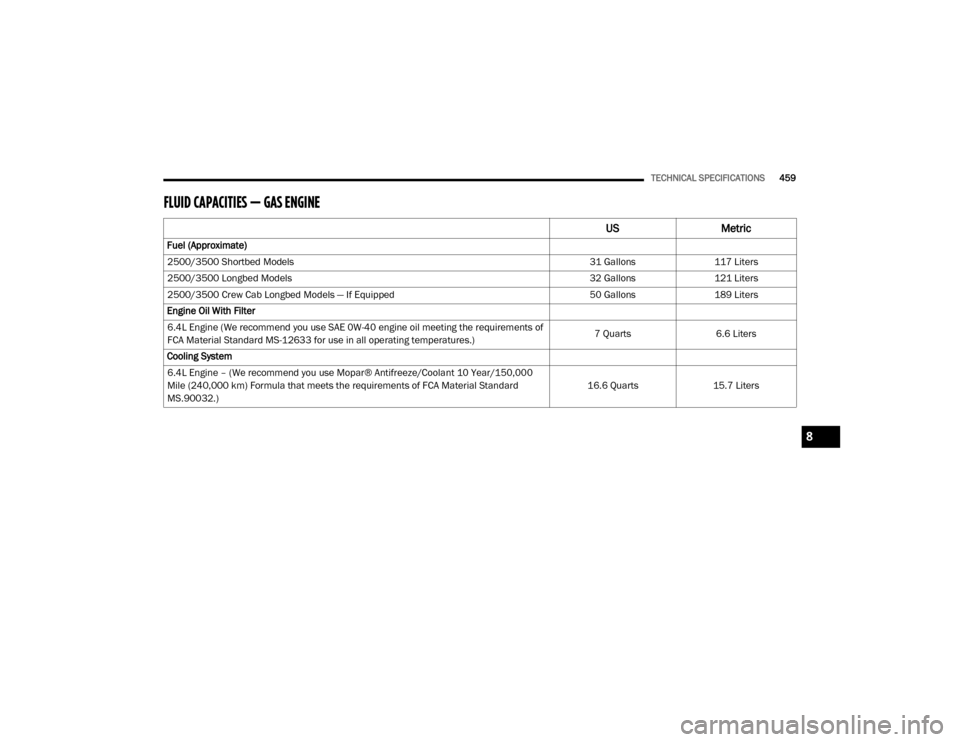
FLUID CAPACITIES — GAS ENGINE
USMetric
Fuel (Approximate)
2500/3500 Shortbed Models 31 Gallons117 Liters
2500/3500 Longbed Models 32 Gallons121 Liters
2500/3500 Crew Cab Longbed Models — If Equipped 50 Gallons189 Liters
Engine Oil With Filter
6.4L Engine (We recommend you use SAE 0W-40 engine oil meeting the requirements of
FCA Material Standard MS-12633 for use in all operating temperatures.) 7 Quarts
6.6 Liters
Cooling System
6.4L Engine – (We recommend you use Mopar® Antifreeze/Coolant 10 Year/150,000
Mile (240,000 km) Formula that meets the requirements of FCA Material Standard
MS.90032.) 16.6 Quarts
15.7 Liters
8
20_DJD2_OM_EN_USC_t.book Page 459
Page 462 of 568

460TECHNICAL SPECIFICATIONS
FLUID CAPACITIES — DIESEL ENGINE
US Metric
Fuel (Approximate)
2500/3500 Standard Cab Longbed
Models 28 Gallons
106 Liters
2500/3500 Crew/Mega Cab
Shortbed Models 31 Gallons
117 Liters
2500/3500 Crew Cab Longbed
Models 32 Gallons
121 Liters
2500/3500 Crew Cab Longbed
Models — If Equipped 50 Gallons
189 Liters
Diesel Exhaust Fluid Tank 5.7 Gallons21 Liters
Engine Oil With Filter
6.7L Turbo Diesel Engine 12 Quarts11.4 Liters
Cooling System
6.7L Turbo Diesel Engine with
68RFE (Mopar Engine Coolant/
Antifreeze 10 Year/150,000 Mile
[240,000 km] Formula) 22.0 Quarts
20.8 Liters
20_DJD2_OM_EN_USC_t.book Page 460
Page 464 of 568

462TECHNICAL SPECIFICATIONS
(Continued)
CAUTION!
Mixing of engine coolant (antifreeze) other
than specified Organic Additive Technology
(OAT) engine coolant (antifreeze), may
result in engine damage and may decrease
corrosion protection. Organic Additive Tech -
nology (OAT) engine coolant is different and
should not be mixed with Hybrid Organic
Additive Technology (HOAT) engine coolant
(antifreeze) or any “globally compatible”
coolant (antifreeze). If a non-OAT engine
coolant (antifreeze) is introduced into the
cooling system in an emergency, the
cooling system will need to be drained,
flushed, and refilled with fresh OAT coolant
(conforming to MS.90032), by an autho -
rized dealer as soon as possible.Do not use water alone or alcohol-based
engine coolant (antifreeze) products. Do
not use additional rust inhibitors or antirust
products, as they may not be compatible
with the radiator engine coolant and may
plug the radiator.
This vehicle has not been designed for use
with propylene glycol-based engine coolant
(antifreeze). Use of propylene glycol-based
engine coolant (antifreeze) is not recom -
mended.
CAUTION! (Continued)
20_DJD2_OM_EN_USC_t.book Page 462
Page 555 of 568

553
Belts, Seat
..................................................... 210Blind Spot Monitoring.................................... 153Body Builders Guide........................................ 12Body Mechanism Lubrication........................ 414B-Pillar Location............................................. 433Brake Assist System...................................... 145Brake Control System.................................... 145Brake Fluid.......................................... 421, 463Brake System...................................... 421, 452Fluid Check............................................... 421Master Cylinder......................................... 421Parking...................................................... 231Warning Light............................................ 131Brake/Transmission Interlock....................... 235Bulb Replacement......................................... 351Bulbs, Light.......................................... 212, 351
C
Cab Top Clearance Lights.............................. 357Camera.......................................................... 309Camera, AUX........................................ 311, 318Camera, Rear...................................... 309, 312Camper............................................................ 98Capacities, Antifreeze (Engine Coolant)......... 460Capacities, Fluid.................................. 459, 460Caps, Filler Oil (Engine)...................................... 396, 402Radiator (Coolant Pressure)...................... 419Car Washes................................................... 448Carbon Monoxide Warning.................. 209, 456
Cargo Light....................................................... 52Cellular Phone.............................................. 540Center High Mounted Stop Light................... 356Center Seat Storage Compartment.................. 81Charge Air Cooler.......................................... 421Chart, Tire Sizing........................................... 430Check Engine Light (Malfunction
Indicator Light).............................................. 143Checking Your Vehicle For Safety................. 209Checks, Safety.............................................. 209Child Restraint.............................................. 191Child RestraintsBooster Seats........................................... 194Child Seat Installation..................... 202, 204How To Stow An unused ALR Seat Belt.... 201Infant And Child Restraints....................... 192Locating The LATCH Anchorages.............. 199Lower Anchors And Tethers For Children.. 195Older Children And Child Restraints......... 193Seating Positions...................................... 195Clean Air Gasoline......................................... 454CleaningWheels..................................................... 442Climate Control................................................ 57Automatic.................................................... 61Manual........................................................ 57Cold Weather Operation............................... 217Compact Spare Tire...................................... 441Contract, Service.......................................... 549Cooling Pressure Cap (Radiator Cap)............ 419
Cooling System............................................. 417Adding Coolant (Antifreeze)...................... 418Coolant Level................................... 418, 420Cooling Capacity.............................. 459, 460Disposal Of Used Coolant......................... 420Drain, Flush, And Refill............................. 418Inspection................................................. 420Points To Remember................................ 420Pressure Cap............................................ 419Radiator Cap............................................. 419Selection Of Coolant (Antifreeze).... 418, 459, 461, 464Corrosion Protection..................................... 447Cruise Control (Speed Control)............. 280, 282Cruise Light................................................... 141Cupholders.......................................................86Customer Assistance.................................... 548Cybersecurity................................................ 467
D
Daytime Running Lights...................................49Dealer Service............................................... 401Defroster, Rear Window...................................57Defroster, Windshield............................ 57, 210Delay (Intermittent) Wipers..............................55Diagnostic System, Onboard......................... 142Diesel Exhaust Brake.................................... 232Diesel Fuel.................................................... 456Diesel Fuel Requirements............................. 456
11
20_DJD2_OM_EN_USC_t.book Page 553
Page 562 of 568

560 Inflation Pressure
...................................... 436Life Of Tires............................................... 439Load Capacity.................................. 433, 434
Pressure Monitoring System (TPMS)... 136, 163
Quality Grading.......................................... 446Radial........................................................ 437Replacement............................................. 439Rotation.................................................... 444Safety.............................................. 429, 435Sizes.......................................................... 430Snow Tires................................................. 440Spare Tires...................................... 441, 442Spinning.................................................... 438Trailer Towing............................................ 331Tread Wear Indicators............................... 438Wheel Nut Torque..................................... 452To Open Hood.................................................. 74Tongue Weight/Trailer Weight....................... 330Tonneau Cover.................................... 100, 448Tonneau Cover Cleaning................................ 448Torque Converter Clutch................................ 245
Towing................................................. 325, 381Disabled Vehicle....................................... 381Guide........................................................ 330Recreational............................................. 339Weight...................................................... 330Towing Behind A Motorhome........................ 339Traction......................................................... 343Traction Control............................................ 153Trailer Sway Control (TSC)............................. 153Trailer Towing............................................... 325Cooling System Tips................................. 336Hitches..................................................... 329Minimum Requirements........................... 330Mirrors......................................................... 46Tips........................................................... 335Trailer And Tongue Weight........................ 330Wiring....................................................... 334Trailer Towing Guide..................................... 330Trailer Weight................................................ 330Transfer Case............................................... 425Electronically Shifted....................... 246, 250Fluid................................................ 463, 466
Transmission................................................. 235Automatic............................... 235, 239, 422Fluid................................................. 463, 466Maintenance............................................ 422Shifting..................................................... 233Transporting Pets.......................................... 209Tread Wear Indicators................................... 438Turn Signals......................... 51, 141, 353, 355
U
UconnectUconnect Settings
.......................... 476, 478,494, 497, 514, 516Uconnect PhoneCall Continuation...................................... 537Uconnect SettingsCustomer Programmable Features... 28, 476, 478, 494, 497, 514, 516Passive Entry Programming............... 28, 476, 494, 514Uconnect Voice Command............................ 541Uniform Tire Quality Grades.......................... 446
20_DJD2_OM_EN_USC_t.book Page 560