air condition Ram 3500 Chassis Cab 2017 Owner's Guide
[x] Cancel search | Manufacturer: RAM, Model Year: 2017, Model line: 3500 Chassis Cab, Model: Ram 3500 Chassis Cab 2017Pages: 542, PDF Size: 5.09 MB
Page 466 of 542
CAUTION!(Continued)
•If a “fast charger” is used while the battery is in the
vehicle, disconnect both vehicle battery cables before
connecting the charger to the battery. Do not use a
“fast charger” to provide starting voltage.
Air Conditioner Maintenance
For best possible performance, your air conditioner should
be checked and serviced by an authorized dealer at the
start of each warm season. This service should include
cleaning of the condenser fins and a performance test.
Drive belt tension should also be checked at this time.
WARNING!
• Use only refrigerants and compressor lubricants ap-
proved by the manufacturer for your air conditioning
system. Some unapproved refrigerants are flam-
mable and can explode, injuring you. Other unap-
proved refrigerants or lubricants can cause the sys-
tem to fail, requiring costly repairs. Refer to
Warranty Information Book for further warranty
information.
(Continued)
WARNING! (Continued)
•The air conditioning system contains refrigerant un-
der high pressure. To avoid risk of personal injury or
damage to the system, adding refrigerant or any
repair requiring lines to be disconnected should be
done by an experienced technician.
CAUTION!
Do not use chemical flushes in your air conditioning
system as the chemicals can damage your air condition-
ing components. Such damage is not covered by the
New Vehicle Limited Warranty.
Refrigerant Recovery And Recycling R134a — If
Equipped
R-134a Air Conditioning Refrigerant is a hydrofluoro-
carbon (HFC) that is an ozone-saving product. However,
the manufacturer recommends that air conditioning ser-
vice be performed by authorized dealer or other service
facilities using recovery and recycling equipment.
NOTE: Use only manufacturer approved A/C system PAG
compressor oil and refrigerants.
464 MAINTAINING YOUR VEHICLE
Page 467 of 542

Refrigerant Recovery And Recycling R1234yf — If
Equipped
R-1234yf Air Conditioning Refrigerant is a hydrofluoole-
fine HFO that is an ozone-saving product with a low GWP
(Global Warming Potential). However, the manufacturer
recommends that air conditioning service be performed by
authorized dealer or other service facilities using recovery
and recycling equipment.
NOTE:Use only manufacturer approved A/C system
PAG compressor oil and refrigerants.
Cabin Filter Replacement (A/C Air Filter)
Refer to the “Maintenance Schedule” for the proper main-
tenance intervals.
WARNING!
Do not remove the cabin air filter while the vehicle is
running, or while the ignition is in the ACC or ON/
RUN mode. With the cabin air filter removed and the
blower operating, the blower can contact hands and
may propel dirt and debris into your eyes, resulting in
personal injury. The cabin air filter is located in the fresh air inlet behind the
glove compartment. Perform the following procedure to
replace the filter:
1. Open the glove compartment and remove all contents.
2. With the glove compartment door open, remove the
glove compartment tension tether and tether clip by
sliding the clip toward the face of the glove compart-
ment door. Lift the clip out of glove compartment door
and release into dash panel.
7
MAINTAINING YOUR VEHICLE 465
Page 482 of 542

Checking Coolant Level — 6.4L Engine
The level of the coolant in the pressurized coolant bottle
should be between the “MIN” and “MAX” range on the
bottle when the engine is cold.
The radiator normally remains completely full, so there is
no need to remove the cap unless checking for coolant
freeze point or replacing engine coolant (antifreeze). Ad-
vise your service attendant of this. As long as the engine
operating temperature is satisfactory, the coolant bottle
need only be checked once a month. When additional
engine coolant (antifreeze) is needed to maintain the
proper level, it should be added to the coolant bottle. Do
not overfill.
Points To Remember
NOTE:When the vehicle is stopped after a few miles/
kilometers of operation, you may observe vapor coming
from the front of the engine compartment. This is normally
a result of moisture from rain, snow, or high humidity
accumulating on the radiator and being vaporized when
the thermostat opens, allowing hot engine coolant (anti-
freeze) to enter the radiator. If an examination of your engine compartment shows no
evidence of radiator or hose leaks, the vehicle may be
safely driven. The vapor will soon dissipate.
•
Do not overfill the coolant expansion bottle.
• Check the coolant freeze point in the radiator and in the
coolant expansion bottle. If engine coolant (antifreeze)
needs to be added, the contents of the coolant expansion
bottle must also be protected against freezing.
• If frequent engine coolant (antifreeze) additions are
required, the cooling system should be pressure tested
for leaks.
• Maintain engine coolant (antifreeze) concentration at a
minimum of 50% OAT coolant (conforming to
MS.90032) and distilled water for proper corrosion pro-
tection of your engine which contains aluminum com-
ponents.
• Make sure that the coolant expansion bottle overflow
hoses are not kinked or obstructed.
• Keep the front of the radiator clean. If your vehicle is
equipped with air conditioning, keep the front of the
condenser clean.
• Do not change the thermostat for Summer or Winter
operation. If replacement is ever necessary, install ONLY
480 MAINTAINING YOUR VEHICLE
Page 488 of 542
NOTE:If it is necessary to check the transmissionbelowthe
operating temperature, the fluid level should be between the
two “COLD” (lower) holes on the dipstick with the fluid at
60-70°F / 16-21°C for 66RFE transmission, or 68-86°F /
20-30°C for AS66RC transmission. Only use the COLD region
of the dipstick as a rough reference when setting the fluid
level after a transmission service or fluid change. Re-check
the fluid level, and adjust as required, once the transmission
reaches normal operating temperature.
CAUTION!
If the fluid temperature is below 50°F (10°C) it may not
register on the dipstick. Do not add fluid until the
temperature is elevated enough to produce an accurate
reading. Run the engine at idle, in PARK, to warm the
fluid.
9. Reinsert the dipstick. Check for leaks. Release the park- ing brake.
NOTE: To prevent dirt and water from entering the trans-
mission after checking or replenishing fluid, make sure that
the dipstick cap is properly reseated. It is normal for the dipstick cap to spring back slightly from its fully seated
position, as long as its seal remains engaged in the dipstick
tube.
Fluid And Filter Changes — Six Speed Transmission
Refer to the “Maintenance Schedule” for the proper main-
tenance intervals.
In addition, change the fluid and filter(s) if the fluid
becomes contaminated (with water, etc.), or if the transmis-
sion is disassembled for any reason.
Appearance Care And Protection From Corrosion
Protection Of Body And Paint From Corrosion
Vehicle body care requirements vary according to geographic
locations and usage. Chemicals that make roads passable in
snow and ice, and chemicals that are sprayed on trees and
road surfaces during other seasons, are highly corrosive to
the metal in your vehicle. Outside parking, which exposes
your vehicle to airborne contaminants, road surfaces on
which the vehicle is operated, extreme hot or cold weather
and other extreme conditions will have an adverse effect on
paint, metal trim, and underbody protection.
486 MAINTAINING YOUR VEHICLE
Page 492 of 542

•For grease stains, apply Mopar Multi-Purpose Cleaner
to a clean, damp cloth and remove stain. Use a fresh,
damp towel to remove soap residue.
• Do not use any harsh solvents or any other form of
protectants on Stain Repel products.
Interior Care
Use Mopar Total Clean to clean fabric upholstery and
carpeting.
Use Mopar Total Clean to clean vinyl upholstery.
Mopar Total Clean is specifically recommended for leather
upholstery.
Your leather upholstery can be best preserved by regular
cleaning with a damp soft cloth. Small particles of dirt can
act as an abrasive and damage the leather upholstery and
should be removed promptly with a damp cloth. Stubborn
soils can be removed easily with a soft cloth and Mopar
Total Clean. Care should be taken to avoid soaking your
leather upholstery with any liquid. Please do not use
polishes, oils, cleaning fluids, solvents, detergents, or
ammonia-based cleaners to clean your leather upholstery.
Application of a leather conditioner is not required to
maintain the original condition.
WARNING!
Do not use volatile solvents for cleaning purposes.
Many are potentially flammable, and if used in closed
areas they may cause respiratory harm.
CAUTION!
• Direct contact of air fresheners, insect repellents,
suntan lotions, or hand sanitizers to the plastic,
painted, or decorated surfaces of the interior may
cause permanent damage. Wipe away immediately.
• Damage caused by these type of products may not be
covered by your New Vehicle Limited Warranty.
• Do not use Alcohol and Alcohol-based and/or Keton
based cleaning products to clean leather seats, as
damage to the seat may result.
Cleaning Headlights
Your vehicle is equipped with plastic headlights and fog
lights that are lighter and less susceptible to stone breakage
than glass headlights.
Plastic is not as scratch resistant as glass and therefore
different lens cleaning procedures must be followed.
490 MAINTAINING YOUR VEHICLE
Page 499 of 542
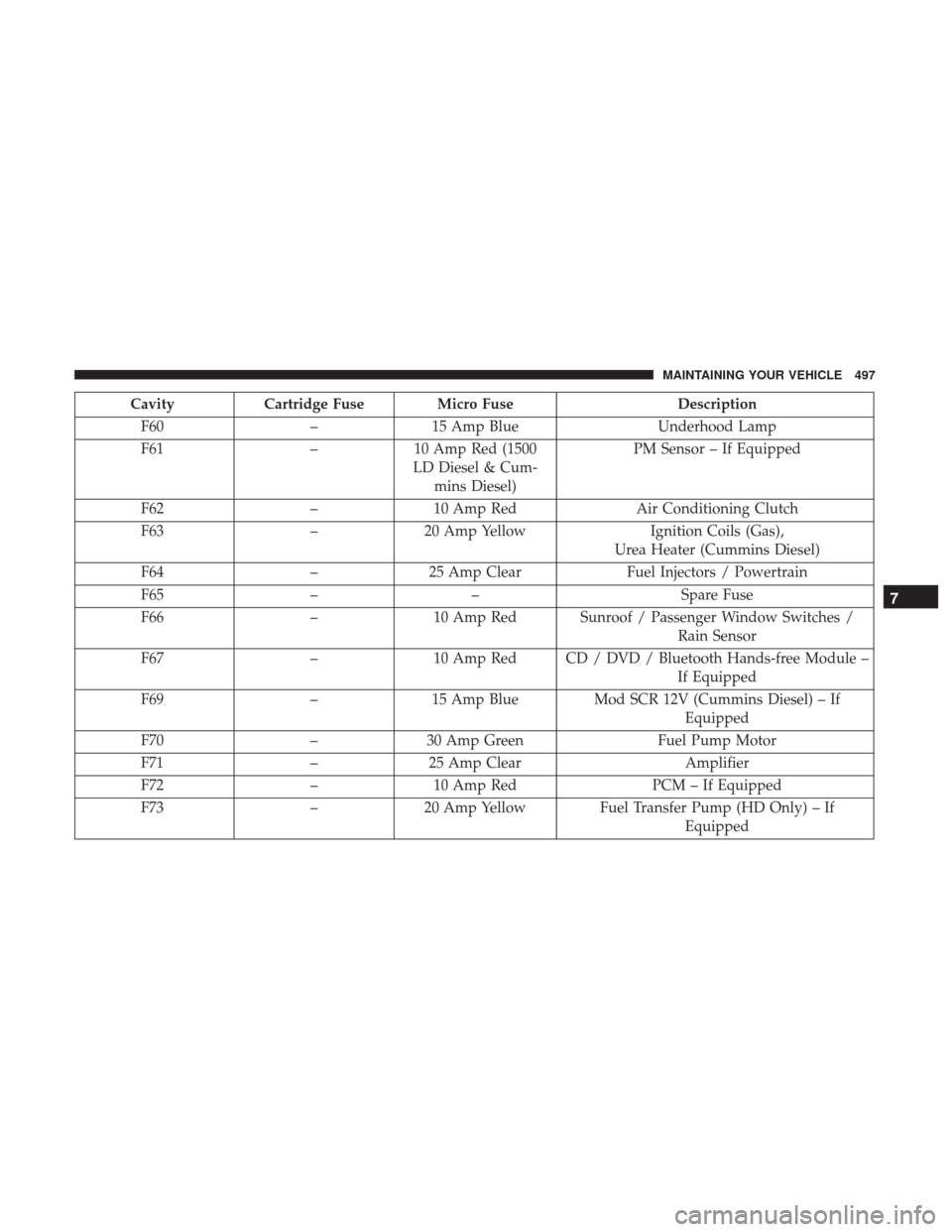
CavityCartridge Fuse Micro Fuse Description
F60 –15 Amp Blue Underhood Lamp
F61 –10 Amp Red (1500
LD Diesel & Cum- mins Diesel) PM Sensor – If Equipped
F62 –10 Amp Red Air Conditioning Clutch
F63 –20 Amp Yellow Ignition Coils (Gas),
Urea Heater (Cummins Diesel)
F64 –25 Amp Clear Fuel Injectors / Powertrain
F65 –– Spare Fuse
F66 –10 Amp Red Sunroof / Passenger Window Switches /
Rain Sensor
F67 –10 Amp Red CD / DVD / Bluetooth Hands-free Module –
If Equipped
F69 –15 Amp Blue Mod SCR 12V (Cummins Diesel) – If
Equipped
F70 –30 Amp Green Fuel Pump Motor
F71 –25 Amp Clear Amplifier
F72 –10 Amp Red PCM – If Equipped
F73 –20 Amp Yellow Fuel Transfer Pump (HD Only) – If
Equipped
7
MAINTAINING YOUR VEHICLE 497
Page 502 of 542

CAUTION!(Continued)
•Whenreplacing a blown fuse, it is important to use
only a fuse having the correct amperage rating. The
use of a fuse with a rating other than indicated may
result in a dangerous electrical system overload. If a
properly rated fuse continues to blow, it indicates a
problem in the circuit that must be corrected.
VEHICLE STORAGE
If you are storing your vehicle for more than 21 days, we
recommend that you take the following steps to minimize
the drain on your vehicle’s battery:
• Disconnect the negative cable from battery.
• Any time you store your vehicle or keep it out of service
(i.e., vacation) for two weeks or more, run the air
conditioning system at idle for about five minutes in the
fresh air and high blower setting. This will ensure
adequate system lubrication to minimize the possibility
of compressor damage when the system is started again.
REPLACEMENT BULBS
LIGHT BULBS — Interior
Bulb Number
Overhead Console Lamps TS 212-2
Dome Lamp 7679
For lighted switches, see your authorized dealer for replacement instructions.
LIGHT BULBS — Exterior
Bulb Number
Quad Headlamp – Low Beam H11
Quad Headlamp – High Beam 9005
Quad Headlamp – Front Turn Signal Lamp 3157NA
Premium Headlamp – Low Beam HIR2
Premium Headlamp – High Beam 9005
500 MAINTAINING YOUR VEHICLE
Page 515 of 542

Maintenance Chart
Required Maintenance
Refer to the Maintenance Schedules on the following pages
for required maintenance.
At Every Oil Change Interval As Indicated By OilChange Indicator System:
•Change oil and filter.
• Rotate the tires. Rotate at the first sign of irregular
wear, even if it occurs before the oil indicator
system turns on.
• Inspect engine cooling system protection and hoses.
• Inspect exhaust system.
• Inspect engine air cleaner if using in dusty or
off-road conditions.
At Every Oil Change Interval As Indicated By Oil
Change Indicator System:
•Inspect battery and clean and tighten terminals as
required.
• Inspect automatic transmission fluid if equipped
with dipstick.
• Inspect brake pads, shoes, rotors, drums, hoses and
park brake.
• Inspect front end, and lubricate — If equipped with
serviceable fittings.
• Lube the front drive shaft fitting (4X4 models only).
8
MAINTENANCE SCHEDULES 513
Page 526 of 542

Adding Engine Coolant (Antifreeze).............478
Adding Fuel ............................. .406
Additives, Fuel ........................... .404
Adjust Down .............................113,114
Forward ............................112,113
Rearward ...........................112,113
Up................................113,114
Adjustable Pedals ......................... .140
Air Bag Air Bag Operation .........................58
Air Bag Warning Light .....................55
Enhanced Accident Response ..............64, 448
Event Data Recorder (EDR) .................449
If A Deployment Occurs ....................63
Knee Impact Bolsters .......................59
Maintaining Your Air Bag System ..............65
Side Air Bags ............................59
Transporting Pets .........................91
Air Bag Light ....................... .55, 94, 201
Air Bag Maintenance .........................65
Air Cleaner, Engine (Engine Air Cleaner Filter) ......460
Air Conditioner Maintenance ..................464
Air Conditioning .......................... .280
Air Conditioning Controls ....................280 Air Conditioning Filter
...................295, 465
Air Conditioning, Operating Tips ...............295
Air Conditioning Refrigerant ...............464, 465
Air Conditioning System ...............280, 294, 464
Air Pressure, Tires ......................... .382
Alarm, Panic ...............................24
Alarm (Security Alarm) ....................19, 203
Alarm System (Security Alarm) .................19
Alterations/Modifications, Vehicle ................7
Antifreeze (Engine Coolant) ...................477
Capacities ............................. .507
Disposal .............................. .479
Anti-Lock Brake System (ABS) .................358
Appearance Care .......................... .486
Ashtray ................................ .177
Assist, Hill Start .......................... .360
Auto
Down Power Windows ...................39
Automatic Door Locks ........................32
Automatic Headlights ...................... .128
Automatic High Beams ..................... .130
Automatic Temperature Control (ATC) ...........294
Automatic Transmission ..................... .484
Adding Fluid .......................... .485
Fluid And Filter Changes ...................486
Fluid Level Check .....................484, 485
524 INDEX
Page 530 of 542

Ethanol................................. .403
Exhaust Gas Caution .....................93, 405
Exhaust System ........................ .93, 475
Exterior Lighting .......................... .128
Exterior Lights .............................96
Filters Air Cleaner ............................ .460
Air Conditioning .....................295, 465
Engine Fuel ........................... .508
Engine Oil ......................... .459, 508
Engine Oil Disposal ...................... .459
Flashers Turn Signal ...................... .96, 135, 220
Flat Tire Stowage .......................... .440
Flooded Engine Starting ..................... .327
Fluid, Brake ............................. .510
Fluid Capacities ........................... .507
Fluid Leaks ...............................96
Fluid Level Checks Automatic Transmission ....................485
Brake ................................ .481
Power Steering ......................... .354
Fluids, Lubricants And Genuine Parts ............508
Fog Lights ........................... .131, 503Fold Flat Load Floor
....................... .189
Four-Way Hazard Flasher .....................430
Four Wheel Drive ......................... .342
Freeing A Stuck Vehicle ..................... .443
Front Axle (Differential) ..................... .482
Fuel ................................... .402
Adding .............................. .406
Additives ............................. .404
Clean Air ............................. .402
Ethanol .............................. .403
Filler Cap (Gas Cap) ..................... .407
Filter ................................ .508
Gasoline .............................. .402
Light ................................ .214
Materials
Added ........................ .404
Methanol ............................. .403
Octane Rating .......................... .402
Requirements .......................... .402
Tank Capacity .......................... .507
Fuses .................................. .492
Garage Door Opener (HomeLink) ............164, 171
Gas Cap (Fuel Filler Cap) .................407, 455
Gasoline, Clean Air ........................ .402
Gasoline (Fuel) ........................... .402
528 INDEX