tires Ram 3500 Chassis Cab 2018 Service Manual
[x] Cancel search | Manufacturer: RAM, Model Year: 2018, Model line: 3500 Chassis Cab, Model: Ram 3500 Chassis Cab 2018Pages: 527, PDF Size: 5.83 MB
Page 411 of 527

Spare Tires — If Equipped
NOTE:For vehicles equipped with Tire Service Kit instead
of a spare tire, please refer to “Tire Service Kit” in “In Case
Of Emergency” for further information.
CAUTION!
Because of the reduced ground clearance, do not take
your vehicle through an automatic car wash with a
compact or limited use temporary spare installed.
Damage to the vehicle may result.
Spare Tire Matching Original Equipped Tire And
Wheel — If Equipped
Your vehicle may be equipped with a spare tire and wheel
equivalent in look and function to the original equipment
tire and wheel found on the front or rear axle of your
vehicle. This spare tire may be used in the tire rotation for
your vehicle. If your vehicle has this option, refer to an
authorized tire dealer for the recommended tire rotation
pattern.
Compact Spare Tire — If Equipped
The compact spare is for temporary emergency use only.
You can identify if your vehicle is equipped with a compact spare by looking at the spare tire description on the Tire
and Loading Information Placard located on the driver ’s
side door opening or on the sidewall of the tire. Compact
spare tire descriptions begin with the letter “T” or “S”
preceding the size designation. Example: T145/80D18
103M.
T, S = Temporary Spare Tire
Since this tire has limited tread life, the original equipment
tire should be repaired (or replaced) and reinstalled on
your vehicle at the first opportunity.
Do not install a wheel cover or attempt to mount a
conventional tire on the compact spare wheel, since the
wheel is designed specifically for the compact spare tire.
Do not install more than one compact spare tire and wheel
on the vehicle at any given time.
WARNING!
Compact and collapsible spares are for temporary
emergency use only. With these spares, do not drive
more than 50 mph (80 km/h). Temporary use spares
have limited tread life. When the tread is worn to the
tread wear indicators, the temporary use spare tire
(Continued)
8
SERVICING AND MAINTENANCE 409
Page 415 of 527
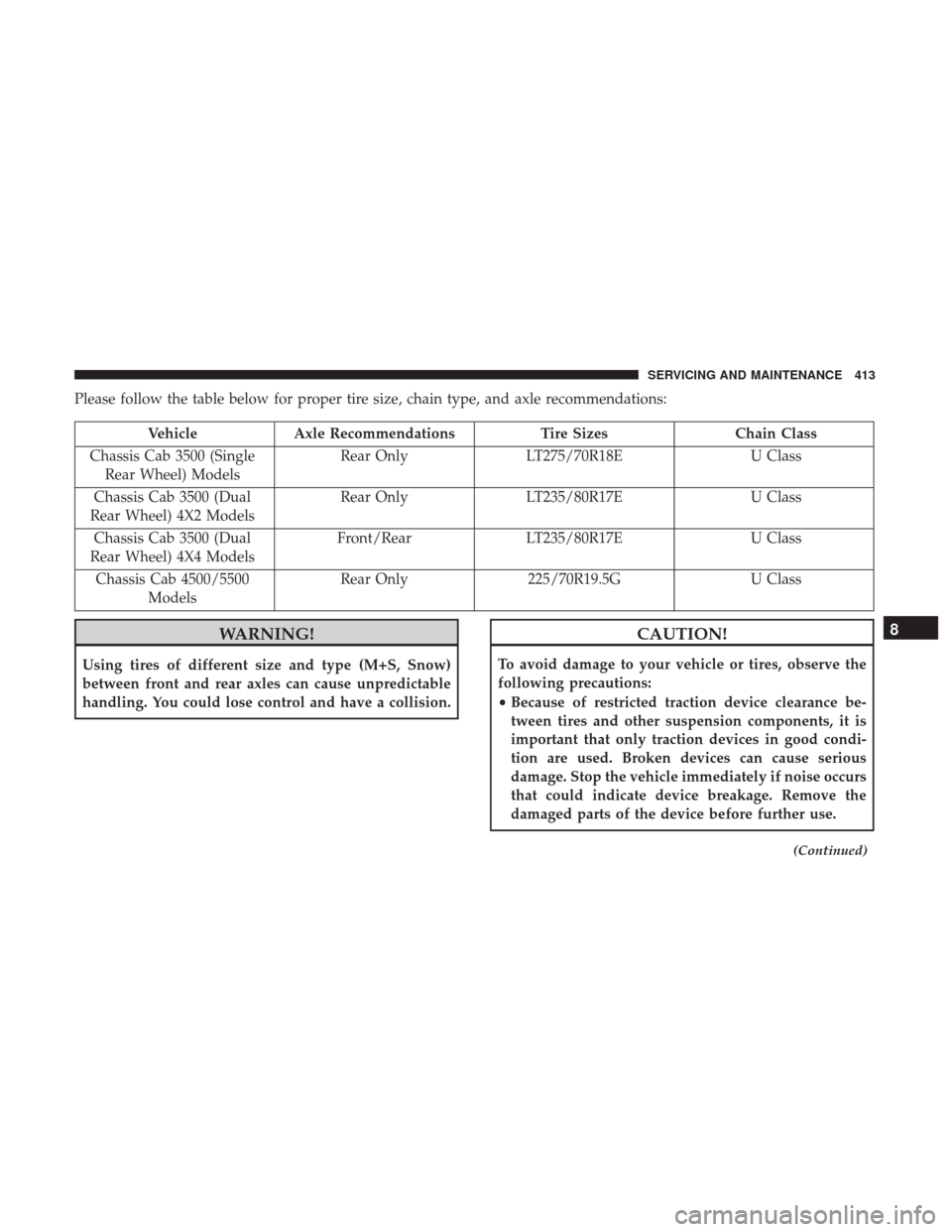
Please follow the table below for proper tire size, chain type, and axle recommendations:
VehicleAxle Recommendations Tire SizesChain Class
Chassis Cab 3500 (Single Rear Wheel) Models Rear Only
LT275/70R18E U Class
Chassis Cab 3500 (Dual
Rear Wheel) 4X2 Models Rear Only
LT235/80R17E U Class
Chassis Cab 3500 (Dual
Rear Wheel) 4X4 Models Front/Rear
LT235/80R17E U Class
Chassis Cab 4500/5500 Models Rear Only
225/70R19.5G U Class
WARNING!
Using tires of different size and type (M+S, Snow)
between front and rear axles can cause unpredictable
handling. You could lose control and have a collision.
CAUTION!
To avoid damage to your vehicle or tires, observe the
following precautions:
•Because of restricted traction device clearance be-
tween tires and other suspension components, it is
important that only traction devices in good condi-
tion are used. Broken devices can cause serious
damage. Stop the vehicle immediately if noise occurs
that could indicate device breakage. Remove the
damaged parts of the device before further use.
(Continued)
8
SERVICING AND MAINTENANCE 413
Page 416 of 527
CAUTION!(Continued)
•Install device as tightly as possible and then re-
tighten after driving about ½ mile (0.8 km).
• Do not exceed 30 mph (48 km/h).
• Drive cautiously and avoid severe turns and large
bumps, especially with a loaded vehicle.
• Do not drive for a prolonged period on dry pave-
ment.
• Observe the traction device manufacturer ’s instruc-
tions on the method of installation, operating speed,
and conditions for use. Always use the suggested
operating speed of the device manufacturer ’s if it is
less than 30 mph (48 km/h).
• Do not use traction devices on a compact spare tire.
Tire Rotation Recommendations
Tires on the front and rear axles of vehicles operate at
different loads and perform different steering, driving, and
braking functions. For these reasons, they wear at unequal
rates.
These effects can be reduced by timely rotation of tires. The
benefits of rotation are especially worthwhile with aggres-
sive tread designs such as those on On/Off Road type tires. Rotation will increase tread life, help to maintain mud,
snow, and wet traction levels, and contribute to a smooth,
quiet ride.
Refer to the “Maintenance Plan” for the proper mainte-
nance intervals. More frequent rotation is permissible if
desired. The reasons for any rapid or unusual wear should
be corrected prior to rotation being performed.
NOTE:
On Canadian vehicles only, if your vehicle is
equipped with All-Season type tires on the front and
On/Off Road type tires mounted on the rear, do not use a
front to back rotation pattern. Instead, rotate your tires side
to side at the recommended intervals.
Tire Rotation
414 SERVICING AND MAINTENANCE
Page 417 of 527

Dual Rear Wheels
The tires used on dual wheel assemblies should be
matched for wear to prevent overloading one tire in a set.
To check if tires are even, lay a straight edge across all four
tires. The straight edge should touch all the tires.
NOTE:If your vehicle is equipped with a Tire Pressure
Information System (TPIS):
• The Tire Pressure Information System (TPIS) uses
unique sensors in the inner rear wheels to help identify
them from the outer rear wheels, because of this, the
inner and outer wheel locations can’t be switched. •
After a tire rotation is completed, as shown below, the
system can auto learn the locations of each sensor ID.
Auto learning/localization occurs when the vehicle ig-
nition status is changed from Off to On and speeds of
greater than 5 mph (8km/h) are obtained and remain
over 5mph (8km/h) for at about a 15 minute period. You
may need to drive for 20 minutes to account slower
speeds and stops.
• If the tires are rotated incorrectly, the Auto localization of
the TPIS sensors will fail to locate correctly resulting in
incorrect locations for the pressure values displayed in
the Instrument Cluster.
CAUTION!
• 4500/5500 Dual Rear Tires may only have one ap-
proved direction of rotation. This is to accommodate
the asymmetrical design (tread pattern) of the On/
Off road tire.
• When replacing a flat, the spare tire may have to be
remounted on the rim or installed at a different
location to maintain the correct placement of the tire
on the wheel relative to the tire/wheel position on
the vehicle. For example, if the spare is used to
(Continued)
Tire Rotation
8
SERVICING AND MAINTENANCE 415
Page 418 of 527
CAUTION!(Continued)
replace an outer rear tire it will have to be remounted
on the rim so that the wheel is dished inward. That
way the tread design of asymmetrical tires will
maintain proper position.
DEPARTMENT OF TRANSPORTATION UNIFORM
TIRE QUALITY GRADES
The following tire grading categories were established
by the National Highway Traffic Safety Administration.
The specific grade rating assigned by the tire’s manu-
facturer in each category is shown on the sidewall of the
tires on your vehicle.
All passenger vehicle tires must conform to Federal
safety requirements in addition to these grades.
Treadwear
The Treadwear grade is a comparative rating, based on
the wear rate of the tire when tested under controlled
conditions on a specified government test course. For
example, a tire graded 150 would wear one and one-half
times as well on the government course as a tire graded
100. The relative performance of tires depends upon the
actual conditions of their use, however, and may depart significantly from the norm due to variations in driving
habits, service practices, and differences in road charac-
teristics and climate.
Traction Grades
The Traction grades, from highest to lowest, are AA, A,
B, and C. These grades represent the tire’s ability to stop
on wet pavement, as measured under controlled condi-
tions on specified government test surfaces of asphalt
and concrete. A tire marked C may have poor traction
performance.
WARNING!
The traction grade assigned to this tire is based on
straight-ahead braking traction tests, and does not
include acceleration, cornering, hydroplaning, or
peak traction characteristics.
Temperature Grades
The Temperature grades are A (the highest), B, and C,
representing the tire’s resistance to the generation of
heat and its ability to dissipate heat, when tested under
controlled conditions on a specified indoor laboratory
test wheel.
416 SERVICING AND MAINTENANCE
Page 419 of 527
Sustained high temperature can cause the material of
the tire to degenerate and reduce tire life, and excessive
temperature can lead to sudden tire failure. The grade C
corresponds to a level of performance, which all pas-
senger vehicle tires must meet under the Federal Motor
Vehicle Safety Standard No. 109. Grades B and A
represent higher levels of performance on the laboratory
test wheel, than the minimum required by law.
WARNING!
The temperature grade for this tire is established for
a tire that is properly inflated and not overloaded.
Excessive speed, under-inflation, or excessive load-
ing, either separately or in combination, can cause
heat buildup and possible tire failure.
STORING THE VEHICLE
If you are storing your vehicle for more than 21 days, we
recommend that you take the following steps to minimize
the drain on your vehicle’s battery:
• Disconnect the negative cable from battery.
• Any time you store your vehicle or keep it out of service
(i.e., vacation) for two weeks or more, run the air
conditioning system at idle for about five minutes in the fresh air and high blower setting. This will ensure
adequate system lubrication to minimize the possibility
of compressor damage when the system is started again.
BODYWORK
Protection From Atmospheric Agents
Vehicle body care requirements vary according to geo-
graphic locations and usage. Chemicals that make roads
passable in snow and ice and those that are sprayed on
trees and road surfaces during other seasons are highly
corrosive to the metal in your vehicle. Outside parking,
which exposes your vehicle to airborne contaminants, road
surfaces on which the vehicle is operated, extreme hot or
cold weather and other extreme conditions will have an
adverse effect on paint, metal trim, and underbody protec-
tion.
The following maintenance recommendations will enable
you to obtain maximum benefit from the corrosion resis-
tance built into your vehicle.
What Causes Corrosion?
Corrosion is the result of deterioration or removal of paint
and protective coatings from your vehicle.
8
SERVICING AND MAINTENANCE 417
Page 428 of 527
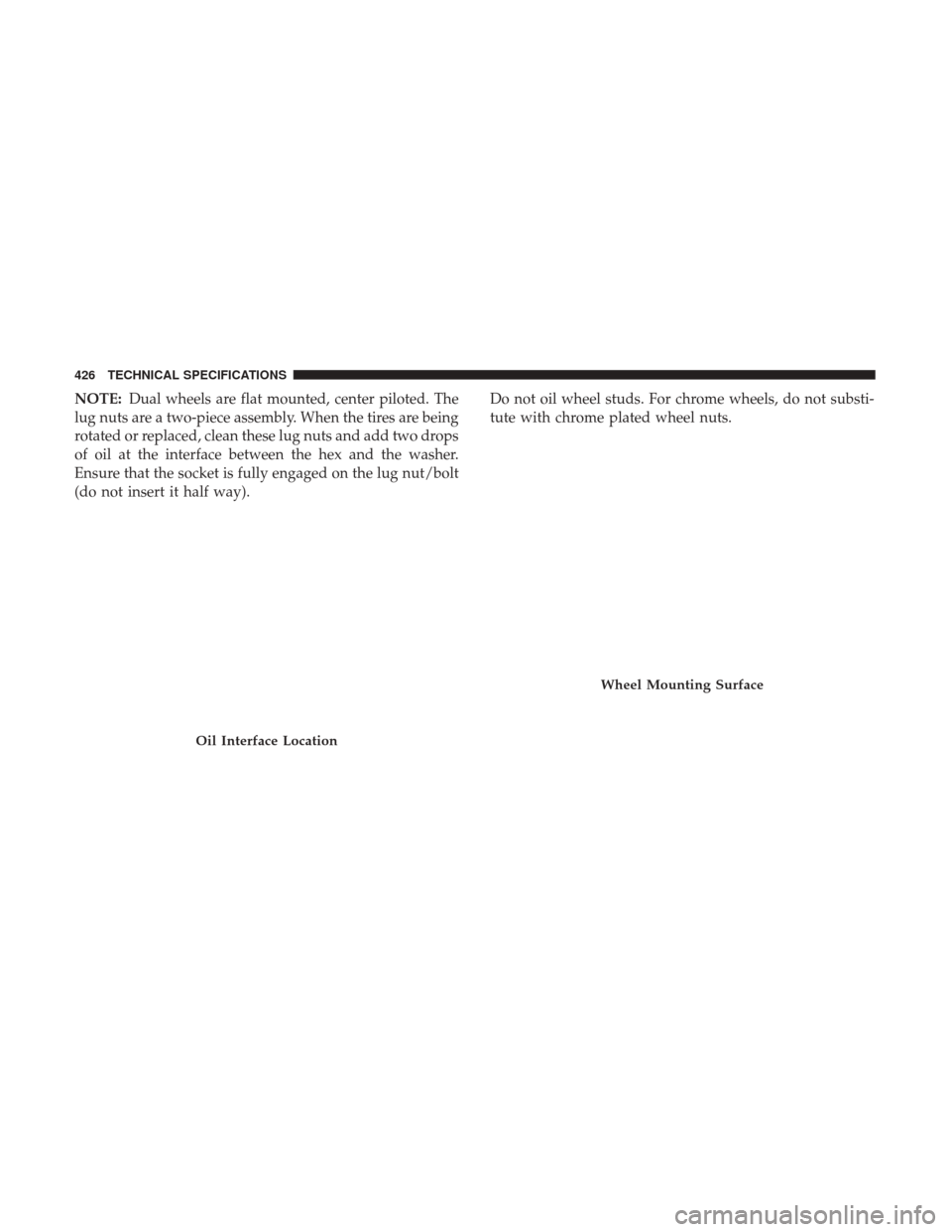
NOTE:Dual wheels are flat mounted, center piloted. The
lug nuts are a two-piece assembly. When the tires are being
rotated or replaced, clean these lug nuts and add two drops
of oil at the interface between the hex and the washer.
Ensure that the socket is fully engaged on the lug nut/bolt
(do not insert it half way). Do not oil wheel studs. For chrome wheels, do not substi-
tute with chrome plated wheel nuts.
Oil Interface Location
Wheel Mounting Surface
426 TECHNICAL SPECIFICATIONS
Page 512 of 527

Adding Engine Coolant (Antifreeze).............383
Adding Fuel ............................. .287
Additives, Fuel ........................ .288, 428
Adjust Down .............................. .45, 46
Forward ............................ .44, 46
Rearward ........................... .44, 46
Up ................................ .45, 46
Adjustable Pedals ...........................57
Air Bag Air Bag Operation ....................... .196
Air Bag Warning Light .....................193
Enhanced Accident Response .............203, 353
Event Data Recorder (EDR) .................353
If A Deployment Occurs ....................201
Knee Impact Bolsters ..................... .197
Maintaining Your Air Bag System .............203
Transporting Pets ....................... .230
Air Bag Light ...................... .147, 193, 232
Air Bag Maintenance ....................... .203
Air Cleaner, Engine (Engine Air Cleaner Filter) ......366
Air Conditioner Maintenance ..................369
Air Conditioning ............................80
Air Conditioning Filter ....................94, 370
Air Conditioning, Operating Tips ................93Air Conditioning Refrigerant
...............369, 370
Air Conditioning System ...................92, 369
Air Filter ............................... .366
Air Pressure, Tires ......................... .403
Alarm, Panic ...............................22
Alarm (Security Alarm) ....................33, 148
Alarm System (Security Alarm) .................33
Alterations/Modifications, Vehicle ................7
Antifreeze (Engine Coolant) ...................382
Capacities ............................. .432
Disposal .............................. .385
Anti-Lock Brake System (ABS) .................160
Anti-Lock Warning Light .....................153
Ashtray ................................ .123
Assist,
Hill Start .......................... .162
Audio Systems (Radio) ...................... .439
Auto Down Power Windows ...................96
Automatic Door Locks ........................39
Automatic Headlights ........................70
Automatic High Beams .......................69
Automatic Temperature Control (ATC) ............92
Automatic Transmission Adding Fluid .......................... .389
Fluid And Filter Changes ...................390
Fluid Level Check .....................387, 388
510 INDEX
Page 518 of 527
Jump Starting............................ .343
Key Fob Panic Alarm .............................22
Programming Additional Key Fobs ..........25, 32
Key Fob Battery Service (Remote Keyless Entry) .....22
Key Fob Programming (Remote Keyless Entry) ......25
Key-In Reminder ............................28
Keyless Enter-N-Go ..................... .36, 240
Lock The Vehicle’s Doors ................449, 470
Passive Entry ............................36
Passive Entry Programming ...........36, 449, 470
Key, Replacement ...........................32
Keys ....................................19
Key, Sentry (Immobilizer) ......................31
Lane Change And Turn Signals .................73
Lane Change Assist ..........................73
Latches ................................. .234
Hood ..................................98
Lead Free Gasoline ........................ .428
Leaks, Fluid ............................. .234
Life Of Tires ............................. .406
Light Bulbs .............................. .234
Lights .................................. .234AirBag .........................147, 193, 232
Automatic Headlights
......................70
Brake Assist Warning ..................... .168
Brake Warning ......................... .147
Bulb Replacement ....................... .323
Cap Top Clearance ...................... .328
Cargo .................................73
Center Mounted Stop ..................... .326
Courtesy/Reading ..................... .74, 75
Cruise ............................... .156
Daytime Running .........................69
Engine Temperature Warning ................148
Exterior .............................. .234
Fog ........................... .72, 154, 326
Four-Wheel Drive Indicator .................258
Hazard Warning Flasher ...................318
Headlights ..............................67
High Beam ..............................69
High Beam/Low Beam Select .................
69
Hill Descent Control Indicator ...............170
Illuminated Entry .........................76
Interior ............................. .74, 75
Low Fuel ............................. .153
Malfunction Indicator (Check Engine) ..........150
Park ................................. .155
516 INDEX
Page 519 of 527

Passing................................70
Seat Belt Reminder ...................... .147
Security Alarm ......................... .148
Service ............................... .323
Tire Pressure Monitoring (TPMS) ..........152, 172
Traction Control ........................ .168
Transfer Case .......................... .258
Turn Signal ....................73, 155, 234, 324
Warning (Instrument Cluster Description) . . . .148, 155
Limited-Slip Differential ..................263, 391
Loading Vehicle ........................... .288
Tires................................. .398
Load Shed Battery Saver Mode ...................... .145
Battery Saver On ........................ .145
Electrical Load Reduction ...................145
Intelligent Battery Sensor ...................145
Locks Automatic Door ..........................39
Child Protection ..........................40
Power Door .............................36
Low Tire Pressure System .....................172
Lubrication, Body ......................... .376
Lug Nuts ............................ .341, 425Maintenance Free Battery
.....................363
Maintenance Schedule ...................... .357
Malfunction Indicator Light (Check Engine) . . . .150, 157
Manual, Service ........................... .508
Manual Transmission Fluid Level Check ....................... .391
Memory Feature (Memory Seat) .................41
Memory Seat ........................... .41, 47
Memory Seats And Radio .....................41
Methanol ............................... .429
Mirrors ..................................59
Electric Powered ..........................62
Heated .................................65
Memory ................................47
Outside ................................61
Rearview ........................ .59, 60, 318
Trailer Towing ...........................65
Modifications/Alterations,
Vehicle................7
Monitor, Tire Pressure System ..................172
Mopar Parts ............................. .507
Multi-Function Control Lever ...................69
Navigation System (Uconnect GPS) ..............284
New Vehicle Break-In Period ..................242
12
INDEX 517