trailer Ram 5500 Chassis Cab 2011 Owner's Guide
[x] Cancel search | Manufacturer: RAM, Model Year: 2011, Model line: 5500 Chassis Cab, Model: Ram 5500 Chassis Cab 2011Pages: 476, PDF Size: 7.32 MB
Page 339 of 476

actuated brakes. When towing a trailer equipped with
a hydraulic surge actuated brake system, an electronic
brake controller is not required.
•Trailer brakes are recommended for trailers over
1,000 lbs (454 kg) and required for trailers in excess of
2,000 lbs (907 kg).
CAUTION!
If the trailer weighs more than 1,000 lbs (454 kg)
loaded, it should have its own brakes and they
should be of adequate capacity. Failure to do this
could lead to accelerated brake lining wear, higher
brake pedal effort, and longer stopping distances.
WARNING!
•Do not connect trailer brakes to your vehicle’s
hydraulic brake lines. It can overload your brake
system and cause it to fail. You might not have
brakes when you need them and could have an
accident.
•Towing any trailer will increase your stopping
distance. When towing you should allow for addi-
tional space between your vehicle and the vehicle
in front of you. Failure to do so could result in an
accident.
Integrated Trailer Brake Module – If Equipped
Your vehicle may have a Integrated Trailer Brake Module
for electric trailer brakes.
338 STARTING AND OPERATING
Page 340 of 476

NOTE:This module is designed for only electric trailer
brakes. To determine the type of brakes on your trailer,
check with your trailer manufacturer or dealer. The user interface consists of the following:
GAIN/ Brake Output Power Display
Shows the current GAIN setting.
This display may also be used to display diagnostic
information, if needed.
•SC — Short Circuit to Ground
•Sb — Short to Battery
•CF — Controller Fault – If this message appears on the
display, see your authorized dealer.
When the vehicle brakes are applied, the display will no
longer show GAIN and will change to the output to the
trailer brakes.
1 — GAIN/Brake Output Power Display
2 — Manual Brake Control Lever
3 — Trailer Brake Status Indicator Light
4 — GAIN Adjustment Buttons
5
STARTING AND OPERATING 339
Page 341 of 476

Manual Brake Control Lever
Slide the manual brake control lever to the right to
activate power to the trailer’s electric brakes independent
of the tow vehicle’s brakes. If the manual brake control
lever is activated while the brake is also applied, the
greater of the two inputs determines the power sent to
the trailer brakes.
The trailer and the vehicle’s brake lamps will come on
when either vehicle braking or manual trailer brakes are
applied.
Trailer Brake Status Indicator Light
This light indicates the trailer electrical connection status.
If no electrical connection is detected after the ignition is
turned on, pressing the GAIN adjustment button or
sliding the manual brake control lever will display the
GAIN setting for 10 seconds and the “Trailer Brake Status
Indicator Light” will not be displayed.If a fault is detected in the trailer wiring or the Integrated
Trailer Brake Module (ITBM), the “Trailer Brake Status
Indicator Light” will flash.
GAIN Adjustment Buttons (+/-)
Pressing these buttons will adjust the brake control
power output to the trailer brakes in 0.5 increments. The
GAIN setting can be increased to a maximum of 10 or
decreased to a minimum of 0 (no trailer braking).
GAIN
The GAIN setting is used to set the trailer brake control
for the specific towing condition and should be changed
as towing conditions change. Changes to towing condi-
tions include trailer load, vehicle load, road conditions
and weather.
340 STARTING AND OPERATING
Page 342 of 476

Adjusting GAIN
NOTE:This should only be performed in a traffic free
environment at speeds of approximately 20–25 mph
(30–40 km/h).
1. Make sure the trailer brakes are in good working
condition, functioning normally, and properly adjusted.
See your trailer dealer if necessary.
2. Hook up the trailer and make the electrical connec-
tions according to the trailer manufacturer’s instructions.
3. When a trailer with electric brakes is plugged in, the
GAIN setting will illuminate.
4. Use the GAIN adjustment (+/-) buttons to increase or
decrease the GAIN setting to the desired starting point. A
GAIN setting of 6 is a good starting point for heavier
loads. 5. In a traffic-free environment, tow the trailer on a dry,
level surface at a speed of 20–25 mph (30–40 km/h) and
squeeze the manual brake control lever completely.
6. If the trailer wheels lockup (indicated by squealing
tires), reduce the GAIN setting; if the trailer wheels turn
freely, increase the GAIN setting.
Repeat Steps 5 and 6 until the GAIN setting is at a point
just below trailer wheel lockup. If towing a heavier
trailer, trailer wheel lockup may not be attainable even
with the maximum GAIN setting of 10.
EVIC Display Messages
The trailer brake control interacts with the Electronic
Vehicle Information Center (EVIC). Display messages,
along with a single chime, will be displayed when a
malfunction is determined in the trailer connection,
trailer brake control, or on the trailer. Refer to “Electronic
Vehicle Information Center (EVIC)” in “Understanding
Your Instrument Panel” for further information.
5
STARTING AND OPERATING 341
Page 343 of 476

CAUTION!
Connecting a trailer that is not compatible with the
ITBM system may result in reduced or complete loss
of trailer braking. There may be a increase in stop-
ping distance or trailer instability which could result
in damage to your vehicle, trailer, or other property.
WARNING!
Connecting a trailer that is not compatible with the
ITBM system may result in reduced or complete loss
of trailer braking. There may be a increase in stop-
ping distance or trailer instability which could result
in personal injury.
NOTE: A aftermarket controller may be available for
use with trailers with air or electric-over-hydraulic trailer brake systems. To determine the type of brakes on your
trailer and the availability of controllers, check with your
trailer manufacturer or dealer.
Towing Requirements – Trailer Lights and Wiring
Whenever you pull a trailer, regardless of the trailer size,
stop lights and turn signals on the trailer are required for
motoring safety.
NOTE:
Do not cut or splice wiring into the vehicle’s
wiring harness.
WARNING!
Any work done to the vehicle’s electrical system or
wiring should be performed by a qualified automo-
tive technician. If done improperly it may cause
damage to the electrical system wiring and could
result in serious or fatal injury.
342 STARTING AND OPERATING
Page 344 of 476
Towing Tips
Before setting out on a trip, practice turning, stopping
and backing the trailer up in an area away from heavy
traffic.
Automatic Transmission
The “DRIVE” range can be selected when towing. How-
ever, if frequent shifting occurs while in this range, select
“TOW/HAUL” mode (if equipped) or select a lower gear
using the Electronic Range Select (ERS) feature.
NOTE:Using “TOW/HAUL” mode or a lower gear
range while operating the vehicle under heavy operating
conditions will improve performance and extend trans-
mission life by reducing excessive shifting and heat build
up. This action will also provide better engine braking.
The automatic transmission fluid and filter should be
changed if you regularly tow a trailer for more than
45 minutes of continuous operation. Refer to “Mainte-
nance Schedule” for the proper maintenance intervals. NOTE:
Check the automatic transmission fluid level
before towing.
Tow/Haul
To reduce potential for automatic transmission overheat-
ing, turn the “TOW/HAUL” feature ON when driving in
hilly areas, or select a lower gear range (using the
Electronic Range Select (ERS) feature) on more severe
grades.
Electronic Speed Control – If Equipped
Do not use in hilly terrain or with heavy loads.
When using the speed control, if you experience speed
drops greater than 10 mph (16 km/h), disengage until
you can get back to cruising speed.
Use speed control in flat terrain and with light loads to
maximize fuel efficiency.
5
STARTING AND OPERATING 343
Page 415 of 476
If the belts need cleaning, use a mild soap solution or
lukewarm water. Do not remove the belts from the car to
wash them.
Replace the belts if they appear frayed or worn or if the
buckles do not work properly.
Dry with a soft tissue.
FUSES
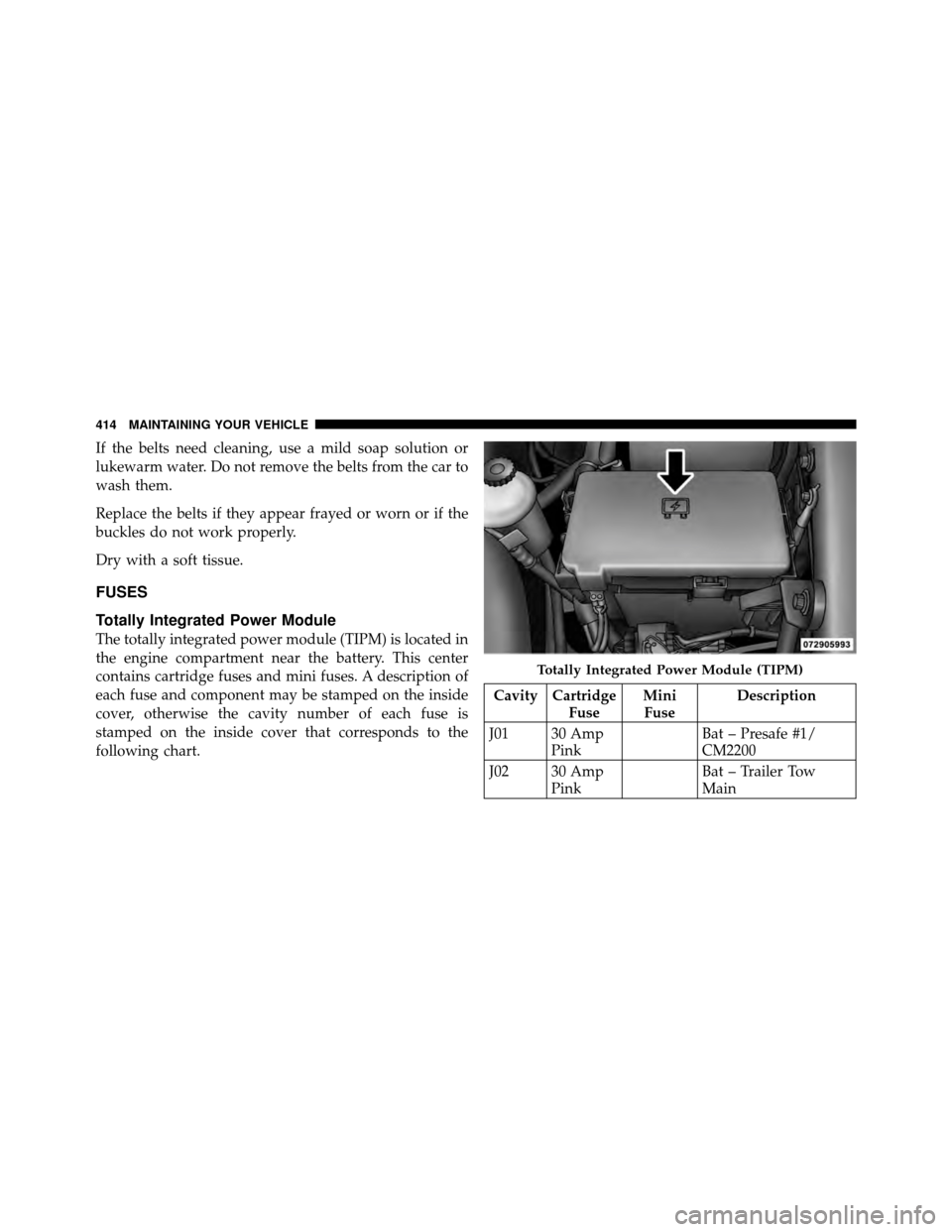
Totally Integrated Power Module
The totally integrated power module (TIPM) is located in
the engine compartment near the battery. This center
contains cartridge fuses and mini fuses. A description of
each fuse and component may be stamped on the inside
cover, otherwise the cavity number of each fuse is
stamped on the inside cover that corresponds to the
following chart.
Cavity CartridgeFuseMini
Fuse Description
J01 30 Amp Pink Bat – Presafe #1/
CM2200
J02 30 Amp Pink Bat – Trailer Tow
Main
Totally Integrated Power Module (TIPM)
414 MAINTAINING YOUR VEHICLE
Page 435 of 476
18,000 Miles (30,000 km) or
18 Months Maintenance
Service Schedule
❏Change the engine oil and engine oil
filter.
❏ Rotate tires.
❏ Lube front drive shaft fitting (4x4 only).
❏ Lubricate outer tie rod ends.
❏ Inspect the front & rear axle fluid.
Change if using your vehicle for police,
taxi, fleet, off-road or frequent trailer
towing.
Odometer Reading Date
Repair Order #Dealer Code
Signature Authorized Chrysler Dealer
24,000 Miles (40,000 km) or 24 Months Maintenance Service
Schedule
❏Change the engine oil and engine oil filter.
❏ Rotate tires.
❏ If using your vehicle for any of the following: Dusty or off-road conditions. Inspect the
engine air cleaner filter, replace if necessary.
❏ Inspect the brake linings, replace if necessary.
❏ Lubricate outer tie rod ends.
❏ Inspect the front suspension, tie rod ends, and boot seals, replace if necessary.
❏ Lube front drive shaft fitting (4x4 only).
❏ Inspect the CV joints.
❏ Inspect exhaust system.
Odometer Reading Date
Repair Order #Dealer Code
Signature Authorized Chrysler Dealer
8
M
A I
N T
E
N A
N CE
S
C
H E
D
U L
E
S434 MAINTENANCE SCHEDULES
Page 436 of 476
30,000 Miles (50,000 km) or
30 Months Maintenance
Service Schedule
❏Change the engine oil and engine oil
filter.
❏ Rotate tires.
❏ Replace the engine air cleaner filter.
❏ Replace the spark plugs (5.7L engine).
❏ Adjust parking brake on vehicles
equipped with four wheel disc brakes.
❏ Lube front drive shaft fitting (4x4 only).
❏ Lubricate outer tie rod ends.
❏ Inspect the transfer case fluid.
Odometer Reading Date
Repair Order #Dealer Code
Signature Authorized Chrysler Dealer
36,000 Miles (60,000 km) or 36 Months Maintenance Service
Schedule
❏Change the engine oil and engine oil filter.
❏ Rotate tires.
❏ If using your vehicle for any of the following: Dusty or off-road conditions. Inspect the
engine air cleaner filter, replace if necessary.
❏ Inspect the brake linings, replace if necessary.
❏ Lube front drive shaft fitting (4x4 only).
❏ Lubricate outer tie rod ends.
❏ Inspect the front & rear axle fluid. Change if using your vehicle for police, taxi, fleet,
off-road or frequent trailer towing.
Odometer Reading Date
Repair Order #Dealer Code
Signature Authorized Chrysler Dealer
8
M
A I
N T
E
N A
N CE
S
C
H E
D
U L
E
SMAINTENANCE SCHEDULES 435
Page 438 of 476
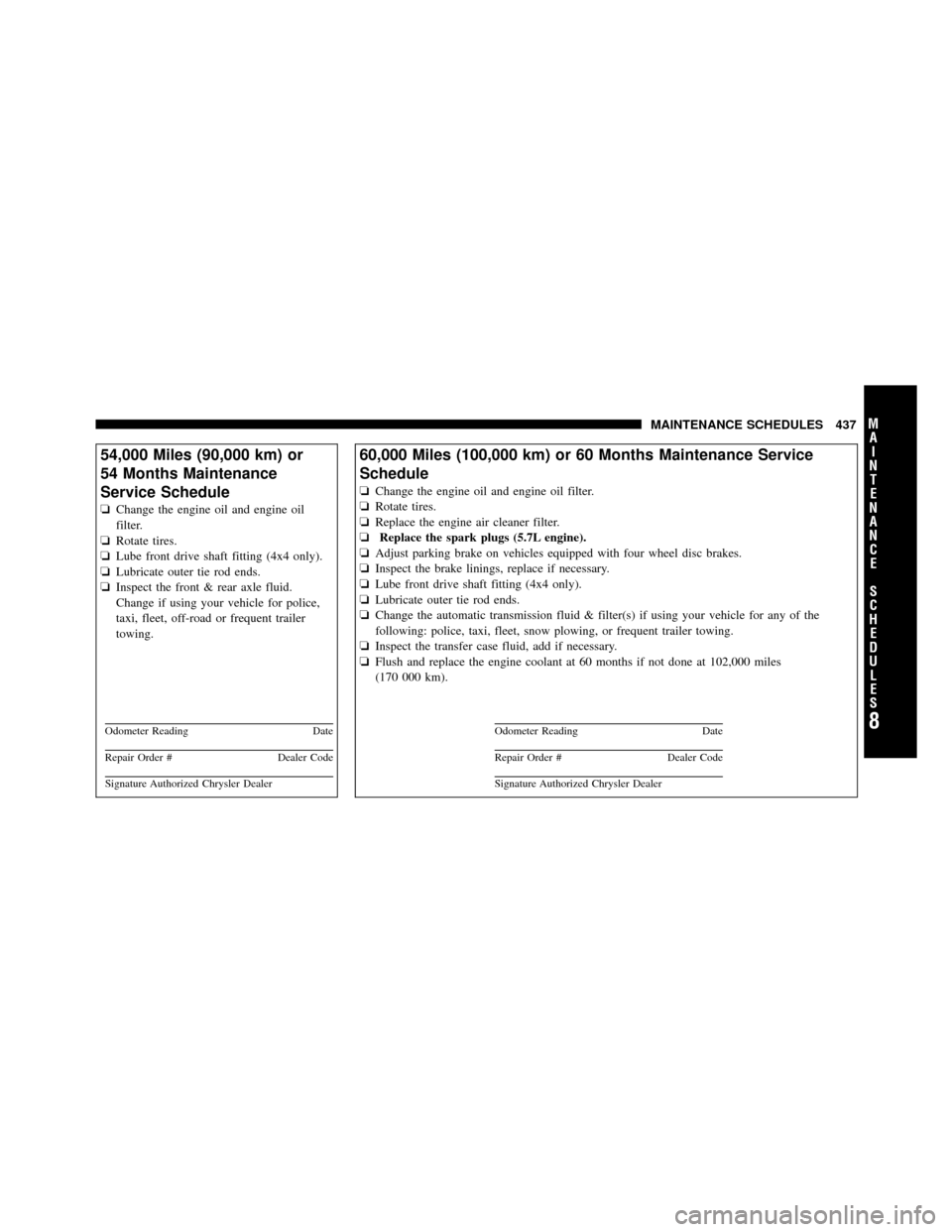
54,000 Miles (90,000 km) or
54 Months Maintenance
Service Schedule
❏Change the engine oil and engine oil
filter.
❏ Rotate tires.
❏ Lube front drive shaft fitting (4x4 only).
❏ Lubricate outer tie rod ends.
❏ Inspect the front & rear axle fluid.
Change if using your vehicle for police,
taxi, fleet, off-road or frequent trailer
towing.
Odometer Reading Date
Repair Order #Dealer Code
Signature Authorized Chrysler Dealer
60,000 Miles (100,000 km) or 60 Months Maintenance Service
Schedule
❏Change the engine oil and engine oil filter.
❏ Rotate tires.
❏ Replace the engine air cleaner filter.
❏ Replace the spark plugs (5.7L engine).
❏ Adjust parking brake on vehicles equipped with four wheel disc brakes.
❏ Inspect the brake linings, replace if necessary.
❏ Lube front drive shaft fitting (4x4 only).
❏ Lubricate outer tie rod ends.
❏ Change the automatic transmission fluid & filter(s) if using your vehicle for any of the
following: police, taxi, fleet, snow plowing, or frequent trailer towing.
❏ Inspect the transfer case fluid, add if necessary.
❏ Flush and replace the engine coolant at 60 months if not done at 102,000 miles
(170 000 km).
Odometer Reading Date
Repair Order #Dealer Code
Signature Authorized Chrysler Dealer
8
M
A I
N T
E
N A
N CE
S
C
H E
D
U L
E
SMAINTENANCE SCHEDULES 437