instrument panel Ram 5500 Chassis Cab 2015 Owner's Manual
[x] Cancel search | Manufacturer: RAM, Model Year: 2015, Model line: 5500 Chassis Cab, Model: Ram 5500 Chassis Cab 2015Pages: 599, PDF Size: 4.51 MB
Page 357 of 599
alignment and shift completion to occur. The preferred
method is with the vehicle rolling 2 to 3 mph (3 to
5 km/h). Avoid attempting to engage or disengage 4L
with the vehicle moving faster than 2 to 3 mph (3 to
5 km/h).
• Do not attempt to shift into or from 4L while the
transmission is in gear.
Transfer Case Position Indicator Light
The “Transfer Case Position Indicator Light” in the
instrument cluster is used to alert the driver that the front
axle is fully engaged and all four wheels are driving.
Electronically Shifted Transfer Case
(Four-Position Switch) — If Equipped
This is an electronic shift transfer case and is operated by
the 4WD Control Switch (Transfer Case Switch), which is
located on the instrument panel. This electronically shifted transfer case provides four
mode positions:
•
Two-wheel drive high range (2WD)
• Four-wheel drive lock range (4WD LOCK)
• Four-wheel drive low range (4WD LOW)
• Neutral (NEUTRAL)
Transfer Case Switch (Four-Position)
5
STARTING AND OPERATING 355
Page 369 of 599
WARNING!
Fluid level should be checked on a level surface and
with the engine off to prevent injury from moving
parts and to ensure accurate fluid level reading. Do
not overfill. Use only manufacturer’s recommended
power steering fluid.
If necessary, add fluid to restore to the proper indicated
level. With a clean cloth, wipe any spilled fluid from all
surfaces. Refer to “Fluids, Lubricants, and Genuine
Parts” in “Maintaining Your Vehicle” for further informa-
tion.
PARKING BRAKE
Before leaving the vehicle, make sure that the parking
brake is fully applied, the engine is off and the Key Fob
is removed from the ignition switch. Also, be certain to
leave an automatic transmission in PARK, or manual
transmission in REVERSE or first gear.
The foot operated parking brake is located below the
lower left corner of the instrument panel. To apply the
parking brake, firmly push the parking brake pedal fully.
To release the parking brake, pull the parking brake
release handle.
5
STARTING AND OPERATING 367
Page 377 of 599
WARNING!(Continued)
•HSA is not a parking brake. If you stop the vehicle
on a hill without putting the transmission in PARK
or using the parking brake, it will roll down the
incline and could collide with another vehicle,
object or person, and cause serious or fatal injury.
Always remember to use the parking brake while
parking on a hill and that the driver is responsible
for braking the vehicle.
HSA Off
HSA is a Customer Programmable Feature in the EVIC/
DID. If you wish to turn off the HSA feature, refer to
“Electronic Vehicle Information Center (EVIC)/Driver
Information Display (DID)” in “Understanding Your
Instrument Panel” for further information.
Electronic Stability Control (ESC)
The ESC system enhances directional control and stabil-
ity of the vehicle under various driving conditions. ESC
corrects for oversteering or understeering of the vehicle
by applying the brake of the appropriate wheel to assist
in counteracting the oversteer or understeer condition.
Engine power may also be reduced to help the vehicle
maintain the desired path.
ESC uses sensors in the vehicle to determine the vehicle
path intended by the driver and compares it to the actual
path of the vehicle. When the actual path does not match
the intended path, ESC applies the brake of the appro-
priate wheel to assist in counteracting the oversteer or
understeer condition.
• Oversteer - when the vehicle is turning more than
appropriate for the steering wheel position.
5
STARTING AND OPERATING 375
Page 447 of 599

EVIC/DID Display Messages
The trailer brake control interacts with the Electronic
Vehicle Information Center (EVIC)/Driver Information
Display (DID). Display messages, along with a single
chime, will be displayed when a malfunction is deter-
mined in the trailer connection, trailer brake control, or
on the trailer. Refer to “Electronic Vehicle Information
Center/Driver Information Display (DID)” in “Under-
standing Your Instrument Panel” for further information.
CAUTION!
Connecting a trailer that is not compatible with the
ITBM system may result in reduced or complete loss
of trailer braking. There may be a increase in stop-
ping distance or trailer instability which could result
in damage to your vehicle, trailer, or other property.
WARNING!
Connecting a trailer that is not compatible with the
ITBM system may result in reduced or complete loss
of trailer braking. There may be a increase in stop-
ping distance or trailer instability which could result
in personal injury.
NOTE:
• An aftermarket controller may be available for use
with trailers with air or electric-over-hydraulic trailer
brake systems. To determine the type of brakes on
your trailer and the availability of controllers, check
with your trailer manufacturer or dealer.
• Removal of the ITBM will cause errors and it may
cause damage to the electrical system and electronic
modules of the vehicle. See your authorized dealer if
an aftermarket module is to be installed.
5
STARTING AND OPERATING 445
Page 492 of 599
(EVIC)” or “Driver Information Display (DID)” in “Un-
derstanding Your Instrument Panel” for further informa-
tion. Tighten the fuel filler cap properly and press the
SELECT button to turn off the message. If the problem
continues, the message will appear the next time the
vehicle is started.
A loose, improperly installed, or damaged fuel filler cap
may also turn on the Malfunction Indicator Light (MIL).
EMISSIONS INSPECTION AND MAINTENANCE
PROGRAMS
In some localities, it may be a legal requirement to pass
an inspection of your vehicle’s emissions control system.
Failure to pass could prevent vehicle registration.For states that require an Inspection and Mainte-
nance (I/M), this check verifies the “Malfunction
Indicator Light (MIL)” is functioning and is not
on when the engine is running, and that the OBD II
system is ready for testing. Normally, the OBD II system will be ready. The OBD II
system may
notbe ready if your vehicle was recently
serviced, recently had a dead battery or a battery replace-
ment. If the OBD II system should be determined not
ready for the I/M test, your vehicle may fail the test.
Your vehicle has a simple ignition actuated test, which
you can use prior to going to the test station. To check if
your vehicle’s OBD II system is ready, you must do the
following:
1. Cycle the ignition switch to the ON position, but do not crank or start the engine.
NOTE: If you crank or start the engine, you will have to
start this test over.
2. As soon as you cycle the ignition switch to the ON position, you will see the Malfunction Indicator Light
(MIL) symbol come on as part of a normal bulb check.
490 MAINTAINING YOUR VEHICLE
Page 528 of 599

Fluid Level Check
Check the fluid level when the engine is fully warmed up
and the transmission fluid is at normal operating tem-
perature. Driving with an improper fluid level will
greatly reduce the life of the transmission and of the
fluid. Check the fluid level whenever the vehicle is
serviced.
Fluid Level Check — Procedure
It is best to check the fluid level when the transmission is
at normal operating temperature (170-180°F / 77-82°C for
66RFE transmission, or 158–176°F / 70–80°C for AS66RC
transmission). This normally occurs after at least 15 miles
(25 km) of driving. At normal operating temperature the
fluid cannot be held comfortably between the fingertips.
You can read the transmission sump temperature in theEVIC/DID display (refer to “Electronic Vehicle Informa-
tion Center (EVIC)/Driver Information Display (DID)” in
“Understanding Your Instrument Panel” for further in-
formation).
Use the following procedure to check the transmission
fluid level properly:
1. Monitor the transmission temperature using the
EVIC/DID display, and operate the vehicle as re-
quired to reach the normal operating temperature. If
the transmission is not functioning properly, or the
vehicle cannot be driven, see the NOTE and CAU-
TION below about checking the fluid level at colder
temperatures.
2. Park the vehicle on level ground.
3. Run the engine at normal idle speed for at least 60 seconds, and leave the engine running for the rest
of this procedure.
526 MAINTAINING YOUR VEHICLE
Page 542 of 599
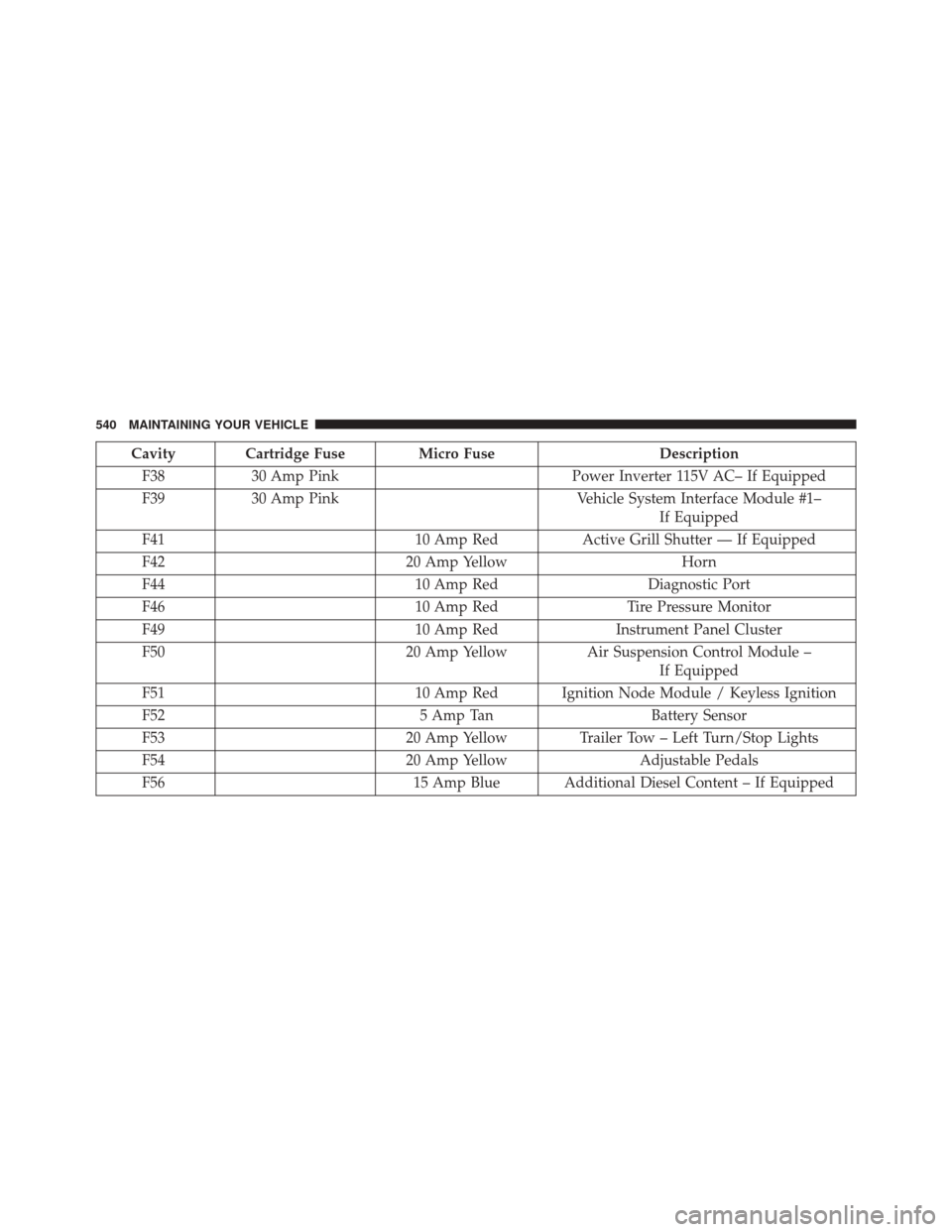
Cavity Cartridge Fuse Micro FuseDescription
F38 30 Amp Pink Power Inverter 115V AC– If Equipped
F39 30 Amp Pink Vehicle System Interface Module #1–
If Equipped
F41 10 Amp RedActive Grill Shutter — If Equipped
F42 20 Amp Yellow Horn
F44 10 Amp RedDiagnostic Port
F46 10 Amp RedTire Pressure Monitor
F49 10 Amp RedInstrument Panel Cluster
F50 20 Amp YellowAir Suspension Control Module –
If Equipped
F51 10 Amp Red Ignition Node Module / Keyless Ignition
F52 5 Amp TanBattery Sensor
F53 20 Amp Yellow Trailer Tow – Left Turn/Stop Lights
F54 20 Amp YellowAdjustable Pedals
F56 15 Amp Blue Additional Diesel Content – If Equipped
540 MAINTAINING YOUR VEHICLE
Page 545 of 599
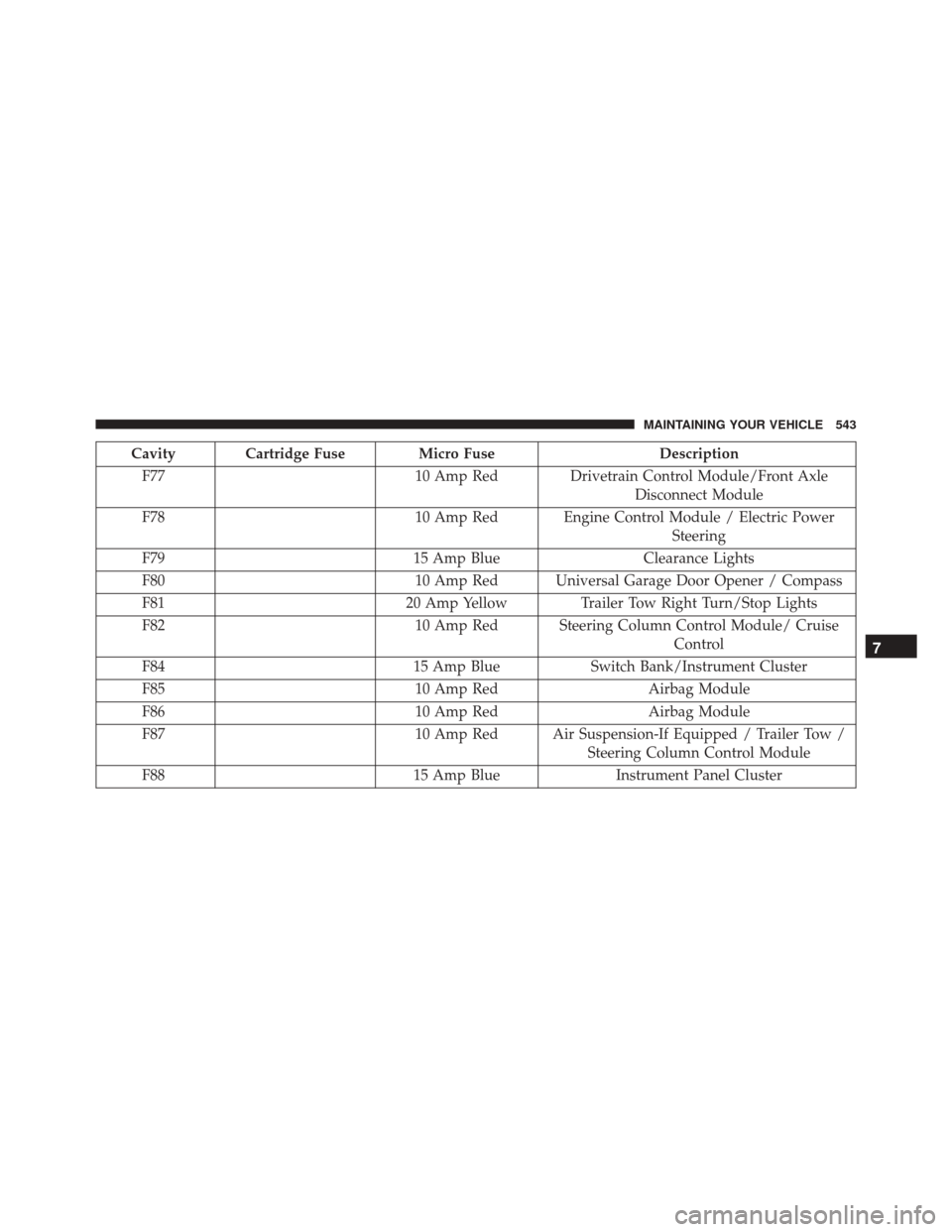
Cavity Cartridge Fuse Micro FuseDescription
F77 10 Amp Red Drivetrain Control Module/Front Axle
Disconnect Module
F78 10 Amp Red Engine Control Module / Electric Power
Steering
F79 15 Amp BlueClearance Lights
F80 10 Amp Red Universal Garage Door Opener / Compass
F81 20 Amp Yellow Trailer Tow Right Turn/Stop Lights
F82 10 Amp Red Steering Column Control Module/ Cruise
Control
F84 15 Amp BlueSwitch Bank/Instrument Cluster
F85 10 Amp RedAirbag Module
F86 10 Amp RedAirbag Module
F87 10 Amp Red Air Suspension-If Equipped / Trailer Tow /
Steering Column Control Module
F88 15 Amp BlueInstrument Panel Cluster
7
MAINTAINING YOUR VEHICLE 543
Page 546 of 599
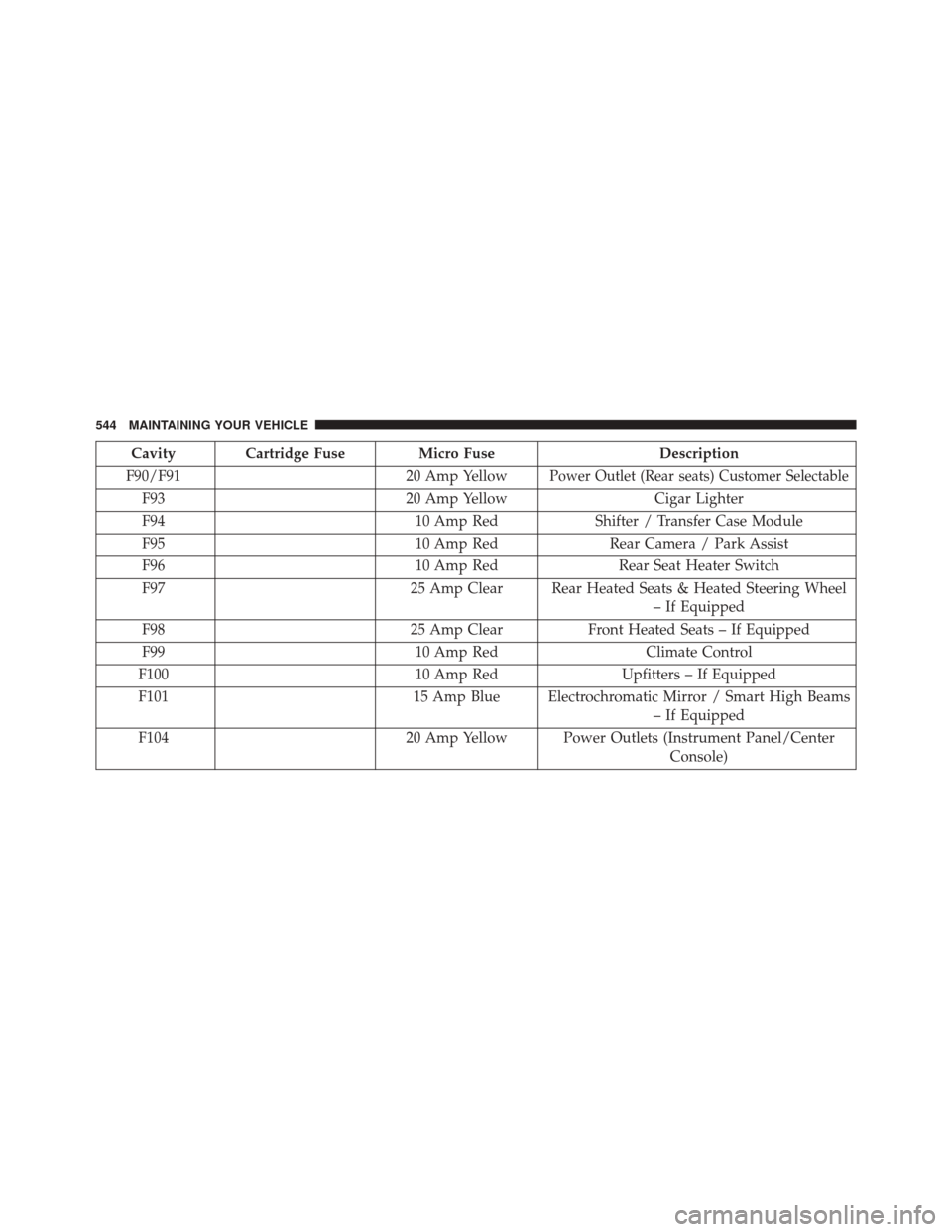
Cavity Cartridge Fuse Micro FuseDescription
F90/F91 20 Amp Yellow
Power Outlet (Rear seats) Customer Selectable
F9320 Amp YellowCigar Lighter
F94 10 Amp RedShifter / Transfer Case Module
F95 10 Amp RedRear Camera / Park Assist
F96 10 Amp RedRear Seat Heater Switch
F97 25 Amp Clear Rear Heated Seats & Heated Steering Wheel
– If Equipped
F98 25 Amp ClearFront Heated Seats – If Equipped
F99 10 Amp RedClimate Control
F100 10 Amp RedUpfitters – If Equipped
F101 15 Amp Blue Electrochromatic Mirror / Smart High Beams
– If Equipped
F104 20 Amp Yellow Power Outlets (Instrument Panel/Center
Console)
544 MAINTAINING YOUR VEHICLE
Page 562 of 599
MAINTENANCE SCHEDULE
Your vehicle is equipped with an automatic oil change
indicator system. The oil change indicator system will
remind you that it is time to take your vehicle in for
scheduled maintenance.
Based on engine operation conditions, the oil change
indicator message will illuminate. This means that ser-
vice is required for your vehicle. Operating conditions
such as frequent short-trips, trailer tow, extremely hot or
cold ambient temperatures, and E85 fuel usage will
influence when the “Oil Change Required” message is
displayed. Severe Operating Conditions can cause the
change oil message to illuminate as early as 3,500 miles
(5,600 km) since last reset. Have your vehicle serviced as
soon as possible, within the next 500 miles (805 km).
Your authorized dealer will reset the oil change indicator
message after completing the scheduled oil change. If a
scheduled oil change is performed by someone other
than your authorized dealer, the message can be reset byreferring to the steps described under “Electronic Vehicle
Information Center (EVIC)/Driver Information Display
(DID)” in “Understanding Your Instrument Panel” for
further information.
NOTE:
•
Gasoline Engines
• Under no circumstances should oil change intervals
exceed 8,000 miles (13,000 km) or twelve months,
whichever comes first.
• Severe Duty
•
Change Engine Oil at 4000 miles (6,500 km) if the vehicle
is operated in a dusty and off road environment. This
type of vehicle use is considered Severe Duty
Once A Month Or Before A Long Trip:
• Check engine oil level
• Check windshield washer fluid level
560 MAINTENANCE SCHEDULES