weight Ram 5500 Chassis Cab 2015 Owner's Guide
[x] Cancel search | Manufacturer: RAM, Model Year: 2015, Model line: 5500 Chassis Cab, Model: Ram 5500 Chassis Cab 2015Pages: 599, PDF Size: 4.51 MB
Page 435 of 599

WARNING!
•An improperly adjusted weight distributing hitch
system may reduce handling, stability and braking
performance and could result in a collision.
• Weight distributing systems may not be compat-
ible with surge brake couplers. Consult with your
hitch and trailer manufacturer or a reputable Rec-
reational Vehicle dealer for additional information.
Without Weight-Distributing Hitch (Incorrect)
5
STARTING AND OPERATING 433
Page 436 of 599

Fifth-Wheel Hitch
The fifth-wheel hitch is a special high platform with a
coupling that mounts over the rear axle of the tow vehicle
in the truck bed. It connects a vehicle and fifth-wheel
trailer with a coupling king pin.
With Weight-Distributing Hitch (Correct)Improper Adjustment Of Weight-Distributing Hitch(Incorrect)
434 STARTING AND OPERATING
Page 437 of 599
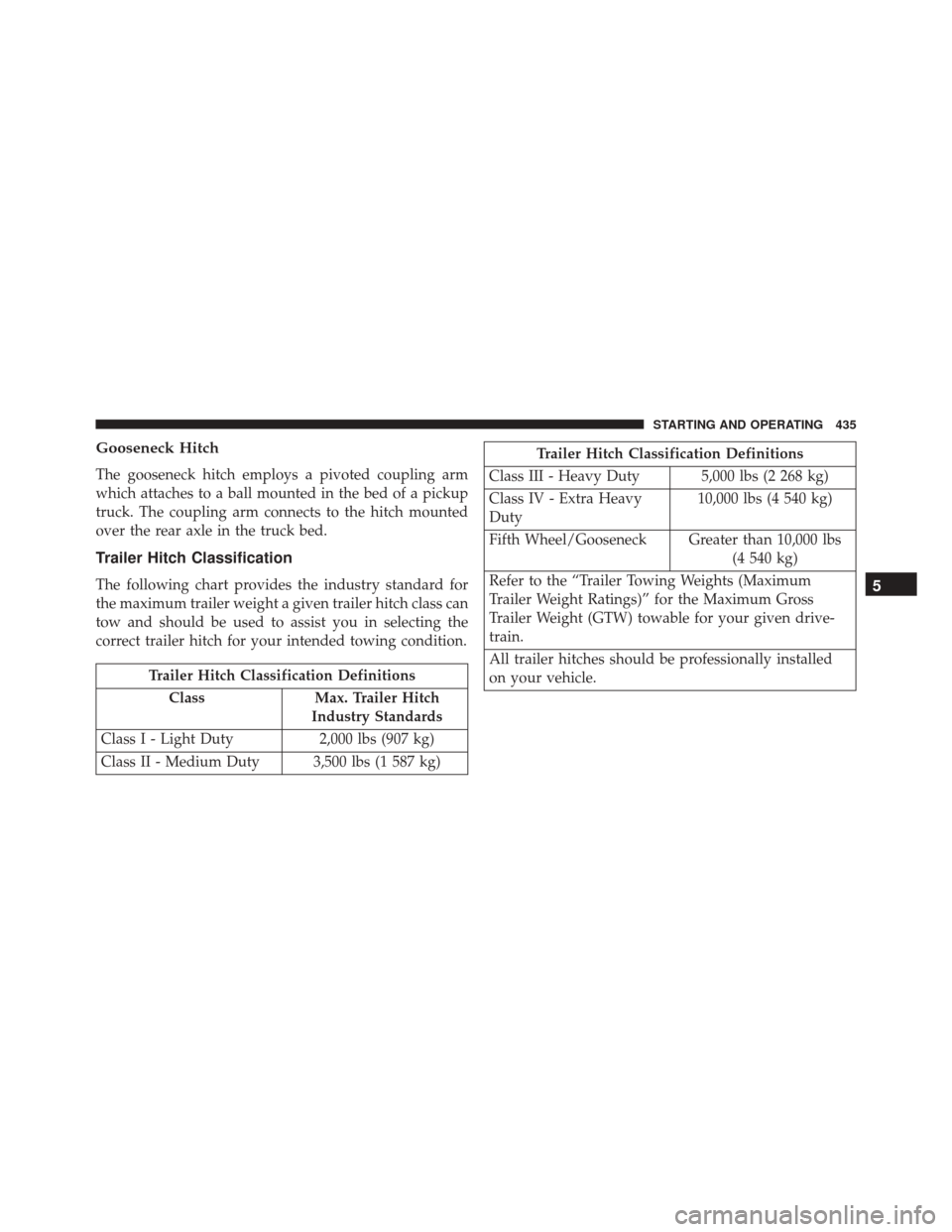
Gooseneck Hitch
The gooseneck hitch employs a pivoted coupling arm
which attaches to a ball mounted in the bed of a pickup
truck. The coupling arm connects to the hitch mounted
over the rear axle in the truck bed.
Trailer Hitch Classification
The following chart provides the industry standard for
the maximum trailer weight a given trailer hitch class can
tow and should be used to assist you in selecting the
correct trailer hitch for your intended towing condition.
Trailer Hitch Classification DefinitionsClass Max. Trailer Hitch
Industry Standards
Class I - Light Duty 2,000 lbs (907 kg)
Class II - Medium Duty 3,500 lbs (1 587 kg)
Trailer Hitch Classification Definitions
Class III - Heavy Duty 5,000 lbs (2 268 kg)
Class IV - Extra Heavy
Duty 10,000 lbs (4 540 kg)
Fifth Wheel/Gooseneck Greater than 10,000 lbs (4 540 kg)
Refer to the “Trailer Towing Weights (Maximum
Trailer Weight Ratings)” for the Maximum Gross
Trailer Weight (GTW) towable for your given drive-
train.
All trailer hitches should be professionally installed
on your vehicle.
5
STARTING AND OPERATING 435
Page 438 of 599
Trailer Towing Weights (Maximum Trailer Weight
Ratings)
NOTE:For additional trailer towing information (maxi-
mum trailer weight ratings) refer to the following website
addresses:
• ramtrucks.com/en/towing_guide/
• ramtruck.ca (Canada)
• rambodybuilder.com
Trailer And Tongue Weight
Always load a trailer with 60% of the weight in the front
of the trailer. This places 10% of the GTW on the tow
hitch of your vehicle. Loads balanced over the wheels or
heavier in the rear can cause the trailer to sway severely
side to side which will cause loss of control of the vehicle
and trailer. Failure to load trailers heavier in front is the
cause of many trailer collisions. Never exceed the maxi-
mum tongue weight stamped on your trailer hitch. Consider the following items when computing the
weight on the rear axle of the vehicle:
•
The tongue weight of the trailer
• The weight of any other type of cargo or equipment
put in or on your vehicle
• The weight of the driver and all passengers
436 STARTING AND OPERATING
Page 441 of 599
WARNING!(Continued)
•Total weight must be distributed between the tow
vehicle and the trailer such that the following four
ratings are not exceeded:
1. GVWR
2. GTW
3. GAWR
4. Tongue weight rating for the trailer hitch uti-
lized.
Towing Requirements — Tires
• Do not attempt to tow a trailer while using a compact
spare tire.
• Proper tire inflation pressures are essential to the safe
and satisfactory operation of your vehicle. Refer to “Tires – General Information” in “Starting and Oper-
ating” for proper tire inflation procedures.
• Check the trailer tires for proper tire inflation pres-
sures before trailer usage.
• Check for signs of tire wear or visible tire damage
before towing a trailer. Refer to “Tires – General
Information” in “Starting and Operating” for the
proper inspection procedure.
• When replacing tires, refer to “Tires – General Infor-
mation” in “Starting and Operating” for proper tire
replacement procedures. Replacing tires with a higher
load carrying capacity will not increase the vehicle’s
GVWR and GAWR limits.
5
STARTING AND OPERATING 439
Page 451 of 599
Snowplow Prep Package Model Availability
For Information about snowplow applications visit
www.ramtrucks.com or refer to the current Ram Body
Builders Guide.
1. The maximum number of occupants in the truckshould not exceed two.
2. The total GVWR or the Front GAWR or the Rear GAWR should never be exceeded.
3. Cargo capacity will be reduced by the addition of options or passengers, etc.
The loaded vehicle weight, including the snowplow
system, all aftermarket accessories, driver, passengers,
options, and cargo, must not exceed either the Gross
Vehicle Weight (GVWR) or Gross Axle Weight (GAWR)
ratings. These weights are specified on the Safety Com-
pliance Certification Label on the driver’s side door
opening. NOTE:
Detach the snowplow when transporting pas-
sengers.
Vehicle front end wheel alignment was set to specifica-
tions at the factory without consideration for the weight
of the plow. Front end toe-in should be checked and reset
if necessary at the beginning and end of the snowplow
season. This will help prevent uneven tire wear.
The blade should be lowered whenever the vehicle is
parked.
Maintain and operate your vehicle and snowplow equip-
ment following the recommendations provided by the
specific snowplow manufacturer.
Over The Road Operation With Snowplow
Attached
The blade restricts air flow to the radiator and causes the
engine to operate at higher than normal temperatures.
Therefore, when transporting the plow, angle the blade
5
STARTING AND OPERATING 449
Page 497 of 599
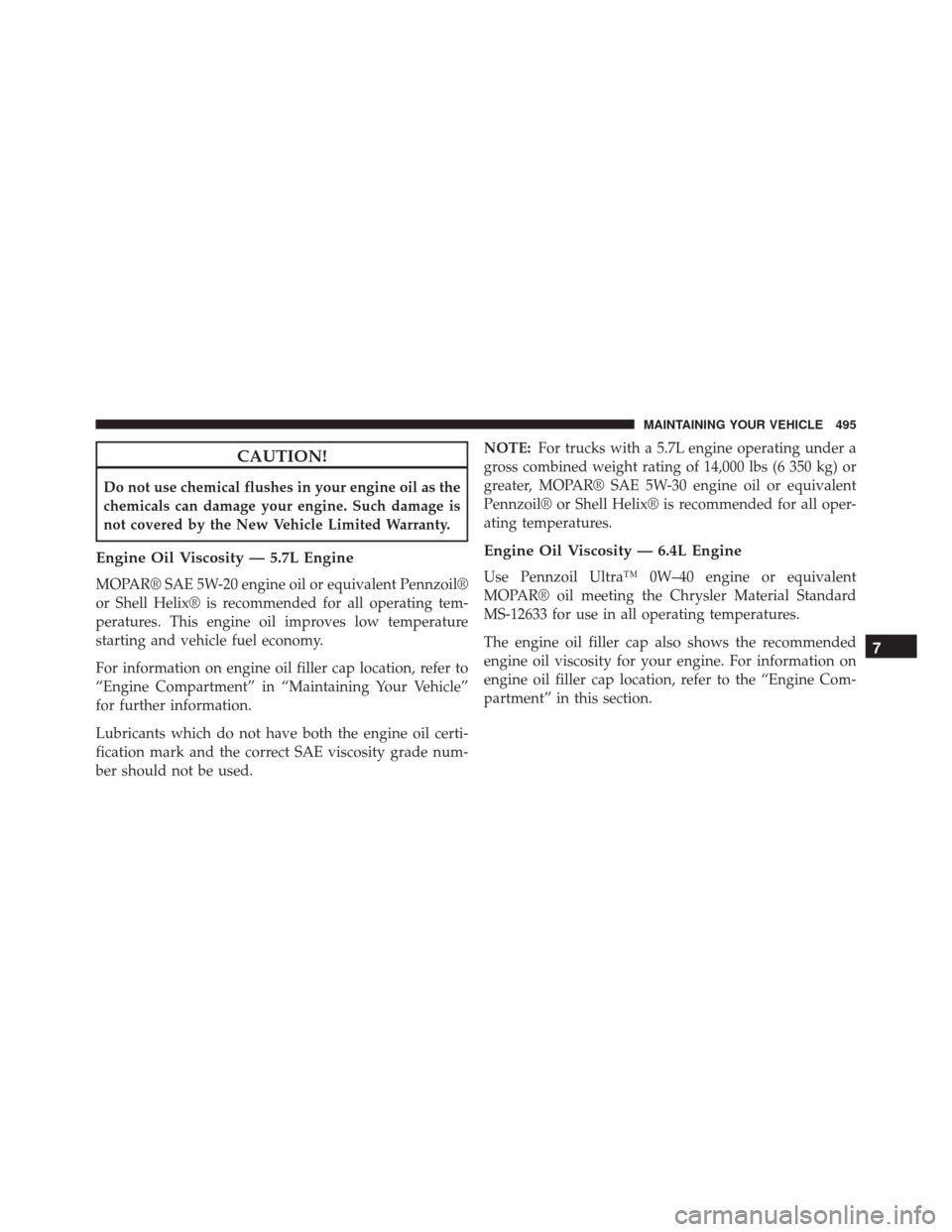
CAUTION!
Do not use chemical flushes in your engine oil as the
chemicals can damage your engine. Such damage is
not covered by the New Vehicle Limited Warranty.
Engine Oil Viscosity — 5.7L Engine
MOPAR® SAE 5W-20 engine oil or equivalent Pennzoil®
or Shell Helix® is recommended for all operating tem-
peratures. This engine oil improves low temperature
starting and vehicle fuel economy.
For information on engine oil filler cap location, refer to
“Engine Compartment” in “Maintaining Your Vehicle”
for further information.
Lubricants which do not have both the engine oil certi-
fication mark and the correct SAE viscosity grade num-
ber should not be used.NOTE:
For trucks with a 5.7L engine operating under a
gross combined weight rating of 14,000 lbs (6 350 kg) or
greater, MOPAR® SAE 5W-30 engine oil or equivalent
Pennzoil® or Shell Helix® is recommended for all oper-
ating temperatures.
Engine Oil Viscosity — 6.4L Engine
Use Pennzoil Ultra™ 0W–40 engine or equivalent
MOPAR® oil meeting the Chrysler Material Standard
MS-12633 for use in all operating temperatures.
The engine oil filler cap also shows the recommended
engine oil viscosity for your engine. For information on
engine oil filler cap location, refer to the “Engine Com-
partment” in this section.
7
MAINTAINING YOUR VEHICLE 495
Page 557 of 599
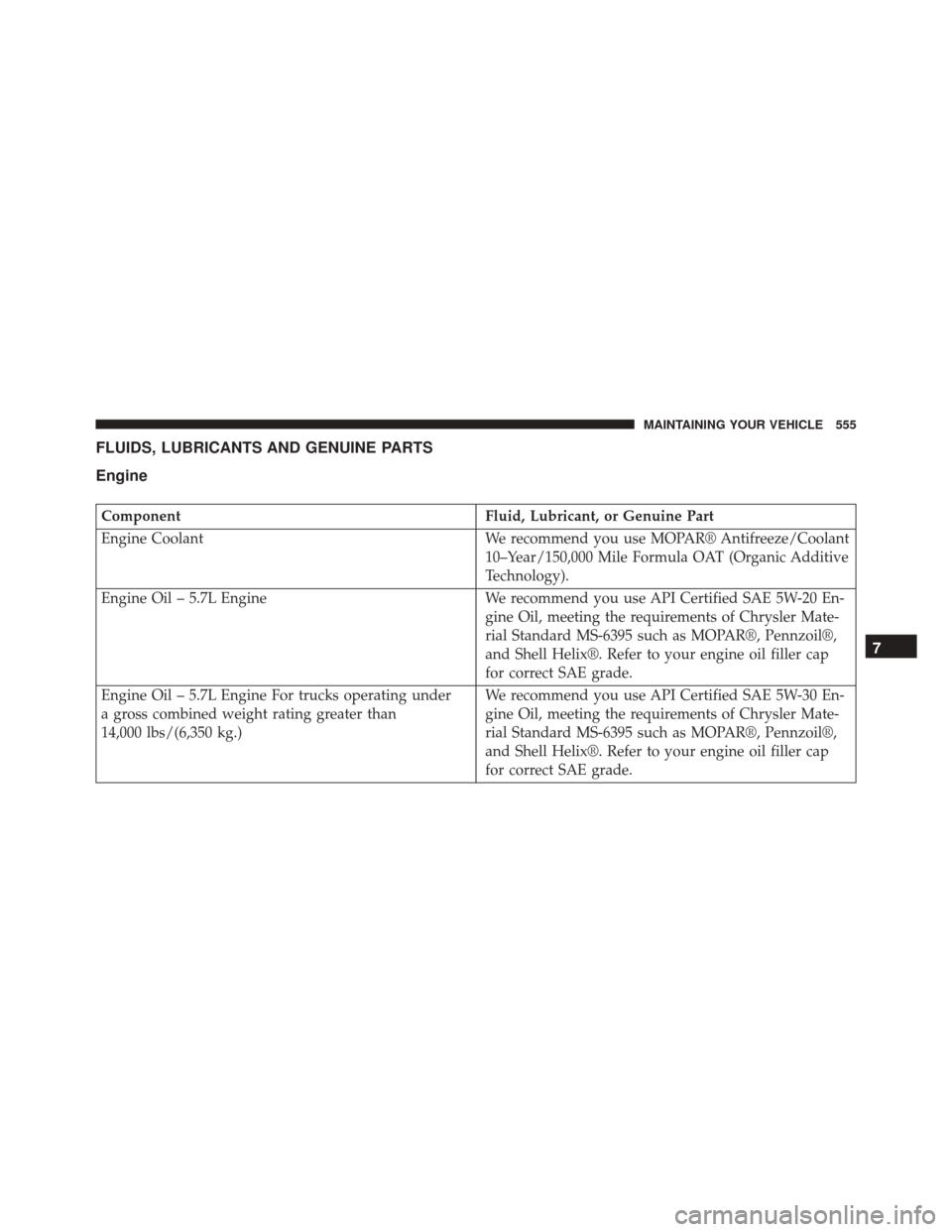
FLUIDS, LUBRICANTS AND GENUINE PARTS
Engine
ComponentFluid, Lubricant, or Genuine Part
Engine Coolant We recommend you use MOPAR® Antifreeze/Coolant
10–Year/150,000 Mile Formula OAT (Organic Additive
Technology).
Engine Oil – 5.7L Engine We recommend you use API Certified SAE 5W-20 En-
gine Oil, meeting the requirements of Chrysler Mate-
rial Standard MS-6395 such as MOPAR®, Pennzoil®,
and Shell Helix®. Refer to your engine oil filler cap
for correct SAE grade.
Engine Oil – 5.7L Engine For trucks operating under
a gross combined weight rating greater than
14,000 lbs/(6,350 kg.) We recommend you use API Certified SAE 5W-30 En-
gine Oil, meeting the requirements of Chrysler Mate-
rial Standard MS-6395 such as MOPAR®, Pennzoil®,
and Shell Helix®. Refer to your engine oil filler cap
for correct SAE grade.
7
MAINTAINING YOUR VEHICLE 555
Page 586 of 599
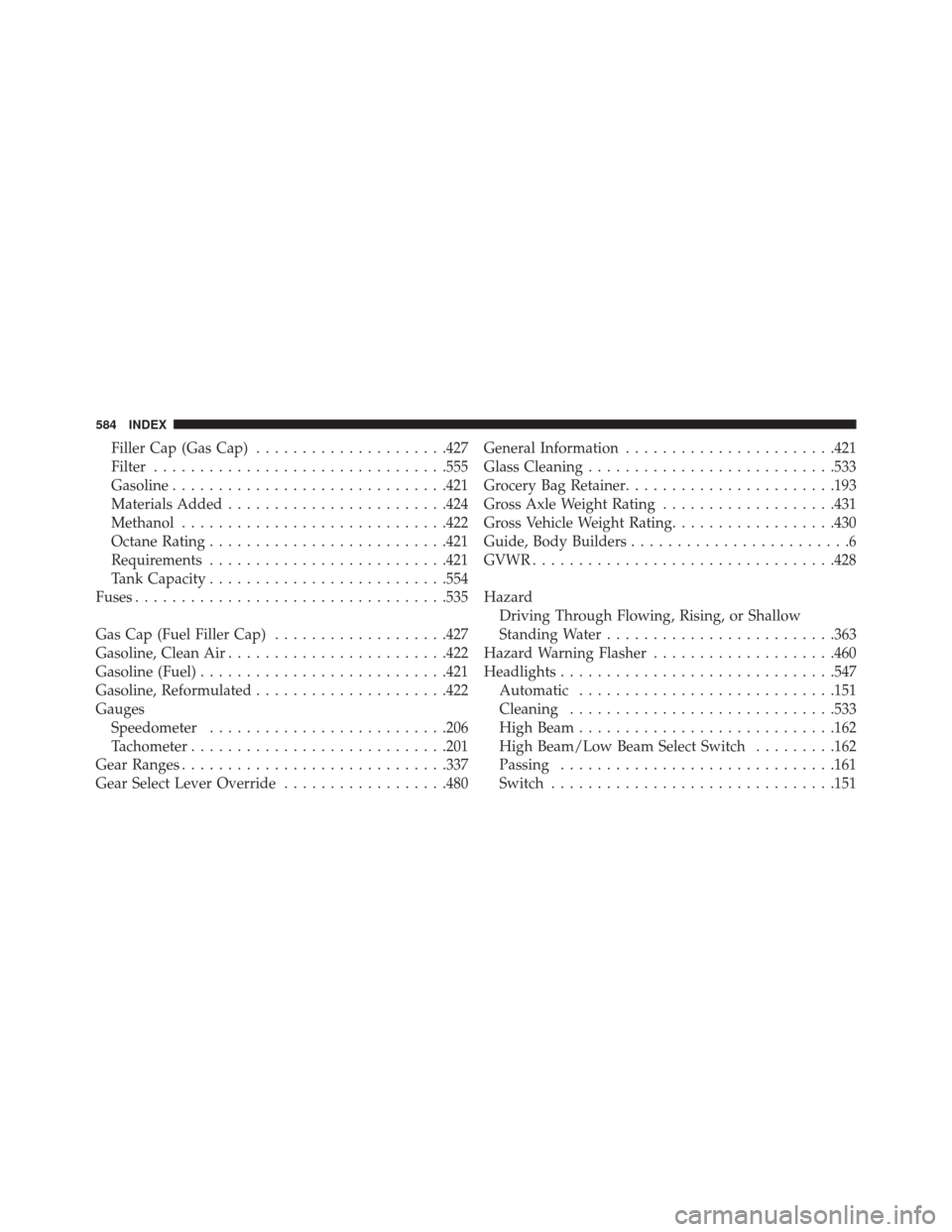
Filler Cap (Gas Cap).....................427
Filter ............................... .555
Gasoline ............................. .421
Materials Added ....................... .424
Methanol ............................ .422
Octane Rating ......................... .421
Requirements ......................... .421
Tank Capacity ......................... .554
Fuses ................................. .535
Gas Cap (Fuel Filler Cap) ...................427
Gasoline, Clean Air ....................... .422
Gasoline (Fuel) .......................... .421
Gasoline, Reformulated .....................422
Gauges Speedometer ......................... .206
Tachometer ........................... .201
Gear Ranges ............................ .337
Gear Select Lever Override ..................480 General Information
...................... .421
Glass Cleaning .......................... .533
Grocery Bag Retainer ...................... .193
Gross Axle Weight Rating ...................431
Gross Vehicle Weight Rating ..................430
Guide, Body Builders ........................6
GVWR ................................ .428
Hazard Driving Through Flowing, Rising, or Shallow
Standing Water ........................ .363
Hazard Warning Flasher ....................460
Headlights ............................. .547
Automatic ........................... .151
Cleaning ............................ .533
High Beam ........................... .162
High Beam/Low Beam Select Switch .........162
Passing ............................. .161
Switch .............................. .151
584 INDEX
Page 595 of 599

Aging (Life of Tires).....................404
Air Pressure .......................... .394
Chains .............................. .407
Compact Spare ........................ .401
Dual ............................... .410
General Information .....................394
High Speed .......................... .397
Inflation Pressures ...................... .395
Life of Tires .......................... .404
Load Capacity ........................ .389
Pressure Monitor System (TPMS) ............411
Pressure Warning Light ...................207
Quality Grading ....................... .575
Radial .............................. .398
Replacement .......................... .405
Rotation ............................. .409
Safety .............................. .382
Sizes ............................... .383
Snow Tires ........................... .399Spinning
............................ .403
Tread Wear Indicators ....................403
Wheel Nut Torque ..................... .469
Tire Safety Information .....................382
Tongue Weight/Trailer Weight ................436
Torque Converter Clutch ....................347
Tow Hooks, Emergency .....................479
Towing ............................... .430
Disabled Vehicle ....................... .481
Guide .............................. .436
Recreational .......................... .451
Weight .............................. .436
Towing Vehicle Behind a Motorhome ...........451
Traction ............................... .362
Traction Control ......................... .372
Trailer Sway Control (TSC) ..................381
T
railer Towing .......................... .430
Cooling System Tips .....................447
Hitches ............................. .43510
INDEX 593