fuel Ram 5500 Chassis Cab 2016 Diesel Supplement
[x] Cancel search | Manufacturer: RAM, Model Year: 2016, Model line: 5500 Chassis Cab, Model: Ram 5500 Chassis Cab 2016Pages: 338, PDF Size: 1.63 MB
Page 209 of 338
NOTE:
•Engine idle speed will automatically increase to
1,000 RPM and engage the Variable Geometry Turbo-
charger at low coolant temperatures to improve engine
warm-up.
• When a diesel engine is allowed to run out of fuel or
the fuel gels at low temperatures, air is pulled into the
fuel system. If your engine has run out of fuel, refer to
“Maintenance Procedures/Priming If The Engine Has
Run Out Of Fuel” in “Maintaining Your Vehicle” for
further information.
• If the engine stalls, or if the ignition switch is left ON
for more than two minutes after the “Wait To Start”
telltale goes out, reset the grid heaters by turning the
ignition switch to the OFF position for at least five
seconds and then back ON. Repeat steps 1 through 5 of
“Starting Procedure – Engine Manifold Air Tempera-
ture Below 66°F (19°C).”Starting Fluids
WARNING!
Starting fluids or flammable liquids must never be
used in the Cummins diesel engine (see Warning
label). Never pour diesel fuel, flammable liquid,
starting fluids (ether) into the air cleaner canister, air
intake piping, or turbocharger inlet in an attempt to
start the vehicle. This could result in a flash fire and
explosion causing serious personal injury and engine
damage.
The engine is equipped with an automatic electric air
preheating system. If the instructions in this manual are
followed, the engine should start in all conditions.
5
STARTING AND OPERATING 207
Page 211 of 338
the post-heat cycle of the intake manifold heater system.
The number of cycles and the length of the cycling
operation is controlled by the engine control module.
Post-heat operation can run for several minutes, and then
the electrical system and voltmeter needle will stabilize.
The cycling action will cause temporary dimming of the
headlamps, interior lamps, and also a noticeable reduc-
tion in blower motor speed.
Cold Weather Precautions
Operation in ambient temperature below 32°F (0°C) may
require special considerations. The following charts sug-
gest these options:
Fuel Operating Range
NOTE:Use “Ultra Low Sulfur Diesel Fuels” ONLY.*No. 1 Ultra Low Sulfur Diesel Fuel should only be used
where extended arctic conditions (-10°F/-23°C) exist.
NOTE:
•
Use of Climatized Ultra Low Sulfur Diesel Fuel or
Number 1 Ultra Low Sulfur Diesel Fuel results in a
noticeable decrease in fuel economy.
Fuel Operating Range Chart
5
STARTING AND OPERATING 209
Page 212 of 338
•Climatized Ultra Low Sulfur Diesel Fuel is a blend of
Number 2 Ultra Low Sulfur and Number 1 Ultra Low
Sulfur Diesel Fuels which reduces the temperature at
which wax crystals form in fuel.
• The fuel grade should be clearly marked on the pump
at the fuel station.
• The engine requires the use of “Ultra Low Sulfur
Diesel Fuel”. Use of incorrect fuel could result in
engine and exhaust system damage. Refer to “Fuel
Requirements” in “Starting And Operating” for fur-
ther information.
• Commercially available fuel additives are not neces-
sary for the proper operation of your Cummins diesel
engine. However, if seasonably adjusted fuel is not
available and you are operating below 20°F (-6°C),
MOPAR Premium Diesel Fuel Treatment (or equiva-
lent) may be beneficial to avoid fuel gelling.Engine Oil Usage
Refer to “Maintenance Procedures” in “Maintaining Your
Vehicle” for the correct engine oil viscosity.
Winter Front Usage
A winter front or cold weather cover is to be used in
ambient temperatures below 32°F (0°C), especially dur-
ing extended idle conditions to reduce condensation
build-up within engine crankcase. If a winter front or
cold weather cover is to be used, a percentage of the total
grille opening area must be left uncovered to provide
sufficient air flow to the charge air cooler and automatic
transmission oil cooler. The percentage of opening must
be increased with the increasing ambient air temperature
and/or engine load. If the cooling fan can be heard
cycling frequently, increase the size of the opening in the
winter front. A suitable cold weather cover is available
from your MOPAR dealer.
210 STARTING AND OPERATING
Page 214 of 338
•Operating the exhaust brake at idle will greatly im-
prove warm up rate and will help keep the engine
close to operating temperature during extended idle.
Engine Idling
Avoid prolonged idling, long periods of idling may be
harmful to your engine because combustion chamber
temperatures can drop so low that the fuel may not burn
completely. Incomplete combustion allows carbon and
varnish to form on piston rings, engine valves, and
injector nozzles. Also, the unburned fuel can enter the
crankcase, diluting the oil and causing rapid wear to the
engine.
If the engine is allowed to idle, under some conditions
the idle speed may increase to 900 RPM then return to
normal idle speed. This is normal operation. NOTE:
For EVIC/DID messages related to the vehicle’s
exhaust system, refer to “Electronic Vehicle Information
Center (EVIC)” or “Driver Information Display (DID)”
for further information.Idle-Up Feature — Automatic Transmission Only
The driver-controlled high idle speed feature will help
increase cylinder temperatures and provide additional
cab heat, however, excessive idling may still cause the
exhaust aftertreatment system to not properly regenerate.
Extended periods of idle time should be avoided.
The Idle-Up feature uses the speed control switches to
increase engine idle speed and quickly warm the vehi-
cle’s interior.
1. With the transmission in PARK, the parking brake applied, and the engine running, push the speed
control switch to the ON position, then push the SET
switch.
212 STARTING AND OPERATING
Page 217 of 338
Operating Precautions
Avoid Overheating The Engine
The temperature of the engine coolant (antifreeze) (a
mixture of 50% ethylene-glycol and 50% water) must not
exceed the normal range of the temperature gauge 240°F
(116°C) with a 21 psi (145 kPa) coolant pressure cap.
Usually the engine coolant (antifreeze) temperature indi-
cated during operation will be to the left of center in the
normal range of the gauge.
Avoid Low Coolant Temperature Operation
Continual operation at low engine coolant (antifreeze)
temperature below the normal range on the gauge 140°F
(60°C) can be harmful to the engine. Low engine coolant
(antifreeze) temperature can cause incomplete combus-
tion which allows carbon and varnish to form on pistonrings and injector nozzles. Also, the unburned fuel can
enter the crankcase, diluting the lubricating oil and
causing rapid wear to the engine.
Cooling System Tips — Automatic Transmission
To reduce potential for engine and transmission over-
heating in high ambient temperature conditions, take the
following actions:
•
City Driving —
When stopped, shift the transmission into NEUTRAL
and increase engine idle speed.
• Highway Driving —
Reduce your speed.
• Up Steep Hills —
Select a lower transmission gear.
• Air Conditioning —
Turn it off temporarily.
5
STARTING AND OPERATING 215
Page 218 of 338
Do Not Operate The Engine With Low Oil
Pressure
When the engine is at normal operating temperature, the
minimum oil pressures required are:
Idle 700 to 800 RPM 10 psi (69 kPa)
Full speed and load 30 psi (207 kPa)
CAUTION!
If oil pressure falls to less than normal readings, shut
the engine off immediately. Failure to do so could
result in immediate and severe engine damage.
Do Not Operate The Engine With Failed Parts
All engine failures give some warning before the parts
fail. Be on the alert for changes in performance, sounds,
and visual evidence that the engine requires service.
Some important clues are:
•Engine misfiring or vibrating severely.
• Sudden loss of power.
• Unusual engine noises.
• Fuel, oil or coolant leaks.
• Sudden change, outside the normal operating range, in
the engine operating temperature.
• Excessive smoke.
• Oil pressure drop.
216 STARTING AND OPERATING
Page 230 of 338
DRIVE (D)
This range should be used for most city and highway
driving. It provides the smoothest upshifts and down-
shifts, and the best fuel economy. The transmission
automatically upshifts through underdrive first, second,
and third gears, direct fourth gear and overdrive fifth and
sixth gears. The DRIVE position provides optimum driv-
ing characteristics under all normal operating conditions.
When frequent transmission shifting occurs (such as
when operating the vehicle under heavy loading condi-
tions, in hilly terrain, traveling into strong head winds, or
while towing heavy trailers), use the Electronic Range
Select (ERS) shift control (refer to “Electronic Range
Select (ERS) Operation” in this section for further infor-
mation) to select a lower gear range. Under these condi-
tions, using a lower gear range will improve performance
and extend transmission life by reducing excessive shift-
ing and heat buildup.If the transmission temperature exceeds normal operat-
ing limits, the powertrain controller will modify the
transmission shift schedule and expand the range of
torque converter clutch engagement. This is done to
prevent transmission damage due to overheating.
If the transmission becomes extremely hot or is in danger
of overheating, the “Transmission Temperature Warning
Light” may illuminate and the transmission may operate
differently until the transmission cools down.
NOTE:
Use caution when operating a heavily loaded
vehicle at low speeds (such as towing a trailer up a steep
grade, or in stop-and-go traffic) during hot weather. In
these conditions, torque converter slip can impose a
significant additional heat load on the cooling system.
Downshifting the transmission to the lowest possible
gear (when climbing a grade), or shifting to NEUTRAL
(when stopped in heavy traffic) can help to reduce this
excess heat generation.
228 STARTING AND OPERATING
Page 235 of 338
The “TOW/HAUL Indicator Light” will illuminate in the
instrument cluster to indicate that TOW/HAUL mode has
been activated. Pressing the switch a second time restores
normal operation. Normal operation is always the default at
engine start-up. If TOW/HAUL mode is desired, the switch
must be pressed each time the engine is started.
WARNING!
Do not use the “TOW/HAUL” feature when driving
in icy or slippery conditions. The increased engine
braking could cause the rear wheels to slide, and the
vehicle to swing around with the possible loss of
vehicle control, which could cause an accident possi-
bly resulting in personal injury or death.
Torque Converter Clutch
A feature designed to improve fuel economy has been
included in the automatic transmission on your vehicle.
A clutch within the torque converter engages automati-
cally at calibrated speeds. This may result in a slightly
different feeling or response during normal operation in
the upper gears. When the vehicle speed drops or during
some accelerations, the clutch automatically disengages.
TOW/HAUL Switch
5
STARTING AND OPERATING 233
Page 238 of 338
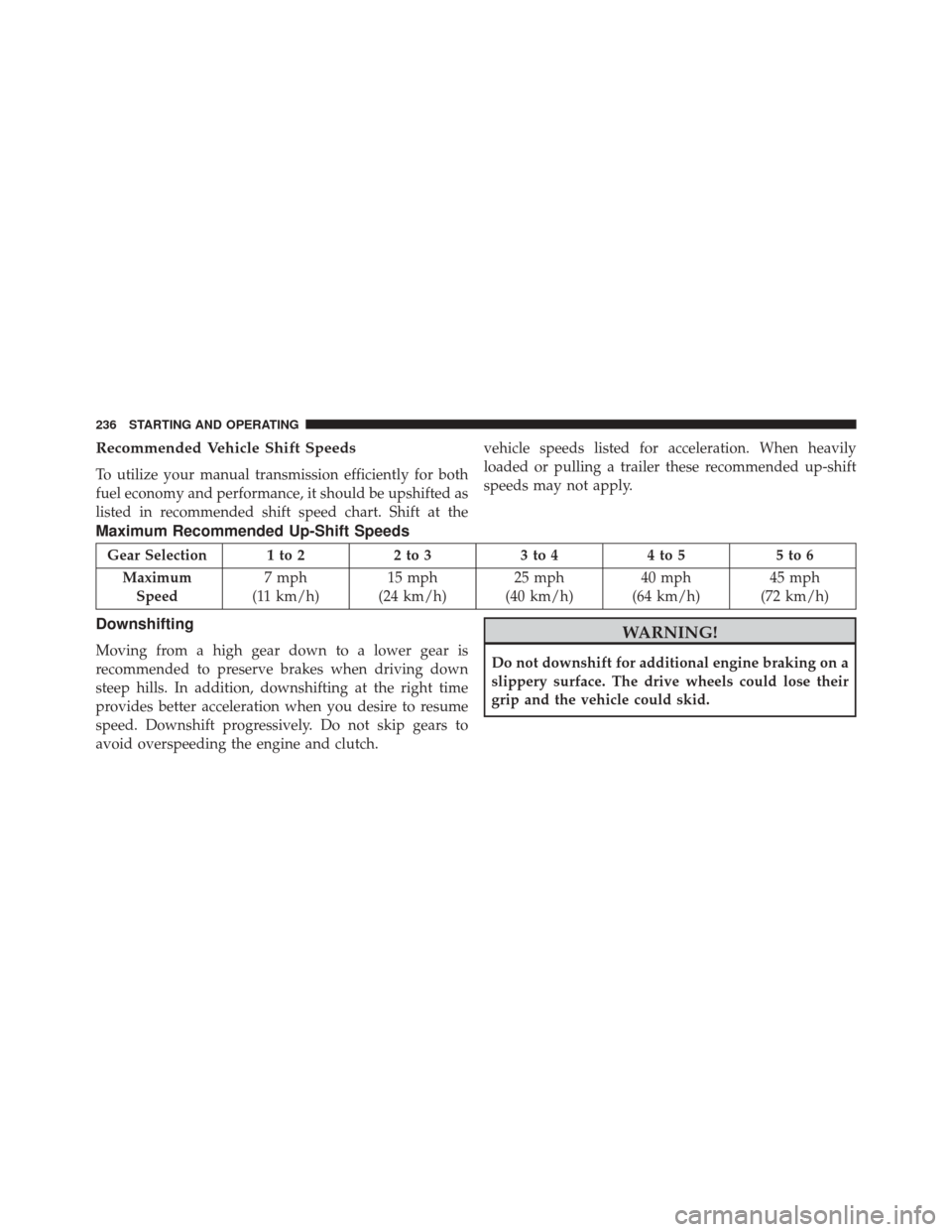
Recommended Vehicle Shift Speeds
To utilize your manual transmission efficiently for both
fuel economy and performance, it should be upshifted as
listed in recommended shift speed chart. Shift at thevehicle speeds listed for acceleration. When heavily
loaded or pulling a trailer these recommended up-shift
speeds may not apply.
Maximum Recommended Up-Shift Speeds
Gear Selection 1 to 2
2 to 33 to 44 to 5 5 to 6
Maximum Speed 7 mph
(11 km/h) 15 mph
(24 km/h) 25 mph
(40 km/h) 40 mph
(64 km/h) 45 mph
(72 km/h)
Downshifting
Moving from a high gear down to a lower gear is
recommended to preserve brakes when driving down
steep hills. In addition, downshifting at the right time
provides better acceleration when you desire to resume
speed. Downshift progressively. Do not skip gears to
avoid overspeeding the engine and clutch.
WARNING!
Do not downshift for additional engine braking on a
slippery surface. The drive wheels could lose their
grip and the vehicle could skid.
236 STARTING AND OPERATING
Page 245 of 338
WARNING!
In case of engine runaway due to flammable fumes
from fuel spills or turbocharger oil leaks being
sucked into the engine, do the following to help
avoid personal injury and/or vehicle damage:
1. Turn the ignition switch to the OFF position.
2. Using a CO2 or dry chemical type fire extinguisher,
direct the spray from the fire extinguisher into the
grille on the passenger side so that the spray enters
the engine air intake.
The inlet for the engine air intake is located behind
the passenger side headlamp and receives air
through the grille.
FUEL REQUIREMENTS
Use good quality diesel fuel from a reputable supplier in
your vehicle. Federal law requires that you must fuel this
vehicle with Ultra Low Sulfur Highway Diesel fuel(15 ppm Sulfur maximum) and prohibits the use of Low
Sulfur Highway Diesel fuel (500 ppm Sulfur maximum)
to avoid damage to the emissions control system.
For most year-round service, No. 2 diesel fuel meeting
ASTM (formerly known as the American Society for
Testing and Materials) specification D-975 Grade S15 will
provide good performance. If the vehicle is exposed to
extreme cold (below 20°F or -7°C), or is required to
operate at colder-than-normal conditions for prolonged
periods, use climatized No. 2 diesel fuel or dilute the No.
2 diesel fuel with 50% No. 1 diesel fuel. This will provide
better protection from fuel gelling or wax-plugging of the
fuel filters.
5
STARTING AND OPERATING 243