def tank Ram 5500 Chassis Cab 2016 Diesel Supplement
[x] Cancel search | Manufacturer: RAM, Model Year: 2016, Model line: 5500 Chassis Cab, Model: Ram 5500 Chassis Cab 2016Pages: 338, PDF Size: 1.63 MB
Page 255 of 338
microbes form “slime” that will clog the fuel filtration
system and lines. Drain condensation from the supply
tank and change the line filter on a regular basis.
NOTE:When a diesel engine is allowed to run out of
fuel, air is pulled into the fuel system.
If the vehicle will not start, refer to “Maintenance
Procedures/Priming If The Engine Has Run Out Of Fuel”
in “Maintaining Your Vehicle” for further information.
WARNING!
Do not open the high pressure fuel system with the
engine running. Engine operation causes high fuel
pressure. High pressure fuel spray can cause serious
injury or death.
Diesel Exhaust Fluid Storage
Diesel Exhaust Fluid (DEF) is considered a very stable
product with a long shelf life. If DEF is kept in tempera-
tures between 10° and 90°F (-12° and 32°C), it will last a
minimum of one year.
DEF is subject to freezing at the lowest temperatures. For
example, DEF may freeze at temperatures at or below
12° F (-11° C). The system has been designed to operate in
this environment.
NOTE: When working with DEF, it is important to know
that:
•
Any containers or parts that come into contact with DEF
must be DEF compatible (plastic or stainless steel). Cop-
per, brass, aluminum, iron or non-stainless steel should be
avoided as they are subject to corrosion by DEF.
• If DEF is spilled, it should be wiped up completely.
5
STARTING AND OPERATING 253
Page 256 of 338
Adding Diesel Exhaust Fluid
The DEF gauge (located on the instrument cluster) will
display the level of DEF remaining in the tank. Refer to
“Instrument Cluster” and “Instrument Cluster Descrip-
tions” in “Understanding Your Instrument Panel” for
further information.
NOTE:Driving conditions (altitude, vehicle speed, load,
etc.) will effect the amount of DEF that is used in your
vehicle.
Another factor is that outside temperature can affect DEF
consumption. In cold conditions, 12° F (-11° C) and
below, the DEF gauge needle can stay on a fixed position
and may not move for extended periods of time. This is
a normal function of the system.
DEF Fill Procedure
NOTE: Refer to “Fluids, Lubricants, and Genuine Parts”
in “Maintaining Your Vehicle” for the correct fluid type. 1. Remove cap from DEF tank (located on drivers side of
the vehicle or in fuel door).
DEF Filler Cap Chassis Cab Models
254 STARTING AND OPERATING
Page 257 of 338
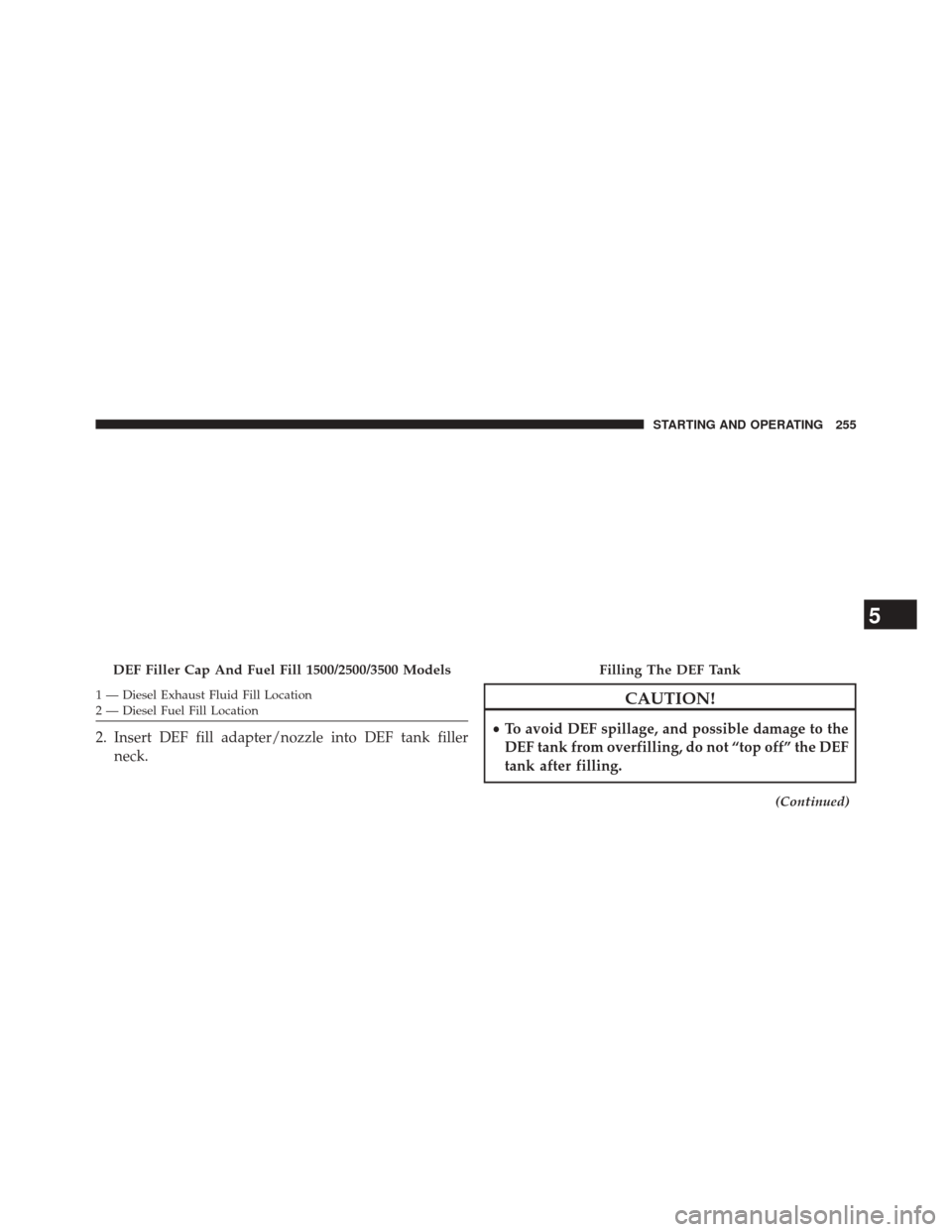
1 — Diesel Exhaust Fluid Fill Location
2 — Diesel Fuel Fill Location
2. Insert DEF fill adapter/nozzle into DEF tank fillerneck.
CAUTION!
•To avoid DEF spillage, and possible damage to the
DEF tank from overfilling, do not “top off” the DEF
tank after filling.
(Continued)
DEF Filler Cap And Fuel Fill 1500/2500/3500 ModelsFilling The DEF Tank
5
STARTING AND OPERATING 255
Page 258 of 338
CAUTION!(Continued)
•DO NOT OVERFILL. DEF will freeze below 12ºF
(-11ºC). The DEF system is designed to work in
temperatures below the DEF freezing point, how-
ever, if the tank is overfilled and freezes, the
system could be damaged.
• When DEF is spilled, clean the area immediately
with water and use an absorbent material to soak
up the spills on the ground.
• Do not attempt to start your engine if DEF is
accidentally added to the diesel fuel tank as it can
result in severe damage to your engine, including
but not limited to failure of the fuel pump and
injectors.
(Continued)
CAUTION! (Continued)
•Never add anything other than DEF to the tank –
especially any form of hydrocarbon such as diesel
fuel, fuel system additives, gasoline, or any other
petroleum-based product. Even a very small
amount of these (less than 100 parts per million or
less than 1 oz. per 78 gallons) will contaminate the
entire DEF system and will require replacement. If
owners use a container, funnel or nozzle when
refilling the tank, it should either be new or one
that is has only been used for adding DEF. MOPAR
provides an attachable nozzle with its DEF for this
purpose.
3. Stop filling the DEF tank immediately when any of the following happen: DEF stops flowing from the fill
bottle into the DEF tank, DEF splashes out the filler
neck, or a DEF pump nozzle automatically shuts off.
256 STARTING AND OPERATING
Page 259 of 338
4. Reinstall cap onto DEF tank.
Filling The Def Tank In Cold Climates
Since DEF will begin to freeze at 12°F (-11°C), your
vehicle is equipped with an automatic DEF heating
system. This allows the DEF injection system to operate
properly at temperatures below 12°F (-11°C). If your
vehicle is not in operation for an extended period of time
with temperatures below 12°F (-11°C), the DEF in the
tank may freeze. If the tank is overfilled and freezes, it
could be damaged. Therefore, do not overfill the DEF
tank.
The DEF tank on these vehicles is designed with a large
amount of full reserve. So the level sensor will indicate a
Full reading even before the tank is completely full. To
put it another way, there’s additional storage capacity in
the tank above the Full mark that’s not represented in the
gauge. You may not see any movement in the reading –
even after driving up to 2,000 miles in some cases.The difference this makes varies by vehicle. Heavy-duty
pickup trucks have a 5.7-gallon tank that will display a
Full reading when about 90 percent full. This means that
drivers can consume at least 10 percent of a truly full DEF
tank without seeing any visible change in the gauge
reading. Chassis cabs have a larger 9-gallon tank, and
will display a Full reading when about 75 percent full. So
drivers can consume 25 percent of a truly full DEF tank
without seeing any visible change in the gauge reading.
Extra care should be taken when filling with portable
containers to avoid overfilling. Note the level of the DEF
gauge in your instrument cluster. On pickup applica-
tions, you may safely add a maximum of 2 gallons of DEF
from portable containers when your DEF gauge is read-
ing ½ full. On Chassis Cab applications a maximum of
2 gallons may be added when the DEF gauge is reading
¾ full.
5
STARTING AND OPERATING 257
Page 260 of 338
DIESEL EXHAUST FLUID
Your vehicle is equipped with a Selective Catalytic Re-
duction system to meet the very stringent diesel emis-
sions standards required by the Environmental Protec-
tion Agency.
The purpose of the SCR system is to reduce levels of NOx
(oxides of nitrogen emitted from engines) that are harm-
ful to our health and the environment to a near-zero level.
Small quantities of Diesel Exhaust Fluid (DEF) is injected
into the exhaust upstream of a catalyst where, when
vaporized, it converts smog-forming nitrogen oxides
(NOx) into harmless nitrogen (N2) and water vapor
(H2O), two natural components of the air we breathe.
You can operate with the comfort that your vehicle is
contributing to a cleaner, healthier world environment
for this and generations to come.
System Overview
This vehicle is equipped with a Diesel Exhaust Fluid
(DEF) injection system and a Selective Catalytic Reduc-
tion (SCR) catalyst to meet the emission requirements.
The DEF injection system consists of the following com-
ponents:
•DEF tank
• DEF pump
• DEF injector
• Electronically-heated DEF lines
• DEF control module
• NOx sensors
• Temperature sensors
• SCR catalyst
258 STARTING AND OPERATING
Page 319 of 338
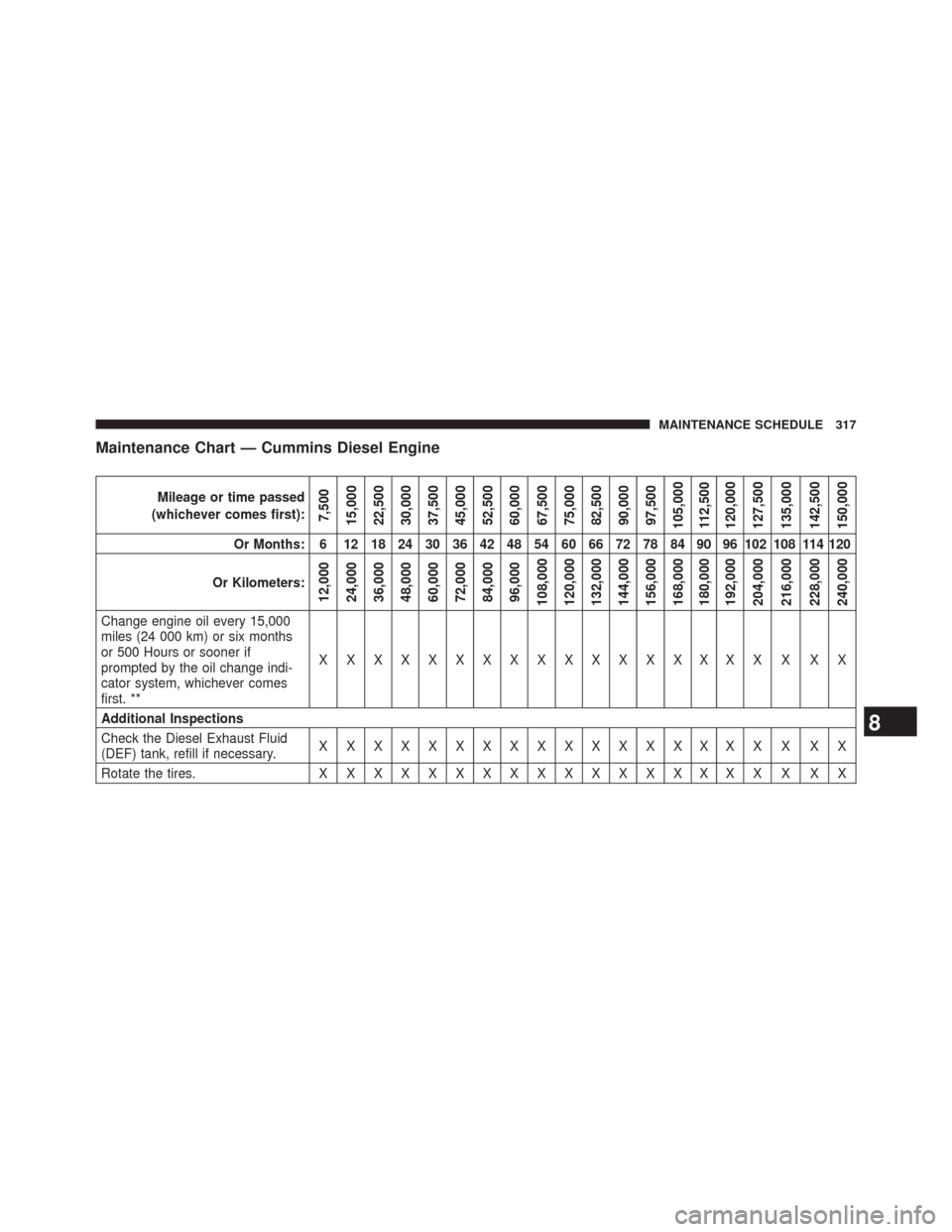
Maintenance Chart — Cummins Diesel Engine
Mileage or time passed
(whichever comes first):
7,500
15,000
22,500
30,000
37,500
45,000
52,500
60,000
67,500
75,000
82,500
90,000
97,500
105,000 112,500
120,000
127,500
135,000
142,500
150,000
Or Months: 6 12 18 24 30 36 42 48 54 60 66 72 78 84 90 96 102 108 114 120
Or Kilometers:
12,000
24,000
36,000
48,000
60,000
72,000
84,000
96,000
108,000
120,000
132,000
144,000
156,000
168,000
180,000
192,000
204,000
216,000
228,000
240,000
Change engine oil every 15,000
miles (24 000 km) or six months
or 500 Hours or sooner if
prompted by the oil change indi-
cator system, whichever comes
first. ** XXXXXXXXXXXXXXXXX X XX
Additional Inspections
Check the Diesel Exhaust Fluid
(DEF) tank, refill if necessary. XXXXXXXXXXXXXXXXX X XX
Rotate the tires. X X X X X X X X X X X X X X X X X X X X
8
MAINTENANCE SCHEDULE 317