service Ram 5500 Chassis Cab 2016 Diesel Supplement
[x] Cancel search | Manufacturer: RAM, Model Year: 2016, Model line: 5500 Chassis Cab, Model: Ram 5500 Chassis Cab 2016Pages: 338, PDF Size: 1.63 MB
Page 279 of 338
The condition of the air cleaner filter is monitored by the
Engine Control Module. The “SERVICE AIR FILTER”
message will display in the Electronic Vehicle Informa-
tion Center (EVIC) or Driver Information Display (DID)
when service is required. Refer to “Electronic Vehicle
Information Center (EVIC)” or “Driver Information Dis-
play (DID)” in “Understanding Your Instrument Panel”
for further information.
The “SERVICE AIR FILTER” message could be displayed
periodically. This is because engine air flow requirements
change based on driving conditions. As the filter becomes
more restrictive and air flow requirements increase the
“SERVICE AIR FILTER” message will be displayed. The
message may not be displayed in subsequent drive cycles
if the same conditions are not met. The air filter element
should be replaced within 250 miles (402 km) from the
first time this message is displayed to ensure proper
engine operation during all driving conditions.CAUTION!
Driving with a restricted air filter can cause engine
damage. Driving in dusty environments for extended
periods will lead to rapid air filter plugging. Action
should be taken as soon as the “SERVICE AIR
FILTER” message is displayed.
If the vehicle experiences a sudden loss of engine power
while being driven in heavy snow or rain, or when
plowing snow, and/or the “SERVICE AIR FILTER” mes-
sage is displayed on the EVIC/DID along with a chime
that repeats every 60 seconds, visually inspect the air
filter for snow/ice build up or extreme water saturation.
If the air filter is not damaged, remove all snow/ice and
reinstall air filter. If the air filter is damaged, replace filter
element.
7
MAINTAINING YOUR VEHICLE 277
Page 280 of 338
NOTE:The air filter housing contains a Mass Air Flow
sensor. This sensor is critical to proper engine operation
and component longevity. Any damage or modification
to this sensor could result in major engine and/or
exhaust aftertreatment damage. We recommend you use
MOPAR brand parts.
Even though your vehicle is equipped with an Air Filter
Monitor, a visual inspection of the air cleaner filter element
is recommended every 15,000 miles (24,000km) or 12 months
– whichever occurs first. Under no circumstances should
the air cleaner filter element exceed 30,000 miles
(48,000 km) or 24 months, whichever comes first.
CAUTION!
Many aftermarket performance air filter elements do
not adequately filter the air entering the engine. Use
of such filters can severely damage your engine.
Engine Air Cleaner Filter Selection
The quality of replacement engine air cleaner filters
varies considerably. Only high quality filters should be
used to assure most efficient service. MOPAR engine air
cleaner filters are a high quality filter and are recom-
mended.
Engine Air Cleaner Filter Inspection and
Replacement
Inspect engine air cleaner filter for dirt and or debris, if
you find evidence of either dirt or debris you should
change your air cleaner filter.
Engine Air Cleaner Filter Removal
1. Remove the screws from the air cleaner cover.
278 MAINTAINING YOUR VEHICLE
Page 283 of 338
second filter location is on the frame behind the front
axle. The best access to this water drain valve is from
under the vehicle.
CAUTION!
•Do not drain the fuel/water separator filters when
the engine is running.
• Diesel fuel will damage blacktop paving surfaces.
Drain the filters into an appropriate container.
If water is detected in the water separator while the
engine is running, or while the ignition switch is in the
ON position, the “Water In Fuel Indicator Light” will
illuminate and an audible chime will be heard five times.
At this point you should stop the engine and drain the
water from both of the filters.
CAUTION!
If the “Water In Fuel Indicator Light” remains on, DO
NOT START the engine before you drain water from
the fuel filters to avoid engine damage.
If the “Water In Fuel Indicator Light” comes on and a
single chime is heard while you are driving, or with the
ignition switch in the ON position, there may be a
problem with your water separator wiring or sensor. See
your authorized dealer for service.
Upon proper draining of the water from both fuel filters,
the “Water In Fuel Indicator Light” will remain illumi-
nated for approximately 10 seconds. If the water was
drained while the engine was running, the “Water In Fuel
Indicator Light” may remain on for approximately three
minutes.
7
MAINTAINING YOUR VEHICLE 281
Page 284 of 338
NOTE:Care should be taken in disposing of used fluids
from your vehicle. Used fluids, indiscriminately dis-
carded, can present a problem to the environment. Con-
tact an authorized dealer, service station, or government
agency for advice on recycling programs and for where
used fluids and filters can be properly disposed of in
your area.
Drain the fuel/water separator filters when the “Water In
Fuel Indicator Light” is ON. Within 10 minutes of vehicle
shutdown, turn the engine mounted filter drain valve
(located on the side of the filter assembly) counterclock-
wise 1/4 turn, and turn the under body mounted filter
drain valve (located on the bottom of the filter assembly)
counterclock wise 1 full turn. Then turn the ignition
switch to the ON position, and allow any accumulated
water to drain. Leave the drain valve open until all water
and contaminants have been removed. When clean fuel is
visible, close the drain valves by turning them fully
clockwise, and turn the ignition switch to OFF. If more than a couple ounces/milliliters of fuel have been
drained, follow the directions for “Priming If The Engine
Has Run Out Of Fuel.”
Engine Mounted Fuel Filter Replacement
NOTE:
•
Using a fuel filter that does not meet the manufactur-
er’s filtration and water separating requirements can
severely impact fuel system life and reliability.
•
The engine mounted filter housing is equipped with a
No-Filter-No-Run (NFNR) feature. Engine will not run if:
1. No filter is installed.
2. Inferior/Non-approved filter is used. Use of OEM
filter is required to ensure vehicle will run.
282 MAINTAINING YOUR VEHICLE
Page 288 of 338
5. Remove lid using a socket or strap wrench. Rotatecounterclockwise for removal. Remove used o-ring
and discard it.
6. Remove the used filter cartridge from the housing and dispose of according to your local regulations.
7. Wipe clean the sealing surfaces of the lid and housing.
8. Install new o-ring back into ring groove on the filter housing and lubricate with clean engine oil.
NOTE: WIF sensor is re-usable. Service kit comes with
new o-ring for filter canister and WIF sensor.Priming If The Engine Has Run Out Of Fuel
WARNING!
Do not open the high pressure fuel system with the
engine running. Engine operation causes high fuel
pressure. High pressure fuel spray can cause serious
injury or death.
1. Add a substantial amount of fuel to the tank, approxi- mately 2 to 5 gal (8L to 19L).
2. Turn ignition switch to the start position to engage starter for one second, return ignition switch to run
position. This will activate in tank fuel pump for
approximately 15 seconds. Repeat this process twice.
3. Start the engine using the “Normal Starting” proce- dure. Refer to “Starting Procedures” in “Starting and
Operating” for further information.
286 MAINTAINING YOUR VEHICLE
Page 298 of 338
•Do not change the thermostat for Summer or Winter
operation. If replacement is ever necessary, install
ONLY the correct type thermostat. Other designs may
result in unsatisfactory engine coolant (antifreeze)
performance, poor gas mileage, and increased emis-
sions.
Charge Air Cooler — Inter-Cooler
The charge air cooler is positioned below the radiator and
the air conditioner condenser. Air enters the engine
through the air cleaner and passes through the turbo-
charger, where it is pressurized. This pressurized air
rapidly reaches high temperature. The air is then directed
through a hose to the charge air cooler and through
another hose to the intake manifold of the engine. The air
entering the engine has been cooled by about 50° to 100°F
(10° to 38°C). This cooling process enables more efficient
burning of fuel resulting in fewer emissions. To guarantee optimum performance of the system, keep
the surfaces of the charge air cooler, condenser and
radiator clean and free of debris. Periodically check the
hoses leading to and from the charge air cooler for cracks
or loose clamps resulting in loss of pressure and reduced
engine performance.
Brake System
Brake Master Cylinder — Brake Fluid Level Check
The fluid level of the master cylinder should be checked
when performing under the hood service, or immedi-
ately if the “Brake System Warning Light” indicates
system failure.
The brake master cylinder has a translucent plastic
reservoir. On the outboard side of the reservoir, there is a
“MAX” mark and a “MIN” mark. The fluid level must be
kept within these two marks. Do not add fluid above the
full mark because leakage may occur at the cap.
296 MAINTAINING YOUR VEHICLE
Page 304 of 338
NOTE:If it is necessary to check the transmission below
the operating temperature, the fluid level should be
between the two “COLD” (lower) holes on the dipstick
with the fluid at 60-70°F / 16-21°C for 68RFE transmis-
sion, or 68-86°F / 20-30°C for AS69RC transmission. Only
use the COLD region of the dipstick as a rough reference
when setting the fluid level after a transmission service
or fluid change. Re-check the fluid level, and adjust as
required, once the transmission reaches normal operating
temperature.
CAUTION!
If the fluid temperature is below 50°F (10°C) it may
not register on the dipstick. Do not add fluid until
the temperature is elevated enough to produce an
accurate reading. Run the engine at idle, in PARK, to
warm the fluid. 8. Reinsert the dipstick. Check for leaks. Release the
parking brake.
NOTE: To prevent dirt and water from entering the
transmission after checking or replenishing fluid, make
sure that the dipstick cap is properly reseated. It is
normal for the dipstick cap to spring back slightly from
its fully seated position, as long as its seal remains
engaged in the dipstick tube.
Fluid And Filter Changes
Refer to the “Maintenance Schedule” for the proper
maintenance intervals.
In addition, change the fluid and filter(s) if the fluid
becomes contaminated (with water, etc.), or if the trans-
mission is disassembled for any reason.
302 MAINTAINING YOUR VEHICLE
Page 305 of 338
Noise Control System Required Maintenance &
Warranty
All vehicles built over 10,000 lbs. (4 535 kg) Gross Vehicle
Weight Rating and manufactured for sale and use in the
United States are required to comply with the Federal
Government’s Exterior Noise Regulations. These vehicles
can be identified by the Noise Emission Control Label
located in the operator’s compartment.
Required Maintenance For Noise Control Systems
The following maintenance services must be performed
every six months or 7,500 miles (12 000 km) whichever
comes first, to assure proper operation of the noise
control systems. In addition, inspection and service
should be performed anytime a malfunction is observed7
MAINTAINING YOUR VEHICLE 303
Page 306 of 338
or suspected. Proper maintenance of the entire vehicle
will help the effectiveness of the noise control systems.
Exhaust System
Inspect the entire exhaust system for leaks and damaged
parts. Devices such as hangers, clamps, and U-bolts
should be tight and in good condition. Damaged compo-
nents, burned or blown out mufflers, burned or rusted
out exhaust pipes should be replaced according to the
procedures and specifications outlined in the appropriate
service manual.
Air Cleaner Assembly
Inspect air cleaner housing for proper assembly and fit.
Make certain that the air cleaner is properly positioned
and that the cover is tight. Check all hoses leading to the
air cleaner for tightness. The air filter element must also
be clean and serviced according to the instructions out-
lined in the Maintenance Schedule section of this manual.Tampering With Noise Control System Prohibited
Federal law prohibits the following acts or the causing
thereof: (1) the removal or rendering inoperative by any
person, other than for purposes of maintenance, repair, or
replacement, of any device or element of design incorpo-
rated into any new vehicle for the purpose of noise
control prior to its sale or delivery to the ultimate
purchaser or while it is in use, or (2) the use of the vehicle
after such device or element of design has been removed
or rendered inoperative by any person.
Among those acts presumed to constitute tampering are
the acts listed below.
AIR CLEANER
•Removal of the air cleaner.
• Removal of the air cleaner filter element from the air
cleaner housing.
304 MAINTAINING YOUR VEHICLE
Page 308 of 338
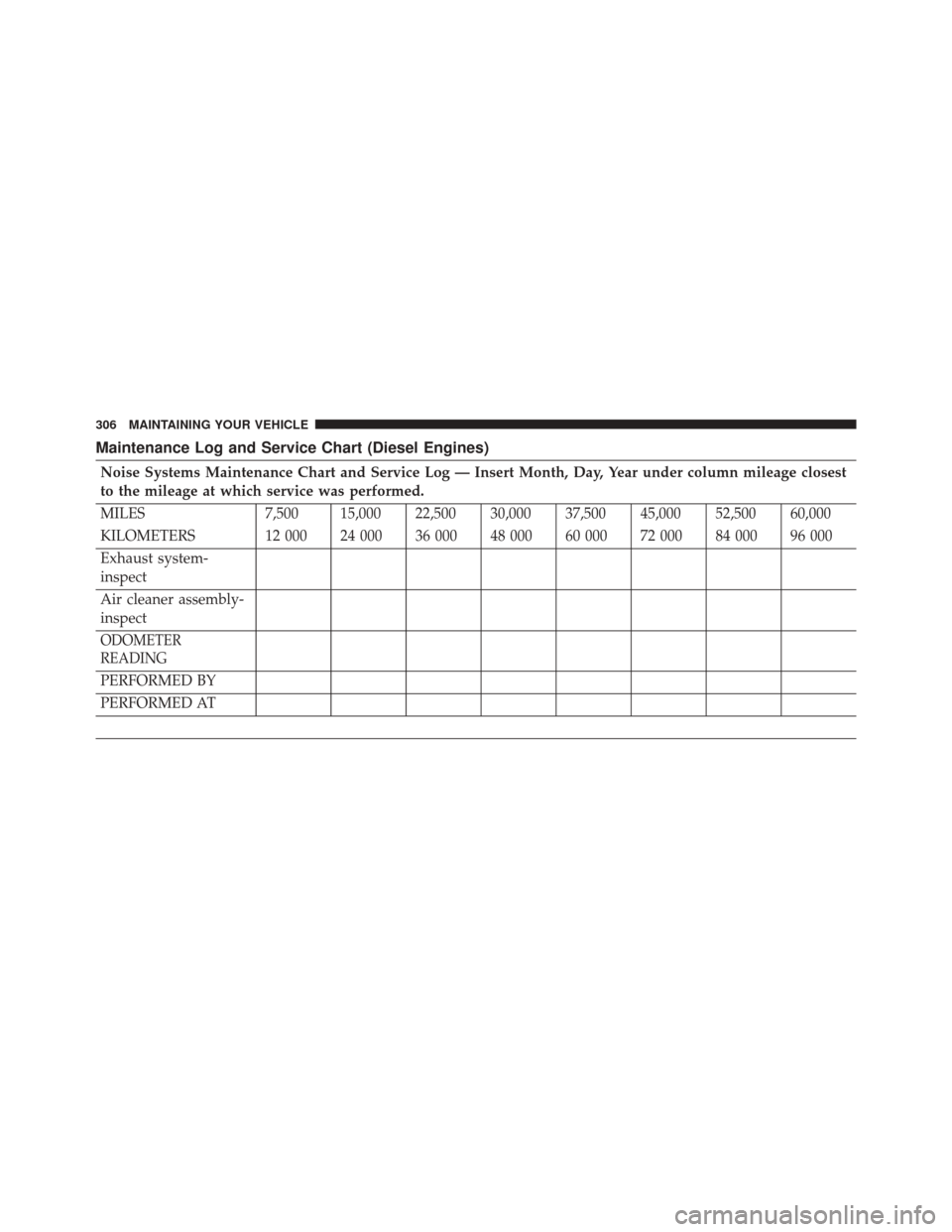
Maintenance Log and Service Chart (Diesel Engines)
Noise Systems Maintenance Chart and Service Log — Insert Month, Day, Year under column mileage closest
to the mileage at which service was performed.
MILES 7,500 15,000 22,500 30,000 37,500 45,000 52,500 60,000
KILOMETERS 12 000 24 000 36 000 48 000 60 000 72 000 84 000 96 000
Exhaust system-
inspect
Air cleaner assembly-
inspect
ODOMETER
READING
PERFORMED BY
PERFORMED AT
306 MAINTAINING YOUR VEHICLE