lock Ram 5500 Chassis Cab 2017 Owner's Manual
[x] Cancel search | Manufacturer: RAM, Model Year: 2017, Model line: 5500 Chassis Cab, Model: Ram 5500 Chassis Cab 2017Pages: 534, PDF Size: 4.74 MB
Page 434 of 534
3. When changing the front wheel, assemble the jack drivetube to the jack and connect the drive tube to the
extension tube. Place the jack under the axle as close to
the tire as possible with the drive tubes extending to the
front. Connect the jack tube extension and wheel
wrench.
When changing a rear wheel, assemble the jack drive tube
to the jack and connect the drive tube to the extension tube.
Securely place the jack under the sway bar bracket (unless
both tires are flat on one side, then place jack under shock
bracket) facing forward in vehicle. Connect the jack tube
extension and lug wrench. Before raising the wheel off the ground, make sure that
the jack will not damage surrounding truck parts and
adjust the jack position as required.
NOTE:
If the jack will not lower by turning the dial
(thumbwheel) by hand, it may be necessary to use the jack
drive tube in order to lower the jack.
4. By rotating the wheel wrench clockwise, raise the ve- hicle until the wheel just clears the surface.
Front Jacking Locations
Rear Jacking Location
432 WHAT TO DO IN EMERGENCIES
Page 435 of 534
WARNING!
Raising the vehicle higher than necessary can make the
vehicle unstable. It could slip off the jack and hurt
someone near it. Raise the vehicle only enough to
remove the tire.
5. Remove the wheel nuts and pull the wheel off. Install the spare wheel and wheel nuts with the cone shaped
end of the nuts toward the wheel on single rear wheel
(SRW) models. On dual rear wheel models (DRW) the
lug nuts are a two-piece assembly with a flat face.
Lightly tighten the nuts. To avoid risk of forcing the
vehicle off the jack, do not fully tighten the nuts until the
vehicle has been lowered.
6. Using the wheel wrench, finish tightening the nuts using a crisscross pattern. For the proper lug nut torque
specifications refer to “Wheel and Tire Torque Specifi-
cations” in this section. If in doubt about the correct
tightness, have them checked with a torque wrench by
your authorized dealer or at a service station.
WARNING!
A loose tire or jack thrown forward in a collision or
hard stop could injure someone in the vehicle. Always
stow the jack parts and the extra tire and wheel in the
places provided.
7. Install wheel center cap (if equipped) and remove wheel blocks. Do not install chrome or aluminum wheel center
caps on the spare wheel. This may result in cap damage.
8. Lower the jack to its fully closed position. If the jack will not lower by turning the dial (thumbwheel) by hand, it
may be necessary to use the jack drive tube in order to
lower the jack. Stow the replaced tire, jack, and tools as
previously described.
9. Adjust the tire pressure when possible.
6
WHAT TO DO IN EMERGENCIES 433
Page 439 of 534
WARNING!(Continued)
switch is ON. You can be injured by moving fan
blades.
• Remove any metal jewelry such as rings, watch
bands and bracelets that could make an inadvertent
electrical contact. You could be seriously injured.
• Batteries contain sulfuric acid that can burn your
skin or eyes and generate hydrogen gas which is
flammable and explosive. Keep open flames or
sparks away from the battery.
1. Apply the parking brake, shift the automatic transmis- sion into PARK and turn the ignition to LOCK.
2. Turn off the heater, radio, and all unnecessary electrical accessories.
3. If using another vehicle to jump-start the battery, park the vehicle within the jumper cables reach, set the
parking brake and make sure the ignition is OFF.
WARNING!
Do not allow vehicles to touch each other as this could
establish a ground connection and personal injury
could result.
Jump-Starting Procedure
WARNING!
Failure to follow this jump-starting procedure could
result in personal injury or property damage due to
battery explosion.
CAUTION!
Failure to follow these procedures could result in
damage to the charging system of the booster vehicle
or the discharged vehicle.
Connecting The Jumper Cables
1. Connect the positive (+)end of the jumper cable to the
positive (+)post of the discharged vehicle.
NOTE: Do not jump off fuses. Only jump directly off
positive post.
2. Connect the opposite end of the positive (+)jumper
cable to the positive (+)post of the booster battery.
3. Connect the negative (-)end of the jumper cable to the
negative (-)post of the booster battery.6
WHAT TO DO IN EMERGENCIES 437
Page 458 of 534
3. Remove the air cleaner filter element from the housingassembly.
Engine Air Cleaner Filter Installation
NOTE: Inspect and clean the housing if dirt or debris is
present before replacing the air filter element.
1. Install the air cleaner filter element into the housing assembly with the air cleaner filter inspection surface
facing downward. 2. Install the air cleaner cover onto the housing assembly
locating tabs.
3. Latch the spring clips and lock the air cleaner cover to the housing assembly.
Accessory Drive Belt Inspection
WARNING!
•Do not attempt to inspect an accessory drive belt
with vehicle running.
• When working near the radiator cooling fan, discon-
nect the fan motor lead. The fan is temperature
controlled and can start at any time regardless of
ignition mode. You could be injured by the moving
fan blades.
• You can be badly injured working on or around a
motor vehicle. Only do service work for which you
have the knowledge and the proper equipment. If
you have any doubt about your ability to perform a
service job, take your vehicle to a competent me-
chanic.
When inspecting accessory drive belts, small cracks that
run across ribbed surface of belt from rib to rib, are
considered normal. These are not a reason to replace belt.
Air Cleaner Filter
1 — Air Cleaner Filter
2 — Air Cleaner Filter Inspection Surface 456 MAINTAINING YOUR VEHICLE
Page 467 of 534
joint. Refer to the “Maintenance Schedule” for the proper
maintenance intervals. Use MOPAR Type MS-6560
(lithium-based grease), or equivalent.Body Lubrication
Locks and all body pivot points, including such items as
seat tracks, door hinge pivot points and rollers, liftgate,
tailgate, decklid, sliding doors and hood hinges, should be
lubricated periodically with a lithium based grease, such as
MOPAR Spray White Lube to assure quiet, easy operation
and to protect against rust and wear. Prior to the applica-
tion of any lubricant, the parts concerned should be wiped
clean to remove dust and grit; after lubricating excess oil
and grease should be removed. Particular attention should
also be given to hood latching components to ensure
proper function. When performing other underhood ser-
vices, the hood latch, release mechanism and safety catch
should be cleaned and lubricated.
The external lock cylinders should be lubricated twice a
year, preferably in the Fall and Spring. Apply a small
amount of a high quality lubricant, such as MOPAR Lock
Cylinder Lubricant directly into the lock cylinder.
Double Cardan Joint
1 — Double Cardan Joint
2 — Grease Fitting
3 — Exploded View – Grease Fitting
7
MAINTAINING YOUR VEHICLE 465
Page 469 of 534

1. Lift the wiper arm to raise the wiper blade off of theglass, until the wiper arm is in the full up position. 2. To disengage the wiper blade from the wiper arm, flip
up the locking tab.
Windshield Wiper Arm
1—Wiper
2 — Locking Tab
3—WiperArm
Wiper Locking Assembly
1—Wiper
2 — Locking Tab
7
MAINTAINING YOUR VEHICLE 467
Page 470 of 534

3. Tilt the lower end of the wiper blade away from the armand use one finger push the release tab toward the
wiper arm.
4. Slide the wiper blade down towards the base of the wiper arm.
5. With the wiper blade disengaged, remove the wiper blade from the wiper arm by holding the wiper arm with one hand and separating the wiper blade from the
wiper arm with the other hand (move the wiper blade
down toward the base of the wiper arm and away from
the J hook in the end of the wiper arm).
6. Gently lower the wiper arm onto the glass.
Wiper Disengaging
1 — Locking Tab
2—Wiper
3 — Release TabRemoving Wiper From Wiper Arm
1—Wiper
2 — Locking Tab
3 — Wiper Arm J Hook
468 MAINTAINING YOUR VEHICLE
Page 471 of 534
Installing The Front Wipers
1. Lift the wiper arm off of the glass, until the wiper arm isin the full up position.
2. Position the wiper blade under the hook on the tip of the wiper arm with the wiper locking tab open.
3. Insert the receiver bracket on the wiper assembly into the hook on the tip of the arm through the opening in
the wiper blade under the locking tab.
4. Slide the wiper blade up into the hook on the wiper arm until it is latched (engagement will be accompanied by
an audible click). Fold down the latch release tab and
snap it into its locked position.
5. Gently lower the wiper blade onto the glass.
Adding Washer Fluid
The fluid reservoir is located under the hood and should be
checked for fluid level at regular intervals. Fill the reservoir
with windshield washer solvent only (not radiator anti-
freeze). When refilling the washer fluid reservoir, take
some washer fluid and apply it to a cloth or towel and wipe
the wiper blades clean. This will help blade performance.
To prevent freeze-up of your windshield washer system in
cold weather, select a solution or mixture that meets or exceeds the temperature range of your climate. This rating
information can be found on most washer fluid containers.
WARNING!
Commercially available windshield washer solvents
are flammable. They could ignite and burn you. Care
must be exercised when filling or working around the
washer solution.
After the engine has warmed up, operate the defroster for
a few minutes to reduce the possibility of smearing or
freezing the fluid on the cold windshield. Windshield
washer solution used with water as directed on the con-
tainer, aids cleaning action, reduces the freezing point to
avoid line clogging, and is not harmful to paint or trim.
Exhaust System
The best protection against carbon monoxide entry into the
vehicle body is a properly maintained engine exhaust
system.
If you notice a change in the sound of the exhaust system;
or if the exhaust fumes can be detected inside the vehicle;
or when the underside or rear of the vehicle is damaged;
7
MAINTAINING YOUR VEHICLE 469
Page 489 of 534
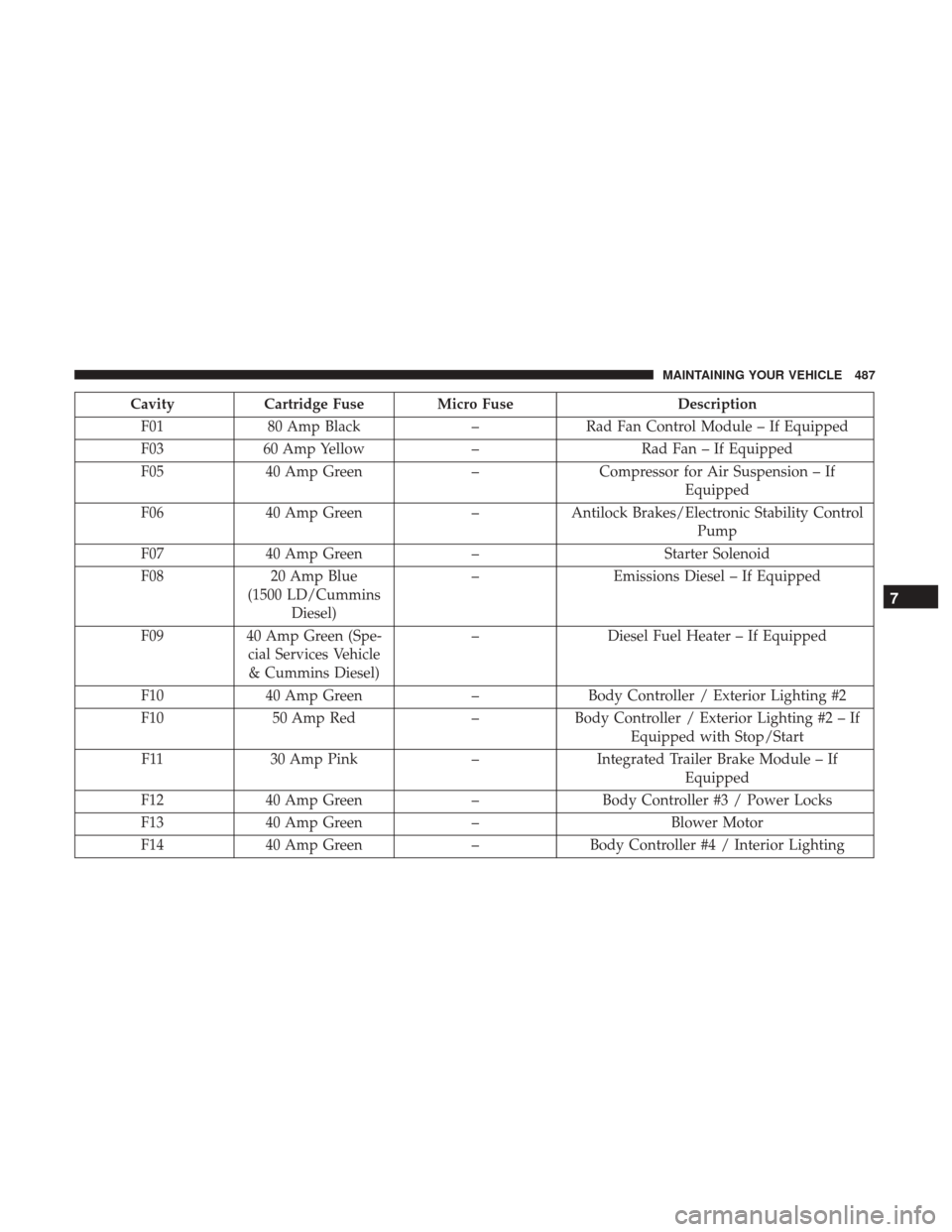
CavityCartridge Fuse Micro Fuse Description
F01 80 Amp Black –Rad Fan Control Module – If Equipped
F03 60 Amp Yellow –Rad Fan – If Equipped
F05 40 Amp Green –Compressor for Air Suspension – If
Equipped
F06 40 Amp Green –Antilock Brakes/Electronic Stability Control
Pump
F07 40 Amp Green –Starter Solenoid
F08 20 Amp Blue
(1500 LD/Cummins Diesel) –
Emissions Diesel – If Equipped
F09 40 Amp Green (Spe-
cial Services Vehicle& Cummins Diesel) –
Diesel Fuel Heater – If Equipped
F10 40 Amp Green –Body Controller / Exterior Lighting #2
F10 50 Amp Red –Body Controller / Exterior Lighting #2 – If
Equipped with Stop/Start
F11 30 Amp Pink –Integrated Trailer Brake Module – If
Equipped
F12 40 Amp Green –Body Controller #3 / Power Locks
F13 40 Amp Green –Blower Motor
F14 40 Amp Green –Body Controller #4 / Interior Lighting
7
MAINTAINING YOUR VEHICLE 487
Page 490 of 534

CavityCartridge Fuse Micro Fuse Description
F16 30 Amp Pink –Smart Bar – If Equipped
F19 20 Amp Blue
(1500 LD Diesel)
30 Amp Pink (Cum- mins Diesel) –
SCR – If Equipped
F20 30 Amp Pink –Passenger Door Module
F21 30 Amp Pink –Drive Train Control Module
F22 20 Amp Blue
30 Amp Pink (Cum- mins Diesel) –
Engine Control Module
F23 30 Amp Pink –Body Controller #1 / Interior Lighting
F24 30 Amp Pink –Driver Door Module
F25 30 Amp Pink – Front Wiper
F26 30 Amp Pink –Antilock Brakes / Stability Control Module /
Valves
F28 20 Amp Blue –Trailer Tow Backup Lights – If Equipped
F29 20 Amp Blue –Trailer Tow Parking Lights – If Equipped
F30 30 Amp Pink –Trailer Tow Receptacle
F31 30 Amp Pink
(1500 LD Diesel) –
Urea Heater Control – If Equipped
F32 –– Spare Fuse
488 MAINTAINING YOUR VEHICLE