brake light Ram Cargo Van 2015 Owner's Guide
[x] Cancel search | Manufacturer: RAM, Model Year: 2015, Model line: Cargo Van, Model: Ram Cargo Van 2015Pages: 671, PDF Size: 5.05 MB
Page 468 of 671
spinning faster than the other, the system will apply the
brake of the spinning wheel. This will allow more engine
torque to be applied to the wheel that is not spinning.
This feature remains active even if the ESC is in the
“Partial Off” mode.
The “ESC Activation/Malfunction Indicator Light” (in
the instrument cluster) will start to flash as soon as the
tires lose traction and the wheels begin to spin. This
indicates that the TCS is active. If the indicator light
flashes during acceleration, ease up on the accelerator
and apply as little throttle as possible. Be sure to adapt
your speed and driving to the prevailing road conditions,
and do not switch off the ESC or TCS.WARNING!
•The TCS cannot prevent the natural laws of physics
from acting on the vehicle, nor can it increase the
traction afforded.
• The TCS cannot prevent collisions, including those
resulting from excessive speed in turns, or hydro-
planing.
• The capabilities of a TCS-equipped vehicle must
never be exploited in a reckless or dangerous
manner, which could jeopardize the user’s safety or
the safety of others.
Brake Assist System (BAS)
The Brake Assist System (BAS) is designed to optimize
the vehicle’s braking capability during emergency brak-
ing maneuvers. The system detects an emergency brak-
ing situation by sensing the rate and amount of brake
application, and then applies optimum pressure to the
466 STARTING AND OPERATING
Page 473 of 671
•Each time the ignition is turned ON, the ESC system
will be ON even if it was turned off previously.
• The ESC system will make buzzing or clicking sounds
when it is active. This is normal; the sounds will stop
when ESC becomes inactive following the maneuver
that caused the ESC activation.
The “ESC OFF Indicator Light” indicates the
Electronic Stability Control (ESC) is partially
off.
Trailer Sway Control (TSC)
TSC uses sensors in the vehicle to recognize an exces-
sively swaying trailer and will take the appropriate
actions to attempt to stop the sway. The system may
reduce engine power and apply the brake of the appro-
priate wheel(s) to counteract the sway of the trailer. TSC
will become active automatically once an excessively swaying trailer is recognized. Note that TSC cannot stop
all trailers from swaying. Always use caution when
towing a trailer and follow the trailer tongue weight
recommendations. Refer to “Trailer Towing” in this sec-
tion for further information. When TSC is functioning,
the “ESC Activation/Malfunction Indicator Light” will
flash, the engine power may be reduced and you may
feel the brakes being applied to individual wheels to
attempt to stop the trailer from swaying. TSC is disabled
when the ESC system is in the “Partial Off” mode.
WARNING!
If TSC activates while driving, slow the vehicle
down, stop at the nearest safe location, and adjust the
trailer load to eliminate trailer sway.
5
STARTING AND OPERATING 471
Page 474 of 671
Hill Start Assist (HSA)
The HSA system is designed to assist the driver when
starting a vehicle from a stop on a hill. HSA will maintain
the level of brake pressure the driver applied for a short
period of time after the driver takes their foot off of the
brake pedal. If the driver does not apply the throttle
during this short period of time, the system will release
brake pressure and the vehicle will roll down the hill. The
system will release brake pressure in proportion to the
amount of throttle applied as the vehicle starts to move in
the intended direction of travel.
HSA Activation Criteria
The following criteria must be met in order for HSA to
activate:
•Vehicle must be stopped. •
Vehicle must be on a 6% (approximate) grade or
greater hill.
• Gear selection matches vehicle uphill direction (i.e.,
vehicle facing uphill is in forward gear; vehicle back-
ing uphill is in REVERSE gear).
HSA will work in REVERSE and all forward gears when
the activation criteria have been met. The system will not
activate if the vehicle is placed in NEUTRAL or PARK.
WARNING!
There may be situations on minor hills with a loaded
vehicle, or while pulling a trailer, when the system
will not activate and slight rolling may occur. This
could cause a collision with another vehicle or object.
Always remember the driver is responsible for brak-
ing the vehicle.
472 STARTING AND OPERATING
Page 475 of 671
Disabling/Enabling HSA
If you wish to turn on or off the HSA system, it can be
done using the Customer Programmable Features in the
Electronic Vehicle Information Center (EVIC). Refer to
“Electronic Vehicle Information Center (EVIC)” in “Un-
derstanding Your Instrument Panel” for further informa-
tion.
For vehicles not equipped with the EVIC, perform the
following steps:
NOTE:You must complete Steps 1 through 8 within
90 seconds. 1. Center the steering wheel (front wheels pointing
straight forward).
2. Shift the transmission into NEUTRAL.
3. Apply the parking brake.
4. Start the engine.
5. Release the clutch pedal (if equipped).
6. Rotate the steering wheel one-half turn to the left.
7.
Press the “ESC Off” switch (located in the lower switch
bank below the climate controls) four times within
20 seconds. The “ESC Activation/Malfunction Indicator
Light” should turn on and turn off two times.
5
STARTING AND OPERATING 473
Page 476 of 671
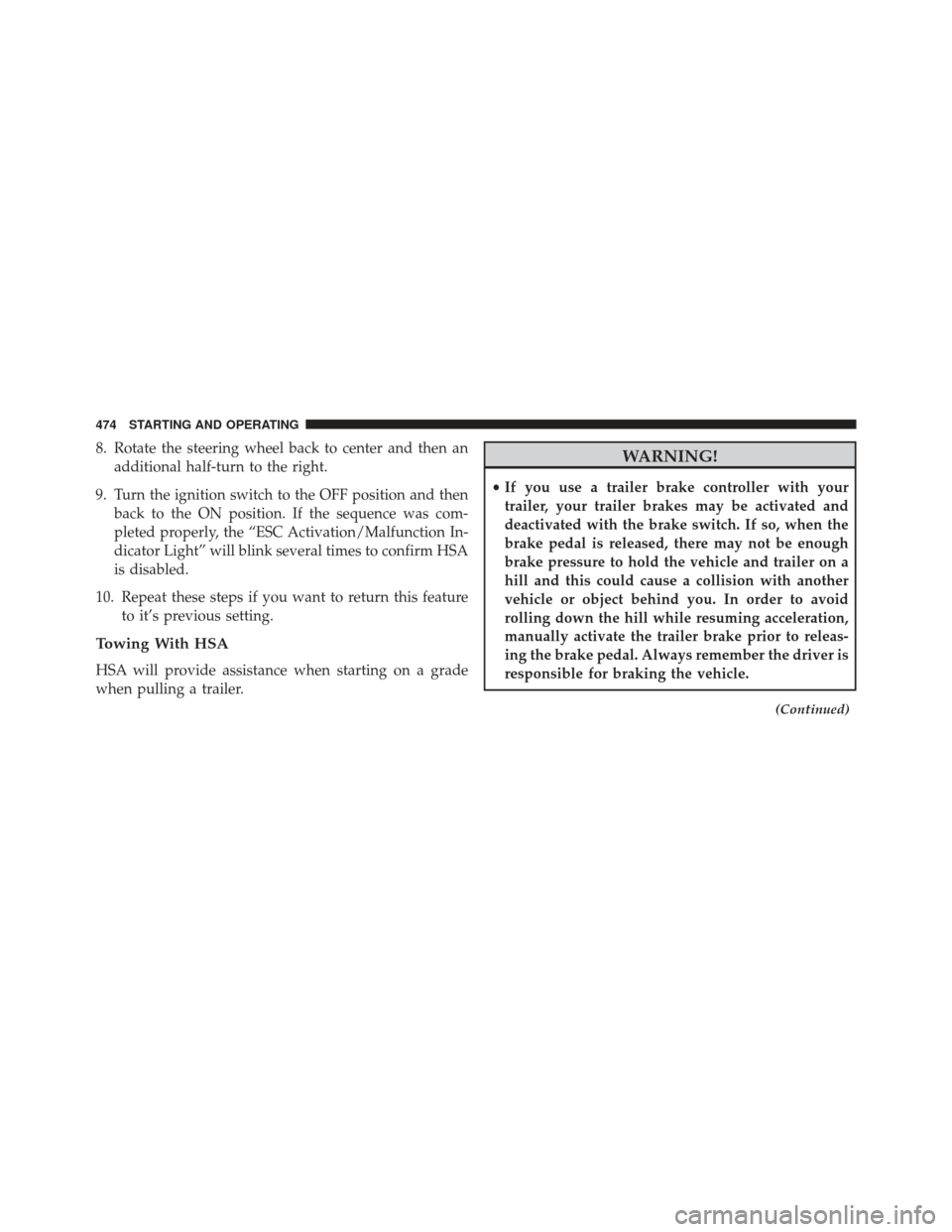
8. Rotate the steering wheel back to center and then anadditional half-turn to the right.
9. Turn the ignition switch to the OFF position and then back to the ON position. If the sequence was com-
pleted properly, the “ESC Activation/Malfunction In-
dicator Light” will blink several times to confirm HSA
is disabled.
10. Repeat these steps if you want to return this feature to it’s previous setting.
Towing With HSA
HSA will provide assistance when starting on a grade
when pulling a trailer.
WARNING!
•If you use a trailer brake controller with your
trailer, your trailer brakes may be activated and
deactivated with the brake switch. If so, when the
brake pedal is released, there may not be enough
brake pressure to hold the vehicle and trailer on a
hill and this could cause a collision with another
vehicle or object behind you. In order to avoid
rolling down the hill while resuming acceleration,
manually activate the trailer brake prior to releas-
ing the brake pedal. Always remember the driver is
responsible for braking the vehicle.
(Continued)
474 STARTING AND OPERATING
Page 601 of 671
Master Cylinder — Brake Fluid Level Check
The fluid level in the master cylinder should be checked
when performing underhood services, or immediately if
the “Brake System Warning Light” indicates system
failure.
Clean the top of the master cylinder area before removing
the cap. Add fluid to bring the level up to the top of the
“FULL” mark on the side of the master cylinder reservoir.
Overfilling of fluid is not recommended because it may
cause leaking in the system.
Add enough fluid to bring the level up to the require-
ments described on the brake fluid reservoir. With disc
brakes, fluid level can be expected to fall as the brake
pads wear. However, low fluid level may be caused by a
leak and a checkup may be needed.Use only manufacturer’s recommended brake fluid. Re-
fer to “Fluids, Lubricants, and Genuine Parts” in “Main-
taining Your Vehicle” for further information.
WARNING!
•
Use only manufacturer’s recommended brake
fluid. Refer to “Fluids, Lubricants, and Genuine
Parts” in “Maintaining Your Vehicle” for further
information. Using the wrong type of brake fluid
can severely damage your brake system and/or
impair its performance. The proper type of brake
fluid for your vehicle is also identified on the
original factory installed hydraulic master cylinder
reservoir.
(Continued)
7
MAINTAINING YOUR VEHICLE 599
Page 633 of 671
•Check the fluid levels of the coolant reservoir, brake
master cylinder, and power steering and fill as needed.
• Check function of all interior and exterior lights. Required Maintenance Intervals.
Refer to the maintenance schedules on the following
page for the required maintenance intervals.
At Every Oil Change Interval As Indicated By Oil Change Indicator System:
•
Change oil and filter.
• Rotate the tires. Rotate at the first sign of irregular wear, even if it occurs before the oil indicator system
turns on.
• Inspect battery and clean and tighten terminals as required.
• Inspect brake pads, shoes, rotors, drums, hoses and park brake.
• Inspect engine cooling system protection and hoses.
• Inspect exhaust system.
• Inspect engine air cleaner if using in dusty or off-road conditions. 8
MAINTENANCE SCHEDULES 631
Page 650 of 671
About Your Brakes....................... .462
Adding Engine Coolant (Antifreeze) ............594
Adding Fuel ............................ .519
Adding Washer Fluid ..................... .591
Additives, Fuel .......................... .514
Adjustable Pedals ........................ .210
Airbag.................................78
Air Bag Advance Front Air Bag ....................79
Air Bag Components .....................78
Air bag Operation .......................81
Air Bag Warning Light ....................90
Driver Knee Air Bag ......................83
Enhanced Accident Response ................89
Event Data Recorder (EDR) .................92
FrontAirBag...........................78
If A Deployment Occurs ...................88
Knee Impact Bolsters .....................82
Maintaining Your Air Bag System ............92Side Air Bags
...........................83
Air bag Deployment ........................78
Air bag Light .............................90
Air bag Maintenance ........................92
Air Cleaner, Engine (Engine Air Cleaner Filter) . . . .583
Air Conditioner Maintenance .................587
Air Conditioning ......................... .412
Air Conditioning Controls ...................412
Air Conditioning Filter .....................432
Air Conditioning, Operating Tips ..............431
Air Conditioning, Rear Zone .................417
Air Conditioning Refrigerant .................587
Air Conditioning System ....................412
Air Conditioning System, Zone Control ..........412
Air Pressure, Tires ........................ .488
Alarm (Security Alarm) ......................17
Alterations/Modifications, Vehicle ...............7
Antenna, Satellite Radio .....................352
Antifreeze (Engine Coolant) ..................593
648 INDEX
Page 651 of 671
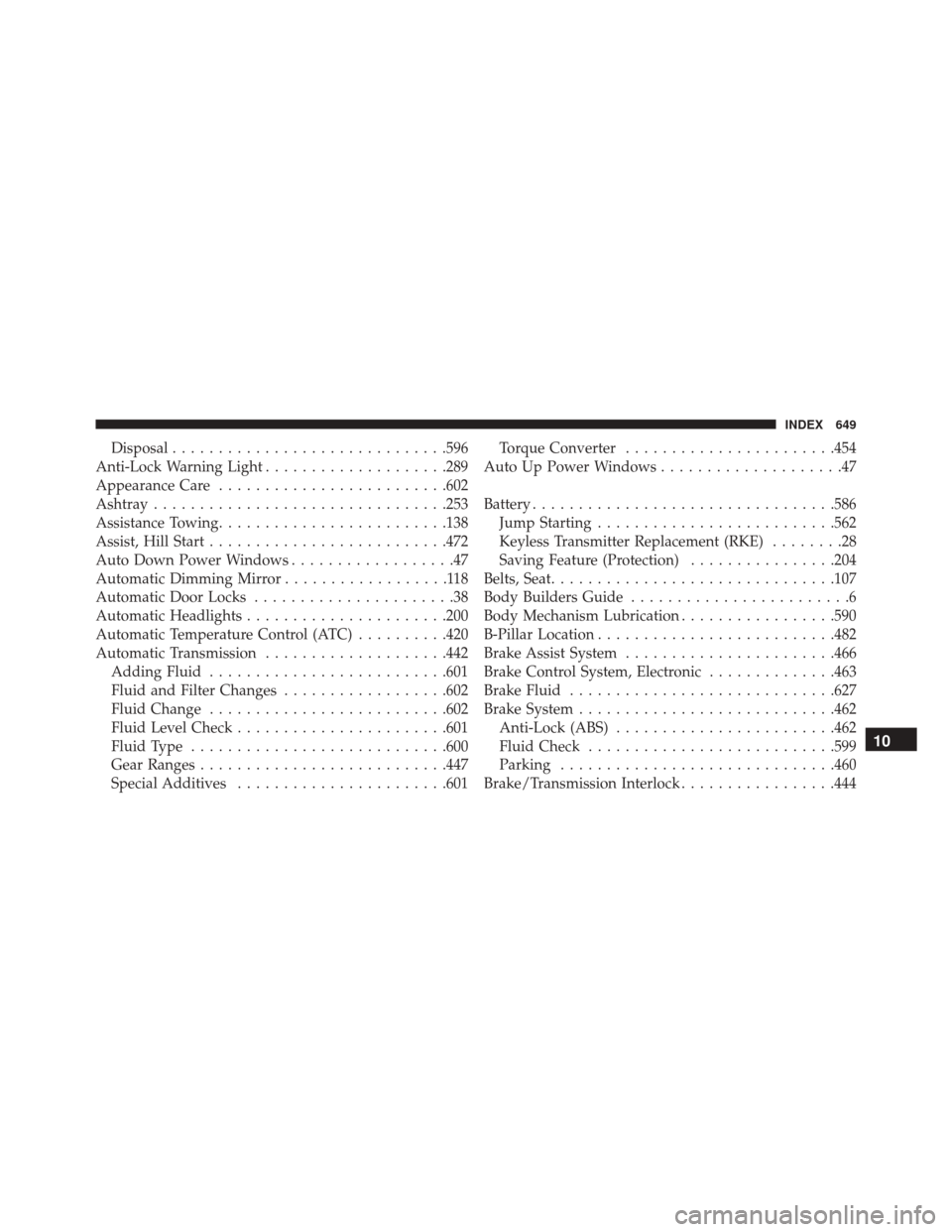
Disposal............................. .596
Anti-Lock Warning Light ....................289
Appearance Care ........................ .602
Ashtray ............................... .253
Assistance Towing ........................ .138
Assist, Hill Start ......................... .472
Auto Down Power Windows ..................47
Automatic Dimming Mirror ..................118
Automatic Door Locks ......................38
Automatic Headlights ..................... .200
Automatic Temperature Control (ATC) ..........420
Automatic Transmission ....................442
Adding Fluid ......................... .601
Fluid and Filter Changes ..................602
Fluid Change ......................... .602
Fluid Level Check ...................... .601
Fluid Type ........................... .600
Gear Ranges .......................... .447
Special Additives ...................... .601Torque Converter
...................... .454
Auto Up Power Windows ....................47
Battery ................................ .586
Jump Starting ......................... .562
Keyless Transmitter Replacement (RKE) ........28
Saving Feature (Protection) ................204
Belts, Seat .............................. .107
Body Builders Guide ........................6
Body Mechanism Lubrication .................590
B-Pillar Location ......................... .482
Brake Assist System ...................... .466
Brake Control System, Electronic ..............463
Brake Fluid ............................ .627
Brake System ........................... .462
Anti-Lock (ABS) ....................... .462
Fluid Check .......................... .599
Parking ............................. .460
Brake/T
ransmission Interlock .................444
10
INDEX 649
Page 656 of 671
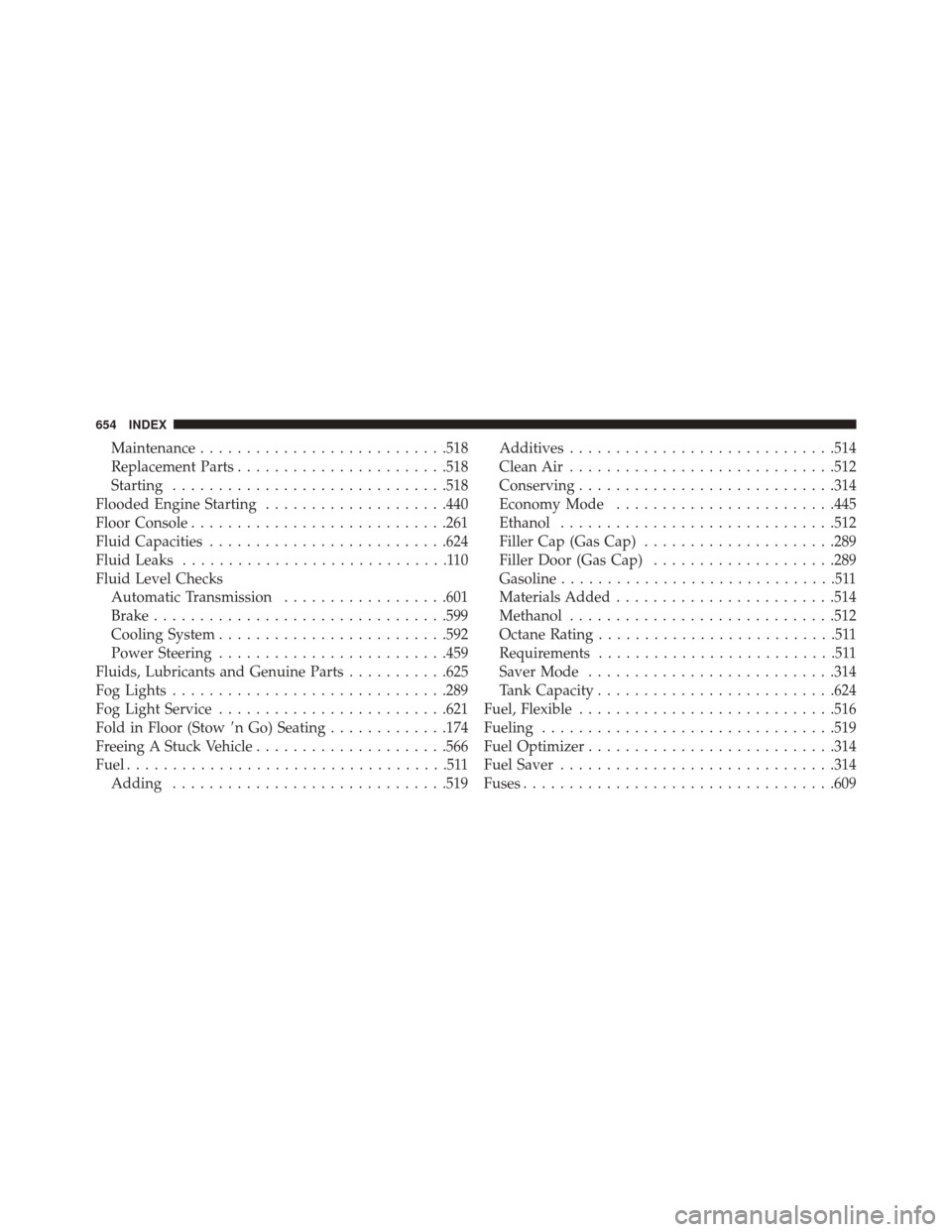
Maintenance.......................... .518
Replacement Parts ...................... .518
Starting ............................. .518
Flooded Engine Starting ....................440
Floor Console ........................... .261
Fluid Capacities ......................... .624
Fluid Leaks .............................110
Fluid Level Checks Automatic Transmission ..................601
Brake ............................... .599
Cooling System ........................ .592
Power Steering ........................ .459
Fluids, Lubricants and Genuine Parts ...........625
Fog Lights ............................. .289
Fog Light Service ........................ .621
Fold in Floor (Stow n Go) Seating.............174
Freeing A Stuck Vehicle .....................566
Fuel ...................................511
Adding ............................. .519Additives
............................ .514
Clean Air ............................ .512
Conserving ........................... .314
Economy Mode ....................... .445
Ethanol ............................. .512
Filler Cap (Gas Cap) .....................289
Filler Door (Gas Cap) ....................289
Gasoline ..............................511
Materials Added ....................... .514
Methanol ............................ .512
Octane Rating ..........................511
Requirements ..........................511
Saver Mode .......................... .314
Tank Capacity ......................... .624
Fuel, Flexible ........................... .516
Fueling ............................... .519
Fuel Optimizer .......................... .314
Fuel
Saver ............................. .314
Fuses ................................. .609
654 INDEX