belt Ram Cargo Van 2015 Service Manual
[x] Cancel search | Manufacturer: RAM, Model Year: 2015, Model line: Cargo Van, Model: Ram Cargo Van 2015Pages: 671, PDF Size: 5.05 MB
Page 172 of 671
To recline, lean forward slightly, lift the lever, then push
back to the desired position and release the lever. Lean
forward and lift the lever to return the seatback to its
normal position. Using body pressure, lean forward and
rearward on the seat to be sure the seatback has latched.
WARNING!
Do not ride with the seatback reclined so that the
shoulder belt is no longer resting against your chest.
In a collision you could slide under the seat belt,
which could result in serious injury or death.
Head Restraints
Head restraints are designed to reduce the risk of injury
by restricting head movement in the event of a rear
impact. Head restraints should be adjusted so that the top
of the head restraint is located above the top of your ear.
WARNING!
The head restraints for all occupants must be prop-
erly installed and adjusted prior to operating the
vehicle or occupying a seat. Head restraints should
never be adjusted while the vehicle is in motion.
Driving a vehicle with the head restraints improperly
adjusted or removed could cause serious injury or
death in the event of a collision.
Active Head Restraints — Front Seats
Active Head Restraints are passive, deployable compo-
nents, and vehicles with this equipment cannot be readily
identified by any markings, only through visual inspec-
tion of the head restraint. The Active Head Restraints
(AHR) will be split in two halves, with the front half
being soft foam and trim, the back half being decorative
plastic.
170 UNDERSTANDING THE FEATURES OF YOUR VEHICLE
Page 184 of 671
While sitting in the seat, pull up on the handle and slide
the seat forward or rearward. Release the bar once you
have reached the desired position. Then, using body
pressure, move forward and rearward on the seat to be
sure that the seat adjusters have latched.
WARNING!
•Adjusting a seat while driving may be dangerous.
Moving a seat while driving could result in loss of
control which could cause a collision and serious
injury or death.
• Seats should be adjusted before fastening the seat
belts and while the vehicle is parked. Serious
injury or death could result from a poorly adjusted
seat belt.
Manual Recline
To recline, lean forward slightly, lift the lever, then push
back to the desired position and release the lever. Lean
forward and lift the lever to return the seatback to its
normal position. Using body pressure, lean forward and
rearward on the seat to be sure the seatback has latched.Manual Seat Adjuster
182 UNDERSTANDING THE FEATURES OF YOUR VEHICLE
Page 185 of 671
WARNING!
Do not ride with the seatback reclined so that the
shoulder belt is no longer resting against your chest.
In a collision you could slide under the seat belt,
which could result in serious injury or death.
Fold-Flat
To fold the seat, lift the recliner lever to the full upward
position and push the seatback forward until it rests on
the seat cushion.
Recline Lever
Fold-Flat Quad Seat
3
UNDERSTANDING THE FEATURES OF YOUR VEHICLE 183
Page 191 of 671
NOTE:
•Disconnect the center shoulder belt from the small
buckle and lower the head restraints before attempting
to fold/stow the power third row seats.
• To abort seat operation while seat is in motion, press a
different seat position selector switch to stop the seat.
Once the seat stops moving, then the desired position
can be selected.
• The third row power seat system includes obstacle
detection for safe operation. When the system detects
an obstacle, the motors will stop and reverse the
motion a short distance to move the seat away from
the obstacle. Should this occur, remove the obstacle
and press the button again, for the desired position.
Manually Folding Third Row Seats — If Equipped
1. Lower the center head restraint down to the seatback
by pushing the button on the guide and pushing the
head restraint down. 2. Lower the outboard head restraints by pulling on the
release strap marked “1” located on the outboard side
of the head restraint.
Head Restraint Release Strap “1”
3
UNDERSTANDING THE FEATURES OF YOUR VEHICLE 189
Page 301 of 671
WARNING!
Driving a vehicle with the red brake light on is
dangerous. Part of the brake system may have failed.
It will take longer to stop the vehicle. You could have
a collision. Have the vehicle checked immediately.
Vehicles equipped with the Anti-Lock Brake System
(ABS) are also equipped with Electronic Brake Force
Distribution (EBD). In the event of an EBD failure, the
Brake Warning Light will turn on along with the ABS
Light. Immediate repair to the ABS system is required.
Operation of the Brake Warning Light can be checked by
turning the ignition switch from the OFF position to the
ON/RUN position. The light should illuminate for ap-
proximately two seconds. The light should then turn off
unless the parking brake is applied or a brake fault is
detected. If the light does not illuminate, have the light
inspected by an authorized dealer. The light also will turn on when the parking brake is
applied with the ignition switch in the ON/RUN posi-
tion.
NOTE:
This light shows only that the parking brake is
applied. It does not show the degree of brake application.
19. Seat Belt Reminder Light
When the ignition switch is first turned to ON/
RUN, this light will turn on for four to eight
seconds as a bulb check. During the bulb check, if
the driver or front passenger’s seat belt is unbuckled, a
chime will sound. After the bulb check or when driving,
if the driver’s seat belt remains unbuckled, the Seat Belt
Reminder Light will illuminate and the chime will sound.
Refer to “Occupant Restraints” in “Things To Know
Before Starting Your Vehicle” for further information.
4
UNDERSTANDING YOUR INSTRUMENT PANEL 299
Page 441 of 671
STARTING PROCEDURES
Before starting your vehicle, adjust your seat, adjust the
inside and outside mirrors, fasten your seat belt, and if
present, instruct all other occupants to buckle their seat
belts.
WARNING!
•When leaving the vehicle, always remove the key
fob from the ignition and lock your vehicle.
• Never leave children alone in a vehicle, or with
access to an unlocked vehicle.
• Allowing children to be in a vehicle unattended is
dangerous for a number of reasons. A child or
others could be seriously or fatally injured. Chil-
dren should be warned not to touch the parking
brake, brake pedal or the shift lever.
(Continued)
WARNING! (Continued)
•Do not leave the key fob in or near the vehicle, or
in a location accessible to children and do not leave
the ignition of a vehicle equipped with Keyless
Enter-N-Go™ in the ACC or ON/RUN Mode. A
child could operate power windows, other controls,
or move the vehicle.
Automatic Transmission
The shift lever must be in the NEUTRAL or PARK
position before you can start the engine. Press the brake
pedal before shifting into any driving gear.
Normal Starting
1. Do not press the accelerator.
2. Use the Fob with Integrated Key to briefly turn the ignition switch to the START position and release it as
5
STARTING AND OPERATING 439
Page 590 of 671
test. Drive belt tension should also be checked at this
time.
WARNING!
•Use only refrigerants and compressor lubricants
approved by the manufacturer for your air condi-
tioning system. Some unapproved refrigerants are
flammable and can explode, injuring you. Other
unapproved refrigerants or lubricants can cause the
system to fail, requiring costly repairs. Refer to
Warranty Information Book, located on the DVD,
for further warranty information.
• The air conditioning system contains refrigerant
under high pressure. To avoid risk of personal
injury or damage to the system, adding refrigerant
or any repair requiring lines to be disconnected
should be done by an experienced technician.
CAUTION!
Do not use chemical flushes in your air conditioning
system as the chemicals can damage your air condi-
tioning components. Such damage is not covered by
the New Vehicle Limited Warranty.
Refrigerant Recovery And Recycling
R-134a Air Conditioning Refrigerant is a hydrofluoro-
carbon (HFC) that is endorsed by the Environmental
Protection Agency and is an ozone-saving product. How-
ever, the manufacturer recommends that air conditioning
service be performed by authorized dealer or other
service facilities using recovery and recycling equipment.
NOTE: Use only manufacturer approved A/C system
PAG compressor oil and refrigerants.
588 MAINTAINING YOUR VEHICLE
Page 610 of 671
Cleaning Plastic Instrument Cluster Lenses
The lenses in front of the instruments in this vehicle are
molded in clear plastic. When cleaning the lenses, care
must be taken to avoid scratching the plastic.
1. Clean with a wet soft rag. A mild soap solution may beused, but do not use high alcohol content or abrasive
cleaners. If soap is used, wipe clean with a clean damp
rag.
2. Dry with a soft cloth.
Seat Belt Maintenance
Do not bleach, dye, or clean the belts with chemical
solvents or abrasive cleaners. This will weaken the fabric.
Sun damage can also weaken the fabric.
If the belts need cleaning, use MOPAR® Total Clean, a
mild soap solution, or lukewarm water. Do not remove
the belts from the vehicle to wash them. Dry with a soft
cloth. Replace the belts if they appear frayed or worn or if the
buckles do not work properly.
WARNING!
A frayed or torn belt could rip apart in a collision and
leave you with no protection. Inspect the belt system
periodically, checking for cuts, frays, or loose parts.
Damaged parts must be replaced immediately. Do
not disassemble or modify the system. Seat belt
assemblies must be replaced after a collision if they
have been damaged (i.e., bent retractor, torn web-
bing, etc.).
Cleaning The Instrument Panel Cupholders
Removal
Pull the flexible liner from the cupholder drawer starting
at one edge to ease removal.
608 MAINTAINING YOUR VEHICLE
Page 651 of 671
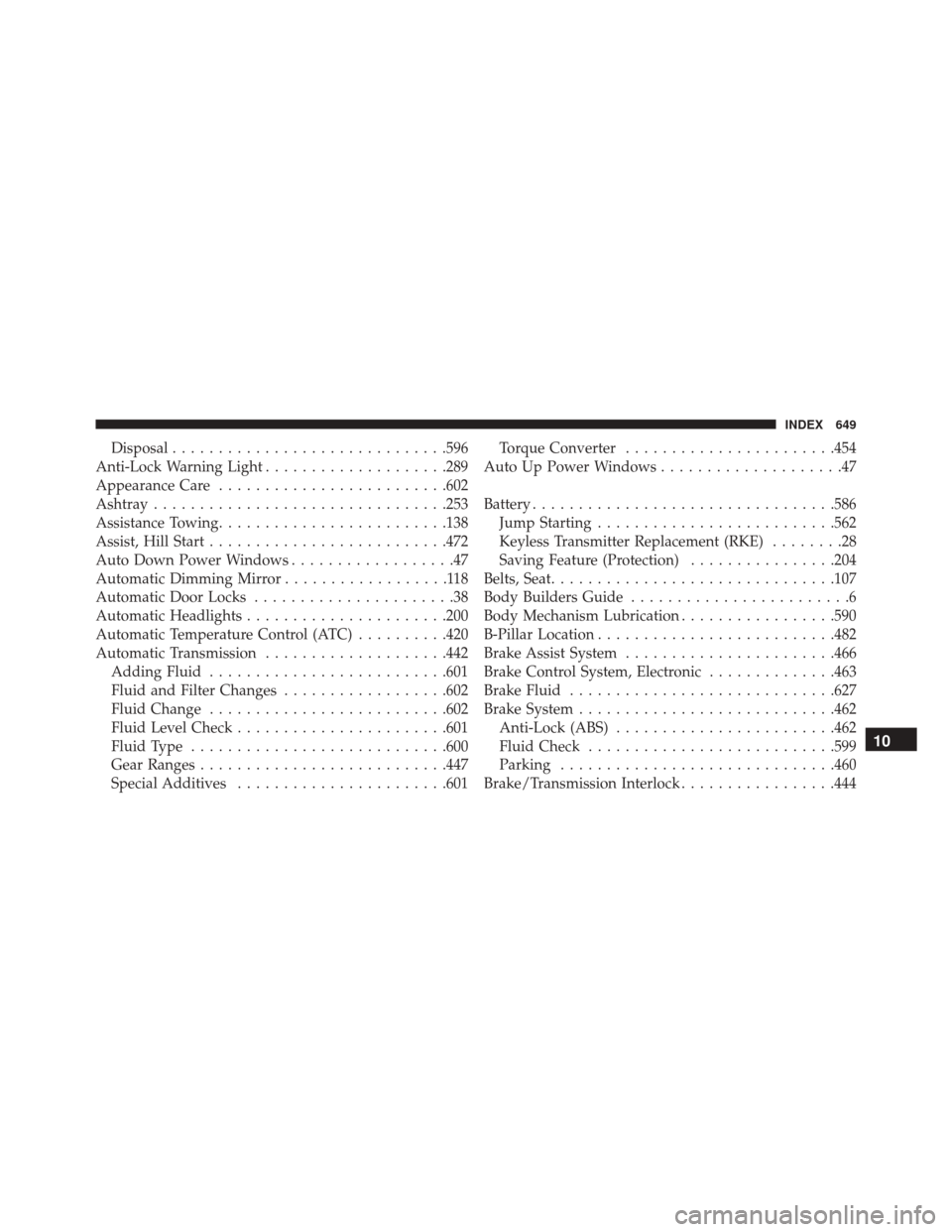
Disposal............................. .596
Anti-Lock Warning Light ....................289
Appearance Care ........................ .602
Ashtray ............................... .253
Assistance Towing ........................ .138
Assist, Hill Start ......................... .472
Auto Down Power Windows ..................47
Automatic Dimming Mirror ..................118
Automatic Door Locks ......................38
Automatic Headlights ..................... .200
Automatic Temperature Control (ATC) ..........420
Automatic Transmission ....................442
Adding Fluid ......................... .601
Fluid and Filter Changes ..................602
Fluid Change ......................... .602
Fluid Level Check ...................... .601
Fluid Type ........................... .600
Gear Ranges .......................... .447
Special Additives ...................... .601Torque Converter
...................... .454
Auto Up Power Windows ....................47
Battery ................................ .586
Jump Starting ......................... .562
Keyless Transmitter Replacement (RKE) ........28
Saving Feature (Protection) ................204
Belts, Seat .............................. .107
Body Builders Guide ........................6
Body Mechanism Lubrication .................590
B-Pillar Location ......................... .482
Brake Assist System ...................... .466
Brake Control System, Electronic ..............463
Brake Fluid ............................ .627
Brake System ........................... .462
Anti-Lock (ABS) ....................... .462
Fluid Check .......................... .599
Parking ............................. .460
Brake/T
ransmission Interlock .................444
10
INDEX 649
Page 659 of 671
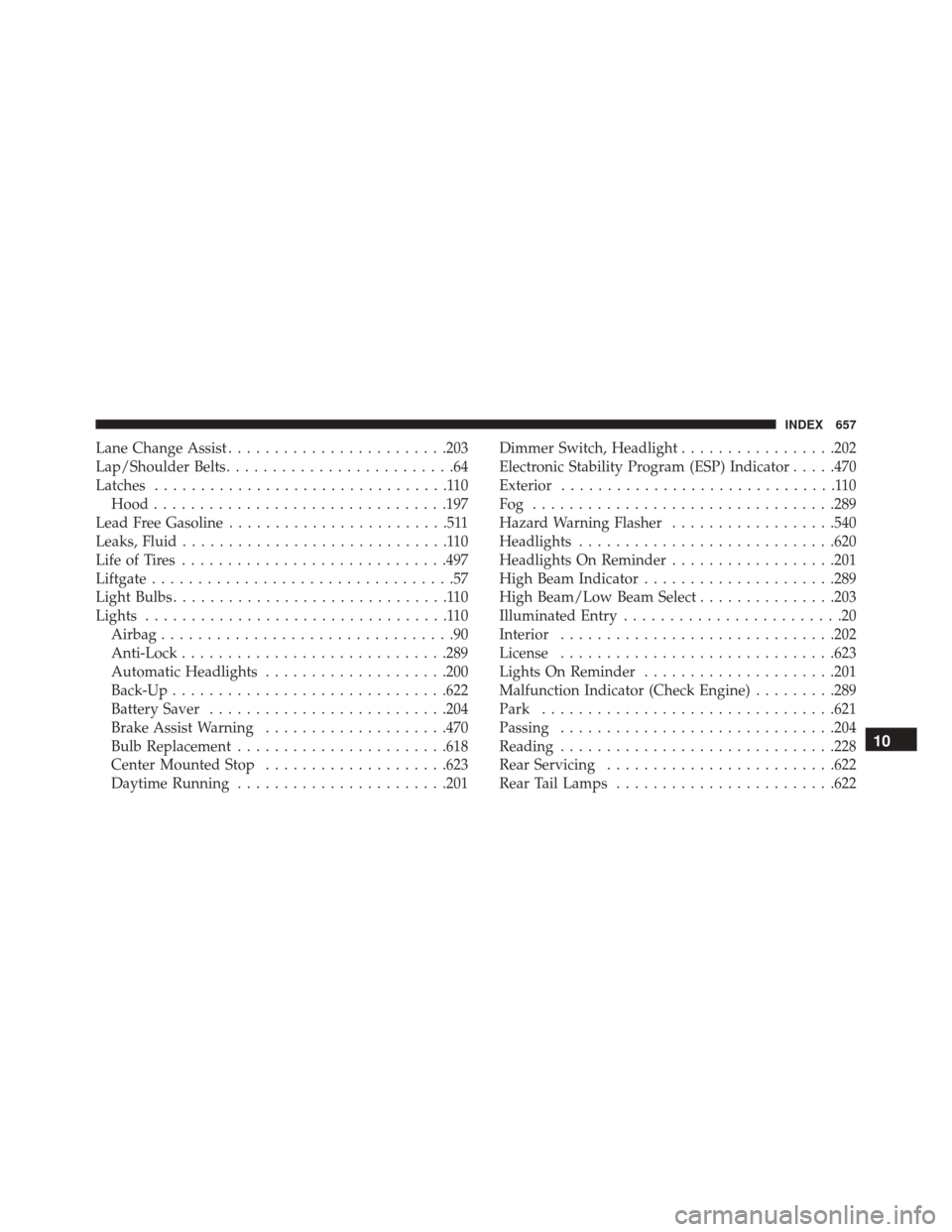
Lane Change Assist....................... .203
Lap/Shoulder Belts .........................64
Latches ................................110
Hood ............................... .197
Lead Free Gasoline ........................511
Leaks, Fluid .............................110
Life of Tires ............................ .497
Liftgate .................................57
Light Bulbs ..............................110
Lights .................................110
Airbag ................................90
Anti-Lock ............................ .289
Automatic Headlights ....................200
Back-Up ............................. .622
Battery Saver ......................... .204
Brake Assist Warning ....................470
Bulb Replacement ...................... .618
Center Mounted Stop ....................623
Daytime Running ...................... .201Dimmer Switch, Headlight
.................202
Electronic Stability Program (ESP) Indicator .....470
Exterior ..............................110
Fog ................................ .289
Hazard Warning Flasher ..................540
Headlights ........................... .620
Headlights On Reminder ..................201
High Beam Indicator .....................289
High Beam/Low Beam Select ...............203
Illuminated Entry ........................20
Interior ............................. .202
License ............................. .623
Lights On Reminder .....................201
Malfunction Indicator (Check Engine) .........289
Park ............................... .621
Passing ............................. .204
Reading ............................. .228
Rear Servicing ........................ .622
Rear Tail Lamps ....................... .622
10
INDEX 657