brake light RAM CHASSIS CAB 2009 User Guide
[x] Cancel search | Manufacturer: RAM, Model Year: 2009, Model line: CHASSIS CAB, Model: RAM CHASSIS CAB 2009Pages: 429, PDF Size: 3.51 MB
Page 251 of 429

LIMITED-SLIP DIFFERENTIAL – IF EQUIPPED
The limited-slip differential provides additional traction
on snow, ice, mud, sand and gravel, particularly when
there is a difference between the traction characteristics
of the surface under the right and left rear wheels. During
normal driving and cornering, the limited-slip unit per-
forms similarly to a conventional differential. On slip-
pery surfaces, however, the differential delivers more of
the driving effort to the rear wheel having the better
traction.
The limited-slip differential is especially helpful during
slippery driving conditions. With both rear wheels on a
slippery surface, a slight application of the accelerator
will supply maximum traction. When starting with only
one rear wheel on an excessively slippery surface, slight
momentary application of the parking brake may be
necessary to gain maximum traction.WARNING!
On vehicles equipped with a limited-slip differential
never run the engine with one rear wheel off the
ground since the vehicle may drive through the rear
wheel remaining on the ground. You could lose
control of the vehicle.
Care should be taken to avoid sudden accelerations when
both rear wheels are on a slippery surface. This could
cause both rear wheels to spin, and allow the vehicle to
slide sideways on the crowned surface of a road or in a
turn.
STARTING AND OPERATING 249
5
Page 254 of 429

WARNING!
•Driving through standing water limits your vehi-
cle’s traction capabilities. Do not exceed 5 mph
(8 km/h) when driving through standing water.
•Driving through standing water limits your vehi-
cle’s braking capabilities, which increases stop-
ping distances. Therefore, after driving through
standing water, drive slowly and lightly press on
the brake pedal several times to dry the brakes.
•Getting water inside your vehicle’s engine can
cause it to lock up and stall out, and leave you
stranded.
•Failure to follow these warnings may result in
injuries that are serious or fatal to you, your
passengers, and others around you.
POWER STEERING
The standard power steering system will give you good
vehicle response and increased ease of maneuverability
in tight spaces. The system will provide mechanical
steering capability if power assist is lost.
If for some reason the power assist is interrupted, it will
still be possible to steer your vehicle. Under these condi-
tions, you will observe a substantial increase in steering
effort, especially at very low vehicle speeds and during
parking maneuvers.
NOTE:Increased noise levels at the end of the steering
wheel travel are considered normal and do not indicate
that there is a problem with the power steering system.
Upon initial start-up in cold weather, the power steering
pump may make noise for a short amount of time. This is
due to the cold, thick fluid in the steering system. This
noise should be considered normal, and it does not in any
way damage the steering system.
252 STARTING AND OPERATING
Page 256 of 429
PARKING BRAKE
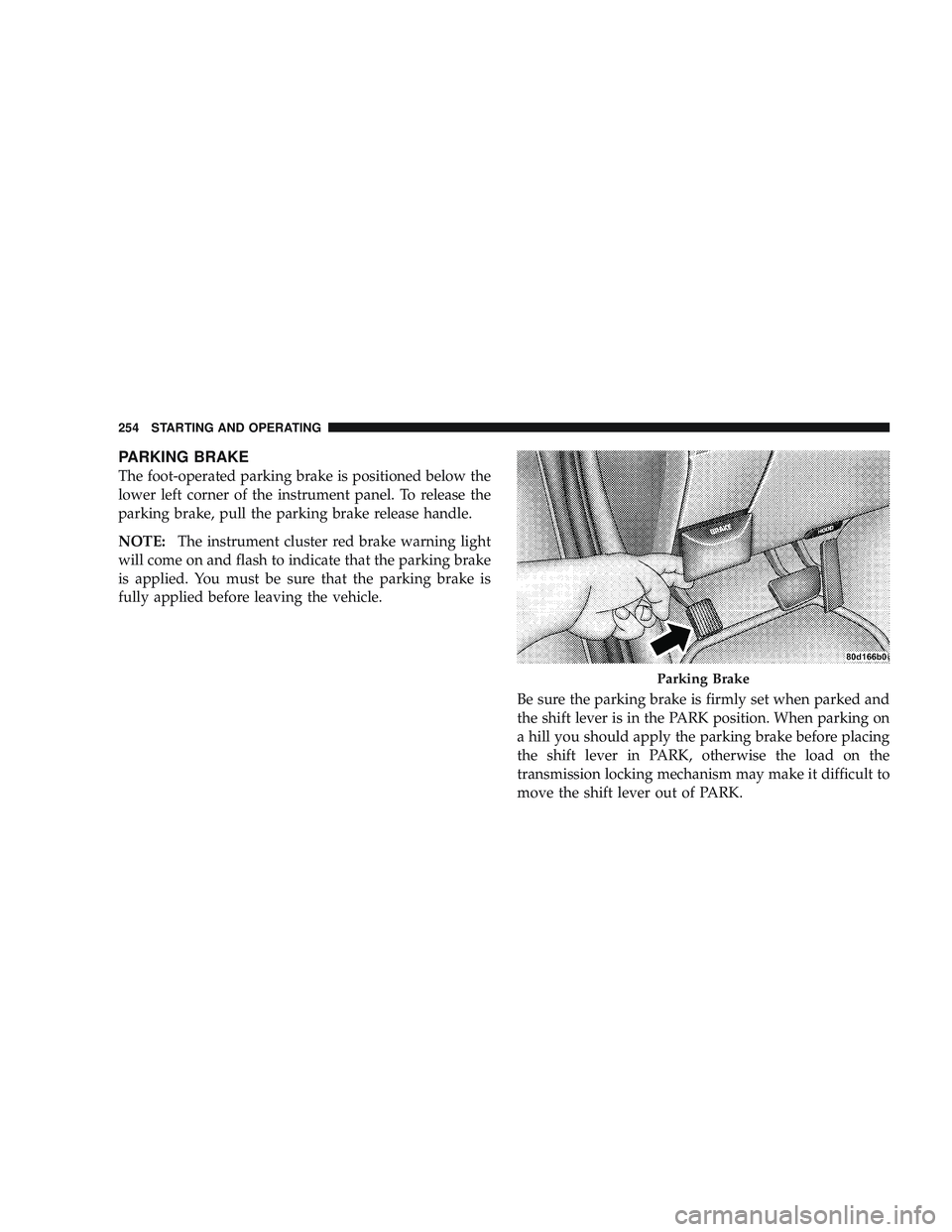
The foot-operated parking brake is positioned below the
lower left corner of the instrument panel. To release the
parking brake, pull the parking brake release handle.
NOTE:The instrument cluster red brake warning light
will come on and flash to indicate that the parking brake
is applied. You must be sure that the parking brake is
fully applied before leaving the vehicle.
Be sure the parking brake is firmly set when parked and
the shift lever is in the PARK position. When parking on
a hill you should apply the parking brake before placing
the shift lever in PARK, otherwise the load on the
transmission locking mechanism may make it difficult to
move the shift lever out of PARK.
Parking Brake
254 STARTING AND OPERATING
Page 257 of 429

WARNING!
•Always fully apply the parking brake when leav-
ing your vehicle, or it may roll and cause damage
or injury. Also be certain to leave the transmission
in PARK. Failure to do so may allow the vehicle to
roll and cause damage or injury.
•Never leave children alone in a vehicle. Leaving
unattended children in a vehicle is dangerous for a
number of reasons. A child or others could be
seriously or fatally injured. Do not leave the key in
the ignition. A child could operate power win-
dows, other controls, or move the vehicle.
•Be sure the parking brake is fully disengaged
before driving, failure to do so can lead to brake
problems due to excessive heating of the rear
brakes.When parking on a hill, turn the front wheels toward the
curb on a downhill grade and away from the curb on an
uphill grade.
The parking brake should always be applied whenever
the driver is not in the vehicle.
BRAKE SYSTEM
If power assist is lost for any reason (for example,
repeated brake applications with the engine off), the
brakes will still function. However, you will experience a
substantial increase in braking effort to stop the vehicle.
If either the front or rear hydraulic systems lose normal
capability, the remaining system will still function with
some loss of overall braking effectiveness. This will be
evident by increased pedal travel during application,
greater pedal force required to slow or stop, and activa-
tion of the BRAKE warning light and the ABS light (if
equipped) during brake use.
STARTING AND OPERATING 255
5
Page 259 of 429
The system’s pump motor runs during an ABS stop to
provide regulated hydraulic pressure. The pump motor
makes a low humming noise during operation. This is
normal.
When you are in a severe braking condition involving
use of the ABS, you will experience some pedal drop as
the vehicle comes to a complete stop. This is the result of
the system reverting to the base brake system and is
normal.
Engagement of the ABS may be accompanied by a
pulsing sensation in the brake pedal. You may also hear
a clicking noise. These occurrences are normal, and
indicate that the system is functioning.ABS Warning Light
The ABS includes an amber warning light, located in the
instrument cluster. When the light is illuminated, the ABS
is not functioning. The system reverts to standard non-
anti-lock brakes.
WARNING!
Pumping of the anti-lock brakes will diminish their
effectiveness and may lead to an accident. Pumping
makes the stopping distance longer. Just press firmly
on your brake pedal when you need to slow down or
stop.
STARTING AND OPERATING 257
5
Page 300 of 429
WARNING!
•Do not connect trailer brakes to your vehicle’s
hydraulic brake lines. It can overload your brake
system and cause it to fail. You might not have
brakes when you need them and could have an
accident.
•Towing any trailer will increase your stopping
distance. When towing you should allow for addi-
tional space between your vehicle and the vehicle
in front of you. Failure to do so could result in an
accident.
Towing Requirements — Trailer Lights & Wiring
Whenever you pull a trailer, regardless of the trailer size,
stop lights and turn signals on the trailer are required for
motoring safety.
Twelve trailer tow circuits are provided at the rear of the
chassis. These circuits are unterminated and sealed.Seven of the 12 circuits are the standard 7-pin trailer
wiring circuits. Three of the 12 circuits are upfitter
circuits used for aftermarket applications. Two of the 12
circuits are additional trailer circuits. For additional
information about trailer tow circuits or other exterior
lighting capabilities of your vehicle, refer to the Body
Builder’s Guide by accessing “www.dodge.com/
bodybuilder” and choosing the appropriate links.
NOTE:
Do not cut or splice wiring into the vehicles
wiring harness.
WARNING!
Any work done to the vehicle’s electrical system or
wiring should be performed by a qualified automo-
tive technician. If done improperly it may cause
damage to the electrical system wiring and could
result in serious or fatal injury.
298 STARTING AND OPERATING
Page 310 of 429

3. Turn the ignition key to the ON position, but do not
start the engine.
4. Depress the brake pedal.
5. Shift transmission into NEUTRAL.
6. Using the point of a ballpoint pen or similar object,
depress the recessed transfer case NEUTRAL button for
four seconds.
7. After shift is completed and the NEUTRAL light
comes on, release the NEUTRAL button.
8. Start engine.
9. Shift transmission into REVERSE.
10. Release brake pedal for five seconds and ensure that
there is no vehicle movement.
11. Repeat steps 9 and 10 with the transmission in
DRIVE.12. Shut engine OFF and place ignition key in the
unlocked OFF position.
13. Shift transmission into PARK.
14. Apply parking brake.
15. Attach vehicle to tow vehicle with tow bar.
16. Release parking brake.
NOTE:
•Steps 1 through 5 are requirements that must be met
prior to depressing the NEUTRAL selection button,
and must continue to be met until the four seconds
elapses and the shift has been completed. If any of
these requirements (with the exception of 3 - Key ON)
are not met prior to depressing the NEUTRAL button
or are no longer met during the four second timer, then
the NEUTRAL indicator light will flash continuously
until all requirements are met or until the NEUTRAL
button is released.
308 STARTING AND OPERATING
Page 311 of 429

•The ignition key must be ON for a shift to take place
and for the position indicator lights to be operable. If
the key in not ON, the shift will not take place and no
position indicator lights will be on or flashing.
•Flashing NEUTRAL position indicator light indicates
that shift requirements have not been met.
CAUTION!
Damage to the transmission may occur if the trans-
mission is shifted into PARK with the transfer case in
NEUTRAL and the engine running. With the transfer
case in NEUTRAL ensure, that the engine is OFF
prior to shifting the transmission into PARK.
Returning to Normal Operation — Electronic Shift
Transfer Case
Use the following procedure to prepare your vehicle for
normal usage:1. Bring vehicle to a complete stop.
2. Shut OFF the engine.
3. Turn the ignition key to the ON position, but do not
start the engine.
4. Depress the brake pedal.
5. Shift transmission into NEUTRAL.
6. Using the point of a ballpoint pen or similar object,
depress the recessed transfer case Neutral (N) button for
one second.
7. After the Neutral indicator light turns off, release the
Neutral (N) button.
8. After the Neutral (N) button has been released, the
transfer case will shift to the position identified by the
selector switch.
9. Shift transmission into PARK.
STARTING AND OPERATING 309
5
Page 312 of 429

NOTE:
•The transfer case cannot be shifted into NEUTRAL
from the 4AUTO (if equipped) position.
•Steps 1 through 5 are requirements that must be met
prior to depressing the transfer case Neutral (N)
button, and must continue to be met until one second
elapses and the shift has been completed. If any of
these requirements (with the exception of step3-key
ON) are not met prior to depressing the Neutral (N)
button, or are no longer met during the one second
time, then all of the mode position indicator lights will
flash continuously until all requirements are met, or
until the Neutral (N) button is released.
•The ignition key must be ON for a transfer case shift to
take place and for the position indicator lights to be
operable. If the key is not ON, the shift will not take
place and no position indicator lights will be on or
flashing.
•Flashing Neutral position indicator light indicates that
shift requirements have not been met.
WARNING!
You or others could be injured if you leave the
vehicle unattended with the transfer case in the
NEUTRAL position without first fully engaging the
parking brake. The transfer case NEUTRAL position
disengages both the front and rear driveshafts from
the powertrain and will allow the vehicle to move
despite the transmission position. The parking brake
should always be applied when the driver is not in
the vehicle.
310 STARTING AND OPERATING
Page 329 of 429

Your vehicle is equipped with two 12-Volt batteries. If it
becomes necessary to use a booster battery with jumper
cables to start a vehicle’s engine because its batteries are
discharged, the following procedure should be used:
Set the parking brake and place the transmission in
PARK. Turn off lights, heater and other electrical loads.
Observe charge indicator (if equipped) in both batteries.
If the indicator (if equipped) is light or yellow on either
battery, replace that battery.CAUTION!
Use the Jump-Start Procedure only when the charge
indicator (if equipped) in both batteries is dark in the
center. Do not attempt jump-starting when either
battery charge indicator (if equipped) is bright or
yellow. If the charge indicator (if equipped) has a
green dot in the center, failure to start is not due to a
discharged battery and cranking system should be
checked.
1. Attach one jumper cable to the positive terminal of
booster battery and the other end of the same cable to the
positive terminal of the discharged battery.
WHAT TO DO IN EMERGENCIES 327
6