automatic transmission RAM CHASSIS CAB 2011 User Guide
[x] Cancel search | Manufacturer: RAM, Model Year: 2011, Model line: CHASSIS CAB, Model: RAM CHASSIS CAB 2011Pages: 472, PDF Size: 7.38 MB
Page 275 of 472
the upper gears. When the vehicle speed drops or during
acceleration when the transmission downshifts to second
gear, the clutch automatically disengages.
NOTE:
• The torque converter clutch will not engage until the
transmission fluid and engine coolant (antifreeze) are
warm [usually after 1 to 3 miles (1.6 to 4.8 km) of
driving]. Because the engine speed is higher when the
torque converter clutch is not engaged, it may seem as
if the transmission is not shifting into Overdrive when
cold. This is normal. Pressing the “TOW/HAUL”
switch when the transmission is sufficiently warm will
demonstrate that the transmission is able to shift into
and out of Overdrive.
• If the vehicle has not been driven in several days, the
first few seconds of operation after shifting the trans-
mission into gear may seem sluggish. This is due to the
fluid partially draining from the torque converter into the transmission. This condition is normal and will not
cause damage to the transmission. The torque con-
verter will refill within five seconds of shifting from
PARK into any other gear position.
FOUR-WHEEL DRIVE OPERATION —
IF EQUIPPED
Four-wheel drive trucks are equipped with either a
manually shifted transfer case or an electronically shifted
transfer case. Refer to the operating instructions for your
transfer case, located in this section for further informa-
tion.
Manually Shifted Transfer Case – If Equipped
The transfer case provides four mode positions.
• Two-wheel drive high range (2H)
• Four-wheel drive high range (4H)
• Neutral (N)274 STARTING AND OPERATING
Page 278 of 472
4L
Four-Wheel Drive Low Range - This range locks the front
and rear driveshafts together forcing the front and rear
wheels to rotate at the same speed. Additional traction
and maximum pulling power for loose, slippery road
surfaces only. Do not exceed 25 mph (40 km/h).
Shifting Procedure – Manually Shifted Transfer
Case
2H ⇔ 4H
Shifting between 2H and 4H can be made with the
vehicle stopped or in motion. If the vehicle is in motion,
shifts can be made up to 55 mph (88 km/h). With the
vehicle in motion, the transfer case will engage/
disengage faster if you momentarily release the accelera-
tor pedal after completing the shift. Apply a constant
force when shifting the transfer case lever. 2H or 4H ⇔ 4L
With the vehicle rolling at 2 to 3 mph (3 to 5 km/h), shift
the transmission into NEUTRAL. While the vehicle is
coasting at 2 to 3 mph (3 to 5 km/h), shift the transfer
case lever firmly to the desired position. Do not pause in
transfer case NEUTRAL.
NOTE:
• Pausing in transfer case NEUTRAL in vehicles
equipped with an automatic transmission may require
shutting the engine OFF to avoid gear clash while
completing the shift. If difficulty occurs, shift the
transmission into NEUTRAL, hold foot on brake, and
turn the engine OFF. Make shift to the desired mode.
• Shifting into or out of 4L is possible with the vehicle
completely stopped, however difficulty may occur due
to the mating clutch teeth not being properly aligned.
Several attempts may be required for clutch teeth
alignment and shift completion to occur. The preferred
5 STARTING AND OPERATING 277
Page 290 of 472
Power Steering Fluid Check
Checking the power steering fluid level at a defined
service interval is not required. The fluid should only be
checked if a leak is suspected, abnormal noises are
apparent, and/or the system is not functioning as antici-
pated. Coordinate inspection efforts through an autho-
rized dealer.
CAUTION!Do not use chemical flushes in your power steering
system as the chemicals can damage your power
steering components. Such damage is not covered by
the New Vehicle Limited Warranty. WARNING!Fluid level should be checked on a level surface and
with the engine off to prevent injury from moving
parts and to ensure accurate fluid level reading. Do
not overfill. Use only manufacturer’s recommended
power steering fluid.
If necessary, add fluid to restore to the proper indicated
level. With a clean cloth, wipe any spilled fluid from all
surfaces. Refer to “Fluids, Lubricants, and Genuine Parts”
in “Maintaining Your Vehicle” for further information.
PARKING BRAKE
Before leaving the vehicle, make sure that the parking
brake is fully applied, the engine is off and the key fob is
removed from the ignition switch. Also, be certain to
leave an automatic transmission in PARK, or manual
transmission in REVERSE or first gear.
5 STARTING AND OPERATING 289
Page 291 of 472
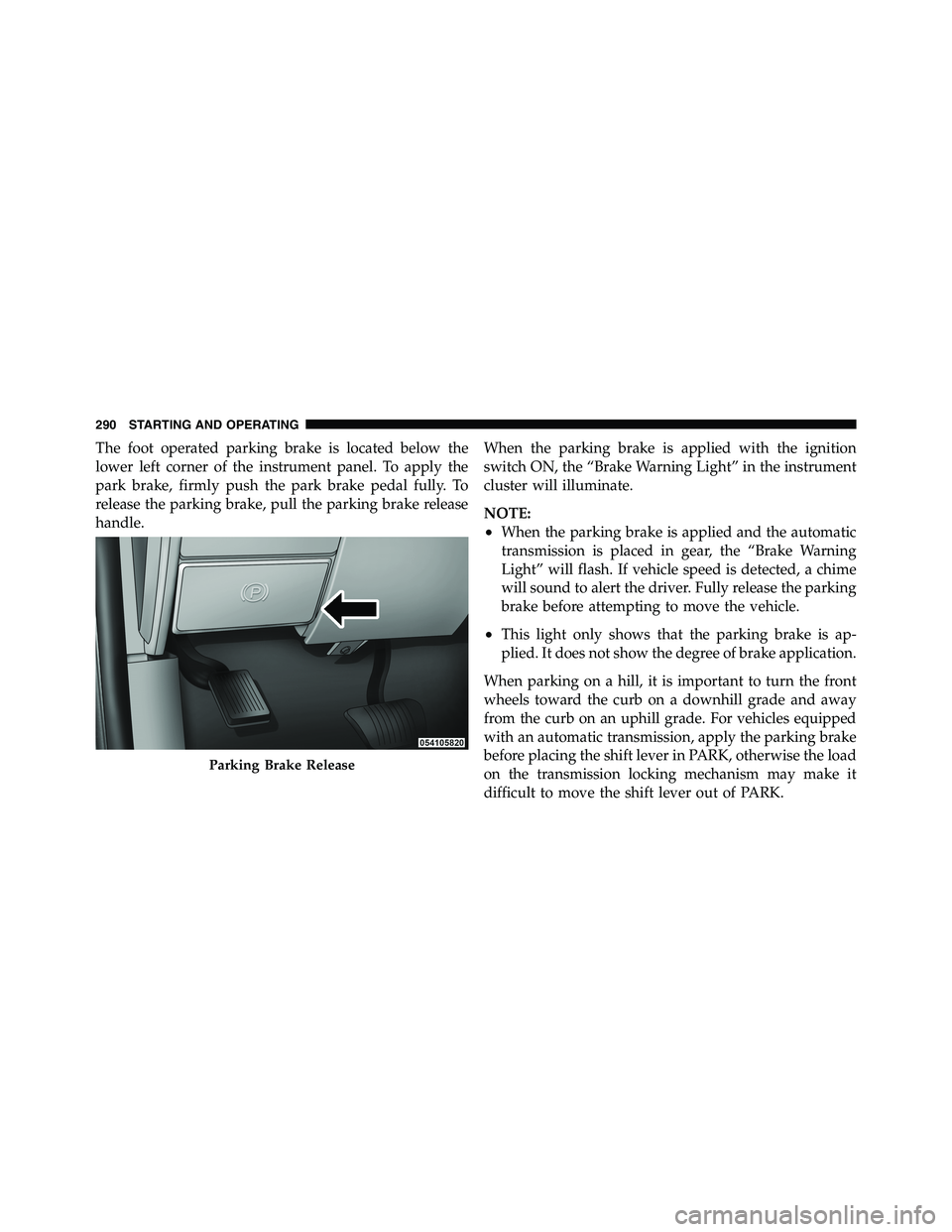
The foot operated parking brake is located below the
lower left corner of the instrument panel. To apply the
park brake, firmly push the park brake pedal fully. To
release the parking brake, pull the parking brake release
handle. When the parking brake is applied with the ignition
switch ON, the “Brake Warning Light” in the instrument
cluster will illuminate.
NOTE:
• When the parking brake is applied and the automatic
transmission is placed in gear, the “Brake Warning
Light” will flash. If vehicle speed is detected, a chime
will sound to alert the driver. Fully release the parking
brake before attempting to move the vehicle.
• This light only shows that the parking brake is ap-
plied. It does not show the degree of brake application.
When parking on a hill, it is important to turn the front
wheels toward the curb on a downhill grade and away
from the curb on an uphill grade. For vehicles equipped
with an automatic transmission, apply the parking brake
before placing the shift lever in PARK, otherwise the load
on the transmission locking mechanism may make it
difficult to move the shift lever out of PARK.Parking Brake Release290 STARTING AND OPERATING
Page 292 of 472
The parking brake should always be applied whenever
the driver is not in the vehicle.
WARNING!• Never leave children alone in a vehicle. Leaving
unattended children in a vehicle is dangerous for a
number of reasons. A child or others could be
seriously or fatally injured.
• Do not leave the key fob in the ignition switch. A
child could operate power windows, other con-
trols, or move the vehicle.
• Be sure the parking brake is fully disengaged
before driving; failure to do so can lead to brake
failure and an accident.
(Continued) WARNING! (Continued)• Always fully apply the parking brake when leav-
ing your vehicle or it may roll and cause damage or
injury. Also, be certain to leave an automatic
transmission in PARK, a manual transmission in
REVERSE or first gear. Failure to do so may cause
the vehicle to roll and cause damage or injury.
CAUTION!If the “Brake Warning Light” remains on with the
parking brake released, a brake system malfunction
is indicated. Have the brake system serviced by an
authorized dealer immediately.
5 STARTING AND OPERATING 291
Page 340 of 472
WARNING!Any work done to the vehicle’s electrical system or
wiring should be performed by a qualified automo-
tive technician. If done improperly it may cause
damage to the electrical system wiring and could
result in serious or fatal injury.
Towing Tips
Before setting out on a trip, practice turning, stopping
and backing the trailer up in an area away from heavy
traffic.
Automatic Transmission
The “DRIVE” range can be selected when towing. How-
ever, if frequent shifting occurs while in this range, select
“TOW/HAUL” mode (if equipped) or select a lower gear
using the Electronic Range Select (ERS) feature. NOTE: Using “TOW/HAUL” mode or a lower gear
range while operating the vehicle under heavy operating
conditions will improve performance and extend trans-
mission life by reducing excessive shifting and heat build
up. This action will also provide better engine braking.
The automatic transmission fluid and filter should be
changed if you regularly tow a trailer for more than
45 minutes of continuous operation. Refer to “Mainte-
nance Schedule” for the proper maintenance intervals.
NOTE: Check the automatic transmission fluid level
before towing.
Tow/Haul
To reduce potential for automatic transmission overheat-
ing, turn the “TOW/HAUL” feature ON when driving in
hilly areas, or select a lower gear range (using the
Electronic Range Select (ERS) feature) on more severe
grades.
5 STARTING AND OPERATING 339
Page 344 of 472
NOTE: During snowplow usage on vehicles equipped
with outside temperature display, the display may show
higher temperatures than the outside ambient tempera-
ture. The higher displayed temperature is due to blocked
or reduced airflow to the underhood ambient tempera-
ture sensor caused by the snowplow. In addition, on
vehicles equipped with Automatic Temperature Control
(ATC), it is suggested that the interior cabin temperature
be manually controlled should the system not perform as
desired while in automatic mode. Both the outside tem-
perature display and ATC operation will return to nor-
mal when the snowplow is removed.
General Maintenance
Snowplows should be maintained in accordance with the
plow manufacturer’s instructions.
Keep all snowplow electrical connections and battery
terminals clean and free of corrosion. When plowing snow, to avoid transmission and drive-
train damage, the following precautions should be ob-
served.
• Operate with transfer case in 4L when plowing small
or congested areas where speeds are not likely to
exceed 15 mph (24 km/h). At higher speeds operate in
4H.
• Vehicles with automatic transmissions should use 4L
range when plowing deep or heavy snow for extended
periods of time to avoid transmission overheating.
• Do not shift the transmission unless the engine has
returned to idle and wheels have stopped. Make a
practice of stepping on the brake pedal before shifting
the transmission.
5 STARTING AND OPERATING 343
Page 345 of 472
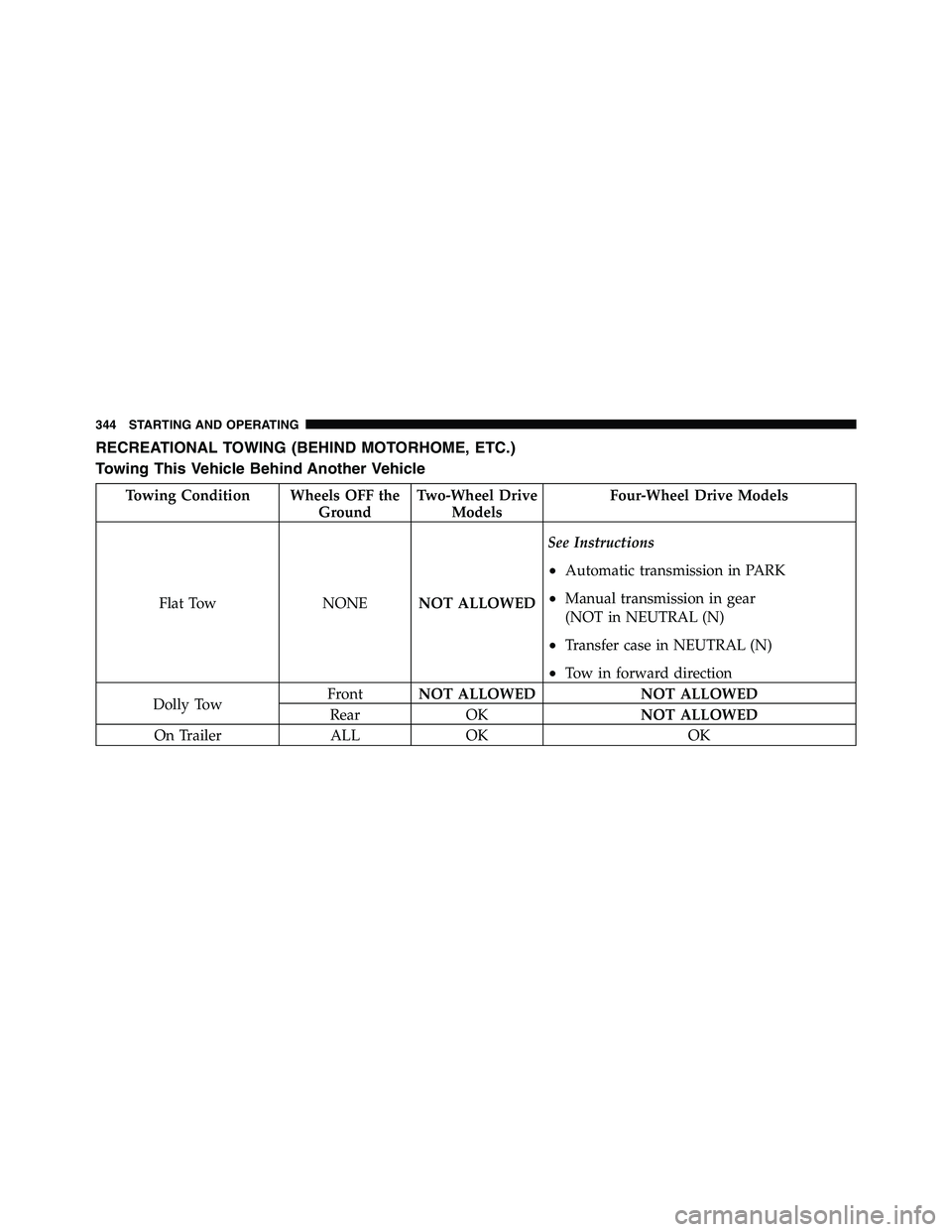
RECREATIONAL TOWING (BEHIND MOTORHOME, ETC.)
Towing This Vehicle Behind Another Vehicle
Towing Condition Wheels OFF the
Ground Two-Wheel Drive
Models Four-Wheel Drive Models
Flat Tow NONE NOT ALLOWED See Instructions
• Automatic transmission in PARK
• Manual transmission in gear
(NOT in NEUTRAL (N)
• Transfer case in NEUTRAL (N)
• Tow in forward direction
Dolly Tow Front NOT ALLOWED NOT ALLOWED
Rear OK NOT ALLOWED
On Trailer ALL OK OK344 STARTING AND OPERATING
Page 346 of 472
Recreational Towing – Two-Wheel Drive Models
DO NOT flat tow this vehicle. Damage to the drivetrain
will result.
Recreational towing (for two-wheel drive models) is
allowed ONLY if the rear wheels are OFF the ground.
This may be accomplished using a tow dolly or vehicle
trailer. If using a tow dolly, follow this procedure:
1. Properly secure the dolly to the tow vehicle, following
the dolly manufacturer’s instructions.
2. Drive the rear wheels onto the tow dolly.
3. Firmly set the parking brake. Place automatic transmis-
sion in PARK, manual transmission in gear (not in Neutral).
4. Properly secure the rear wheels to the dolly, following
the dolly manufacturer’s instructions.
5. Remove the key fob from the ignition switch.
6. Install a suitable clamping device, designed for tow-
ing, to secure the front wheels in the straight position. CAUTION!• Towing with the rear wheels on the ground will
cause severe transmission damage. Damage from
improper towing is not covered under the New
Vehicle Limited Warranty.
• Do not disconnect the driveshaft because fluid
will leak from the transmission, causing damage
to internal parts.
Recreational Towing – Four-Wheel Drive Models
NOTE: Both the manual shift and electronic shift trans-
fer cases must be shifted into NEUTRAL for recreational
towing. Automatic transmissions must be shifted into
PARK for recreational towing. Manual transmissions
must be placed in gear (NOT in NEUTRAL) for recre-
ational towing. Refer to the following for the proper
transfer case NEUTRAL shifting procedure for your
vehicle. 5 STARTING AND OPERATING 345
Page 347 of 472
CAUTION!• Front or rear wheel lifts should not be used.
Internal damage to the transmission or transfer
case will occur if a front or rear wheel lift is used
when recreational towing.
• Tow only in the forward direction. Towing this
vehicle backwards can cause severe damage to the
transfer case.
• Automatic transmissions must be placed in the
PARK position for recreational towing.
• Manual transmissions must be placed in gear (not
in Neutral) for recreational towing.
• Before recreational towing, perform the procedure
outlined under “Shifting Into NEUTRAL” to be
certain that the transfer case is fully in NEUTRAL.
Otherwise, internal damage will result.
(Continued) CAUTION! (Continued)• Towing this vehicle in violation of the above
requirements can cause severe transmission and/or
transfer case damage. Damage from improper tow-
ing is not covered under the New Vehicle Limited
Warranty.
• Do not disconnect the rear driveshaft because
fluid will leak from the transfer case, causing
damage to internal parts.
• Do not use a bumper-mounted clamp-on tow bar
on your vehicle. The bumper face bar will be
damaged.
Shifting Into Neutral (N) – Manual Shift Transfer
Case (If Equipped)
Use the following procedure to prepare your vehicle for
recreational towing.346 STARTING AND OPERATING