child seat RAM CHASSIS CAB 2011 User Guide
[x] Cancel search | Manufacturer: RAM, Model Year: 2011, Model line: CHASSIS CAB, Model: RAM CHASSIS CAB 2011Pages: 472, PDF Size: 7.38 MB
Page 65 of 472
WARNING!Improper installation can lead to failure of an infant
or child restraint. It could come loose in an accident.
The child could be badly injured or killed. Follow
the manufacturer’s directions exactly when installing
an infant or child restraint.
Lower Anchors and Tether for CHildren (LATCH)
Each vehicle is equipped with the child restraint anchor-
age system called LATCH, which stands for Lower
Anchors and Tether for CHildren. LATCH child restraint
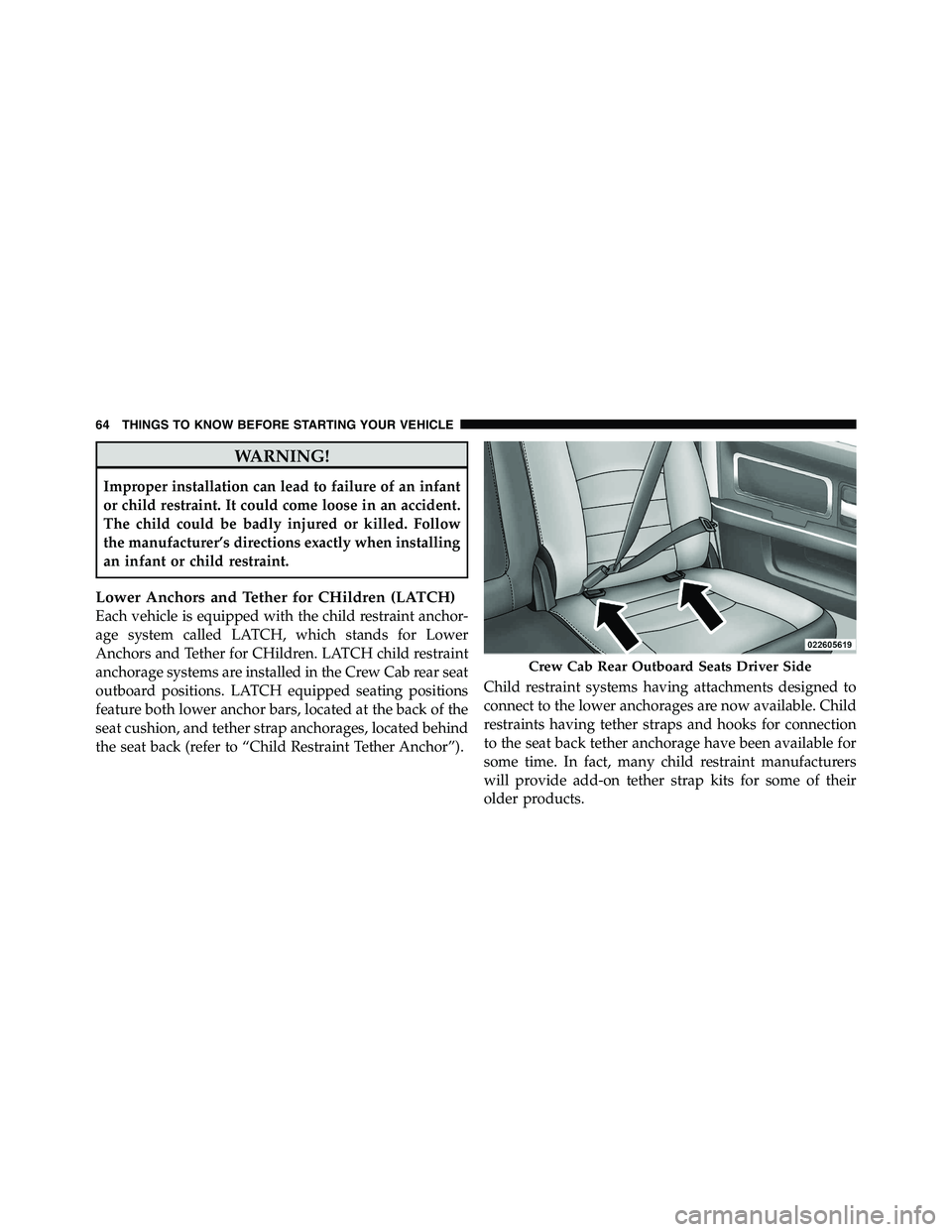
anchorage systems are installed in the Crew Cab rear seat
outboard positions. LATCH equipped seating positions
feature both lower anchor bars, located at the back of the
seat cushion, and tether strap anchorages, located behind
the seat back (refer to “Child Restraint Tether Anchor”). Child restraint systems having attachments designed to
connect to the lower anchorages are now available. Child
restraints having tether straps and hooks for connection
to the seat back tether anchorage have been available for
some time. In fact, many child restraint manufacturers
will provide add-on tether strap kits for some of their
older products. Crew Cab Rear Outboard Seats Driver Side64 THINGS TO KNOW BEFORE STARTING YOUR VEHICLE
Page 66 of 472
Because the lower anchorages are to be introduced to
passenger carrying vehicles over a period of years, child
restraint systems having attachments for those anchor-
ages will continue to have features for installation in
vehicles using the lap or lap/shoulder belt. They will also
have tether straps, and you are urged to take advantage
of all of the available attachments provided with your
child restraint in any vehicle.
NOTE:
• When using the LATCH attaching system to install a
child restraint, please ensure that all seat belts not being
used for occupant restraints are stowed and out of reach
of children. It is recommended that before installing the
child restraint, buckle the seat belt so the seat belt is
tucked behind the child restraint and out of reach. If the
buckled seat belt interferes with the child restraint
installation, instead of tucking the seat belt behind the
child restraint, route the seat belt through the child
restraint belt path and then buckle it. This should stow the seat belt out of the reach of an inquisitive child.
Remind all children in the vehicle that the seat belts are
not toys and should not be played with, and never leave
your child unattended in the vehicle.
• If your child restraint seat is not LATCH-compatible,
install the restraint using the vehicle seat belting.
Installing the Child Restraint System
WARNING!Do not install child restraint systems equipped with
LATCH attachments in the center position of a Crew
Cab model rear seat. The LATCH anchorages in this
seat are designed for the two outboard seating posi-
tions only. A child may be placed in the rear center
seating position of a Crew Cab model using the seat
belt and child tether anchorage. Failure to follow this
may result in serious or fatal injury. 2 THINGS TO KNOW BEFORE STARTING YOUR VEHICLE 65
Page 67 of 472
We urge you to carefully follow the directions of the
manufacturer when installing your child restraint. Many,
but not all, restraint systems will be equipped with
separate straps on each side, with each having a hook or
connector, and a means for adjusting the tension in the
strap. Forward-facing toddler restraints and some
rearward-facing infant restraints will also be equipped
with a tether strap, a hook and means for adjusting the
tension in the strap.
In general, you will first loosen the adjusters on the lower
straps and tether straps so that you can more easily attach
the hook or connector to the lower anchorages and tether
anchorages. Then tighten all three straps as you push the
child restraint rearward and downward into the seat.
Not all child restraint systems will be installed as we
have described here. Again, carefully follow the instruc-
tions that come with the child restraint system. WARNING!Improper installation of a child restraint to the
LATCH anchorages can lead to failure of an infant or
child restraint. The child could be badly injured or
killed. Follow the manufacturer’s directions exactly
when installing an infant or child restraint.
Installing Child Restraints Using the Vehicle Seat
Belt
The seat belts in the passenger seating positions are
equipped with either an Automatic Locking Retractor
(ALR) or a cinching latch plate or both. Both types of seat
belts are designed to keep the lap portion of the seat belt
tight around the child restraint so that it is not necessary
to use a locking clip. The ALR will make a ratcheting
noise if you extract the entire belt from the retractor and66 THINGS TO KNOW BEFORE STARTING YOUR VEHICLE
Page 68 of 472
then allow the belt to retract into the retractor. For
additional information on ALR, refer to “Automatic
Locking Mode”.
To install a child restraint, first, pull enough of the seat
belt webbing from the retractor to route it through the
belt path of the child restraint and slide the latch plate
into the buckle. Next, extract all the seat belt webbing out
of the retractor and then allow the belt to retract into the
retractor. Finally, pull on any excess webbing to tighten
the lap portion around the child restraint. Any seat belt
system will loosen with time, so check the belt occasion-
ally, and pull it tight if necessary.
Child Restraint Tether Anchor
Child restraints having tether straps and hooks for con-
nection to tether anchors have been available for some
time. In fact, many child restraint manufacturers will
provide add-on tether strap kits for their older products.
Regular Cab models have two tether anchorages, one each behind the front center and right seats. Crew Cab
models have three anchorages, one behind each of the
rear seats.
WARNING!An incorrectly anchored tether strap could lead to
seat failure and injury to the child. In a collision, the
seat could come loose and allow the child to crash
into the inside of the vehicle or other passengers, or
even be thrown from the vehicle. Use only the anchor
positions directly behind the child seat to secure a
child restraint top tether strap. Follow the instruc-
tions below. See your authorized dealer for help if
necessary.
2 THINGS TO KNOW BEFORE STARTING YOUR VEHICLE 67
Page 69 of 472
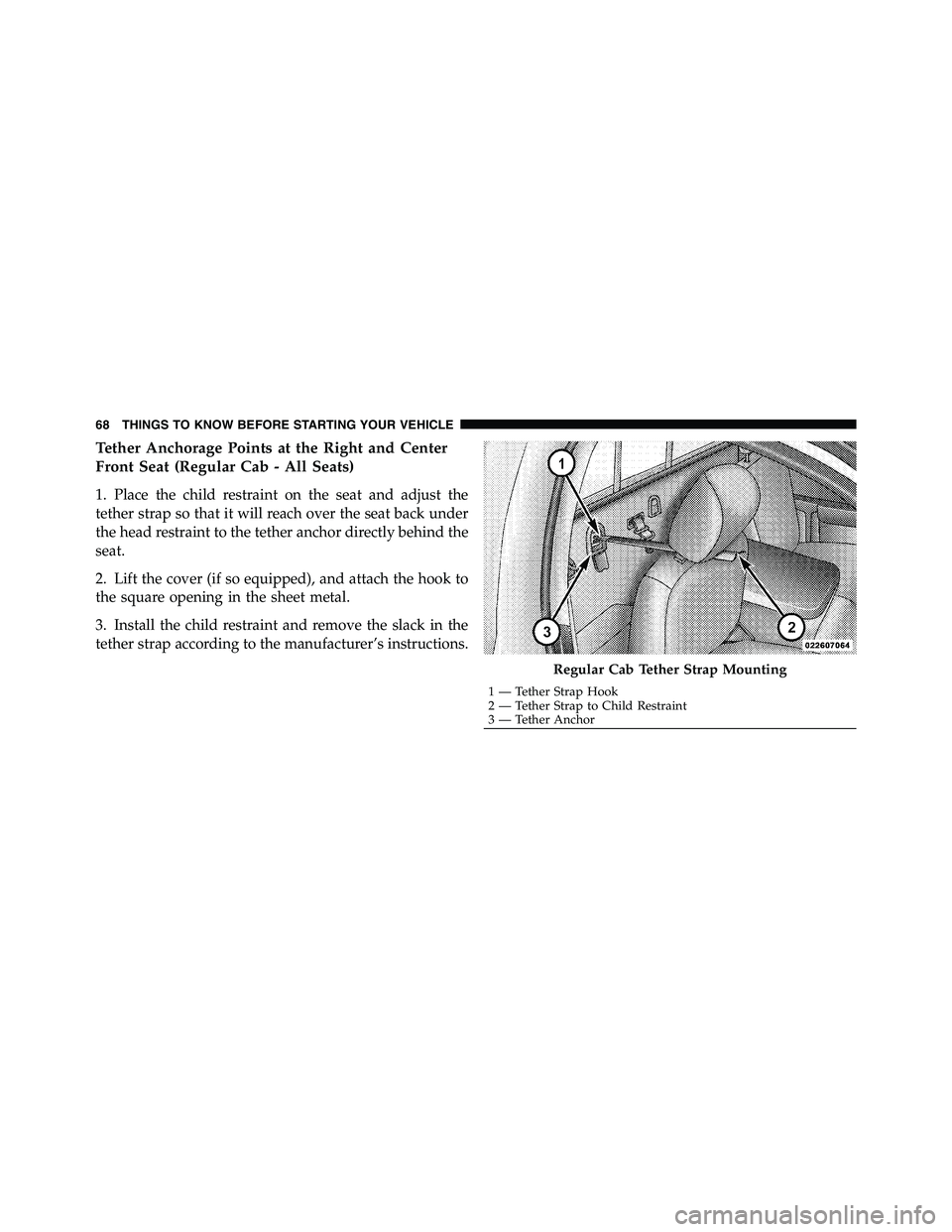
Tether Anchorage Points at the Right and Center
Front Seat (Regular Cab - All Seats)
1. Place the child restraint on the seat and adjust the
tether strap so that it will reach over the seat back under
the head restraint to the tether anchor directly behind the
seat.
2. Lift the cover (if so equipped), and attach the hook to
the square opening in the sheet metal.
3. Install the child restraint and remove the slack in the
tether strap according to the manufacturer’s instructions. Regular Cab Tether Strap Mounting1 — Tether Strap Hook
2 — Tether Strap to Child Restraint
3 — Tether Anchor68 THINGS TO KNOW BEFORE STARTING YOUR VEHICLE
Page 70 of 472
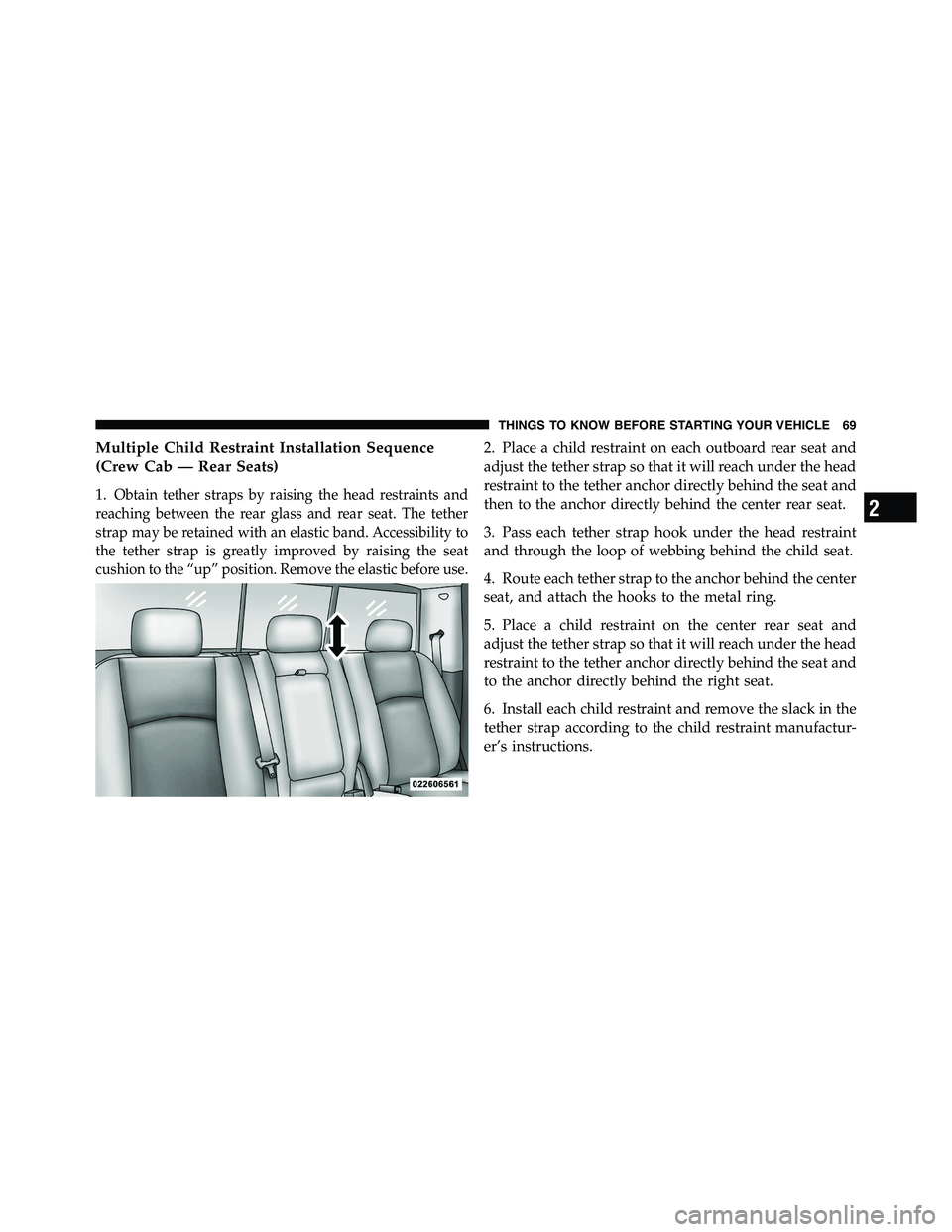
Multiple Child Restraint Installation Sequence
(Crew Cab — Rear Seats)
1. Obtain tether straps by raising the head restraints and
reaching between the rear glass and rear seat. The tether
strap may be retained with an elastic band. Accessibility to
the tether strap is greatly improved by raising the seat
cushion to the “up” position. Remove the elastic before use. 2. Place a child restraint on each outboard rear seat and
adjust the tether strap so that it will reach under the head
restraint to the tether anchor directly behind the seat and
then to the anchor directly behind the center rear seat.
3. Pass each tether strap hook under the head restraint
and through the loop of webbing behind the child seat.
4. Route each tether strap to the anchor behind the center
seat, and attach the hooks to the metal ring.
5. Place a child restraint on the center rear seat and
adjust the tether strap so that it will reach under the head
restraint to the tether anchor directly behind the seat and
to the anchor directly behind the right seat.
6. Install each child restraint and remove the slack in the
tether strap according to the child restraint manufactur-
er’s instructions. 2 THINGS TO KNOW BEFORE STARTING YOUR VEHICLE 69
Page 71 of 472
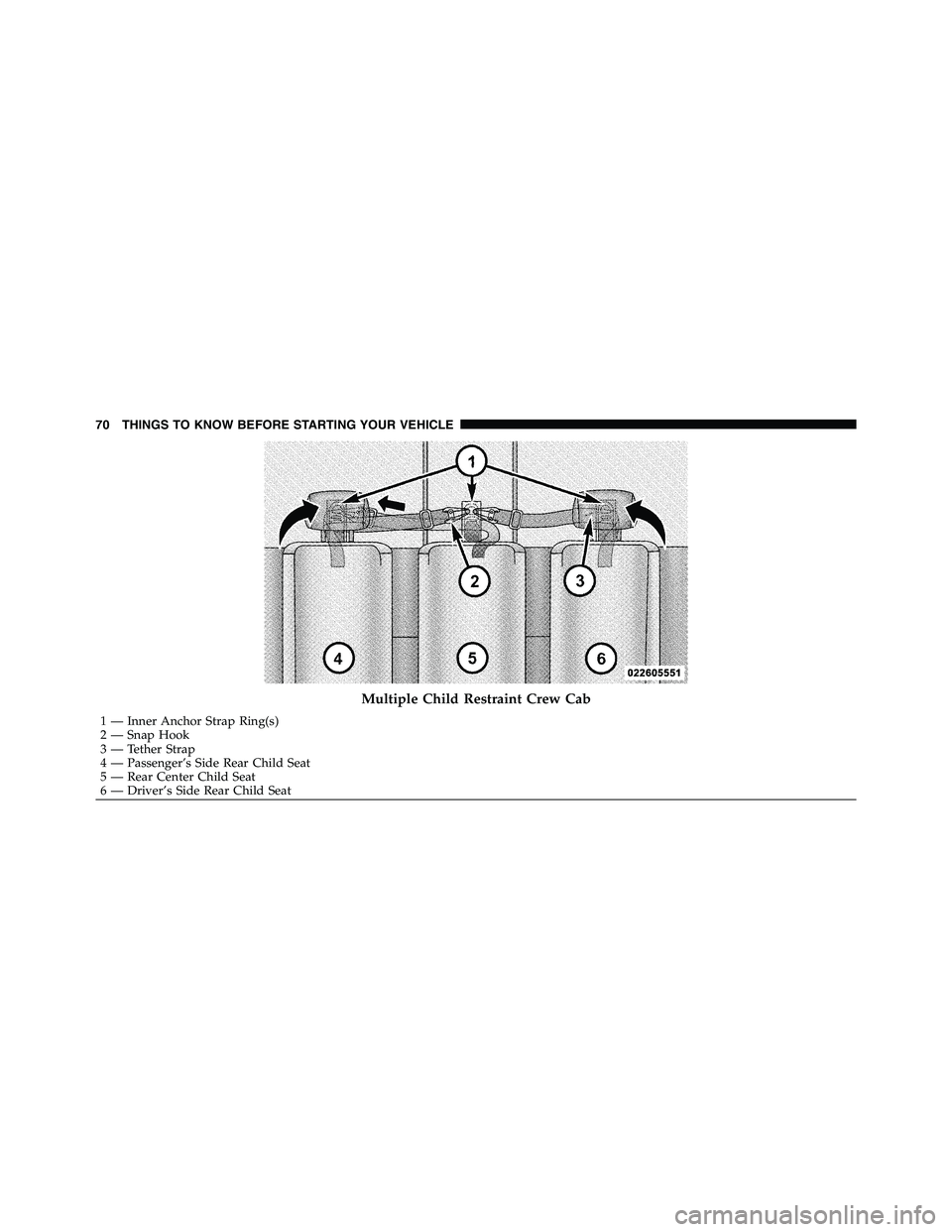
Multiple Child Restraint Crew Cab1 — Inner Anchor Strap Ring(s)
2 — Snap Hook
3 — Tether Strap
4 — Passenger’s Side Rear Child Seat
5 — Rear Center Child Seat
6 — Driver’s Side Rear Child Seat70 THINGS TO KNOW BEFORE STARTING YOUR VEHICLE
Page 72 of 472
Children Too Large for Booster Seats
Children who are large enough to wear the shoulder belt
comfortably, and whose legs are long enough to bend
over the front of the seat when their back is against the
seat back should use the lap/shoulder belt in a rear seat.
• Make sure that the child is upright in the seat.
• The lap portion should be low on the hips and as snug
as possible.
• Check belt fit periodically. A child’s squirming or
slouching can move the belt out of position.
If the shoulder belt contacts the face or neck, move the
child closer to the center of the vehicle. Never allow a
child to put the shoulder belt under an arm or behind
their back. Transporting Pets
Airbags deploying in the front seat could harm your pet.
An unrestrained pet will be thrown about and possibly
injured, or injure a passenger during panic braking or in
an accident. Pets should be restrained in the rear seat in
pet harnesses or pet carriers that are secured by seat belts.
ENGINE BREAK-IN RECOMMENDATIONS
A long break-in period is not required for the engine and
drivetrain (transmission and axle) in your vehicle.
Drive moderately during the first 300 miles (500 km).
After the initial 60 miles (100 km), speeds up to 50 or
55 mph (80 or 90 km/h) are desirable.
While cruising, brief full-throttle acceleration within the
limits of local traffic laws, contributes to a good break-in.
Wide-open throttle acceleration in low gear can be detri-
mental and should be avoided. 2 THINGS TO KNOW BEFORE STARTING YOUR VEHICLE 71
Page 73 of 472
The engine oil installed in the engine at the factory is a
high-quality energy conserving type lubricant. Oil
changes should be consistent with anticipated climate
conditions under which vehicle operations will occur. For
the recommended viscosity and quality grades refer to
“Maintenance Procedures” in “Maintaining Your Ve-
hicle”. NON-DETERGENT OR STRAIGHT MINERAL
OILS MUST NEVER BE USED.
A new engine may consume some oil during its first few
thousand miles (kilometers) of operation. This should be
considered a normal part of the break-in and not inter-
preted as an indication of difficulty. SAFETY TIPS
Transporting Passengers
NEVER TRANSPORT PASSENGERS IN THE CARGO
AREA.
WARNING!• Do not leave children or animals inside parked
vehicles in hot weather. Interior heat build-up may
cause serious injury or death.
• It is extremely dangerous to ride in a cargo area,
inside or outside of a vehicle. In a collision, people
riding in these areas are more likely to be seri-
ously injured or killed.
• Do not allow people to ride in any area of your
vehicle that is not equipped with seats and seat
belts.
• Be sure everyone in your vehicle is in a seat and
using a seat belt properly.72 THINGS TO KNOW BEFORE STARTING YOUR VEHICLE
Page 264 of 472

STARTING PROCEDURES
Before starting your vehicle, adjust your seat, adjust both
inside and outside mirrors, and fasten your seat belt.
The starter should not be operated for more than 15-
second intervals. Waiting a few seconds between such
intervals will protect the starter from overheating.
WARNING!Never leave children alone in a vehicle. Leaving
unattended children in a vehicle is dangerous for a
number of reasons. A child or others could be seri-
ously or fatally injured. Do not leave the key fob in
the ignition. A child could operate power windows,
other controls, or move the vehicle.
Normal Starting
Normal starting of either a warm or cold engine is
obtained without pumping or pressing the accelerator pedal. Turn the key fob to the START position and release
when the engine starts. If the engine fails to start within
10 seconds, turn the key fob to the OFF position, wait five
seconds, then repeat the “Normal Starting” procedure.
Automatic Transmission
Start the engine with the shift lever in the NEUTRAL or
PARK position. Apply the brake before shifting into any
driving range.
NOTE: This vehicle is equipped with a transmission
shift interlocking system. The brake pedal must be
pressed to shift out of PARK.
Tip Start Feature
Do not press the accelerator. Turn the ignition switch
briefly to the START position and release it. The starter
motor will continue to run but will automatically disen-
gage when the engine is running.
5 STARTING AND OPERATING 263