flat tire RAM CHASSIS CAB 2011 User Guide
[x] Cancel search | Manufacturer: RAM, Model Year: 2011, Model line: CHASSIS CAB, Model: RAM CHASSIS CAB 2011Pages: 472, PDF Size: 7.38 MB
Page 308 of 472
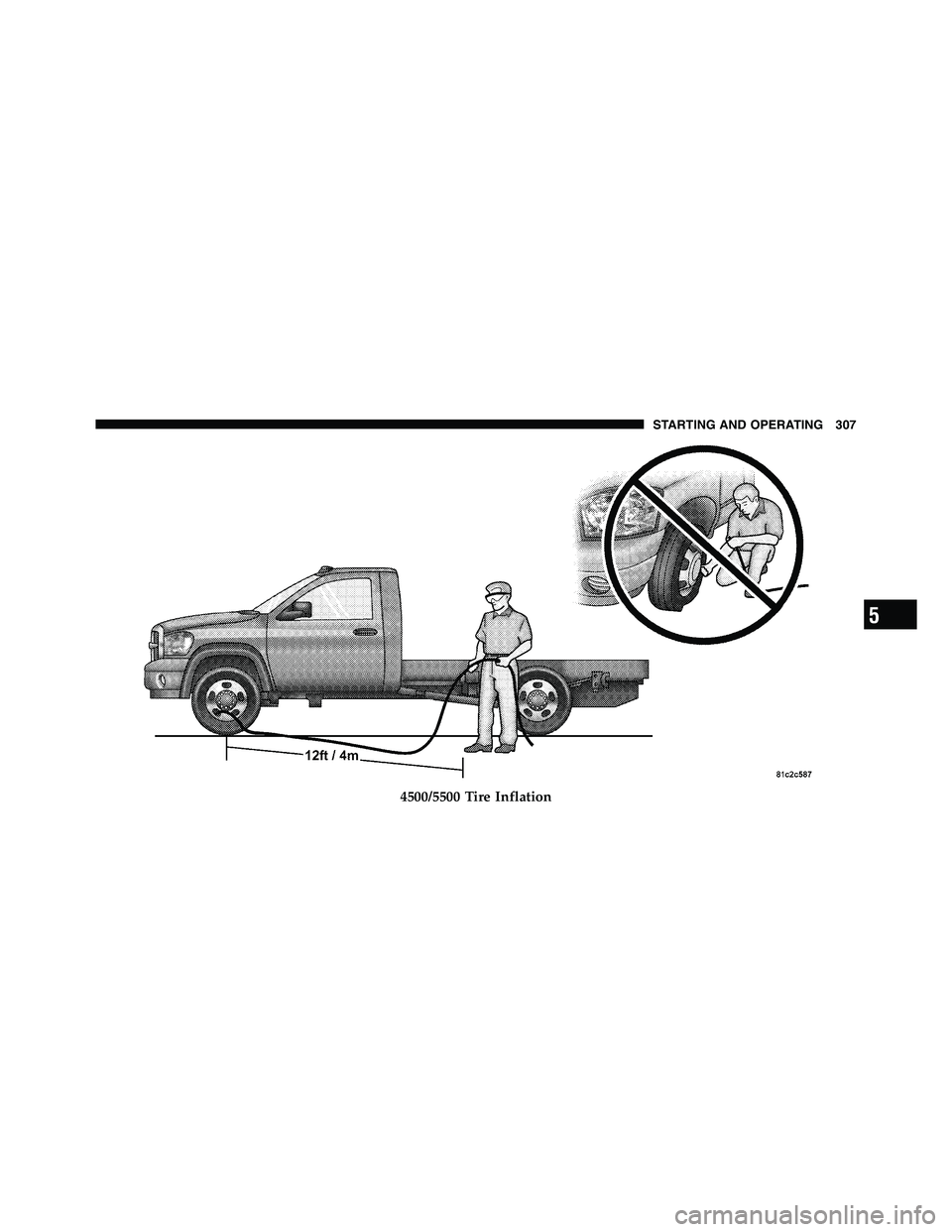
4500/5500 Tire Inflation
5 STARTING AND OPERATING 307
Page 309 of 472
When adjusting inflation pressure to a tire and wheel
assembly mounted on a vehicle, use a Remote Mount
Automatic Inflation Kit or see your authorized dealer.
NOTE: Never attempt to re-inflate a tire and wheel
assembly which has been run flat or is extremely under-
inflated without first removing the tire from the wheel
assembly for inspection.
Personnel trained, supervised, and equipped according
to Federal Occupational Safety and Health Administra-
tion (OSHA) should perform this work.
Inflation Pressure Adjustment When Not Mounted to
Vehicle
When adjusting inflation pressure to a tire and wheel
assembly not mounted on a vehicle, use a Remote Mount
Automatic Inflation Kit and a Tire Inflation Cage or see
your authorized dealer. Tire Pressures for High Speed Operation
The manufacturer advocates driving at safe speeds
within posted speed limits. Where speed limits or condi-
tions are such that the vehicle can be driven at high
speeds, maintaining correct tire inflation pressure is very
important. Increased tire pressure and reduced vehicle
loading may be required for high-speed vehicle opera-
tion. Refer to original equipment or an authorized tire
dealer for recommended safe operating speeds, loading
and cold tire inflation pressures.
WARNING!High speed driving with your vehicle under maxi-
mum load is dangerous. The added strain on your
tires could cause them to fail. You could have a
serious accident resulting in serious injury or death.
Don’t drive a vehicle loaded to the maximum capac-
ity at continuous speeds above 75 mph (120 km/h).308 STARTING AND OPERATING
Page 312 of 472
WARNING!Tires and spare tire should be replaced after six years,
regardless of the remaining tread. Failure to follow
this warning can result in sudden tire failure. You
could lose control and have an accident resulting in
serious injury or death.
Keep dismounted tires in a cool, dry place with as little
exposure to light as possible. Protect tires from contact
with oil, grease, and gasoline. Replacement Tires
The tires on your new vehicle provide a balance of many
characteristics. They should be inspected regularly for
wear and correct cold tire inflation pressure. The manu-
facturer strongly recommends that you use tires equiva-
lent to the originals in size, quality and performance
when replacement is needed (refer to the paragraph on
“Tread Wear Indicators”). Refer to the Tire and Loading
Information placard for the size designation of your tire.
The service description and load identification will be
found on the original equipment tire. Failure to use
equivalent replacement tires may adversely affect the
safety, handling, and ride of your vehicle. We recommend
that you contact your original equipment or an autho-
rized tire dealer with any questions you may have on tire
specifications or capability.
5 STARTING AND OPERATING 311
Page 314 of 472
![RAM CHASSIS CAB 2011 User Guide SUPPLEMENTAL TIRE PRESSURE
INFORMATION — IF EQUIPPED
A light load vehicle condition is defined as two passen-
gers [150 lbs (68 kg) each] plus 200 lbs (91 kg) of cargo.
Cold tire inflation pressures](/img/34/59200/w960_59200-313.png "RAM CHASSIS CAB 2011 User Guide SUPPLEMENTAL TIRE PRESSURE
INFORMATION — IF EQUIPPED
A light load vehicle condition is defined as two passen-
gers [150 lbs (68 kg) each] plus 200 lbs (91 kg) of cargo.
Cold tire inflation pressures")
SUPPLEMENTAL TIRE PRESSURE
INFORMATION — IF EQUIPPED
A light load vehicle condition is defined as two passen-
gers [150 lbs (68 kg) each] plus 200 lbs (91 kg) of cargo.
Cold tire inflation pressures for a lightly loaded vehicle
will be found on the face of the driver’s door.
TIRE CHAINS
Use “Class U” chains or other traction aids that meet SAE
Type “U” specifications.
NOTE: Chains must be the proper size for the vehicle,
as recommended by the chain manufacturer.
CAUTION!To avoid damage to your vehicle, tires or chains,
observe the following precautions:
(Continued) CAUTION! (Continued)• Because of limited chain clearance between tires
and other suspension components, it is important
that only chains in good condition are used. Bro-
ken chains can cause serious vehicle damage. Stop
the vehicle immediately if noise occurs that could
suggest chain breakage. Remove the damaged
parts of the chain before further use.
• Install chains as tightly as possible and then
retighten after driving about 1/2 mi (0.8 km).
• Do not exceed 45 mph (72 km/h).
• Drive cautiously and avoid severe turns and large
bumps, especially with a loaded vehicle.
• Do not install tire chains on front wheels of 4x2
vehicles.
• Do not drive for a prolonged period on dry pave-
ment.
(Continued)5 STARTING AND OPERATING 313
Page 316 of 472

SNOW TIRES
Snow tires should be of the same size and type construc-
tion as the front tires. Consult the manufacturer of the
snow tire to determine any maximum vehicle speed
requirement associated with the tire. These tires should
always be operated at the vehicle maximum capacity
inflation pressures under any load condition.
While studded tires improve performance on ice, skid
and traction capability on wet or dry surfaces may be
poorer than that of non-studded tires. Some states pro-
hibit studded tires; therefore, local laws should be
checked before using these tire types. TIRE ROTATION RECOMMENDATIONS
Tires on the front and rear axles of vehicles operate at
different loads and perform different steering, driving,
and braking functions. For these reasons, they wear at
unequal rates. These effects can be reduced by timely
rotation of tires. The benefits of rotation are especially
worthwhile with aggressive tread designs such as those
on On/Off Road type tires. Rotation will increase tread
life, help to maintain mud, snow, and wet traction levels,
and contribute to a smooth, quiet ride.
5 STARTING AND OPERATING 315
Page 318 of 472
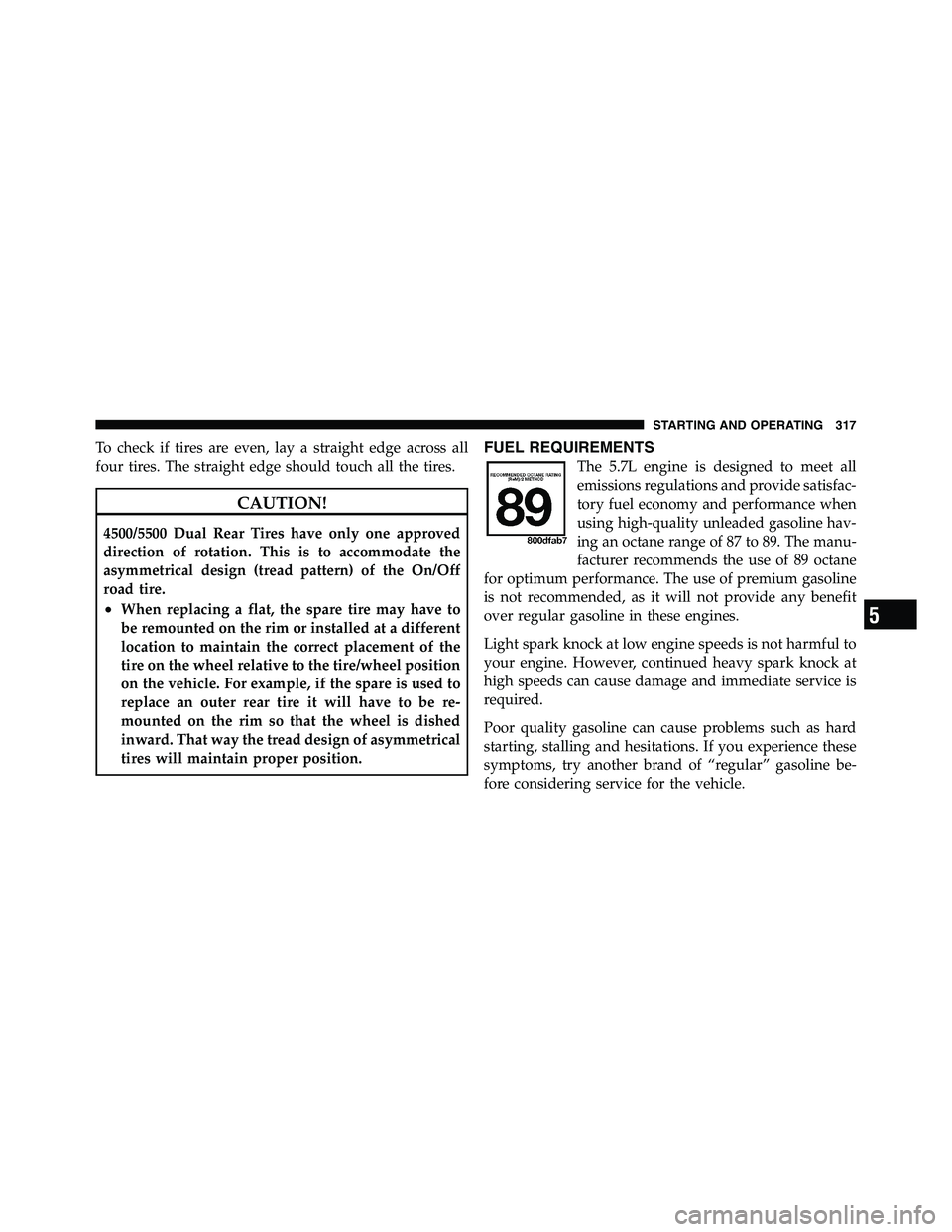
To check if tires are even, lay a straight edge across all
four tires. The straight edge should touch all the tires.
CAUTION!4500/5500 Dual Rear Tires have only one approved
direction of rotation. This is to accommodate the
asymmetrical design (tread pattern) of the On/Off
road tire.
• When replacing a flat, the spare tire may have to
be remounted on the rim or installed at a different
location to maintain the correct placement of the
tire on the wheel relative to the tire/wheel position
on the vehicle. For example, if the spare is used to
replace an outer rear tire it will have to be re-
mounted on the rim so that the wheel is dished
inward. That way the tread design of asymmetrical
tires will maintain proper position. FUEL REQUIREMENTS
The 5.7L engine is designed to meet all
emissions regulations and provide satisfac-
tory fuel economy and performance when
using high-quality unleaded gasoline hav-
ing an octane range of 87 to 89. The manu-
facturer recommends the use of 89 octane
for optimum performance. The use of premium gasoline
is not recommended, as it will not provide any benefit
over regular gasoline in these engines.
Light spark knock at low engine speeds is not harmful to
your engine. However, continued heavy spark knock at
high speeds can cause damage and immediate service is
required.
Poor quality gasoline can cause problems such as hard
starting, stalling and hesitations. If you experience these
symptoms, try another brand of “regular” gasoline be-
fore considering service for the vehicle.
5 STARTING AND OPERATING 317
Page 326 of 472

Tire Size
The tire size on the Label represents the actual tire size on
your vehicle. Replacement tires must be equal to the load
capacity of this tire size.
Rim Size
This is the rim size that is appropriate for the tire size
listed.
Inflation Pressure
This is the cold tire inflation pressure for your vehicle for
all loading conditions up to full GAWR.
Curb Weight
The curb weight of a vehicle is defined as the total weight
of the vehicle with all fluids, including vehicle fuel, at full
capacity conditions, and with no occupants or cargo
loaded into the vehicle. The front and rear curb weight
values are determined by weighing your vehicle on a
commercial scale before any occupants or cargo are
added. Loading
The actual total weight and the weight of the front and
rear of your vehicle at the ground can best be determined
by weighing it when it is loaded and ready for operation.
The entire vehicle should first be weighed on a commer-
cial scale to insure that the GVWR has not been exceeded.
The weight on the front and rear of the vehicle should
then be determined separately to be sure that the load is
properly distributed over front and rear axle. Weighing
the vehicle may show that the GAWR of either the front
or rear axles has been exceeded but the total load is
within the specified GVWR. If so, weight must be shifted
from front to rear or rear to front as appropriate until the
specified weight limitations are met. Store the heavier
items down low and be sure that the weight is distributed
equally. Stow all loose items securely before driving.
5 STARTING AND OPERATING 325
Page 334 of 472

WARNING! (Continued)2. GTW
3. GAWR
4. Trailer tongue weight rating for the trailer hitch
utilized (This requirement may limit the ability to
always achieve the 10% to 15% range of tongue
weight as a percentage of total trailer weight).
Towing Requirements – Tires
• Do not attempt to tow a trailer while using a compact
spare tire.
• Proper tire inflation pressures are essential to the safe
and satisfactory operation of your vehicle. Refer to
“Tires – General Information” in “Starting and Oper-
ating” for proper tire inflation procedures.
• Check the trailer tires for proper tire inflation pres-
sures before trailer usage. • Check for signs of tire wear or visible tire damage
before towing a trailer. Refer to “Tires – General
Information” in “Starting and Operating” for the
proper inspection procedure.
• When replacing tires, refer to “Tires – General Infor-
mation” in “Starting and Operating” for proper tire
replacement procedures. Replacing tires with a higher
load carrying capacity will not increase the vehicle’s
GVWR and GAWR limits.
Towing Requirements – Trailer Brakes
• Do not interconnect the hydraulic brake system or
vacuum system of your vehicle with that of the trailer.
This could cause inadequate braking and possible
personal injury.
5 STARTING AND OPERATING 333
Page 360 of 472
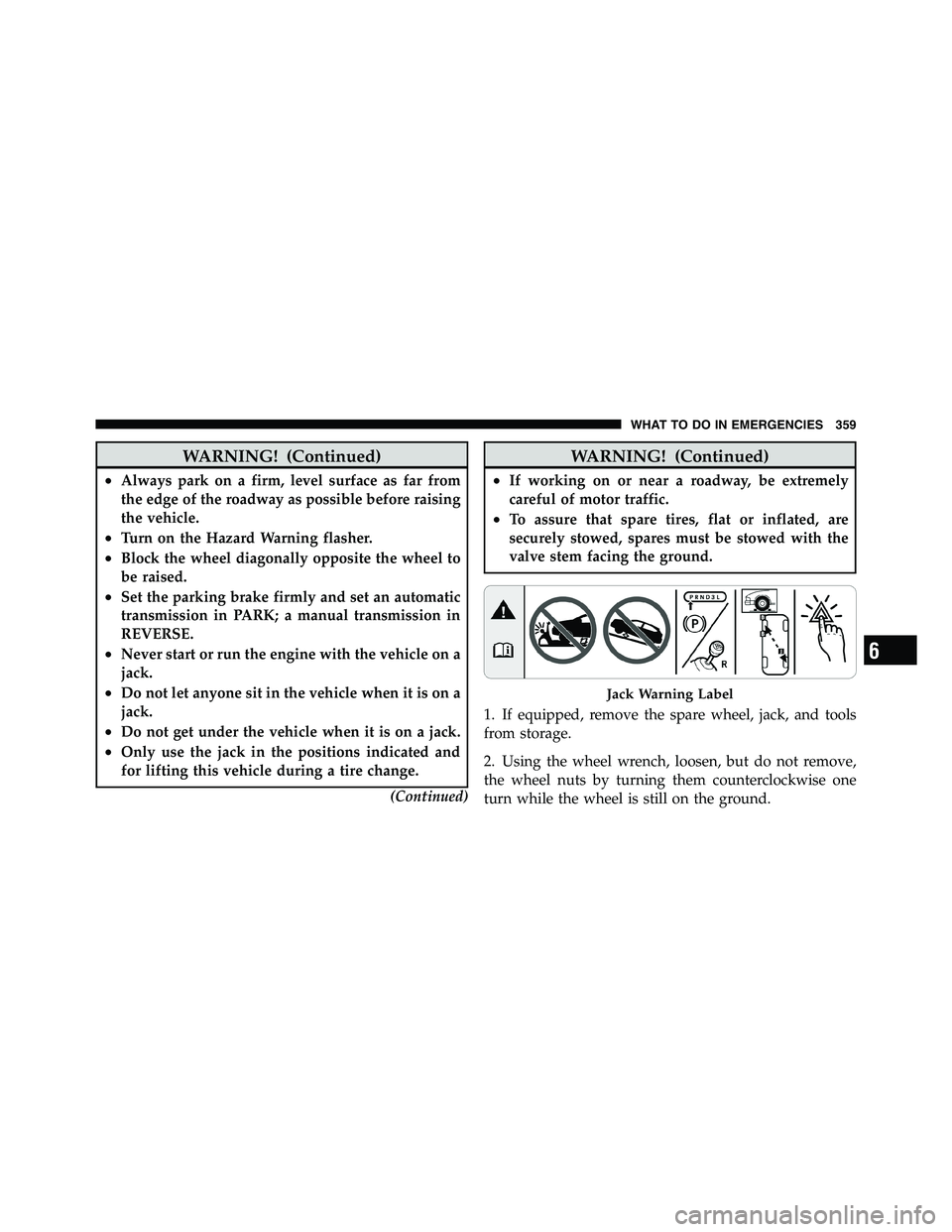
WARNING! (Continued)• Always park on a firm, level surface as far from
the edge of the roadway as possible before raising
the vehicle.
• Turn on the Hazard Warning flasher.
• Block the wheel diagonally opposite the wheel to
be raised.
• Set the parking brake firmly and set an automatic
transmission in PARK; a manual transmission in
REVERSE.
• Never start or run the engine with the vehicle on a
jack.
• Do not let anyone sit in the vehicle when it is on a
jack.
• Do not get under the vehicle when it is on a jack.
• Only use the jack in the positions indicated and
for lifting this vehicle during a tire change.
(Continued) WARNING! (Continued)• If working on or near a roadway, be extremely
careful of motor traffic.
• To assure that spare tires, flat or inflated, are
securely stowed, spares must be stowed with the
valve stem facing the ground.
1. If equipped, remove the spare wheel, jack, and tools
from storage.
2. Using the wheel wrench, loosen, but do not remove,
the wheel nuts by turning them counterclockwise one
turn while the wheel is still on the ground. Jack Warning Label
6 WHAT TO DO IN EMERGENCIES 359
Page 361 of 472
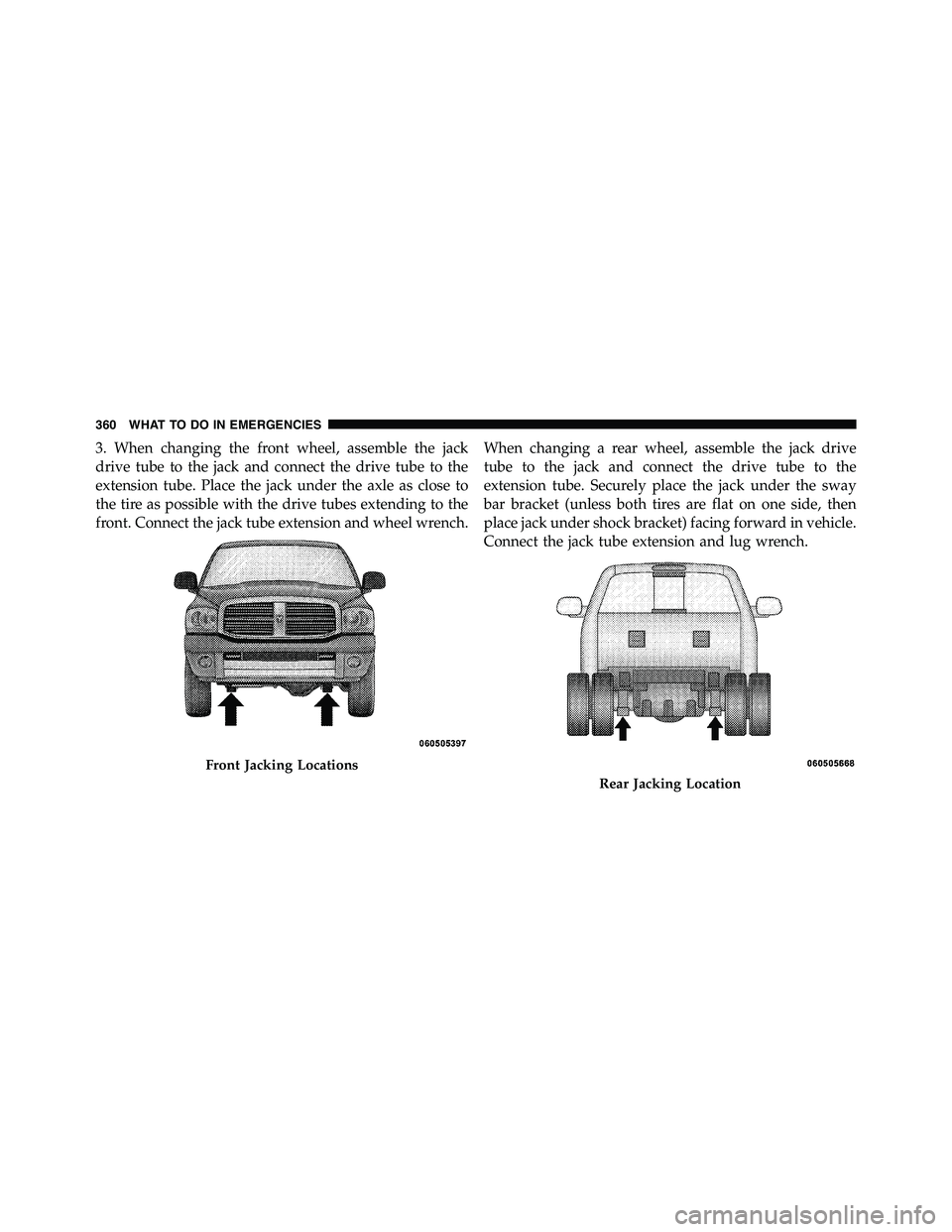
3. When changing the front wheel, assemble the jack
drive tube to the jack and connect the drive tube to the
extension tube. Place the jack under the axle as close to
the tire as possible with the drive tubes extending to the
front. Connect the jack tube extension and wheel wrench. When changing a rear wheel, assemble the jack drive
tube to the jack and connect the drive tube to the
extension tube. Securely place the jack under the sway
bar bracket (unless both tires are flat on one side, then
place jack under shock bracket) facing forward in vehicle.
Connect the jack tube extension and lug wrench.
Front Jacking Locations
Rear Jacking Location360 WHAT TO DO IN EMERGENCIES