traction control RAM CHASSIS CAB 2017 User Guide
[x] Cancel search | Manufacturer: RAM, Model Year: 2017, Model line: CHASSIS CAB, Model: RAM CHASSIS CAB 2017Pages: 536, PDF Size: 5.67 MB
Page 363 of 536

WARNING! (Continued)• The Electronic Stability Control (ESC) cannot pre-
vent the natural laws of physics from acting on the
vehicle, nor can it increase the traction afforded by
prevailing road conditions. ESC cannot prevent all
accidents, including those resulting from excessive
speed in turns, driving on very slippery surfaces, or
hydroplaning. ESC also cannot prevent collisions.
ESC Activation/Malfunction Indicator Light and ESC
OFF Indicator Light
The “ESC Activation/Malfunction Indicator
Light” in the instrument cluster will come on
when the ignition switch is turned to the ON
position. It should go out with the engine run-
ning. If the “ESC Activation/Malfunction Indicator Light”
comes on continuously with the engine running, a mal-
function has been detected in the ESC system. If this light
remains on after several ignition cycles, and the vehicle has
been driven several miles (kilometers) at speeds greater
than 30 mph (48 km/h), see your authorized dealer as soon
as possible to have the problem diagnosed and corrected. The “ESC Activation/Malfunction Indicator Light” (lo-
cated in the instrument cluster) starts to flash as soon as the
tires lose traction and the ESC system becomes active. The
“ESC Activation/Malfunction Indicator Light” also flashes
when TCS is active. If the “ESC Activation/Malfunction
Indicator Light” begins to flash during acceleration, ease
up on the accelerator and apply as little throttle as possible.
Be sure to adapt your speed and driving to the prevailing
road conditions.
NOTE:
• The “ESC Activation/Malfunction Indicator Light” and
the “ESC OFF Indicator Light” come on momentarily
each time the ignition switch is turned ON.
• Each time the ignition is turned ON, the ESC system will
be ON even if it was turned off previously.
• The ESC system will make buzzing or clicking sounds
when it is active. This is normal; the sounds will stop
when ESC becomes inactive following the maneuver
that caused the ESC activation.
The “ESC OFF Indicator Light” indicates the
customer has elected to have the Electronic Sta-
bility Control (ESC) in a reduced mode. 5STARTING AND OPERATING 361
Page 367 of 536

Feedback To The Driver
The instrument cluster has an HDC icon and the HDC
switch has an LED which offer feedback to the driver about
the state HDC is in.
• The cluster icon and switch lamp will illuminate and
remain on solid when HDC is enabled or activated. This
is the normal operating condition for HDC.
• The cluster icon and switch lamp will flash for several
seconds then extinguish when the driver pushes the
HDC switch but enable conditions are not met.
• The cluster icon and switch lamp will flash for several
seconds then extinguish when HDC disables due to
excess speed.
• The cluster icon and switch lamp will flash when HDC
deactivates due to overheated brakes. The flashing will
stop and HDC will activate again once the brakes have
cooled sufficiently.
WARNING!HDC is only intended to assist the driver in controlling
vehicle speed when descending hills. The driver must
remain attentive to the driving conditions and is re-
sponsible for maintaining a safe vehicle speed. TIRE SAFETY INFORMATION
Tire Markings
1 — U.S. DOT Safety Standards
Code (TIN) 4 — Maximum Load
2 — Size Designation 5 — Maximum Pressure
3 — Service Description 6 — Treadwear, Traction and
Temperature Grades 5STARTING AND OPERATING 365
Page 381 of 536

Damaged Run Flat tires, or Run Flat tires that have
experienced a loss of pressure should be replaced immedi-
ately with another Run Flat tire of identical size and service
description (Load Index and Speed Symbol).
Tire Types
All Season Tires — If Equipped
All season tires provide traction for all seasons (Spring,
Summer, Fall and Winter). Traction levels may vary be-
tween different all season tires. All season tires can be
identified by the M+S, M&S, M/S or MS designation on the
tire sidewall. Use all season tires only in sets of four; failure
to do so may adversely affect the safety and handling of
your vehicle.
Summer Or Three Season Tires — If Equipped
Summer tires provide traction in both wet and dry condi-
tions, and are not intended to be driven in snow or on ice.
If your vehicle is equipped with Summer tires, be aware
these tires are not designed for Winter or cold driving
conditions. Install Winter tires on your vehicle when am-
bient temperatures are less than 40°F (5°C) or if roads are
covered with ice or snow. For more information, contact an
authorized dealer. Summer tires do not contain the all season designation or
mountain/snowflake symbol on the tire sidewall. Use
Summer tires only in sets of four; failure to do so may
adversely affect the safety and handling of your vehicle.
WARNING!Do not use Summer tires in snow/ice conditions. You
could lose vehicle control, resulting in severe injury or
death. Driving too fast for conditions also creates the
possibility of loss of vehicle control.
Snow Tires
Some areas of the country require the use of snow tires
during the Winter. Snow tires can be identified by a
“mountain/snowflake” symbol on the tire sidewall.
If you need snow tires, select tires
equivalent in size and type to the origi-
nal equipment tires. Use snow tires only
in sets of four; failure to do so may
adversely affect the safety and handling
of your vehicle.
Snow tires generally have lower speed ratings than what
was originally equipped with your vehicle and should not
be operated at sustained speeds over 75 mph (120 km/h). 5STARTING AND OPERATING 379
Page 387 of 536

WARNING!• Do not use a tire, wheel size or rating other than that
specified for your vehicle. Some combinations of
unapproved tires and wheels may change suspen-
sion dimensions and performance characteristics,
resulting in changes to steering, handling, and brak-
ing of your vehicle. This can cause unpredictable
handling and stress to steering and suspension com-
ponents. You could lose control and have a collision
resulting in serious injury or death. Use only the tire
and wheel sizes with load ratings approved for your
vehicle.
• Never use a tire with a smaller load index or capacity,
other than what was originally equipped on your
vehicle. Using a tire with a smaller load index could
result in tire overloading and failure. You could lose
control and have a collision.
• Failure to equip your vehicle with tires having ad-
equate speed capability can result in sudden tire
failure and loss of vehicle control. CAUTION!Replacing original tires with tires of a different size
may result in false speedometer and odometer read-
ings.
TIRE CHAINS (TRACTION DEVICES)
Use of traction devices require sufficient tire-to-body clear-
ance. Follow these recommendations to guard against
damage.
• Traction device must be of proper size for the tire, as
recommended by the traction device manufacturer. 5STARTING AND OPERATING 385
Page 388 of 536

Please follow the table below for proper tire size, chain
type, and axle recommendations:
Vehicle Axle
Recommenda-
tions Tire Sizes Chain Class
Chassis Cab 3500 (Single Rear Wheel) Models Rear Only LT265/70R18E U Class
Chassis Cab 3500 (Dual Rear Wheel) 4X2 Models Rear Only LT235/80R17E U Class
Chassis Cab 3500 (Dual Rear Wheel) 4X4 Models Front/Rear LT235/80R17E U Class
Chassis Cab 4500/5500 Models Rear Only 225/70R19.5G U Class
WARNING!Using tires of different size and type (M+S, Snow)
between front and rear axles can cause unpredictable
handling. You could lose control and have a collision.
CAUTION!To avoid damage to your vehicle or tires, observe the
following precautions:
• Because of restricted traction device clearance be-
tween tires and other suspension components, it is (Continued) CAUTION! (Continued)important that only traction devices in good condi-
tion are used. Broken devices can cause serious
damage. Stop the vehicle immediately if noise occurs
that could indicate device breakage. Remove the
damaged parts of the device before further use.
• Install device as tightly as possible and then re-
tighten after driving about ½ mile (0.8 km).
• Do not exceed 30 mph (48 km/h).
• Drive cautiously and avoid severe turns and large
bumps, especially with a loaded vehicle. (Continued)386 STARTING AND OPERATING
Page 391 of 536

CAUTION! (Continued)• When replacing a flat, the spare tire may have to be
remounted on the rim or installed at a different
location to maintain the correct placement of the tire
on the wheel relative to the tire/wheel position on
the vehicle. For example, if the spare is used to
replace an outer rear tire it will have to be remounted
on the rim so that the wheel is dished inward. That
way the tread design of asymmetrical tires will
maintain proper position.
DEPARTMENT OF TRANSPORTATION UNIFORM
TIRE QUALITY GRADES
The following tire grading categories were established by
the National Highway Traffic Safety Administration. The
specific grade rating assigned by the tire’s manufacturer in
each category is shown on the sidewall of the tires on your
vehicle.
All passenger vehicle tires must conform to Federal safety
requirements in addition to these grades. Treadwear
The Treadwear grade is a comparative rating, based on the
wear rate of the tire when tested under controlled condi-
tions on a specified government test course. For example, a
tire graded 150 would wear one and one-half times as well
on the government course as a tire graded 100. The relative
performance of tires depends upon the actual conditions of
their use, however, and may depart significantly from the
norm due to variations in driving habits, service practices,
and differences in road characteristics and climate.
Traction Grades
The Traction grades, from highest to lowest, are AA, A, B,
and C. These grades represent the tire’s ability to stop on
wet pavement, as measured under controlled conditions on
specified government test surfaces of asphalt and concrete.
A tire marked C may have poor traction performance.
WARNING!The traction grade assigned to this tire is based on
straight-ahead braking traction tests, and does not
include acceleration, cornering, hydroplaning, or peak
traction characteristics. 5STARTING AND OPERATING 389
Page 523 of 536
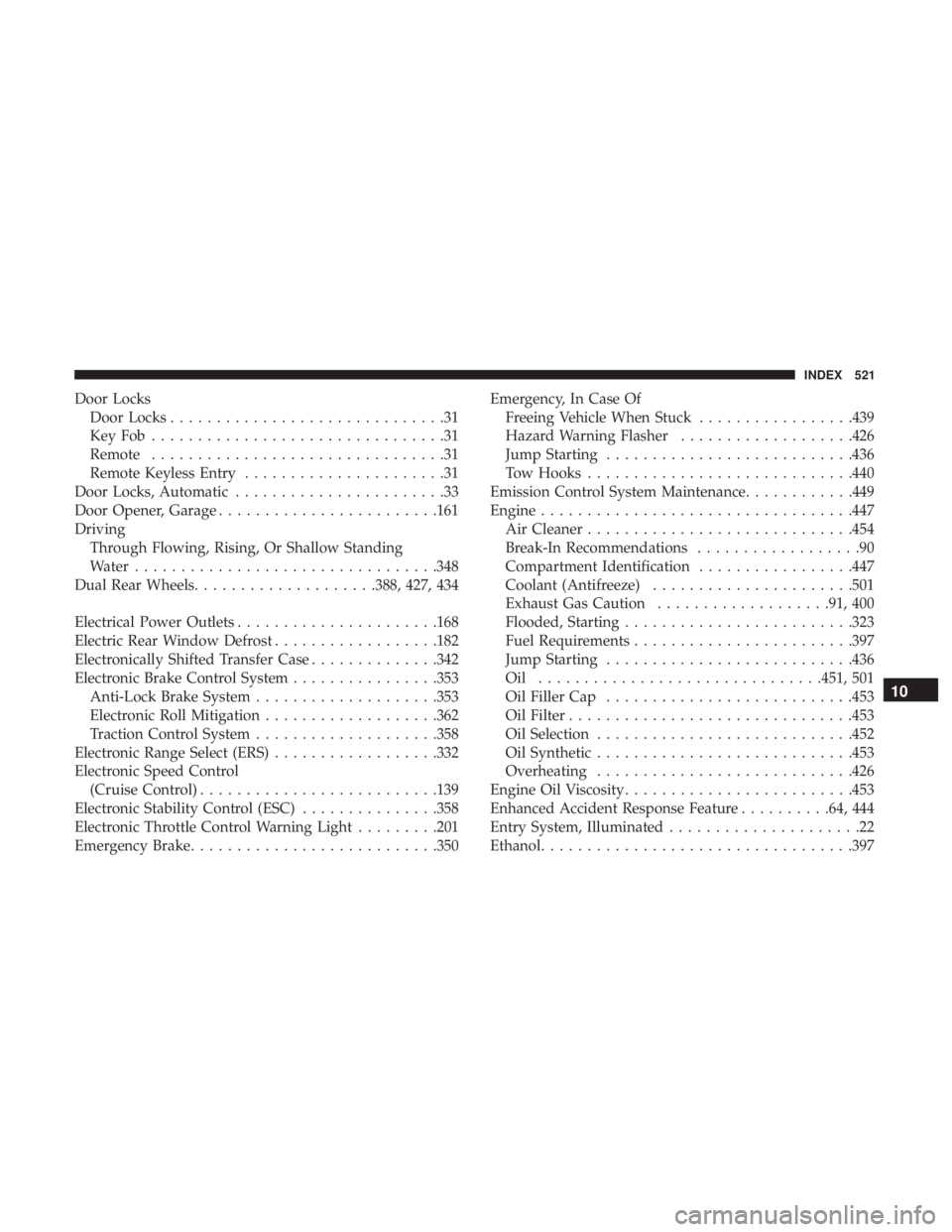
Door Locks
Door Locks ..............................31
KeyFob................................31
Remote ................................31
Remote Keyless Entry ......................31
Door Locks, Automatic .......................33
Door Opener, Garage ....................... .161
Driving
Through Flowing, Rising, Or Shallow Standing
Water ................................ .348
Dual Rear Wheels ................... .388, 427, 434
Electrical Power Outlets ..................... .168
Electric Rear Window Defrost ................. .182
Electronically Shifted Transfer Case ............. .342
Electronic Brake Control System ............... .353
Anti-Lock Brake System ................... .353
Electronic Roll Mitigation .................. .362
Traction Control System ................... .358
Electronic Range Select (ERS )................. .332
Electronic Speed Control
(Cruise Control) ......................... .139
Electronic Stability Control (ESC) .............. .358
Electronic Throttle Control Warning Light ........ .201
Emergency Brake .......................... .350 Emergency, In Case Of
Freeing Vehicle When Stuck ................ .439
Hazard Warning Flasher .................. .426
Jump Starting .......................... .436
Tow Hooks ............................ .440
Emission Control System Maintenance ........... .449
Engine ................................. .447
Air Cleaner ............................ .454
Break-In Recommendations ..................90
Compartment Identification ................ .447
Coolant (Antifreeze) ..................... .501
Exhaust Gas Caution .................. .91, 400
Flooded, Starting ........................ .323
Fuel Requirements ....................... .397
Jump Starting .......................... .436
Oil .............................. .451, 501
Oil Filler Cap .......................... .453
Oil Filter .............................. .453
Oil Selection ........................... .452
Oil Synthetic ........................... .453
Overheating ........................... .426
Engine Oil Viscosity ........................ .453
Enhanced Accident Response Feature ......... .64, 444
Entry System, Illuminated .....................22
Ethanol ................................. .39710 INDEX 521
Page 527 of 536

Low Fuel ............................. .210
Malfunction Indicator (Check Engine) ......... .204
Park ................................. .215
Passing ............................... .132
Seat Belt Reminder ...................... .197
Security Alarm ......................... .199
Service ............................ .494, 495
Tire Pressure Monitoring (TPMS) ......... .208, 390
Traction Control ........................ .361
Transfer Case .......................... .341
Turn Signal ................... .94, 132, 216, 495
Warning (Instrument Cluster Description) . . . .200, 216
Limited-Slip Differential ................. .346, 477
Loading Vehicle ........................... .401
Tires................................. .371
Load Shed
Battery Saver Mode ...................... .232
Battery Saver On ........................ .232
Electrical Load Reduction .................. .232
Intelligent Battery Sensor .................. .232
Locks ....................................31
Automatic Door ..........................33
Child Protection ..........................34
Door ..................................31
Power Door .............................32 Low Tire Pressure System .................... .390
Lubrication, Body ......................... .466
Lug Nuts ......................... .427, 433, 434
Maintenance Free Battery .................... .458
Maintenance Procedures ..................... .451
Maintenance Schedule ...................... .506
Malfunction Indicator Light (Check Engine) . . . .204, 449
Manual, Service ........................... .516
Manual Transmission
Fluid Level Check ....................... .478
Memory Seat ..............................119
Methanol ............................... .397
Mirrors ..................................99
Electric Powered ........................ .106
Heated ............................... .107
Memory ............................... 1 19
Outside .............................. .105
Rearview ........................... .99, 104
Trailer Towing .......................... .109
Modifications/Alterations, Vehicle ................7
Monitor, Tire Pressure System ................. .390
MOPAR Parts ......................... .450, 515
MTBE/ETBE ............................. .39710 INDEX 525
Page 532 of 536

Aging (Life Of Tires) ..................... .383
Air Pressure ........................ .371, 376
Chains ............................... .385
Compact Spare ......................... .381
Dual .......................... .388, 427, 434
General Information .................. .376, 380
High Speed ............................ .378
Inflation Pressures ....................... .377
Life Of Tires ........................... .383
Load Capacity ...................... .371, 373
Pressure Monitor System (TPMS) ............ .390
Pressure Warning Light ................... .208
Quality Grading ........................ .389
Radial ............................... .378
Replacement ........................... .384
Rotation .............................. .387
Safety ............................ .365, 376
Sizes ................................ .367
Snow Tires ............................ .379
Spare Tire ...................... .380, 381, 382
Spinning .............................. .382
Tread Wear Indicators .................... .383
Wheel Nut Torque ....................... .433
Tire Safety Information ...................... .365
Tongue Weight/Trailer Weight ................ .408 Torque Converter Clutch .................... .335
Tow Hooks, Emergency ..................... .440
Towing ............................. .403, 442
Disabled Vehicle ........................ .442
Guide ................................ .408
Recreational ........................... .419
Weight ............................... .408
Towing Vehicle Behind A Motorhome ........... .419
Traction ................................ .347
T raction Control .......................... .358
Trailer Sway Control (TSC) ................... .362
Trailer Towing ............................ .403
Cooling System Tips ..................... .416
Hitches ............................... .408
Minimum Requirements ................... .409
Mirrors ............................... .109
Trailer And Tongue Weight ................. .408
Wiring ............................... .414
Trailer Towing Guide ....................... .408
Trailer Weight ............................ .408
Transfer Case ............................ .477
Electronically Shifted ..................... .342
Fluid ................................ .503
Transmission ............................. .478
Automatic ......................... .327, 478530 INDEX