manual transmission RAM CHASSIS CAB 2019 User Guide
[x] Cancel search | Manufacturer: RAM, Model Year: 2019, Model line: CHASSIS CAB, Model: RAM CHASSIS CAB 2019Pages: 607, PDF Size: 12.68 MB
Page 282 of 607

280 STARTING AND OPERATING
Shifting Procedure — Manually Shifted Transfer Case
2H To 4H
Shifting between 2H and 4H can be made with the vehicle
stopped or in motion. If the vehicle is in motion, shifts can be
made up to 55 mph (88 km/h). With the vehicle in motion,
the transfer case will engage/disengage faster if you
momentarily release the accelerator pedal after completing
the shift. Apply a constant force when shifting the transfer
case lever.
2H Or 4H To 4L
NOTE:
When shifting into or out of 4L some gear noise may be
heard. This noise is normal and is not detrimental to the
vehicle or occupants.
With the vehicle rolling at 2 to 3 mph (3 to 5 km/h), shift the
transmission into NEUTRAL. While the vehicle is coasting at
2 to 3 mph (3 to 5 km/h), shift the transfer case lever firmly
to the desired position. Do not pause in transfer case
NEUTRAL. NOTE:
• Pausing in transfer case NEUTRAL in vehicles equipped
with an automatic transmission may require shutting the
engine OFF to avoid gear clash while completing the shift.
If difficulty occurs, shift the transmission into NEUTRAL,
hold your foot on the brake, and turn the engine OFF.
Complete the range shift to the desired mode.
• Shifting into or out of 4L is possible with the vehicle
completely stopped, however difficulty may occur due to
the mating clutch teeth not being properly aligned. Several
attempts may be required for clutch teeth alignment and
shift completion to occur. The preferred method is with the
vehicle rolling 2 to 3 mph (3 to 5 km/h). Avoid attempting
to engage or disengage 4L with the vehicle moving faster
than 2 to 3 mph (3 to 5 km/h).
• Do not attempt to shift into or out of 4L while the transmis -
sion is in gear.
Transfer Case Position Indicator Light
The “Transfer Case Position Indicator Light” in the instru -
ment cluster is used to alert the driver that the front axle is
fully engaged and all four wheels are driving.
Page 328 of 607

326 STARTING AND OPERATING
PARKVIEW REAR BACK UP CAMERA
Your vehicle may be equipped with the ParkView Rear Back
Up Camera that allows you to see a image of the rear
surroundings of your vehicle whenever the gear selector is
put into REVERSE or whenever it is initiated through the
"Backup Camera" button in the "Controls" menu. Whenever
the gear selector is put into REVERSE, the image will be
displayed in the rearview mirror display (if equipped) or
Uconnect screen (if equipped). If the image is displayed in
the Uconnect screen, a caution note to “check entire
surroundings” will display across the top of the screen. After
five seconds this note will disappear.
NOTE:
For the 3500, 4500, and 5500 Chassis Cab vehicles, the Rear
Backup Camera is shipped loose and not installed. Please
refer to the Ram Body Builders Guide for more information.
Manual Activation Of The Rear View Camera:
1. Press the "Controls" button located on the bottom of the
Uconnect display.
2. Press the "Backup Camera" button to turn the Rear
View Camera system on. When the vehicle is shifted out of REVERSE (with Camera
delay turned off), the rear Camera mode is exited and the
previous screen appears again.
When the vehicle is shifted out of REVERSE (with Camera
delay turned on), the rear Camera image will be displayed
for up to 10 seconds after shifting to another gear, unless the
vehicle speed exceeds 8 mph (13 km/h), the transmission is
shifted into PARK, the ignition is switched to the OFF posi -
tion, or the touchscreen button “X” to disable display of the
Rear View Camera image is pressed.
Whenever the Rear View Camera image is activated through
the "Backup Camera" button in the "Controls" menu, and the
vehicle speed is greater than, or equal to, 8 mph (13 km/h), a
display timer for the image is initiated. The image will
continue to be displayed until the display timer exceeds 10
seconds.
NOTE:
• If the vehicle speed remains below 8 mph (13 km/h), the
Rear View Camera image will be displayed continuously
until deactivated via the touchscreen button "X", the trans -
mission is shifted into PARK, or the ignition is cycled to
the OFF position.
Page 361 of 607

STARTING AND OPERATING 359
(Continued)Recreational Towing — Two-Wheel Drive Models
DO NOT flat tow this vehicle. Damage to the drivetrain
will result.
Recreational towing (for two-wheel drive models) is allowed
ONLY if the rear wheels are OFF the ground. This may be
accomplished using a tow dolly or vehicle trailer. If using a
tow dolly, follow this procedure:
1. Properly secure the dolly to the tow vehicle, following the
dolly manufacturer's instructions.
2. Drive the rear wheels onto the tow dolly.
3. Firmly apply the parking brake. Place automatic trans -
mission in PARK.
4. Properly secure the rear wheels to the dolly, following the
dolly manufacturer's instructions.
5. Turn the ignition OFF and remove the key fob.
6. Install a suitable clamping device, designed for towing, to
secure the front wheels in the straight position. Recreational Towing — Four-Wheel Drive Models
NOTE:
Both the manual shift and electronic shift transfer cases must
be shifted into NEUTRAL (N) for recreational towing. Auto -
matic transmissions must be shifted into PARK for recre -
ational towing. Refer to the following for the proper transfer
case NEUTRAL (N) shifting procedure for your vehicle. CAUTION!
• Towing with the rear wheels on the ground will cause
severe transmission damage. Damage from improper
towing is not covered under the New Vehicle Limited
Warranty.
• Do not disconnect the driveshaft because fluid may
leak from the transmission, causing damage to internal
parts.
CAUTION!
• DO NOT dolly tow any 4WD vehicle. Towing with
only one set of wheels on the ground (front or rear) will
cause severe transmission and/or transfer case damage.
Tow with all four wheels either ON the ground, or OFF
the ground (using a vehicle trailer). 5
Page 362 of 607

360 STARTING AND OPERATING
Shifting Into NEUTRAL (N)
Use the following procedure to prepare your vehicle for
recreational towing.
1. Bring the vehicle to a complete stop on level ground, with
the engine running. Firmly apply the parking brake.
2. Shift the transmission to NEUTRAL.• Tow only in the forward direction. Towing this vehicle
backwards can cause severe damage to the transfer case.
• Before recreational towing, the transfer case must be in
NEUTRAL. To be certain the transfer case is fully in
NEUTRAL, perform the procedure outlined under
“Shifting Into NEUTRAL”. Internal transmission
damage will result, if the transfer case is not in
NEUTRAL during towing.
• The transmission must be placed in PARK for recre -
ational towing.
• Towing this vehicle in violation of the above require -
ments can cause severe transmission and/or transfer
case damage. Damage from improper towing is not
covered under the New Vehicle Limited Warranty.
• Do not disconnect the rear driveshaft because fluid will
leak from the transfer case, causing damage to internal
parts.
• Do not use a bumper-mounted clamp-on tow bar on
your vehicle. The bumper face bar will be damaged. CAUTION! (Continued)
WARNING!
You or others could be injured or killed if you leave the
vehicle unattended with the transfer case in the
NEUTRAL (N) position without first fully engaging the
parking brake. The transfer case NEUTRAL (N) position
disengages both the front and rear driveshafts from the
powertrain, and will allow the vehicle to roll, even if the
automatic transmission is in PARK (or manual
transmission is in gear). The parking brake should
always be applied when the driver is not in the vehicle.
CAUTION!
It is necessary to follow these steps to be certain that the
transfer case is fully in NEUTRAL (N) before
recreational towing to prevent damage to internal parts.
Page 363 of 607

STARTING AND OPERATING 361
3. Press and hold the brake pedal.
4. Shift the transfer case into NEUTRAL:
• With manual shift transfer case, shift the transfer case
lever into NEUTRAL (N).
• With electronic shift transfer case, push and hold the
transfer case NEUTRAL (N) button. Some models have
a small, recessed "N" button (at the center of the
transfer case switches) that must be pressed using a
ballpoint pen or similar object. Other models have a
rectangular NEUTRAL switch, below the rotary
transfer case control knob. The NEUTRAL (N) indi -
cator light will blink while the shift is in progress. The
light will stop blinking (stay on solid) when the shift to
NEUTRAL (N) is complete. After the shift is completed
and the NEUTRAL (N) light stays on, release the
NEUTRAL (N) button.
5. Release the parking brake.
6. Shift the transmission into REVERSE.
7. Release the brake pedal for five seconds and ensure that
there is no vehicle movement.
8. Repeat steps six and seven with automatic transmission
in DRIVE. 9. Shift the transmission to NEUTRAL. Firmly apply the
parking brake. Turn OFF the engine. For vehicles with
Keyless Enter-N-Go, push and hold the ENGINE
START/STOP button until the engine shuts off.
10. Shift the transmission into PARK.
11. Place the ignition in the OFF mode, and remove the key
fob.
12. Attach the vehicle to the tow vehicle using a suitable tow
bar.
13. Release the parking brake.
NOTE:
With electronic shift transfer case:
• Steps 2 through 3 are requirements that must be met before
pushing the NEUTRAL (N) button, and must continue to
be met until the shift has been completed. If any of these
requirements are not met before pushing the NEUTRAL
(N) button or are no longer met during the shift, the
NEUTRAL (N) indicator light will flash continuously until
all requirements are met or until the NEUTRAL (N) button
is released. 5
Page 364 of 607

362 STARTING AND OPERATING
• The ignition must be in the ON/RUN mode for a shift to
take place and for the position indicator lights to be oper -
able. If the ignition is not in the ON/RUN mode, the shift
will not take place and no position indicator lights will be
on or flashing.
• A flashing NEUTRAL (N) position indicator light indi -
cates that shift requirements have not been met.
Shifting Out Of NEUTRAL (N)
Use the following procedure to prepare your vehicle for
normal usage:
1. Bring the vehicle to a complete stop, leaving it connected
to the tow vehicle.
2. Firmly apply the parking brake.
3. Press and hold the brake pedal.
4. Start the engine, and shift the transmission into
NEUTRAL.
• With manual shift transfer case, shift the transfer case
lever to the desired position.
• With electronic shift transfer case with rotary selector
switch, push and hold the transfer case NEUTRAL (N)
button until the NEUTRAL (N) indicator light turns off. After the NEUTRAL (N) indicator light turns off,
release the NEUTRAL (N) button. After the NEUTRAL
(N) button has been released, the transfer case will shift
to the position indicated by the selector switch.
• With electronic shift transfer case with push-button
selector switch, push and hold the switch for the
desired transfer case position, until the NEUTRAL (N)
indicator light turns off and the desired position indi -
cator light turns on.
NOTE:
When shifting out of transfer case NEUTRAL (N), turning
the engine OFF is not required, but may be helpful to avoid
gear clash. With 8-speed automatic transmission, the engine
must remain running, since turning the engine OFF will shift
the transmission to PARK (and the transmission must be in
NEUTRAL for the transfer case to shift out of NEUTRAL).
5. Turn the engine OFF. Shift automatic transmission into
PARK. On 8-speed transmissions the shifter will auto -
matically select PARK when the engine is turned off.
6. Release the brake pedal.
7. Disconnect vehicle from the tow vehicle.
8. Start the engine.
Page 405 of 607
IN CASE OF EMERGENCY 403
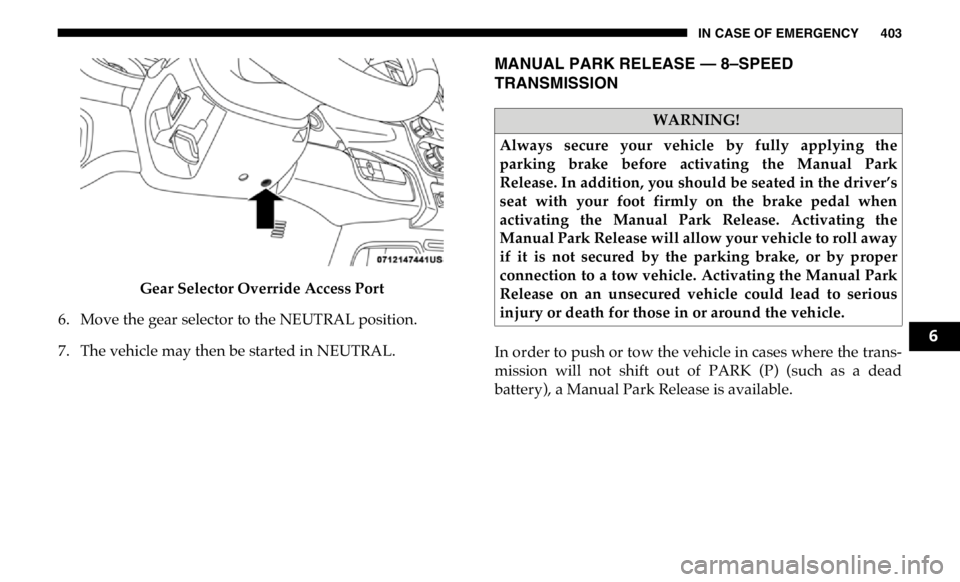
Gear Selector Override Access Port
6. Move the gear selector to the NEUTRAL position.
7. The vehicle may then be started in NEUTRAL. MANUAL PARK RELEASE — 8–SPEED
TRANSMISSION
In order to push or tow the vehicle in cases where the trans -
mission will not shift out of PARK (P) (such as a dead
battery), a Manual Park Release is available. WARNING!
Always secure your vehicle by fully applying the
parking brake before activating the Manual Park
Release. In addition, you should be seated in the driver’s
seat with your foot firmly on the brake pedal when
activating the Manual Park Release. Activating the
Manual Park Release will allow your vehicle to roll away
if it is not secured by the parking brake, or by proper
connection to a tow vehicle. Activating the Manual Park
Release on an unsecured vehicle could lead to serious
injury or death for those in or around the vehicle.
6
Page 409 of 607

IN CASE OF EMERGENCY 407
Proper towing or lifting equipment is required to prevent
damage to your vehicle. Use only tow bars and other equip -
ment designed for this purpose, following equipment manu -
facturer’s instructions. Use of safety chains is mandatory.
Attach a tow bar or other towing device to main structural
members of the vehicle, not to bumpers or associated
brackets. State and local laws regarding vehicles under tow
must be observed.
If you must use the accessories (wipers, defrosters, etc.)
while being towed, the ignition must be in the ON/RUN
mode, not the ACC mode.
If the key fob is unavailable or the vehicle's battery is
discharged, refer to “Manual Park Release” or “Gear Selector
Override” in this section for instructions on shifting the auto -
matic transmission out of PARK for towing. Two-Wheel Drive Models
The manufacturer recommends towing your vehicle with all
four wheels OFF the ground using a flatbed.
If flatbed equipment is not available, and the transmission is
operable, the vehicle may be towed (with the rear wheels on
the ground) under the following conditions:
• The transmission must be in NEUTRAL. Refer to “Manual
Park Release” in this section for instructions on shifting the
8–speed transmission to NEUTRAL when the engine is off.
• The towing speed must not exceed 30 mph (48 km/h).
• The towing distance must not exceed 15 miles (24 km) for
6–speed transmission, or 30 miles (48 km) for 8–speed
transmission.
If the transmission is not operable, or the vehicle must be
towed faster than 30 mph (48 km/h) or farther than 15 miles
(24 km) for 6–speed transmission, or 30 miles (48 km) for
8–speed transmission, tow with the rear wheels OFF the
ground. Acceptable methods are to tow the vehicle on a
flatbed, or with the front wheels raised and the rear wheels
on a towing dolly, or (when using a suitable steering wheel
stabilizer to hold the front wheels in the straight position)
with rear wheels raised and the front wheels on the ground.CAUTION!
• Do not use sling type equipment when towing. Vehicle
damage may occur.
• When securing the vehicle to a flat bed truck, do not
attach to front or rear suspension components. Damage
to your vehicle may result from improper towing. 6
Page 602 of 607

600
Seat Belts .......................................................................... 189, 241
Adjustable Shoulder Belt ................................................... 195
Adjustable Upper Shoulder Anchorage .......................... 195
Adjustable Upper Shoulder Belt Anchorage................... 195
Child Restraints ................................................................... 214
Extender................................................................................ 198
Front Seat...................................................................... 189, 193
Inspection ............................................................................. 241
Lap/Shoulder Belt Operation ........................................... 193
Lap/Shoulder Belt Untwisting ......................................... 194
Operating Instructions ....................................................... 193
Pregnant Women................................................................. 199
Reminder .............................................................................. 189
Seat Belt Extender ............................................................... 198
Seat Belt Reminder .............................................................. 189
Untwisting Procedure ........................................................ 194
Seat Belts Maintenance........................................................... 473
Seats ................................................................................ 39, 41, 42
Adjustment....................................................................... 39, 42
Easy Entry .............................................................................. 46
Folding Floor ....................................................................... 112
Head Restraints ..................................................................... 50
Memory .................................................................................. 44
Power ...................................................................................... 42
Rear Folding........................................................................... 39
Reclining Rear........................................................................ 41 Tilting ......................................................................................39
Security Alarm ...................................................................30, 148
Selection Of Coolant (Antifreeze) .........................................484
Sentry Key
Key Programming .................................................................29
Sentry Key (Immobilizer).........................................................28
Sentry Key Replacement ..........................................................29
Service Assistance ...................................................................585
Service Contract.......................................................................587
Service Manuals ......................................................................589
Shift Lever Override ...............................................................402
Shifting...................................................................................... 254
Automatic Transmission ............................................256, 265
Transfer Case .......................................................................280
Transfer Case, Shifting Into Transfer Case Neutral (N) ........... 360
Transfer Case, Shifting Out Of Transfer Case
Neutral (N) ...........................................................................362
Signals, Turn ..............................................................70, 157, 243
Siri..............................................................................................577
Sliding Rear Window, Power ..................................................94
Snow Chains (Tire Chains) ....................................................465
Snow Plow ...............................................................................355
Snow Tires ................................................................................461
Spare Tire Changing ...............................................................396
Spare Tire Stowage .................................................................396
Spare Tires ................................................................461, 462, 463