tire size RAM CHASSIS CAB 2019 User Guide
[x] Cancel search | Manufacturer: RAM, Model Year: 2019, Model line: CHASSIS CAB, Model: RAM CHASSIS CAB 2019Pages: 607, PDF Size: 12.68 MB
Page 349 of 607
STARTING AND OPERATING 347
(Continued) Towing Requirements — Tires
• Do not attempt to tow a trailer while using a compact spare
tire.
• Do not drive more than 50 mph (80 km/h) when towing
while using a full size spare tire.WARNING!
• Make certain that the load is secured in the trailer and
will not shift during travel. When trailering cargo that
is not fully secured, dynamic load shifts can occur that
may be difficult for the driver to control. You could lose
control of your vehicle and have a collision.
• When hauling cargo or towing a trailer, do not overload
your vehicle or trailer. Overloading can cause a loss of
control, poor performance or damage to brakes, axle,
engine, transmission, steering, suspension, chassis
structure or tires.
• Safety chains must always be used between your
vehicle and trailer. Always connect the chains to the
hook retainers of the vehicle hitch. Cross the chains
under the trailer tongue and allow enough slack for
turning corners.
• Vehicles with trailers should not be parked on a grade.
When parking, apply the parking brake on the tow
vehicle. Put the tow vehicle transmission in PARK. For
four-wheel drive vehicles, make sure the transfer case
is not in NEUTRAL. Always, block or "chock" the
trailer wheels.
• GCWR must not be exceeded. • Total weight must be distributed between the tow
vehicle and the trailer such that the following four
ratings are not exceeded:
• GVWR
• GTW
• GAWR
• Tongue weight rating for the trailer hitch utilized. WARNING! (Continued)
5
Page 447 of 607

SERVICING AND MAINTENANCE 445
Tire Markings
Tire Markings NOTE:
• P (Passenger) — Metric tire sizing is based on U.S. design
standards. P-Metric tires have the letter “P” molded into
the sidewall preceding the size designation. Example:
P215/65R15 95H.
• European — Metric tire sizing is based on European
design standards. Tires designed to this standard have the
tire size molded into the sidewall beginning with the
section width. The letter "P" is absent from this tire size
designation. Example: 215/65R15 96H.
• LT (Light Truck) — Metric tire sizing is based on U.S.
design standards. The size designation for LT-Metric tires
is the same as for P-Metric tires except for the letters “LT”
that are molded into the sidewall preceding the size desig -
nation. Example: LT235/85R16.
• Temporary spare tires are designed for temporary emer -
gency use only. Temporary high pressure compact spare
tires have the letter “T” or “S” molded into the sidewall
preceding the size designation. Example: T145/80D18
103M.
• High flotation tire sizing is based on U.S. design standards
and it begins with the tire diameter molded into the side -
wall. Example: 31x10.5 R15 LT.1 — U.S. DOT Safety
Standards Code (TIN) 4 — Maximum Load
2 — Size Designation 5 — Maximum Pressure
3 — Service Description 6 — Treadwear, Traction
and Temperature Grades 7
Page 448 of 607

446 SERVICING AND MAINTENANCE
Tire Sizing Chart
EXAMPLE:
Example Size Designation: P215/65R15XL 95H, 215/65R15 96H, LT235/85R16C, T145/80D18 103M, 31x10.5 R15 LT
P = Passenger car tire size based on U.S. design standards, or
"....blank...." = Passenger car tire based on European design standards, or
LT = Light truck tire based on U.S. design standards, or
T or S = Temporary spare tire or
31 = Overall diameter in inches (in)
215, 235, 145 = Section width in millimeters (mm)
65, 85, 80 = Aspect ratio in percent (%)
• Ratio of section height to section width of tire, or
10.5 = Section width in inches (in)
R = Construction code
• "R" means radial construction, or
• "D" means diagonal or bias construction
15, 16, 18 = Rim diameter in inches (in)
Service Description:
95 = Load Index
• A numerical code associated with the maximum load a tire can carry
Page 450 of 607

448 SERVICING AND MAINTENANCE
Tire Identification Number (TIN)
The TIN may be found on one or both sides of the tire; however, the date code may only be on one side. Tires with white side -
walls will have the full TIN, including the date code, located on the white sidewall side of the tire. Look for the TIN on the
outboard side of black sidewall tires as mounted on the vehicle. If the TIN is not found on the outboard side, then you will
find it on the inboard side of the tire.
EXAMPLE:
DOT MA L9 ABCD 0301
DOT = Department of Transportation
• This symbol certifies that the tire is in compliance with the U.S. Department of Transportation tire safety standards and is
approved for highway use
MA = Code representing the tire manufacturing location (two digits)
L9 = Code representing the tire size (two digits)
ABCD = Code used by the tire manufacturer (one to four digits)
03 = Number representing the week in which the tire was manufactured (two digits)
• 03 means the 3rd week
01 = Number representing the year in which the tire was manufactured (two digits)
• 01 means the year 2001
• Prior to July 2000, tire manufacturers were only required to have one number to represent the year in which the tire was
manufactured. Example: 031 could represent the 3rd week of 1981 or 1991
Page 451 of 607

SERVICING AND MAINTENANCE 449
Tire Terminology And Definitions
Term Definition
B-Pillar The vehicle B-Pillar is the structural member of the body located behind
the front door.
Cold Tire Inflation Pressure Cold tire inflation pressure is defined as the tire pressure after the vehicle
has not been driven for at least three hours, or driven less than 1 mile
(1.6 km) after sitting for a minimum of three hours. Inflation pressure is
measured in units of PSI (pounds per square inch) or kPa (kilopascals).
Maximum Inflation Pressure The maximum inflation pressure is the maximum permissible cold tire
inflation pressure for this tire. The maximum inflation pressure is
molded into the sidewall.
Recommended Cold Tire Inflation Pressure Vehicle manufacturer's recommended cold tire inflation pressure as
shown on the tire placard.
Tire Placard A label permanently attached to the vehicle describing the vehicle’s
loading capacity, the original equipment tire sizes and the recommended
cold tire inflation pressures.
7
Page 453 of 607
SERVICING AND MAINTENANCE 451
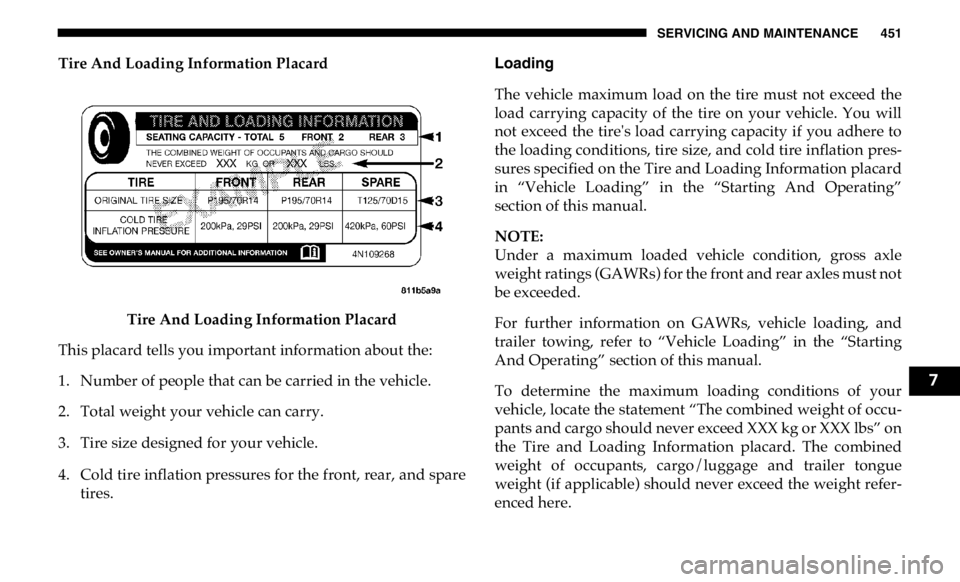
Tire And Loading Information Placard
Tire And Loading Information Placard
This placard tells you important information about the:
1. Number of people that can be carried in the vehicle.
2. Total weight your vehicle can carry.
3. Tire size designed for your vehicle.
4. Cold tire inflation pressures for the front, rear, and spare
tires. Loading
The vehicle maximum load on the tire must not exceed the
load carrying capacity of the tire on your vehicle. You will
not exceed the tire's load carrying capacity if you adhere to
the loading conditions, tire size, and cold tire inflation pres -
sures specified on the Tire and Loading Information placard
in “Vehicle Loading” in the “Starting And Operating”
section of this manual.
NOTE:
Under a maximum loaded vehicle condition, gross axle
weight ratings (GAWRs) for the front and rear axles must not
be exceeded.
For further information on GAWRs, vehicle loading, and
trailer towing, refer to “Vehicle Loading” in the “Starting
And Operating” section of this manual.
To determine the maximum loading conditions of your
vehicle, locate the statement “The combined weight of occu -
pants and cargo should never exceed XXX kg or XXX lbs” on
the Tire and Loading Information placard. The combined
weight of occupants, cargo/luggage and trailer tongue
weight (if applicable) should never exceed the weight refer -
enced here. 7
Page 458 of 607

456 SERVICING AND MAINTENANCE
Tire pressure may increase from 2 to 6 psi (13 to 40 kPa)
during operation. DO NOT reduce this normal pressure
build up or your tire pressure will be too low.
Tire Pressures For High Speed Operation
The manufacturer advocates driving at safe speeds and
within posted speed limits. Where speed limits or conditions
are such that the vehicle can be driven at high speeds, main -
taining correct tire inflation pressure is very important.
Increased tire pressure and reduced vehicle loading may be
required for high-speed vehicle operation. Refer to an autho -
rized tire dealer or original equipment vehicle dealer for
recommended safe operating speeds, loading and cold tire
inflation pressures. Radial Ply Tires
Tire Repair
If your tire becomes damaged, it may be repaired if it meets
the following criteria:
• The tire has not been driven on when flat.
• The damage is only on the tread section of your tire (side -
wall damage is not repairable).
• The puncture is no greater than a ¼ of an inch (6 mm).
Consult an authorized tire dealer for tire repairs and addi -
tional information.
Damaged Run Flat tires, or Run Flat tires that have experi -
enced a loss of pressure should be replaced immediately
with another Run Flat tire of identical size and service
description (Load Index and Speed Symbol). Replace the tire
pressure sensor as well as it is not designed to be reused.WARNING!
High speed driving with your vehicle under maximum
load is dangerous. The added strain on your tires could
cause them to fail. You could have a serious collision. Do
not drive a vehicle loaded to the maximum capacity at
continuous speeds above 75 mph (120 km/h). WARNING!
Combining radial ply tires with other types of tires on
your vehicle will cause your vehicle to handle poorly.
The instability could cause a collision. Always use radial
ply tires in sets of four. Never combine them with other
types of tires.
Page 461 of 607
SERVICING AND MAINTENANCE 459
(Continued)NOTE:
Wheel Valve Stem must be replaced as well when installing
new tires due to wear and tear in existing tires.
Keep dismounted tires in a cool, dry place with as little expo -
sure to light as possible. Protect tires from contact with oil,
grease, and gasoline.
Replacement Tires
The tires on your new vehicle provide a balance of many
characteristics. They should be inspected regularly for wear
and correct cold tire inflation pressures. The manufacturer
strongly recommends that you use tires equivalent to the
originals in size, quality and performance when replacement
is needed. Refer to the paragraph on “Tread Wear Indica -
tors” in this section. Refer to the Tire and Loading Informa -
tion placard or the Vehicle Certification Label for the size
designation of your tire. The Load Index and Speed Symbol
for your tire will be found on the original equipment tire
sidewall.
See the Tire Sizing Chart example found in the “Tire Safety
Information” section of this manual for more information
relating to the Load Index and Speed Symbol of a tire. It is recommended to replace the two front tires or two rear
tires as a pair. Replacing just one tire can seriously affect
your vehicle’s handling. If you ever replace a wheel, make
sure that the wheel’s specifications match those of the orig -
inal wheels.
It is recommended you contact an authorized tire dealer or
original equipment dealer with any questions you may have
on tire specifications or capability. Failure to use equivalent
replacement tires may adversely affect the safety, handling,
and ride of your vehicle.
WARNING!
• Do not use a tire, wheel size, load rating, or speed rating
other than that specified for your vehicle. Some combi -
nations of unapproved tires and wheels may change
suspension dimensions and performance characteris -
tics, resulting in changes to steering, handling, and
braking of your vehicle. This can cause unpredictable
handling and stress to steering and suspension compo -
nents. You could lose control and have a collision
resulting in serious injury or death. Use only the tire
and wheel sizes with load ratings approved for your
vehicle. 7
Page 462 of 607

460 SERVICING AND MAINTENANCE
Tire Types
All Season Tires — If Equipped
All Season tires provide traction for all seasons (Spring,
Summer, Fall, and Winter). Traction levels may vary
between different all season tires. All season tires can be
identified by the M+S, M&S, M/S or MS designation on the
tire sidewall. Use all season tires only in sets of four; failure
to do so may adversely affect the safety and handling of your
vehicle. Summer Or Three Season Tires — If Equipped
Summer tires provide traction in both wet and dry condi -
tions, and are not intended to be driven in snow or on ice. If
your vehicle is equipped with Summer tires, be aware these
tires are not designed for Winter or cold driving conditions.
Install Winter tires on your vehicle when ambient tempera -
tures are less than 40°F (5°C) or if roads are covered with ice
or snow. For more information, contact an authorized dealer.
Summer tires do not contain the all season designation or
mountain/snowflake symbol on the tire sidewall. Use
Summer tires only in sets of four; failure to do so may
adversely affect the safety and handling of your vehicle.• Never use a tire with a smaller load index or capacity,
other than what was originally equipped on your
vehicle. Using a tire with a smaller load index could
result in tire overloading and failure. You could lose
control and have a collision.
• Failure to equip your vehicle with tires having
adequate speed capability can result in sudden tire
failure and loss of vehicle control.
CAUTION!
Replacing original tires with tires of a different size may
result in false speedometer and odometer readings. WARNING! (Continued)
WARNING!
Do not use Summer tires in snow/ice conditions. You
could lose vehicle control, resulting in severe injury or
death. Driving too fast for conditions also creates the
possibility of loss of vehicle control.
Page 463 of 607

SERVICING AND MAINTENANCE 461
Snow Tires
Some areas of the country require the use of snow tires
during the Winter. Snow tires can be identified by a “moun -
tain/snowflake” symbol on the tire sidewall.
If you need snow tires, select tires equivalent in size
and type to the original equipment tires. Use snow
tires only in sets of four; failure to do so may
adversely affect the safety and handling of your vehicle.
Snow tires generally have lower speed ratings than what was
originally equipped with your vehicle and should not be
operated at sustained speeds over 75 mph (120 km/h). For
speeds above 75 mph (120 km/h) refer to original equipment
or an authorized tire dealer for recommended safe operating
speeds, loading and cold tire inflation pressures.
While studded tires improve performance on ice, skid and
traction capability on wet or dry surfaces may be poorer than
that of non-studded tires. Some states prohibit studded tires;
therefore, local laws should be checked before using these
tire types. Spare Tires — If Equipped
NOTE:
For vehicles equipped with Tire Service Kit instead of a spare
tire, please refer to “Tire Service Kit” in “In Case Of Emer -
gency” for further information.
Refer to the “Towing Requirements - Tires” in “Starting And
Operating” for restrictions when towing with a spare tire
designated for temporary emergency use.
Spare Tire Matching Original Equipped Tire And Wheel
— If Equipped
Your vehicle may be equipped with a spare tire and wheel
equivalent in look and function to the original equipment
tire and wheel found on the front or rear axle of your vehicle.
This spare tire may be used in the tire rotation for your
vehicle. If your vehicle has this option, refer to an authorized
tire dealer for the recommended tire rotation pattern. CAUTION!
Because of the reduced ground clearance, do not take
your vehicle through an automatic car wash with a
compact or limited use temporary spare installed.
Damage to the vehicle may result.
7