fuel RAM CHASSIS CAB 2020 Repair Manual
[x] Cancel search | Manufacturer: RAM, Model Year: 2020, Model line: CHASSIS CAB, Model: RAM CHASSIS CAB 2020Pages: 516, PDF Size: 16.57 MB
Page 347 of 516

SERVICING AND MAINTENANCE345
Checking Oil Level — Gas Engine
To ensure proper lubrication of your vehicle's
engine, the engine oil must be maintained at
the correct level. Check the oil level at regular
intervals, such as every fuel stop. The best time
to check the engine oil level is about five
minutes after a fully warmed up engine is shut
off.
Checking the oil while the vehicle is on level
ground will improve the accuracy of the oil level
readings. Always maintain the oil level within
the SAFE zone on the dipstick. Adding one quart
of oil when the reading is at the bottom of the
SAFE zone will result in a reading at the top of
the safe zone on these engines.
Checking Oil Level — Diesel Engine
To ensure proper lubrication of your vehicle's
engine, the engine oil must be maintained at
the correct level. Check the oil level at regular
intervals. The best time to check the oil level is
before starting the engine after it has been parked overnight. When checking oil after oper
-
ating the engine, first ensure the engine is at full
operating temperature, then wait for
30 minutes after engine shutdown to check the
oil.
Engine Oil Dipstick
Checking the oil while the vehicle is on level
ground will improve the accuracy of the oil level
readings. Add oil only when the level on the
dipstick is below the “ADD” mark. The total
capacity from the ADD mark to the Full mark is
2 Quarts (1.9Liters). Never operate the engine with oil level below
the “ADD” mark or above the upper “SAFE”
mark.
Adding Washer Fluid
The fluid reservoir is located under the hood
and should be checked for fluid level at regular
intervals. Fill the reservoir with windshield
washer solvent only (not radiator antifreeze).
When refilling the washer fluid reservoir, take
some washer fluid and apply it to a cloth or
towel and wipe the wiper blades clean. This will
help blade performance.
To prevent freeze-up of your windshield washer
system in cold weather, select a solution or
mixture that meets or exceeds the temperature
range of your climate. This rating information
can be found on most washer fluid containers.
CAUTION!
Overfilling or underfilling will cause oil
aeration or loss of oil pressure. This could
damage your engine.
1 — ADD Range
2 — Full Mark
3 — SAFE Range
CAUTION!
Overfilling or underfilling the crankcase will
cause oil aeration or loss of oil pressure. This
could damage your engine.
7
2020_RAM_CHASSIS_CAB_OM_USA=GUID-6C67832B-7839-4CCF-BEFC-CDF988F949EA=1=en=.book Page 345
Page 356 of 516

354SERVICING AND MAINTENANCE
NOTE:
Ensure the glove compartment door hinges and
glove compartment travel stops are fully
engaged.
9. Reattach the glove compartment tension
tether by inserting the tether clip in the
glove compartment and sliding the clip
away from the face of the glove compart -
ment door.
Accessory Drive Belt Inspection
When inspecting accessory drive belts, small
cracks that run across ribbed surface of belt
from rib to rib, are considered normal. These
are not a reason to replace belt. However,
cracks running along a rib (not across) are not
normal. Any belt with cracks running along a rib
must be replaced. Also have the belt replaced if
it has excessive wear, frayed cords or severe
glazing.
Accessory Belt (Serpentine Belt)
Conditions that would require replacement:
Rib chunking (one or more ribs has sepa -
rated from belt body)
Rib or belt wear
Longitudinal belt cracking (cracks between
two ribs)
Belt slips
“Groove jumping" (belt does not maintain
correct position on pulley)
Belt broken (note: identify and correct
problem before new belt is installed)
Noise (objectionable squeal, squeak, or
rumble is heard or felt while drive belt is in
operation)
Some conditions can be caused by a faulty
component such as a belt pulley. Belt pulleys
should be carefully inspected for damage and
proper alignment.
Belt replacement on some models requires the
use of special tools, we recommend having your
vehicle serviced at an authorized dealer.
Draining Fuel/Water Separator Filter
There are two fuel filter assemblies. One is
located on the driver's side of the engine. The
best access to this water drain valve is from
under the hood. The second one is on the under
body, located in front of the rear axle above the
drive shaft on pick-up models. The Chassis Cab
models second filter location is on the frame
behind the front axle. The best access to this
water drain valve is from under the vehicle.
WARNING!
Do not attempt to inspect an accessory
drive belt with vehicle running.
When working near the radiator cooling fan,
disconnect the fan motor lead. The fan is
temperature controlled and can start at any
time regardless of ignition mode. You could
be injured by the moving fan blades.
You can be badly injured working on or
around a motor vehicle. Only do service
work for which you have the knowledge and
the proper equipment. If you have any
doubt about your ability to perform a
service job, take your vehicle to a compe -
tent mechanic.
2020_RAM_CHASSIS_CAB_OM_USA=GUID-6C67832B-7839-4CCF-BEFC-CDF988F949EA=1=en=.book Page 354
Page 357 of 516

SERVICING AND MAINTENANCE355
If water is detected in the water separator while
the engine is running, or while the ignition
switch is in the ON position, the “Water In Fuel
Indicator Light” will illuminate and an audible
chime will be heard five times. At this point you
should stop the engine and drain the water from
both of the filters.
If the “Water In Fuel Indicator Light” comes on
and a single chime is heard while you are
driving, or with the ignition switch in the ON
position, there may be a problem with your
water separator wiring or sensor. See an autho -
rized dealer for service. Upon proper draining of the water from both
fuel filters, the “Water In Fuel Indicator Light”
will remain illuminated for approximately 10
seconds. If the water was drained while the
engine was running, the “Water In Fuel Indicator
Light” may remain on for approximately three
minutes.
NOTE:
Care should be taken in disposing of used fluids
from your vehicle. Used fluids, indiscriminately
discarded, can present a problem to the envi
-
ronment. Contact an authorized dealer, service
station, or government agency for advice on
recycling programs and for where used fluids
and filters can be properly disposed of in your
area.
Drain the fuel/water separator filters when the
“Water In Fuel Indicator Light” is ON. Within
10 minutes of vehicle shutdown, turn the
engine mounted filter drain valve (located on
the side of the filter assembly) counterclock -
wise quarter turn, and turn the under body
mounted filter drain valve (located on the
bottom of the filter assembly) counterclockwise
wise 1 full turn. Then turn the ignition switch to the ON position, and allow any accumulated
water to drain. Leave the drain valve open until
all water and contaminants have been
removed. When clean fuel is visible, close the
drain valve following these guidelines:
1. Rotate the drain clockwise to close until
you feel resistance from the internal seal.
2. Continue turning the drain half of a turn to properly compress the seal.
NOTE:
Over-compression of the seal due to over-tight -
ening of the drain will damage the seal, cause a
leak, and require the entire sensor to be
replaced.
3. Turn the ignition switch to OFF.
The sensor drain should not be over-tightened
during normal service operations to avoid
internal damage and future fuel leaks. The
drain should be closed and secured without the
use of tools.
If more than a couple ounces/milliliters of fuel
have been drained, follow the directions for
“Priming If The Engine Has Run Out Of Fuel.”
CAUTION!
Do not drain the fuel/water separator filter
when the engine is running.
Diesel fuel will damage blacktop paving
surfaces. Drain the filter into an appro-
priate container.
CAUTION!
If the “Water In Fuel Indicator Light” remains
on, DO NOT START the engine before you
drain water from the fuel filters to avoid
engine damage.
7
2020_RAM_CHASSIS_CAB_OM_USA=GUID-6C67832B-7839-4CCF-BEFC-CDF988F949EA=1=en=.book Page 355
Page 358 of 516
356SERVICING AND MAINTENANCE
Engine Mounted Fuel Filter Replacement
NOTE:
Using a fuel filter that does not meet the
manufacturer's filtration and water sepa -
rating requirements can severely impact fuel
system life and reliability.
The engine mounted filter housing is
equipped with a No-Filter-No-Run (NFNR)
feature. Engine will not run if:
a. No filter is installed.
b. Inferior/Non-approved filter is used. Use of OEM filter is required to ensure vehicle
will run.
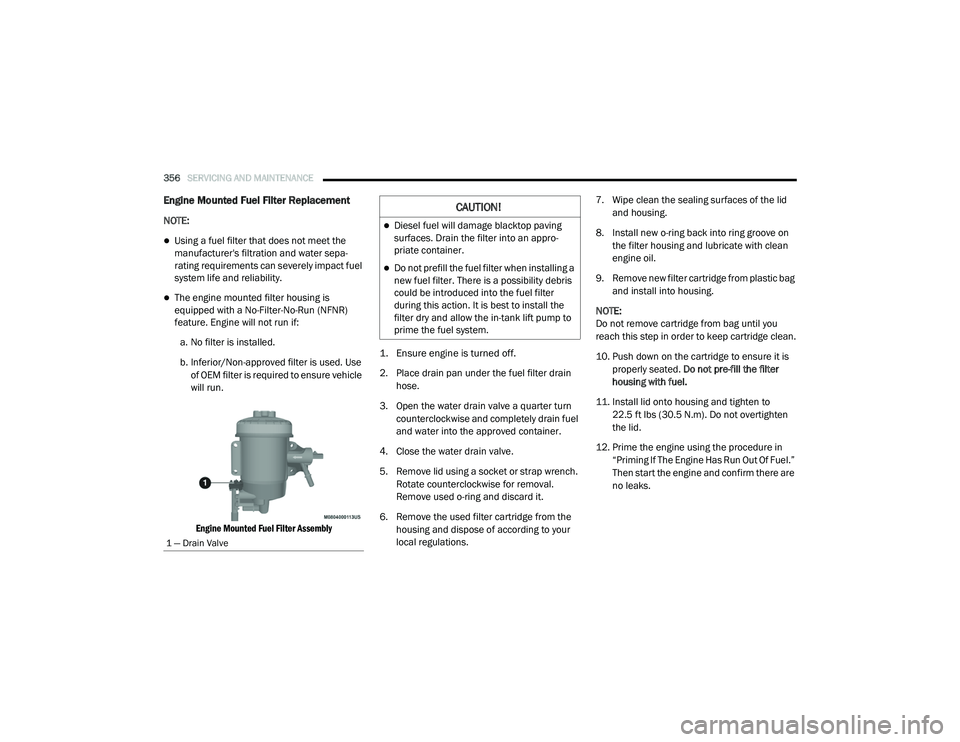
Engine Mounted Fuel Filter Assembly
1. Ensure engine is turned off.
2. Place drain pan under the fuel filter drain
hose.
3. Open the water drain valve a quarter turn counterclockwise and completely drain fuel
and water into the approved container.
4. Close the water drain valve.
5. Remove lid using a socket or strap wrench. Rotate counterclockwise for removal.
Remove used o-ring and discard it.
6. Remove the used filter cartridge from the housing and dispose of according to your
local regulations. 7. Wipe clean the sealing surfaces of the lid
and housing.
8. Install new o-ring back into ring groove on the filter housing and lubricate with clean
engine oil.
9. Remove new filter cartridge from plastic bag and install into housing.
NOTE:
Do not remove cartridge from bag until you
reach this step in order to keep cartridge clean.
10. Push down on the cartridge to ensure it is properly seated. Do not pre-fill the filter
housing with fuel.
11. Install lid onto housing and tighten to 22.5 ft lbs (30.5 N.m). Do not overtighten
the lid.
12. Prime the engine using the procedure in “Priming If The Engine Has Run Out Of Fuel.”
Then start the engine and confirm there are
no leaks.
1 — Drain Valve
CAUTION!
Diesel fuel will damage blacktop paving
surfaces. Drain the filter into an appro-
priate container.
Do not prefill the fuel filter when installing a
new fuel filter. There is a possibility debris
could be introduced into the fuel filter
during this action. It is best to install the
filter dry and allow the in-tank lift pump to
prime the fuel system.
2020_RAM_CHASSIS_CAB_OM_USA=GUID-6C67832B-7839-4CCF-BEFC-CDF988F949EA=1=en=.book Page 356
Page 359 of 516
SERVICING AND MAINTENANCE357
Underbody Mounted Fuel Filter
Replacement
NOTE:
Using a fuel filter that does not meet the
manufacturer's filtration and water sepa -
rating requirements can severely impact fuel
system life and reliability.
The underbody mounted filter housing will
cause the engine not to run if:
a. No filter is installed.
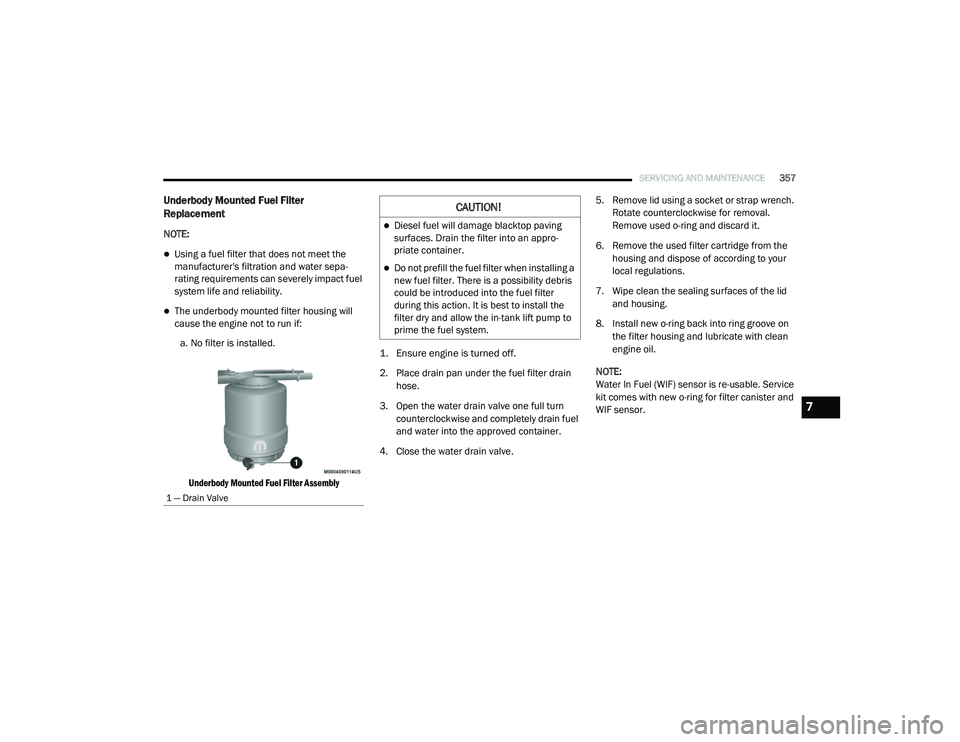
Underbody Mounted Fuel Filter Assembly
1. Ensure engine is turned off.
2. Place drain pan under the fuel filter drain
hose.
3. Open the water drain valve one full turn counterclockwise and completely drain fuel
and water into the approved container.
4. Close the water drain valve. 5. Remove lid using a socket or strap wrench.
Rotate counterclockwise for removal.
Remove used o-ring and discard it.
6. Remove the used filter cartridge from the housing and dispose of according to your
local regulations.
7. Wipe clean the sealing surfaces of the lid and housing.
8. Install new o-ring back into ring groove on the filter housing and lubricate with clean
engine oil.
NOTE:
Water In Fuel (WIF) sensor is re-usable. Service
kit comes with new o-ring for filter canister and
WIF sensor.
1 — Drain Valve
CAUTION!
Diesel fuel will damage blacktop paving
surfaces. Drain the filter into an appro-
priate container.
Do not prefill the fuel filter when installing a
new fuel filter. There is a possibility debris
could be introduced into the fuel filter
during this action. It is best to install the
filter dry and allow the in-tank lift pump to
prime the fuel system.
7
2020_RAM_CHASSIS_CAB_OM_USA=GUID-6C67832B-7839-4CCF-BEFC-CDF988F949EA=1=en=.book Page 357
Page 360 of 516

358SERVICING AND MAINTENANCE
Priming If The Engine Has Run Out Of Fuel
1. Add a substantial amount of fuel to the
tank, approximately 2 to 5 gal (8L to 19L).
2. Three priming cycles must be completed. Turn ignition to the RUN position and wait
approximately 30 seconds. This will activate
the in tank fuel pump. Turn the ignition
switch to the off position, and leave off for at
least 30 seconds. Repeat this procedure
three times before cranking the engine.
3. Start the engine using the “Normal Starting” procedure. Refer to “Starting Procedures”
in “Starting and Operating” for further infor -
mation.
4. Once the engine starts, allow the engine to idle for a minimum of 30 seconds. NOTE:
The engine may run rough until the air is forced
from all the fuel lines.
NOTE:
A maximum blend of 5% biodiesel, meeting
ASTM specification D-975 may be used with
your Cummins diesel engine. (Chassis Cab
models not configured with B20 capability.)
A maximum blend of 20% biodiesel, meeting
ASTM specification D-7467 may be used with
your Cummins diesel engine. (Pickup models
and Chassis Cab models configured with B20
capability.)
Use of biodiesel mixture in excess of 20% can
negatively impact the fuel filter's ability to
separate water from the fuel, resulting in
high pressure fuel system corrosion or
damage.
Ethanol blends are not recommended or
approved for use with your Cummins diesel
engine.
In addition, commercially available fuel addi
-
tives are not necessary for the proper opera -
tion of your Cummins diesel engine.
WARNING!
Do not open the high pressure fuel system
with the engine running. Engine operation
causes high fuel pressure. High pressure fuel
spray can cause serious injury or death.
CAUTION!
Do not engage the starter motor for more
than 15 seconds at a time. Allow two minutes
between the cranking intervals.
WARNING!
Do not use alcohol or gasoline as a fuel
blending agent. They can be unstable under
certain conditions and be hazardous or
explosive when mixed with diesel fuel.
CAUTION!
Due to lack of lubricants in alcohol or
gasoline, the use of these fuels can cause
damage to the fuel system.
2020_RAM_CHASSIS_CAB_OM_USA=GUID-6C67832B-7839-4CCF-BEFC-CDF988F949EA=1=en=.book Page 358
Page 364 of 516
362SERVICING AND MAINTENANCE
Installing The Front Wipers
1. Lift the wiper arm off of the glass, until the
wiper arm is in the full up position.
2. Position the wiper blade under the hook on the tip of the wiper arm with the wiper
locking tab open.
3. Insert the receiver bracket on the wiper assembly into the hook on the tip of the arm
through the opening in the wiper blade
under the locking tab.
4. Slide the wiper blade up into the hook on the wiper arm until it is latched (engage -
ment will be accompanied by an audible
click). Fold down the latch release tab and
snap it into its locked position.
5. Gently lower the wiper blade onto the glass.
Exhaust System
The best protection against carbon monoxide
entry into the vehicle body is a properly main -
tained engine exhaust system.
If you notice a change in the sound of the
exhaust system; or if the exhaust fumes can be
detected inside the vehicle; or when the under -
side or rear of the vehicle is damaged; have an
authorized technician inspect the complete exhaust system and adjacent body areas for
broken, damaged, deteriorated, or misposi
-
tioned parts. Open seams or loose connections
could permit exhaust fumes to seep into the
passenger compartment. In addition, have the
exhaust system inspected each time the vehicle
is raised for lubrication or oil change. Replace
as required.
Under normal operating conditions, the cata-
lytic converter will not require maintenance.
However, it is important to keep the engine
properly tuned to ensure proper catalyst opera-
tion and prevent possible catalyst damage.
WARNING!
Exhaust gases can injure or kill. They
contain carbon monoxide (CO), which is
colorless and odorless. Breathing it can
make you unconscious and can eventually
poison you. To avoid breathing CO, refer to
“Safety Tips” in “Safety” for further informa -
tion.
A hot exhaust system can start a fire if you
park over materials that can burn. Such
materials might be grass or leaves coming
into contact with your exhaust system. Do
not park or operate your vehicle in areas
where your exhaust system can contact
anything that can burn.
CAUTION!
The catalytic converter requires the use of
unleaded fuel only. Leaded gasoline will
destroy the effectiveness of the catalyst as
an emissions control device and may seri -
ously reduce engine performance and
cause serious damage to the engine.
Damage to the catalytic converter can
result if your vehicle is not kept in proper
operating condition. In the event of engine
malfunction, particularly involving engine
misfire or other apparent loss of perfor -
mance, have your vehicle serviced
promptly. Continued operation of your
vehicle with a severe malfunction could
cause the converter to overheat, resulting
in possible damage to the converter and
vehicle.
2020_RAM_CHASSIS_CAB_OM_USA=GUID-6C67832B-7839-4CCF-BEFC-CDF988F949EA=1=en=.book Page 362
Page 368 of 516

366SERVICING AND MAINTENANCE
Checking Coolant Level — 6.4L Engine
The level of the coolant in the pressurized
coolant bottle should be between the “MIN” and
“MAX” range on the bottle when the engine is
cold.
The radiator normally remains completely full,
so there is no need to remove the cap unless
checking for coolant freeze point or replacing
engine coolant (antifreeze). Advise your service
attendant of this. As long as the engine oper -
ating temperature is satisfactory, the coolant
bottle need only be checked once a month.
When additional engine coolant (antifreeze) is
needed to maintain the proper level, it should
be added to the coolant bottle. Do not overfill.
Points To Remember
NOTE:
When the vehicle is stopped after a few miles/
kilometers of operation, you may observe vapor
coming from the front of the engine compart -
ment. This is normally a result of moisture from
rain, snow, or high humidity accumulating on
the radiator and being vaporized when the ther -
mostat opens, allowing hot engine coolant (anti -
freeze) to enter the radiator. If an examination of your engine compartment
shows no evidence of radiator or hose leaks,
the vehicle may be safely driven. The vapor will
soon dissipate.
Do not overfill the coolant expansion bottle.
Check the coolant freeze point in the radiator
and in the coolant expansion bottle. If engine
coolant (antifreeze) needs to be added, the
contents of the coolant expansion bottle
must also be protected against freezing.
If frequent engine coolant (antifreeze) addi-
tions are required, the cooling system should
be pressure tested for leaks.
Maintain engine coolant (antifreeze) concen
-
tration at a minimum of 50% OAT coolant
(conforming to MS.90032) and distilled
water for proper corrosion protection of your
engine which contains aluminum compo -
nents.
Make sure that the coolant expansion bottle
overflow hoses are not kinked or obstructed.
Keep the front of the radiator clean. If your
vehicle is equipped with air conditioning,
keep the front of the condenser clean.
Do not change the thermostat for Summer or
Winter operation. If replacement is ever
necessary, install ONLY the correct type ther -
mostat. Other designs may result in unsatis -
factory engine coolant (antifreeze)
performance, poor gas mileage, and
increased emissions.
Charge Air Cooler — Inter-Cooler
The charge air cooler is positioned below the
radiator and the air conditioner condenser. Air
enters the engine through the air cleaner and
passes through the turbocharger, where it is
pressurized. This pressurized air rapidly
reaches high temperature. The air is then
directed through a hose to the charge air cooler
and through another hose to the intake mani -
fold of the engine. The air entering the engine
has been cooled by about 50° to 100°F
(10° to 38°C). This cooling process enables
more efficient burning of fuel resulting in fewer
emissions.
To guarantee optimum performance of the
system, keep the surfaces of the charge air
cooler, condenser and radiator clean and free
of debris. Periodically check the hoses leading
to and from the charge air cooler for cracks or
loose clamps resulting in loss of pressure and
reduced engine performance.
2020_RAM_CHASSIS_CAB_OM_USA=GUID-6C67832B-7839-4CCF-BEFC-CDF988F949EA=1=en=.book Page 366
Page 384 of 516

382SERVICING AND MAINTENANCE
Tires — General Information
Tire Pressure
Proper tire inflation pressure is essential to the
safe and satisfactory operation of your vehicle.
Four primary areas are affected by improper tire
pressure:
Safety
Fuel Economy
Tread Wear
Ride Comfort and Vehicle Stability Safety
Both underinflation and overinflation affect the
stability of the vehicle and can produce a feeling
of sluggish response or over responsiveness in
the steering.
NOTE:
Unequal tire pressures from side to side may
cause erratic and unpredictable steering
response.
Unequal tire pressure from side to side may
cause the vehicle to drift left or right.
Fuel Economy
Underinflated tires will increase tire rolling
resistance resulting in higher fuel consumption.
Tread Wear
Improper cold tire inflation pressures can cause
abnormal wear patterns and reduced tread life,
resulting in the need for earlier tire replace -
ment.
Ride Comfort And Vehicle Stability
Proper tire inflation contributes to a comfort -
able ride. Overinflation produces a jarring and
uncomfortable ride.
WARNING!
Overloading of your tires is dangerous.
Overloading can cause tire failure, affect
vehicle handling, and increase your stopping
distance. Use tires of the recommended load
capacity for your vehicle. Never overload
them.WARNING!
Improperly inflated tires are dangerous and
can cause collisions.
Underinflation increases tire flexing and
can result in overheating and tire failure.
Overinflation reduces a tire's ability to
cushion shock. Objects on the road and
chuckholes can cause damage that result
in tire failure.
Overinflated or underinflated tires can
affect vehicle handling and can fail
suddenly, resulting in loss of vehicle
control.
Unequal tire pressures can cause steering
problems. You could lose control of your
vehicle.
Unequal tire pressures from one side of the
vehicle to the other can cause the vehicle
to drift to the right or left.
Always drive with each tire inflated to the
recommended cold tire inflation pressure.
2020_RAM_CHASSIS_CAB_OM_USA=GUID-6C67832B-7839-4CCF-BEFC-CDF988F949EA=1=en=.book Page 382
Page 401 of 516

TECHNICAL SPECIFICATIONS399
All wheel nuts should be tightened occasionally
to eliminate the possibility of wheel studs being
sheared or the bolt holes in the wheels
becoming elongated. This is especially
important during the first few hundred miles/
kilometers of operation to allow the wheel nuts
to become properly set. All wheel nuts should
first be firmly seated against the wheel. The
wheel nuts should then be tightened to recom -
mended torque. Tighten the wheel nuts to final
torque in increments. Progress around the bolt
circle, tightening the wheel nut opposite to the
wheel nut just previously tightened until final
torque is achieved.FUEL REQUIREMENTS — GAS ENGINE
6.4L Engine
Do not use E-85 flex fuel or ethanol blends
greater than 15% in this engine.
This engine is designed to meet all
emissions regulations and provide
satisfactory fuel economy and perfor -
mance when using high quality
unleaded gasoline having a posted octane
number range of 87 to 89 as specified by the
(R+M)/2 method. The use of 89 octane “Plus”
gasoline is recommended for optimum perfor -
mance and fuel economy.
While operating on gasoline with an octane
number of 87, hearing a light knocking sound
from the engine is not a cause for concern.
However, if the engine is heard making a heavy
knocking sound, see dealer immediately. Use of
gasoline with an octane number lower than 87
can cause engine failure and may void or not be
covered by the New Vehicle Limited Warranty. Poor quality gasoline can cause problems such
as hard starting, stalling, and hesitations. If you
experience these symptoms, try another brand
of gasoline before considering service for the
vehicle.
Reformulated Gasoline
Many areas of the country require the use of
cleaner burning gasoline referred to as “Refor
-
mulated Gasoline”. Reformulated gasoline
contains oxygenates and are specifically
blended to reduce vehicle emissions and
improve air quality.
The use of reformulated gasoline is recom -
mended. Properly blended reformulated gaso -
line will provide improved performance and
durability of engine and fuel system compo -
nents.
WARNING!
To avoid the risk of forcing the vehicle off the
jack, do not tighten the lug nuts/bolts fully
until the vehicle has been lowered. Failure to
follow this warning may result in personal
injury.
8
2020_RAM_CHASSIS_CAB_OM_USA=GUID-6C67832B-7839-4CCF-BEFC-CDF988F949EA=1=en=.book Page 399