air condition Ram ProMaster 2019 Owner's Guide
[x] Cancel search | Manufacturer: RAM, Model Year: 2019, Model line: ProMaster, Model: Ram ProMaster 2019Pages: 332, PDF Size: 3.66 MB
Page 236 of 332
NOTE:Be sure to follow the “Severe Duty Conditions”
maintenance interval if applicable.
WARNING!
The air induction system (air cleaner, hoses, etc.) can
provide a measure of protection in the case of engine
backfire. Do not remove the air induction system (air
cleaner, hoses, etc.) unless such removal is necessary
for repair or maintenance. Make sure that no one is
near the engine compartment before starting the ve-
hicle with the air induction system (air cleaner, hoses,
etc.) removed. Failure to do so can result in serious
personal injury.
Engine Air Cleaner Filter Selection
The quality of replacement engine air cleaner filters varies
considerably. Only high quality filters should be used to
assure most efficient service. Mopar engine air cleaner
filters are a high quality filter and are recommended.
Air Conditioner Maintenance
For best possible performance, your air conditioner should
be checked and serviced by an authorized dealer at the
start of each warm season. This service should include cleaning of the condenser fins and a performance test.
Drive belt tension should also be checked at this time.
WARNING!
•
Use only refrigerants and compressor lubricants ap-
proved by the manufacturer for your air conditioning
system. Some unapproved refrigerants are flam-
mable and can explode, injuring you. Other unap-
proved refrigerants or lubricants can cause the sys-
tem to fail, requiring costly repairs. Refer to
Warranty Information Book, for further warranty
information.
• The air conditioning system contains refrigerant un-
der high pressure. To avoid risk of personal injury or
damage to the system, adding refrigerant or any
repair requiring lines to be disconnected should be
done by an experienced technician.
CAUTION!
Do not use chemical flushes in your air conditioning
system as the chemicals can damage your air condition-
ing components. Such damage is not covered by the
New Vehicle Limited Warranty.
234 SERVICING AND MAINTENANCE
Page 237 of 332
Refrigerant Recovery And Recycling
R-134a Air Conditioning Refrigerant is a hydrofluoro-
carbon (HFC) that is an ozone-saving product. However,
the manufacturer recommends that air conditioning ser-
vice be performed by authorized dealer or other service
facilities using recovery and recycling equipment.
NOTE:Use only manufacturer approved A/C system PAG
compressor oil and refrigerants.
Cabin Air Filter (A/C Air Filter)
Refer to the “Maintenance Plan” for the proper mainte-
nance intervals.
WARNING!
Do not remove the cabin air filter while the vehicle is
running, or while the ignition is in the ACC or ON/
RUN mode. With the cabin air filter removed and the
blower operating, the blower can contact hands and
may propel dirt and debris into your eyes, resulting in
personal injury. The cabin air filter is located in the fresh air inlet in the
engine compartment. Perform the following procedure to
replace the filter:
1. Remove the two screws that secure the filter retainer to
the fresh air inlet, and remove the filter retainer.
Accessing Air Filter
1 — Screw Locations
2 — Fresh Air Inlet
8
SERVICING AND MAINTENANCE 235
Page 244 of 332
Disposal Of Used Coolant
Used ethylene glycol-based coolant (antifreeze) is a regu-
lated substance requiring proper disposal. Check with your
local authorities to determine the disposal rules for your
community. To prevent ingestion by animals or children,
do not store ethylene glycol-based coolant in open contain-
ers or allow it to remain in puddles on the ground. If
ingested by a child or pet, seek emergency assistance
immediately. Clean up any ground spills immediately.
Coolant Level
The coolant expansion bottle provides a quick visual
method for determining that the coolant level is adequate.
With engine off and cold, the level of the engine coolant
(antifreeze) in the bottle should be between the “MIN” and
“MAX” marks.
Points To Remember
NOTE:When the vehicle is stopped after a few miles/
kilometers of operation, you may observe vapor coming
from the front of the engine compartment. This is normally
a result of moisture from rain, snow, or high humidity
accumulating on the radiator and being vaporized when
the thermostat opens, allowing hot engine coolant (anti-
freeze) to enter the radiator. If an examination of your engine compartment shows no
evidence of radiator or hose leaks, the vehicle may be
safely driven. The vapor will soon dissipate.
•
Do not overfill the coolant expansion bottle.
• Check the coolant freeze point in the radiator and in the
coolant expansion bottle. If engine coolant (antifreeze)
needs to be added, the contents of the coolant expansion
bottle must also be protected against freezing.
• If frequent engine coolant (antifreeze) additions are
required, the cooling system should be pressure tested
for leaks.
• Maintain engine coolant (antifreeze) concentration at a
minimum of 50% OAT coolant (conforming to
MS.90032) and distilled water for proper corrosion pro-
tection of your engine which contains aluminum com-
ponents.
• Make sure that the coolant expansion bottle overflow
hoses are not kinked or obstructed.
• Keep the front of the radiator clean. If your vehicle is
equipped with air conditioning, keep the front of the
condenser clean.
• Do not change the thermostat for Summer or Winter
operation. If replacement is ever necessary, install ONLY
242 SERVICING AND MAINTENANCE
Page 258 of 332
Tire Inflation Pressures
The proper cold tire inflation pressure is listed on the
driver’s side B-Pillar or rear edge of the driver’s side door.
At least once a month:
•Check and adjust tire pressure with a good quality
pocket-type pressure gauge. Do not make a visual
judgement when determining proper inflation. Tires
may look properly inflated even when they are under-
inflated.
• Inspect tires for signs of tire wear or visible damage.
CAUTION!
After inspecting or adjusting the tire pressure, always
reinstall the valve stem cap. This will prevent moisture
and dirt from entering the valve stem, which could
damage the valve stem.
Inflation pressures specified on the placard are always
“cold tire inflation pressure”. Cold tire inflation pressure is
defined as the tire pressure after the vehicle has not been driven for at least three hours, or driven less than 1 mile
(1.6 km) after sitting for a minimum of three hours. The
cold tire inflation pressure must not exceed the maximum
inflation pressure molded into the tire sidewall.
Check tire pressures more often if subject to a wide range
of outdoor temperatures, as tire pressures vary with tem-
perature changes.
Tire pressures change by approximately 1 psi (7 kPa) per
12°F (7°C) of air temperature change. Keep this in mind
when checking tire pressure inside a garage, especially in
the Winter.
Example: If garage temperature = 68°F (20°C) and the
outside temperature = 32°F (0°C) then the cold tire inflation
pressure should be increased by 3 psi (21 kPa), which
equals 1 psi (7 kPa) for every 12°F (7°C) for this outside
temperature condition.
Tire pressure may increase from 2 to 6 psi (13 to 40 kPa)
during operation. DO NOT reduce this normal pressure
build up or your tire pressure will be too low.
256 SERVICING AND MAINTENANCE
Page 260 of 332
Run Flat Tires — If Equipped
Run Flat tires allow you the capability to drive 50 miles
(80 km) at 50 mph (80 km/h) after a rapid loss of inflation
pressure. This rapid loss of inflation is referred to as the
Run Flat mode. A Run Flat mode occurs when the tire
inflation pressure is of/or below 14 psi (96 kPa). Once a
Run Flat tire reaches the run flat mode it has limited
driving capabilities and needs to be replaced immediately.
A Run Flat tire is not repairable. When a run flat tire is
changed after driving with underinflated tire condition,
please replace the TPM sensor as it is not designed to be
reused when driven under run flat mode (14 psi (96 kPa))
condition.
NOTE:TPM Sensor must be replaced after driving the
vehicle on a flat tire condition.
It is not recommended driving a vehicle loaded at full
capacity or to tow a trailer while a tire is in the run flat
mode.
See the tire pressure monitoring section for more informa-
tion.
Tire Spinning
When stuck in mud, sand, snow, or ice conditions, do not
spin your vehicle’s wheels above 30 mph (48 km/h) or for
longer than 30 seconds continuously without stopping.
Refer to “Freeing A Stuck Vehicle” in “In Case Of Emer-
gency” for further information.
WARNING!
Fast spinning tires can be dangerous. Forces generated
by excessive wheel speeds may cause tire damage or
failure. A tire could explode and injure someone. Do
not spin your vehicle’s wheels faster than 30 mph
(48 km/h) for more than 30 seconds continuously when
you are stuck, and do not let anyone near a spinning
wheel, no matter what the speed.
Tread Wear Indicators
Tread wear indicators are in the original equipment tires to
help you in determining when your tires should be re-
placed.
258 SERVICING AND MAINTENANCE
Page 271 of 332
WARNING!
The temperature grade for this tire is established for
a tire that is properly inflated and not overloaded.
Excessive speed, under-inflation, or excessive load-
ing, either separately or in combination, can cause
heat buildup and possible tire failure.
STORING THE VEHICLE
If you are storing your vehicle for more than 21 days, we
recommend that you take the following steps to minimize
the drain on your vehicle’s battery:
• Disconnect the negative cable from battery.
• Any time you store your vehicle or keep it out of service
(i.e., vacation) for two weeks or more, run the air
conditioning system at idle for about five minutes in the
fresh air and high blower setting. This will ensure
adequate system lubrication to minimize the possibility
of compressor damage when the system is started again.
BODYWORK
Protection From Atmospheric Agents
Vehicle body care requirements vary according to geo-
graphic locations and usage. Chemicals that make roads
passable in snow and ice and those that are sprayed on
trees and road surfaces during other seasons are highly
corrosive to the metal in your vehicle. Outside parking,
which exposes your vehicle to airborne contaminants, road
surfaces on which the vehicle is operated, extreme hot or
cold weather and other extreme conditions will have an
adverse effect on paint, metal trim, and underbody protec-
tion.
The following maintenance recommendations will enable
you to obtain maximum benefit from the corrosion resis-
tance built into your vehicle.
What Causes Corrosion?
Corrosion is the result of deterioration or removal of paint
and protective coatings from your vehicle.
8
SERVICING AND MAINTENANCE 269
Page 302 of 332
WARNING!
Do not plug in or remove the iPod or external device
while driving. Failure to follow this warning could
result in a collision.
RADIO OPERATION AND MOBILE PHONES
Under certain conditions, the mobile phone being on in
your vehicle can cause erratic or noisy performance from
your radio. This condition may be lessened or eliminated
by relocating the mobile phone. This condition is not
harmful to the radio. If your radio performance does not
satisfactorily “clear” by the repositioning of the phone, it is
recommended that the radio volume be turned down or off
during mobile phone operation when not using Uconnect
(if equipped).
Regulatory And Safety Information
USA/CANADA
Exposure to Radio Frequency RadiationThe radiated output power of the internal wireless radio is
far below the FCC and IC radio frequency exposure limits.
Nevertheless, the wireless radio will be used in such a
manner that the radio is 8 in (20 cm) or further from the
human body.
The internal wireless radio operates within guidelines
found in radio frequency safety standards and recommen-
dations, which reflect the consensus of the scientific com-
munity.
The radio manufacturer believes the internal wireless radio
is safe for use by consumers. The level of energy emitted is
far less than the electromagnetic energy emitted by wire-
less devices such as mobile phones. However, the use of
wireless radios may be restricted in some situations or
environments, such as aboard airplanes. If you are unsure
of restrictions, you are encouraged to ask for authorization
before turning on the wireless radio.
300 MULTIMEDIA
Page 318 of 332
Adding Engine Coolant (Antifreeze).............240
Adding Washing Fluid ...................... .230
Additives, Fuel ........................... .279
AirBag..................................112 Air Bag Operation ........................114
Air Bag Warning Light .....................111
Enhanced Accident Response ................222
Event Data Recorder (EDR) .................222
If Deployment Occurs .....................119
Maintaining Your Air Bag System .............122
Maintenance ........................... .122
Side Air Bags ...........................115
Transporting Pets ....................... .129
Air Bag Light ....................... .74, 111, 131
Air Cleaner, Engine (Engine Air Cleaner Filter) ......233
Air Conditioner Maintenance ..................234
Air Conditioner Refrigerant ................234, 235
Air Conditioner System ..................... .234
Air Conditioning Filter ....................52, 235
Air Conditioning, Operating Tips .............51, 53
Air Filter ............................... .233
Air Pressure Tires................................. .256
Alarm Security Alarm ........................ .21, 77Alarm System
Security Alarm ...........................21
Alterations/Modifications Vehicle .................................6
Antifreeze (Engine Coolant) ................239, 282
Disposal .............................. .242
Anti-Lock Brake System (ABS) ..................88
Anti-Lock Warning Light ......................80
Assist, Hill Start ............................94
Audio Systems (Radio) ...................... .286
Auto Down Power Windows ...................54
Automatic Door Locks ........................23
Automatic Transmission ..................141, 245
Adding Fluid .......................... .245
Fluid And Filter Change ...................245
Fluid Change .......................... .245
Fluid Level Check .....................244,
245
Fluid Type ......................... .244, 284
Special Additives ........................ .244
AUXCord .............................. .298
Auxiliary Driving Systems .....................95
Battery .............................. .74, 230
Charging System Light .....................74
Keyless Key Fob Replacement ................17
316 INDEX
Page 321 of 332
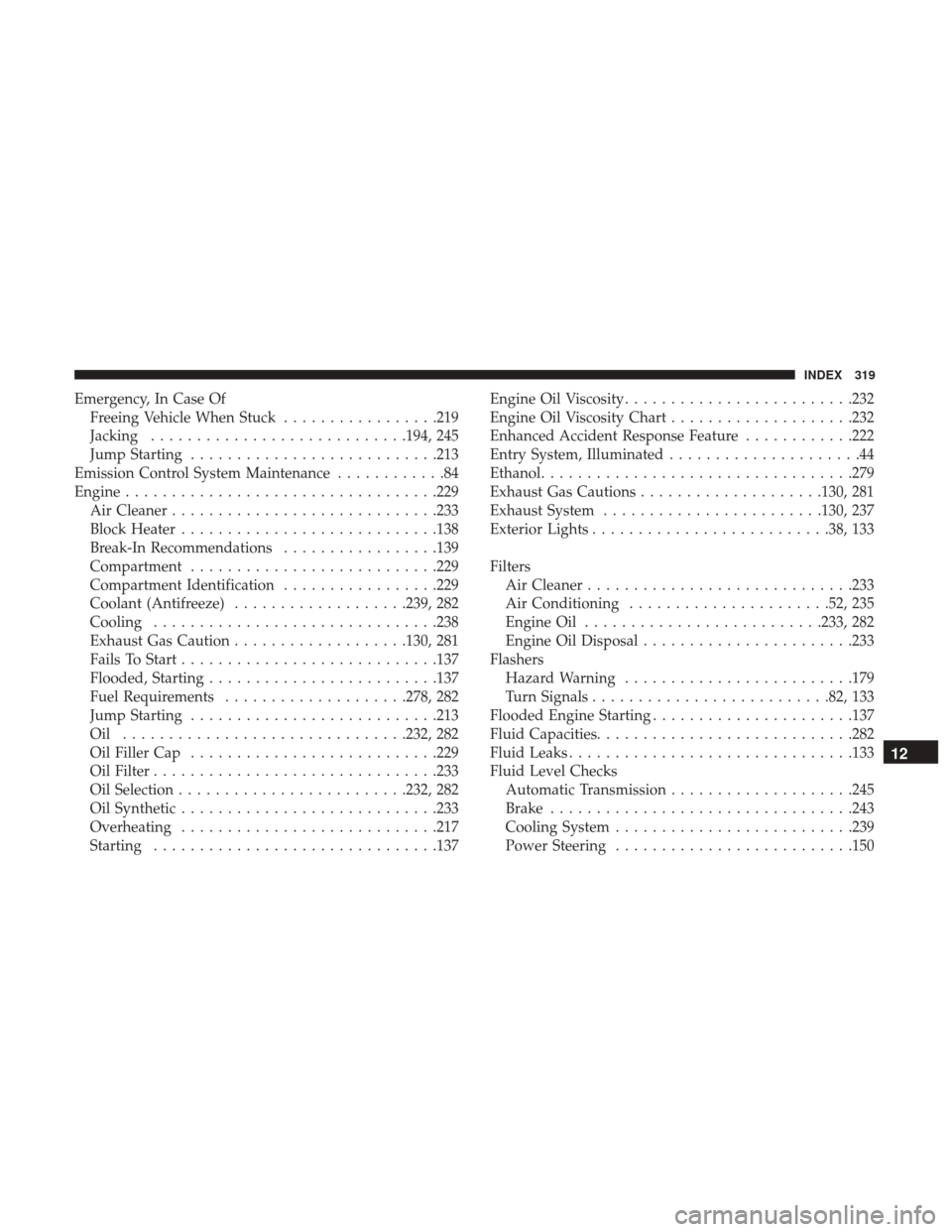
Emergency, In Case OfFreeing Vehicle When Stuck .................219
Jacking ........................... .194, 245
Jump Starting .......................... .213
Emission Control System Maintenance ............84
Engine ................................. .229
Air Cleaner ............................ .233
Block Heater ........................... .138
Break-In Recommendations .................139
Compartment .......................... .229
Compartment Identification .................229
Coolant (Antifreeze) ...................239, 282
Cooling .............................. .238
Exhaust Gas Caution ...................130, 281
Fails To Start ........................... .137
Flooded, Starting ........................ .137
Fuel Requirements ....................278, 282
Jump Starting .......................... .213
Oil .............................. .232, 282
Oil Filler Cap .......................... .229
Oil Filter .............................. .233
Oil Selection ........................ .232, 282
Oil Synthetic ........................... .233
Overheating ........................... .217
Starting .............................. .137Engine Oil Viscosity
........................ .232
Engine Oil Viscosity Chart ....................232
Enhanced Accident Response Feature ............222
Entry System, Illuminated .....................44
Ethanol ................................. .279
Exhaust Gas Cautions ....................130, 281
Exhaust System ....................... .130, 237
Exterior Lights ......................... .38, 133
Filters Air Cleaner ............................ .233
Air Conditioning ..................... .52, 235
Engine Oil ......................... .233,
282
Engine Oil Disposal ...................... .233
Flashers Hazard Warning ........................ .179
Turn Signals ......................... .82, 133
Flooded Engine Starting ..................... .137
Fluid Capacities ........................... .282
Fluid Leaks .............................. .133
Fluid Level Checks Automatic Transmission ....................245
Brake ................................ .243
Cooling System ......................... .239
Power Steering ......................... .150
12
INDEX 319