Parking Ram ProMaster 2019 Owner's Guide
[x] Cancel search | Manufacturer: RAM, Model Year: 2019, Model line: ProMaster, Model: Ram ProMaster 2019Pages: 332, PDF Size: 3.66 MB
Page 211 of 332
WARNING!(Continued)
in injuries that are serious or fatal to you, your
passengers, and others around you.
• Take care not to allow the contents of Tire Service Kit
to come in contact with hair, eyes, or clothing. Tire
Service Kit sealant is harmful if inhaled, swallowed,
or absorbed through the skin. It causes skin, eye, and
respiratory irritation. Flush immediately with plenty
of water if there is any contact with eyes or skin.
Change clothing as soon as possible, if there is any
contact with clothing.
• Tire Service Kit Sealant solution contains latex. In
case of an allergic reaction or rash, consult a physi-
cian immediately. Keep Tire Service Kit out of reach
of children. If swallowed, rinse mouth immediately
with plenty of water and drink plenty of water. Do
not induce vomiting! Consult a physician immedi-
ately.
Sealing A Tire With Tire Service Kit
(A) Whenever You Stop To Use Tire Service Kit:
1. Pull over to a safe location and turn on the vehicle’s Hazard Warning flashers. 2. Verify that the valve stem (on the wheel with the
deflated tire) is in a position that is near to the ground.
This will allow the Tire Service Kit Hoses (3) and (5) to
reach the valve stem and keep the Tire Service Kit flat on
the ground. This will provide the best positioning of the
kit when injecting the sealant into the deflated tire and
running the air pump. Move the vehicle as necessary to
place the valve stem in this position before proceeding.
3. Place the transmission in PARK (auto transmission) or in Gear (manual transmission) and place the ignition in the
OFF position.
4. Apply the parking brake.
(B) Setting Up To Use Tire Service Kit:
1. Push in the Mode Select Knob (2) and turn to the Sealant Mode position.
2. Uncoil the Sealant Hose (3) and then remove the cap from the fitting at the end of the hose.
3. Place the Tire Service Kit flat on the ground next to the deflated tire.
4. Remove the cap from the valve stem and then screw the fitting at the end of the Sealant Hose (3) onto the valve
stem.
7
IN CASE OF EMERGENCY 209
Page 217 of 332

WARNING!(Continued)
•Remove any metal jewelry such as rings, watch
bands and bracelets that could make an inadvertent
electrical contact. You could be seriously injured.
• Batteries contain sulfuric acid that can burn your
skin or eyes and generate hydrogen gas which is
flammable and explosive. Keep open flames or
sparks away from the battery.
1. Apply the parking brake, shift the automatic transmis- sion into PARK and turn the ignition to the OFF
position.
2. Turn off the heater, radio, and all unnecessary electrical accessories.
3. If using another vehicle to jump start the battery, park the vehicle within the jumper cables reach, apply the
parking brake and make sure the ignition is OFF.
WARNING!
Do not allow vehicles to touch each other as this could
establish a ground connection and personal injury
could result.
Jump Starting Procedure
WARNING!
Failure to follow this jump starting procedure could
result in personal injury or property damage due to
battery explosion.
CAUTION!
Failure to follow these procedures could result in
damage to the charging system of the booster vehicle
or the discharged vehicle.
Connecting The Jumper Cables
1. Connect the positive (+)end of the jumper cable to the
remote positive (+)post of the discharged vehicle.
NOTE: The remote positive (+)post is located in the
engine compartment on the driver’s side under the cover of
the Front Power Distribution Center.
2. Connect the opposite end of the positive (+)jumper
cable to the positive (+)post of the booster battery.
3. Connect the negative end (-)of the jumper cable to the
negative (-)post of the booster battery.
7
IN CASE OF EMERGENCY 215
Page 220 of 332
NOTE:There are steps that you can take to slow down an
impending overheat condition:
• If your air conditioner (A/C) is on, turn it off. The A/C
system adds heat to the engine cooling system and
turning the A/C off can help remove this heat.
• You can also turn the temperature control to maximum
heat, the mode control to floor and the blower control to
high. This allows the heater core to act as a supplement
to the radiator and aids in removing heat from the
engine cooling system.
WARNING!
You or others can be badly burned by hot engine
coolant (antifreeze) or steam from your radiator. If you
see or hear steam coming from under the hood, do not
open the hood until the radiator has had time to cool.
Never try to open a cooling system pressure cap when
the radiator or coolant bottle is hot.
CAUTION!
Driving with a hot cooling system could damage your
vehicle. If the temperature gauge reads HOT (H), pull
over and stop the vehicle. Idle the vehicle with the air
conditioner turned off until the pointer drops back
into the normal range. If the pointer remains on HOT
(H), and you hear continuous chimes, turn the engine
off immediately and call for service.
GEAR SELECTOR OVERRIDE
If a malfunction occurs and the gear selector cannot be
moved out of the PARK position, you can use the following
procedure to temporarily move the gear selector:
1. Turn the engine OFF.
2. Firmly apply the parking brake.
3. Using a small screwdriver or similar tool, remove the gear selector override access cover which is located
below the gear selector.
218 IN CASE OF EMERGENCY
Page 267 of 332
Wheel And Wheel Trim Care
All wheels and wheel trim, especially aluminum and chrome
plated wheels, should be cleaned regularly using mild (neutral
Ph) soap and water to maintain their luster and to prevent
corrosion. Wash wheels with the same soap solution recom-
mended for the body of the vehicle and remember to always
wash when the surfaces are not hot to the touch.
Your wheels are susceptible to deterioration caused by salt,
sodium chloride, magnesium chloride, calcium chloride,
etc., and other road chemicals used to melt ice or control
dust on dirt roads. Use a soft cloth or sponge and mild soap
to wipe away promptly. Do not use harsh chemicals or a
stiff brush. They can damage the wheel’s protective coating
that helps keep them from corroding and tarnishing.
CAUTION!
Avoid products or automatic car washes that use acidic
solutions or strong alkaline additives or harsh brushes.
Many aftermarket wheel cleaners and automatic car
washes may damage the wheel’s protective finish.
Such damage is not covered by the New Vehicle
Limited Warranty. Only car wash soap, Mopar Wheel
Cleaner or equivalent is recommended.When cleaning extremely dirty wheels including excessive
brake dust, care must be taken in the selection of tire and
wheel cleaning chemicals and equipment to prevent dam-
age to the wheels. Mopar Wheel Treatment or Mopar
Chrome Cleaner or their equivalent is recommended or
select a non-abrasive, non-acidic cleaner for aluminum or
chrome wheels.
CAUTION!
Do not use scouring pads, steel wool, a bristle brush,
metal polishes or oven cleaner. These products may
damage the wheel’s protective finish. Such damage is
not covered by the New Vehicle Limited Warranty.
Only car wash soap, Mopar Wheel Cleaner or equiva-
lent is recommended.
NOTE: If you intend parking or storing your vehicle for an
extended period after cleaning the wheels with wheel
cleaner, drive your vehicle and apply the brakes to remove
the water droplets from the brake components. This activ-
ity will remove the red rust on the brake rotors and prevent
vehicle vibration when braking.
8
SERVICING AND MAINTENANCE 265
Page 271 of 332
WARNING!
The temperature grade for this tire is established for
a tire that is properly inflated and not overloaded.
Excessive speed, under-inflation, or excessive load-
ing, either separately or in combination, can cause
heat buildup and possible tire failure.
STORING THE VEHICLE
If you are storing your vehicle for more than 21 days, we
recommend that you take the following steps to minimize
the drain on your vehicle’s battery:
• Disconnect the negative cable from battery.
• Any time you store your vehicle or keep it out of service
(i.e., vacation) for two weeks or more, run the air
conditioning system at idle for about five minutes in the
fresh air and high blower setting. This will ensure
adequate system lubrication to minimize the possibility
of compressor damage when the system is started again.
BODYWORK
Protection From Atmospheric Agents
Vehicle body care requirements vary according to geo-
graphic locations and usage. Chemicals that make roads
passable in snow and ice and those that are sprayed on
trees and road surfaces during other seasons are highly
corrosive to the metal in your vehicle. Outside parking,
which exposes your vehicle to airborne contaminants, road
surfaces on which the vehicle is operated, extreme hot or
cold weather and other extreme conditions will have an
adverse effect on paint, metal trim, and underbody protec-
tion.
The following maintenance recommendations will enable
you to obtain maximum benefit from the corrosion resis-
tance built into your vehicle.
What Causes Corrosion?
Corrosion is the result of deterioration or removal of paint
and protective coatings from your vehicle.
8
SERVICING AND MAINTENANCE 269
Page 319 of 332
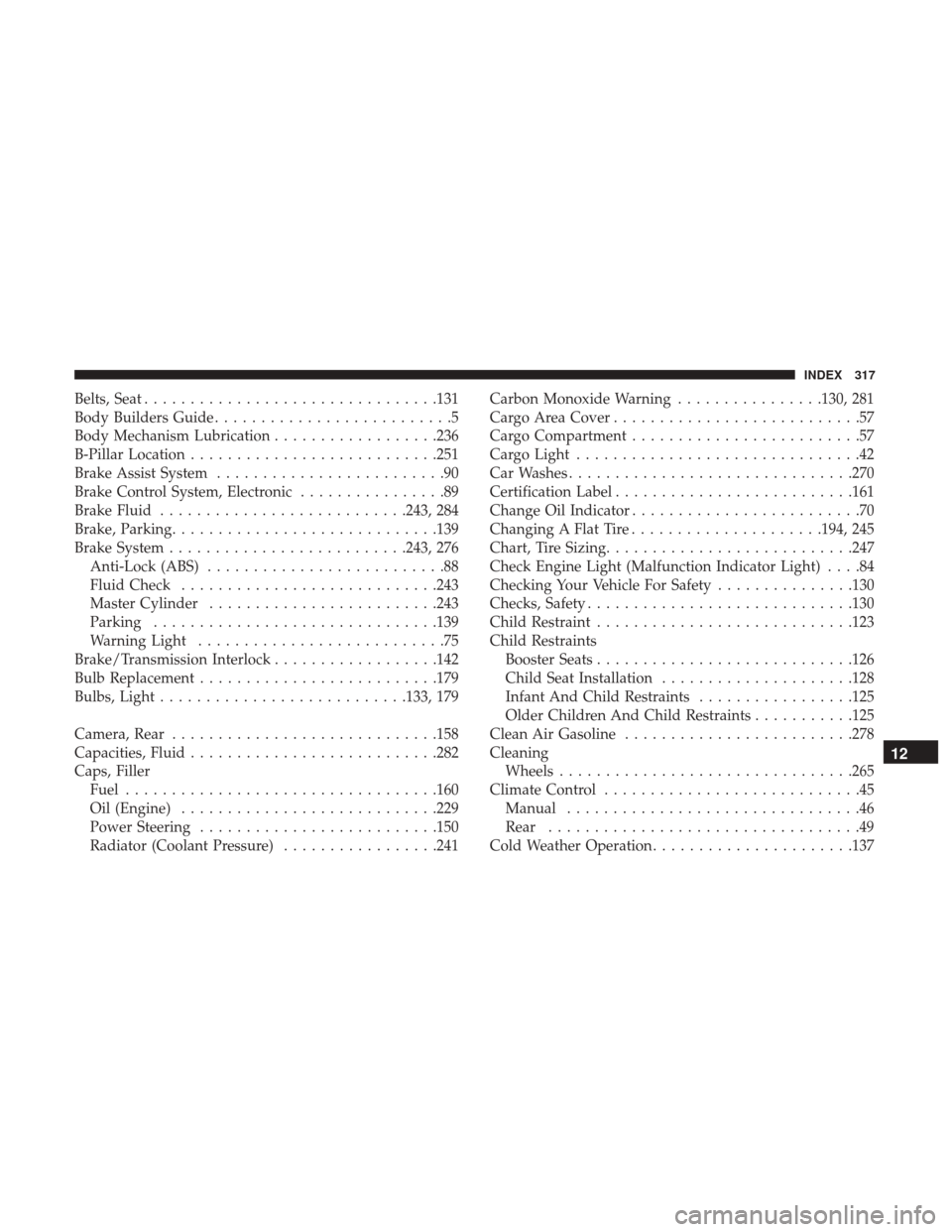
Belts, Seat............................... .131
Body Builders Guide ..........................5
Body Mechanism Lubrication ..................236
B-Pillar Location .......................... .251
Brake Assist System .........................90
Brake Control System, Electronic ................89
Brake Fluid .......................... .243, 284
Brake, Parking ............................ .139
Brake System ......................... .243, 276
Anti-Lock (ABS) ..........................88
Fluid Check ........................... .243
Master Cylinder ........................ .243
Parking .............................. .139
Warning Light ...........................75
Brake/Transmission Interlock ..................142
Bulb Replacement ......................... .179
Bulbs, Light .......................... .133, 179
Camera, Rear ............................ .158
Capacities, Fluid .......................... .282
Caps, Filler Fuel ................................. .160
Oil (Engine) ........................... .229
Power Steering ......................... .150
Radiator (Coolant Pressure) .................241 Carbon Monoxide Warning
................130, 281
Cargo Area Cover ...........................57
Cargo Compartment .........................57
Cargo Light ...............................42
Car Washes .............................. .270
Certification Label ......................... .161
Change Oil Indicator .........................70
Changing A Flat Tire .....................194, 245
Chart, Tire Sizing .......................... .247
Check Engine Light (Malfunction Indicator Light) ....84
Checking Your Vehicle For Safety ...............130
Checks, Safety ............................ .130
Child Restraint ........................... .123
Child Restraints Booster Seats ........................... .126
Child
Seat Installation .....................128
Infant And Child Restraints .................125
Older Children And Child Restraints ...........125
Clean Air Gasoline ........................ .278
Cleaning Wheels ............................... .265
Climate Control ............................45
Manual ................................46
Rear ..................................49
Cold Weather Operation ..................... .137
12
INDEX 317
Page 325 of 332
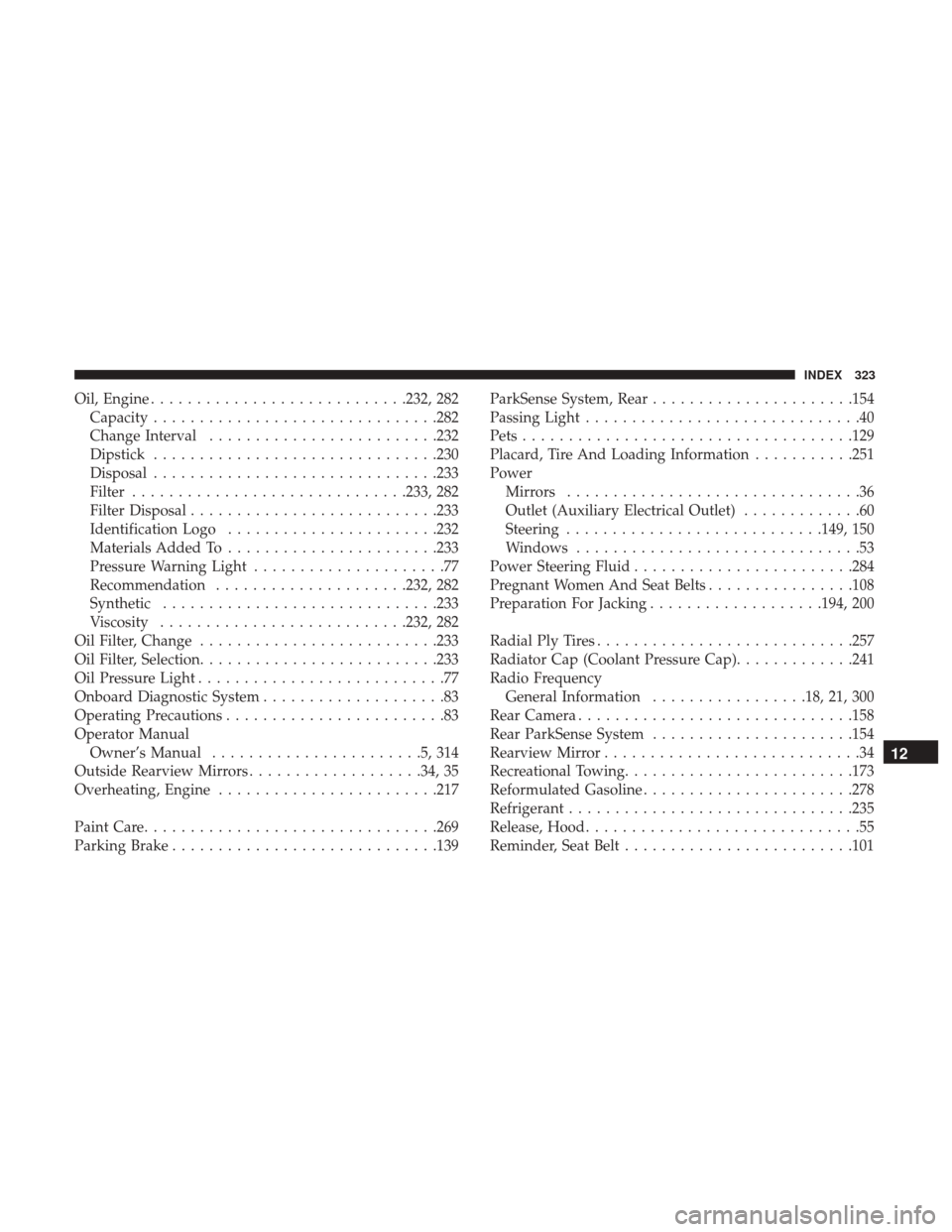
Oil, Engine........................... .232, 282
Capacity .............................. .282
Change Interval ........................ .232
Dipstick .............................. .230
Disposal .............................. .233
Filter ............................. .233, 282
Filter Disposal .......................... .233
Identification Logo ...................... .232
Materials Added To ...................... .233
Pressure Warning Light .....................77
Recommendation .....................232, 282
Synthetic ............................. .233
Viscosity .......................... .232, 282
Oil Filter, Change ......................... .233
Oil Filter, Selection ......................... .233
Oil Pressure Light ...........................77
Onboard Diagnostic System ....................83
Operating Precautions ........................83
Operator Manual Owner’s Manual .......................5,314
Outside Rearview Mirrors ...................34, 35
Overheating, Engine ....................... .217
Paint Care ............................... .269
Parking Brake ............................ .139ParkSense System, Rear
..................... .154
Passing Light ..............................40
Pets ................................... .129
Placard, Tire And Loading Information ...........251
Power Mirrors ................................36
Outlet (Auxiliary Electrical Outlet) .............60
Steering ........................... .149, 150
Windows ...............................53
Power Steering Fluid ....................... .284
Pregnant Women And Seat Belts ................108
Preparation For Jacking ...................194, 200
Radial Ply Tires ........................... .257
Radiator Cap (Coolant Pressure Cap) .............241
Radio Frequency General
Information .................18, 21, 300
Rear Camera ............................. .158
Rear ParkSense System ..................... .154
Rearview Mirror ............................34
Recreational Towing ........................ .173
Reformulated Gasoline ...................... .278
Refrigerant .............................. .235
Release, Hood ..............................55
Reminder, Seat Belt ........................ .101
12
INDEX 323