height Ram ProMaster 2019 Owner's Manual
[x] Cancel search | Manufacturer: RAM, Model Year: 2019, Model line: ProMaster, Model: Ram ProMaster 2019Pages: 332, PDF Size: 3.66 MB
Page 26 of 332
WARNING!
•It is dangerous to ride in a cargo area, inside or
outside of a vehicle. In a collision, people riding in
these areas are more likely to be seriously injured or
killed.
• Do not allow people to ride in any area of your
vehicle that is not equipped with seats and seat belts.
In a collision, people riding in these areas are more
likely to be seriously injured or killed.
• Be sure everyone in your vehicle is in a seat and
using a seat belt properly.
Manual Adjustments
The driver and passenger seats can be adjusted forward/
rearward and reclined. Also, if equipped, front and rear
height and lumbar adjustment.
WARNING!
• Adjusting a seat while driving may be dangerous.
Moving a seat while driving could result in loss of
control which could cause a collision and serious
injury or death.
(Continued)
WARNING! (Continued)
•Seats should be adjusted before fastening the seat
belts and while the vehicle is parked. Serious injury
or death could result from a poorly adjusted seat belt.
Forward And Rearward Adjustment
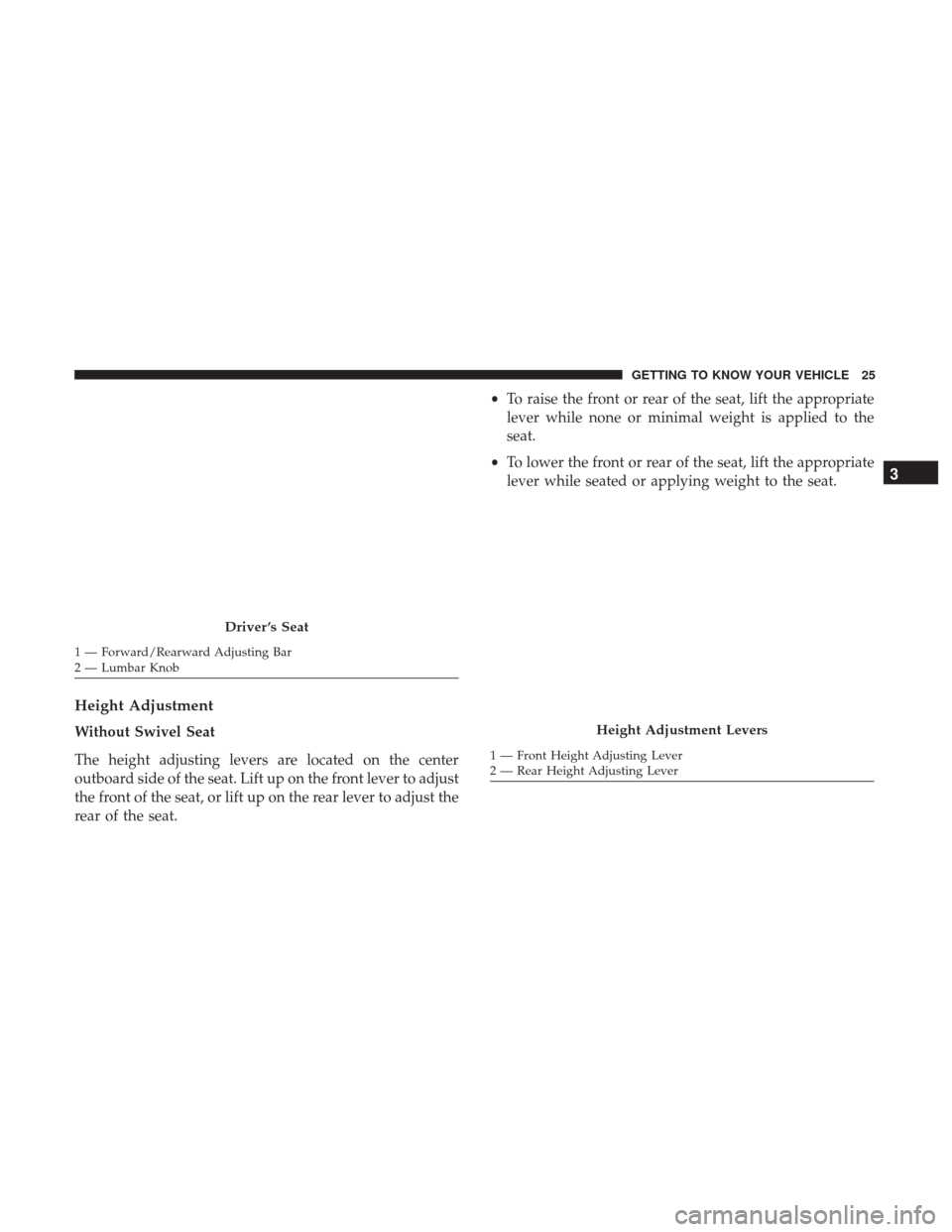
The adjusting bar is at the front of the seat, near the floor.
Pull the bar upward to move the seat forward or rearward.
Release the bar once the seat is in the desired position.
Then, using body pressure, move forward and rearward on
the seat to be sure that the seat adjusters have latched.
24 GETTING TO KNOW YOUR VEHICLE
Page 27 of 332
Height Adjustment
Without Swivel Seat
The height adjusting levers are located on the center
outboard side of the seat. Lift up on the front lever to adjust
the front of the seat, or lift up on the rear lever to adjust the
rear of the seat.•
To raise the front or rear of the seat, lift the appropriate
lever while none or minimal weight is applied to the
seat.
• To lower the front or rear of the seat, lift the appropriate
lever while seated or applying weight to the seat.
Driver ’s Seat
1 — Forward/Rearward Adjusting Bar
2 — Lumbar Knob
Height Adjustment Levers
1 — Front Height Adjusting Lever
2 — Rear Height Adjusting Lever
3
GETTING TO KNOW YOUR VEHICLE 25
Page 28 of 332
With Swivel Seat
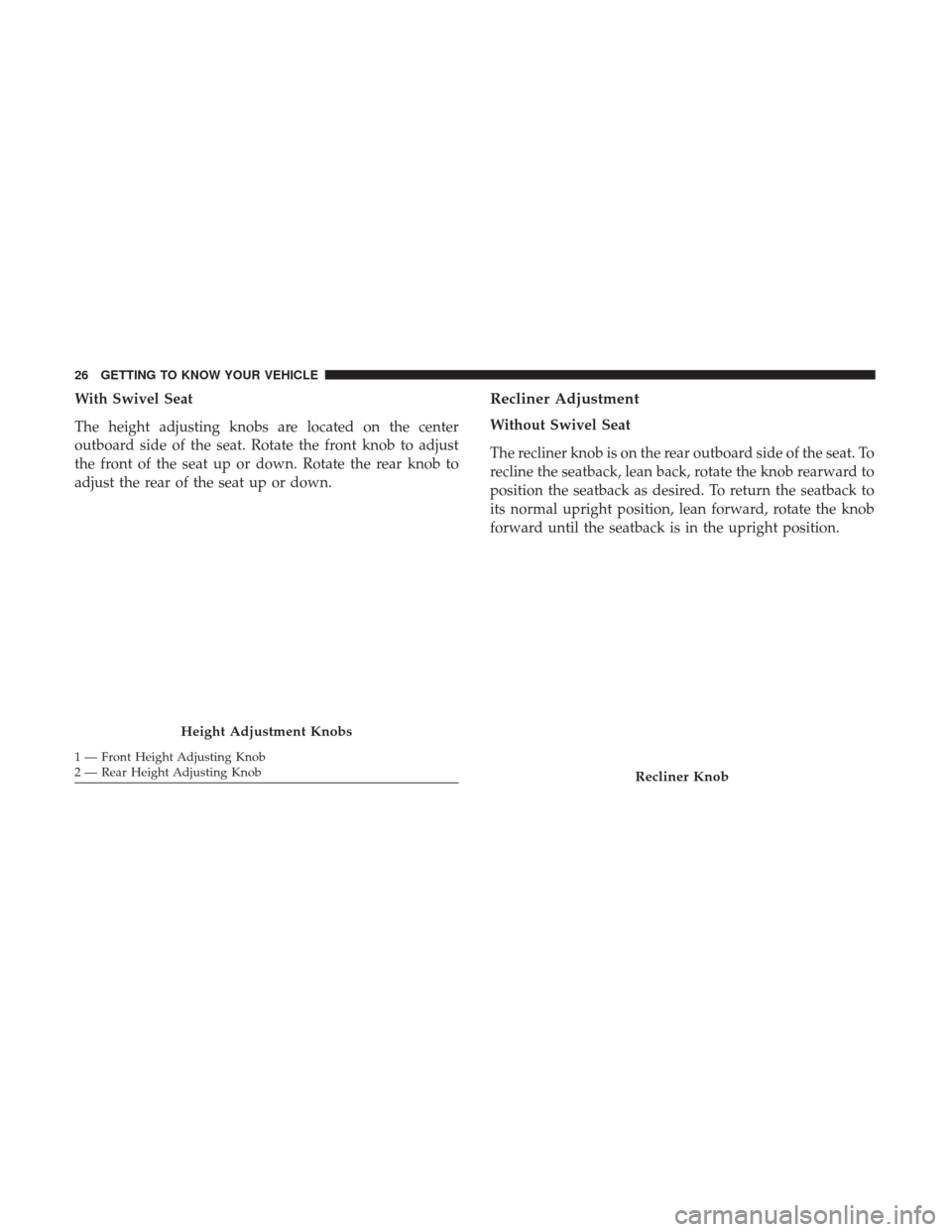
The height adjusting knobs are located on the center
outboard side of the seat. Rotate the front knob to adjust
the front of the seat up or down. Rotate the rear knob to
adjust the rear of the seat up or down.Recliner Adjustment
Without Swivel Seat
The recliner knob is on the rear outboard side of the seat. To
recline the seatback, lean back, rotate the knob rearward to
position the seatback as desired. To return the seatback to
its normal upright position, lean forward, rotate the knob
forward until the seatback is in the upright position.
Height Adjustment Knobs
1 — Front Height Adjusting Knob
2 — Rear Height Adjusting Knob
Recliner Knob
26 GETTING TO KNOW YOUR VEHICLE
Page 33 of 332
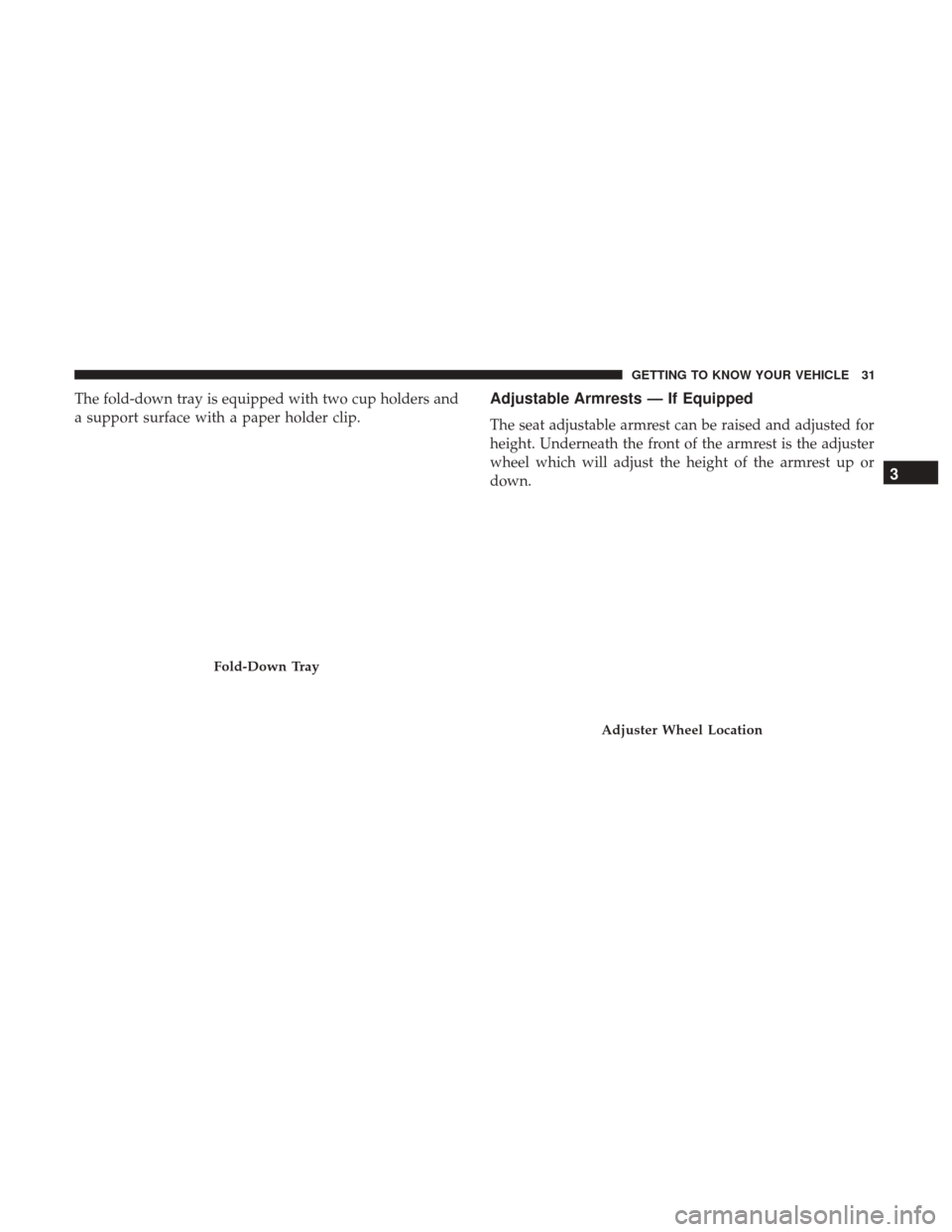
The fold-down tray is equipped with two cup holders and
a support surface with a paper holder clip.Adjustable Armrests — If Equipped
The seat adjustable armrest can be raised and adjusted for
height. Underneath the front of the armrest is the adjuster
wheel which will adjust the height of the armrest up or
down.
Fold-Down Tray
Adjuster Wheel Location
3
GETTING TO KNOW YOUR VEHICLE 31
Page 34 of 332
Turn the adjuster wheel to the right or left to adjust the
height of the armrest up or down.
HEAD RESTRAINTS
Head restraints are designed to reduce the risk of injury by
restricting head movement in the event of a rear impact.
Head restraints should be adjusted so that the top of the
head restraint is located above the top of your ear.
WARNING!
•All occupants, including the driver, should not oper-
ate a vehicle or sit in a vehicle’s seat until the head
restraints are placed in their proper positions in
order to minimize the risk of neck injury in the event
of a crash.
• Head restraints should never be adjusted while the
vehicle is in motion. Driving a vehicle with the head
restraints improperly adjusted or removed could
cause serious injury or death in the event of a
collision.
Front Head Restraint Adjustment
To raise the head restraint, pull upward on the head
restraint. To lower the head restraint, push the adjustment
button located on the base of the head restraint and push
downward on the head restraint.Adjuster Wheel
32 GETTING TO KNOW YOUR VEHICLE
Page 35 of 332
NOTE:Do not reposition the head restraint 180 degrees to
the incorrect position in an attempt to gain additional
clearance to the back of the head.
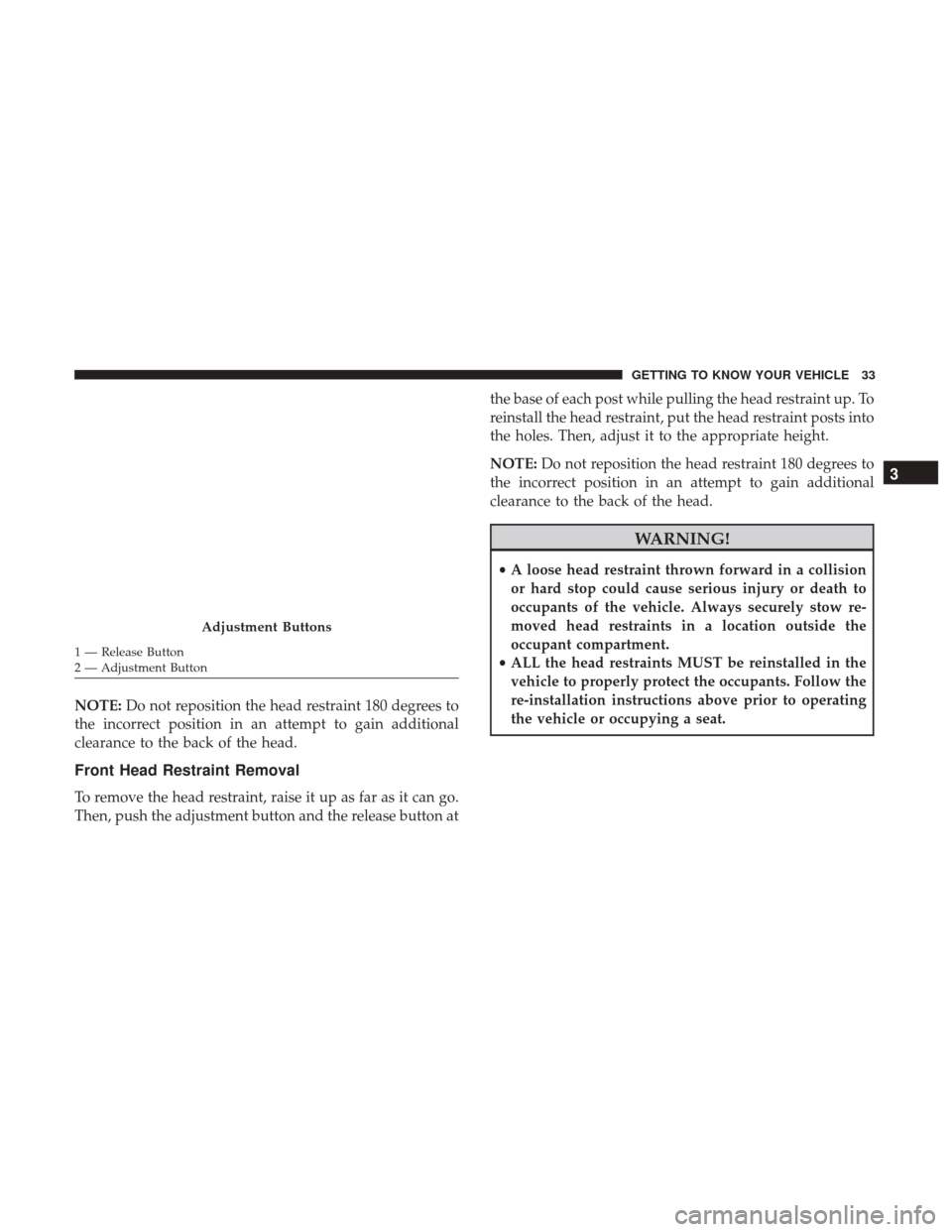
Front Head Restraint Removal
To remove the head restraint, raise it up as far as it can go.
Then, push the adjustment button and the release button at the base of each post while pulling the head restraint up. To
reinstall the head restraint, put the head restraint posts into
the holes. Then, adjust it to the appropriate height.
NOTE:
Do not reposition the head restraint 180 degrees to
the incorrect position in an attempt to gain additional
clearance to the back of the head.
WARNING!
• A loose head restraint thrown forward in a collision
or hard stop could cause serious injury or death to
occupants of the vehicle. Always securely stow re-
moved head restraints in a location outside the
occupant compartment.
• ALL the head restraints MUST be reinstalled in the
vehicle to properly protect the occupants. Follow the
re-installation instructions above prior to operating
the vehicle or occupying a seat.
Adjustment Buttons
1 — Release Button
2 — Adjustment Button
3
GETTING TO KNOW YOUR VEHICLE 33
Page 109 of 332
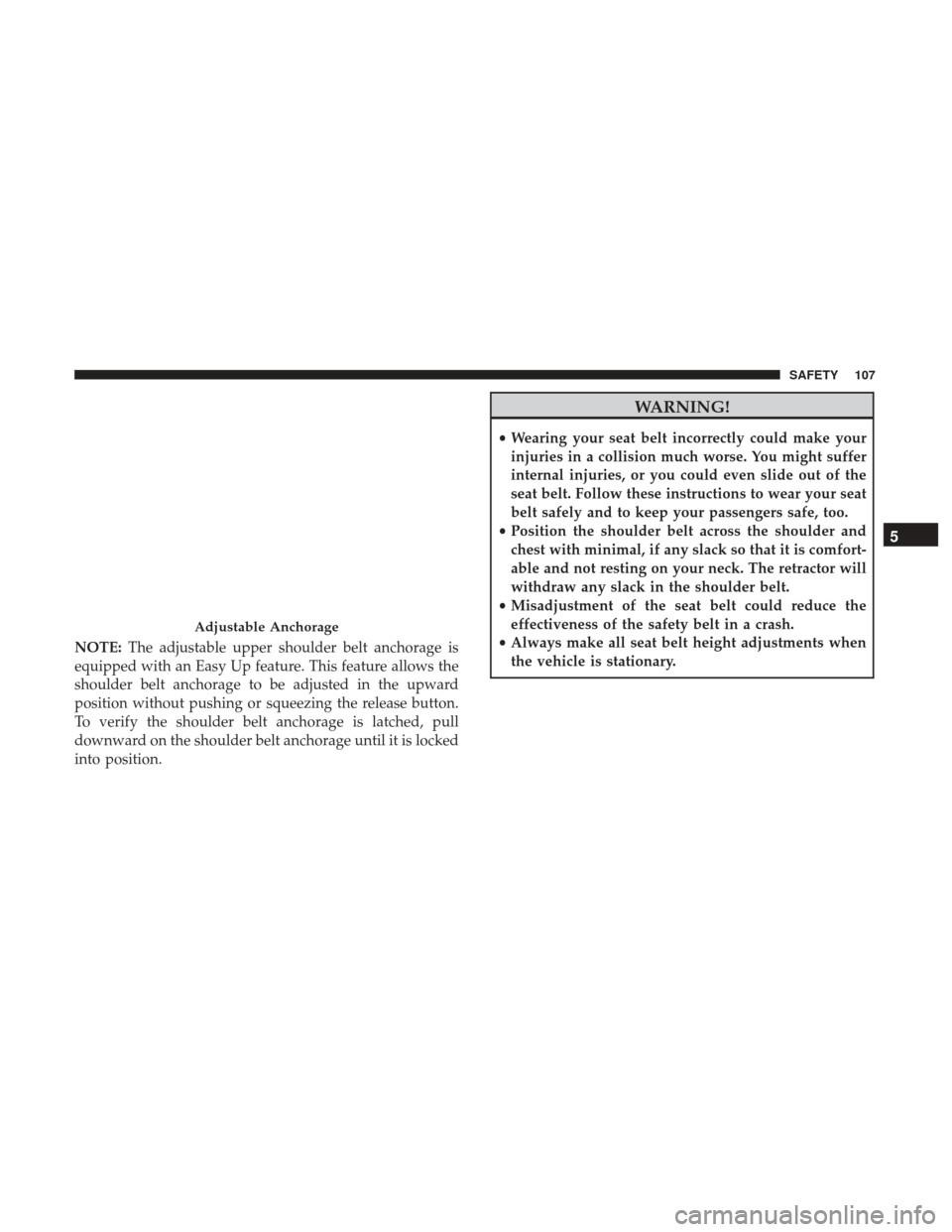
NOTE:The adjustable upper shoulder belt anchorage is
equipped with an Easy Up feature. This feature allows the
shoulder belt anchorage to be adjusted in the upward
position without pushing or squeezing the release button.
To verify the shoulder belt anchorage is latched, pull
downward on the shoulder belt anchorage until it is locked
into position.
WARNING!
• Wearing your seat belt incorrectly could make your
injuries in a collision much worse. You might suffer
internal injuries, or you could even slide out of the
seat belt. Follow these instructions to wear your seat
belt safely and to keep your passengers safe, too.
• Position the shoulder belt across the shoulder and
chest with minimal, if any slack so that it is comfort-
able and not resting on your neck. The retractor will
withdraw any slack in the shoulder belt.
• Misadjustment of the seat belt could reduce the
effectiveness of the safety belt in a crash.
• Always make all seat belt height adjustments when
the vehicle is stationary.
Adjustable Anchorage
5
SAFETY 107
Page 126 of 332
NOTE:
•For additional information, refer to http://
www.nhtsa.gov/parents-and-caregivers or call: 1–888–
327–4236 •
Canadian residents should refer to Transport Canada’s
website for additional information: http://
www.tc.gc.ca/eng/motorvehiclesafety/safedrivers-
childsafety-index-53.htm
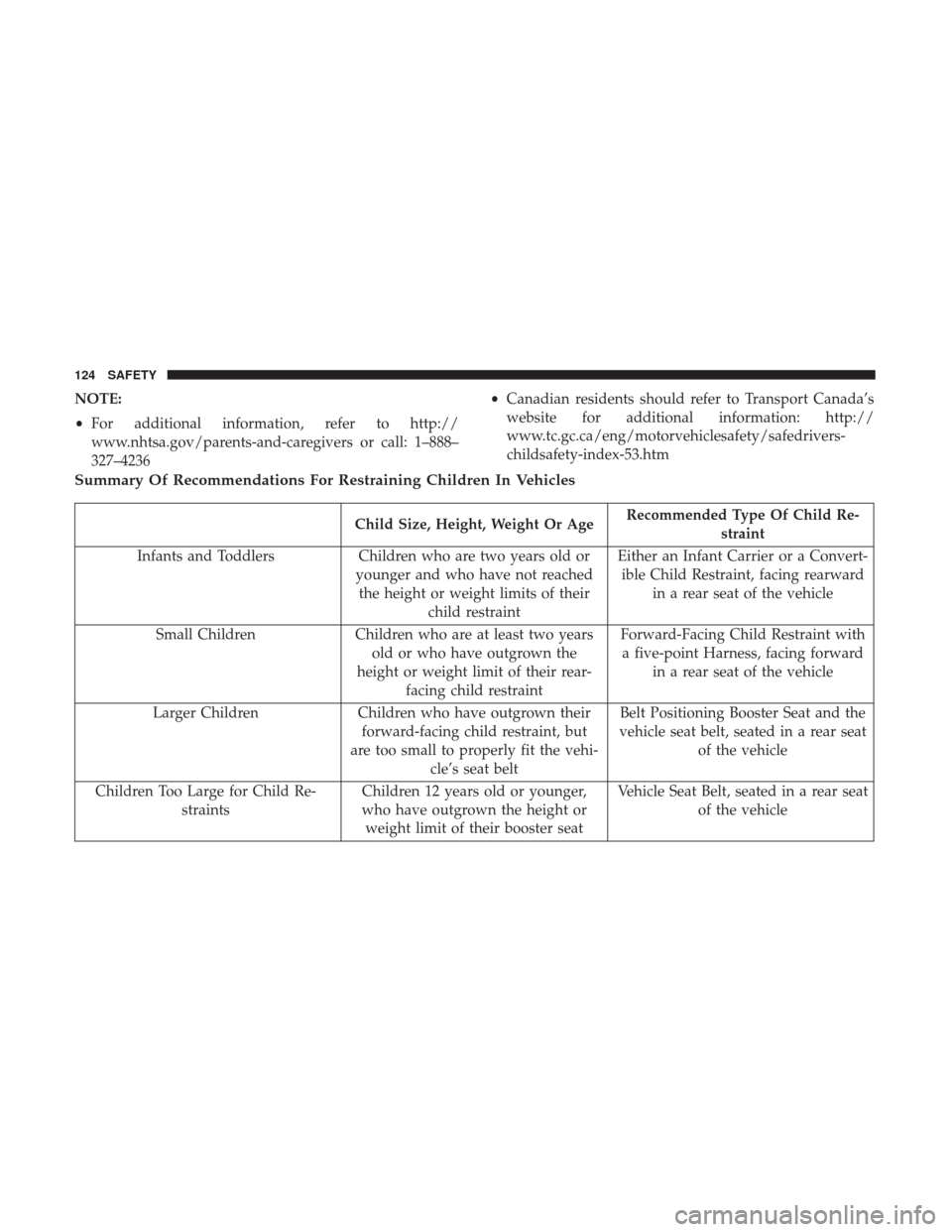
Summary Of Recommendations For Restraining Children In Vehicles
Child Size, Height, Weight Or Age Recommended Type Of Child Re-
straint
Infants and Toddlers Children who are two years old or
younger and who have not reached the height or weight limits of their child restraint Either an Infant Carrier or a Convert-
ible Child Restraint, facing rearward in a rear seat of the vehicle
Small Children Children who are at least two years
old or who have outgrown the
height or weight limit of their rear- facing child restraint Forward-Facing Child Restraint with
a five-point Harness, facing forward in a rear seat of the vehicle
Larger Children Children who have outgrown their
forward-facing child restraint, but
are too small to properly fit the vehi- cle’s seat belt Belt Positioning Booster Seat and the
vehicle seat belt, seated in a rear seat of the vehicle
Children Too Large for Child Re- straints Children 12 years old or younger,
who have outgrown the height or weight limit of their booster seat Vehicle Seat Belt, seated in a rear seat
of the vehicle
124 SAFETY
Page 127 of 332
Infant And Child Restraints
Safety experts recommend that children ride rear-facing in
the vehicle until they are two years old or until they reach
either the height or weight limit of their rear-facing child
restraint. Two types of child restraints can be used rear-
facing: infant carriers and convertible child seats.
The infant carrier is only used rear-facing in the vehicle. It
is recommended for children from birth until they reach
the weight or height limit of the infant carrier. Convertible
child seats can be used either rear-facing or forward-facing
in the vehicle. Convertible child seats often have a higher
weight limit in the rear-facing direction than infant carriers
do, so they can be used rear-facing by children who have
outgrown their infant carrier but are still less than at least
two years old. Children should remain rear-facing until
they reach the highest weight or height allowed by their
convertible child seat.
WARNING!
•Never place a rear-facing child restraint in front of an
air bag. A deploying passenger front air bag can
cause death or serious injury to a child 12 years or
(Continued)
WARNING! (Continued)
younger, including a child in a rear-facing child
restraint.
• Never install a rear-facing child restraint in the front
seat of a vehicle. Only use a rear-facing child re-
straint in the rear seat. If the vehicle does not have a
rear seat, do not transport a rear-facing child restraint
in that vehicle.
Older Children And Child Restraints
Children who are two years old or who have outgrown
their rear-facing convertible child seat can ride forward-
facing in the vehicle. Forward-facing child seats and con-
vertible child seats used in the forward-facing direction are
for children who are over two years old or who have
outgrown the rear-facing weight or height limit of their
rear-facing convertible child seat. Children should remain
in a forward-facing child seat with a harness for as long as
possible, up to the highest weight or height allowed by the
child seat.
All children whose weight or height is above the forward-
facing limit for the child seat should use a belt-positioning
booster seat until the vehicle’s seat belts fit properly. If the
child cannot sit with knees bent over the vehicle’s seat
5
SAFETY 125
Page 156 of 332
PARKSENSE REAR PARK ASSIST — IF EQUIPPED
The ParkSense Rear Park Assist system provides an au-
dible indication of the distance between the rear fascia/
bumper and a detected obstacle when backing up, e.g.
during a parking maneuver. Refer to “ParkSense System
Usage Precautions” for limitations of this system and
recommendations.
The ParkSense Rear Park Assist is automatically activated
when the transmission is placed into REVERSE. As the
distance from an obstacle behind the vehicle decreases, the
audible alert becomes more frequent.
Interaction With Trailer Towing
The Rear Park Assist system is automatically deactivated
when a trailer is hitched to the vehicle. The system will be
automatically activated as soon as the trailer is removed.
ParkSense Rear Park Assist Sensors
The four ParkSense Rear Park Assist sensors, located in the
rear fascia/bumper, monitor the area behind the vehicle
that is within the sensors’ field of view. The sensors can
detect obstacles, in the horizontal direction, from approxi-
mately 12 inches (30 cm) up to 55 inches (140 cm) from the
center of the rear fascia/bumper and up to 24 inches (60cm) from the corners of the rear fascia/bumper, depending
on the location, type and orientation of the obstacle.
If several obstacles are detected, the ParkSense Rear Park
Assist system indicates the nearest obstacle.
The minimum height of a detectable obstacle corresponds
to the maximum height of an obstacle that would clear the
underside of the vehicle during the parking maneuver.
ParkSense Rear Park Assist Alerts
If an obstacle is behind the vehicle when REVERSE gear is
engaged, an audible alert is activated.
Rear Park Assist Sensors Location
154 STARTING AND OPERATING