weight RAM PROMASTER 2021 User Guide
[x] Cancel search | Manufacturer: RAM, Model Year: 2021, Model line: PROMASTER, Model: RAM PROMASTER 2021Pages: 288, PDF Size: 15.22 MB
Page 157 of 288
SAFETY155
NOTE:
TSC cannot stop all trailers from swaying.
Always use caution when towing a trailer and
follow the trailer tongue weight recommenda -
tions Ú page 78.
When TSC is functioning, the ESC Activation/
Malfunction Indicator Light will flash, the engine
power may be reduced, and you may feel the
brakes being applied to individual wheels to
attempt to stop the trailer from swaying. TSC is
disabled when the ESC system is in the “Partial
Off” mode.AUXILIARY DRIVING SYSTEMS
BLIND SPOT MONITORING (BS M) — IF
E
QUIPPED
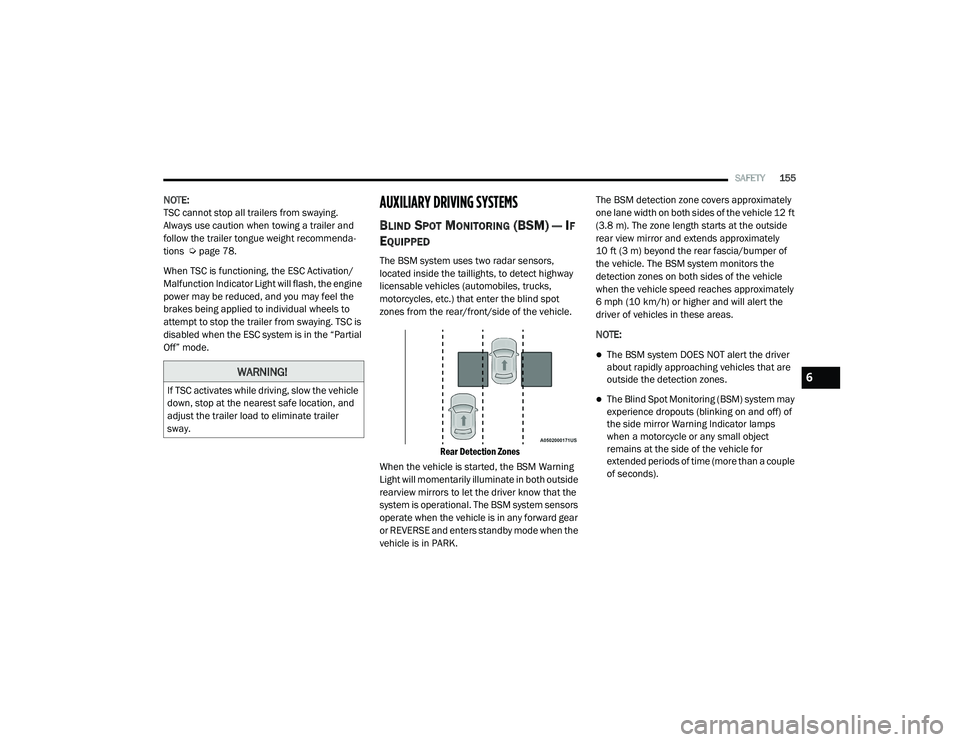
The BSM system uses two radar sensors,
located inside the taillights, to detect highway
licensable vehicles (automobiles, trucks,
motorcycles, etc.) that enter the blind spot
zones from the rear/front/side of the vehicle.
Rear Detection Zones
When the vehicle is started, the BSM Warning
Light will momentarily illuminate in both outside
rearview mirrors to let the driver know that the
system is operational. The BSM system sensors
operate when the vehicle is in any forward gear
or REVERSE and enters standby mode when the
vehicle is in PARK. The BSM detection zone covers approximately
one lane width on both sides of the vehicle 12 ft
(3.8 m). The zone length starts at the outside
rear view mirror and extends approximately
10 ft (3 m) beyond the rear fascia/bumper of
the vehicle. The BSM system monitors the
detection zones on both sides of the vehicle
when the vehicle speed reaches approximately
6 mph (10 km/h) or higher and will alert the
driver of vehicles in these areas.
NOTE:
The BSM system DOES NOT alert the driver
about rapidly approaching vehicles that are
outside the detection zones.
The Blind Spot Monitoring (BSM) system may
experience dropouts (blinking on and off) of
the side mirror Warning Indicator lamps
when a motorcycle or any small object
remains at the side of the vehicle for
extended periods of time (more than a couple
of seconds).
WARNING!
If TSC activates while driving, slow the vehicle
down, stop at the nearest safe location, and
adjust the trailer load to eliminate trailer
sway.
6
21_VF_OM_EN_USC_t.book Page 155
Page 184 of 288
182SAFETY
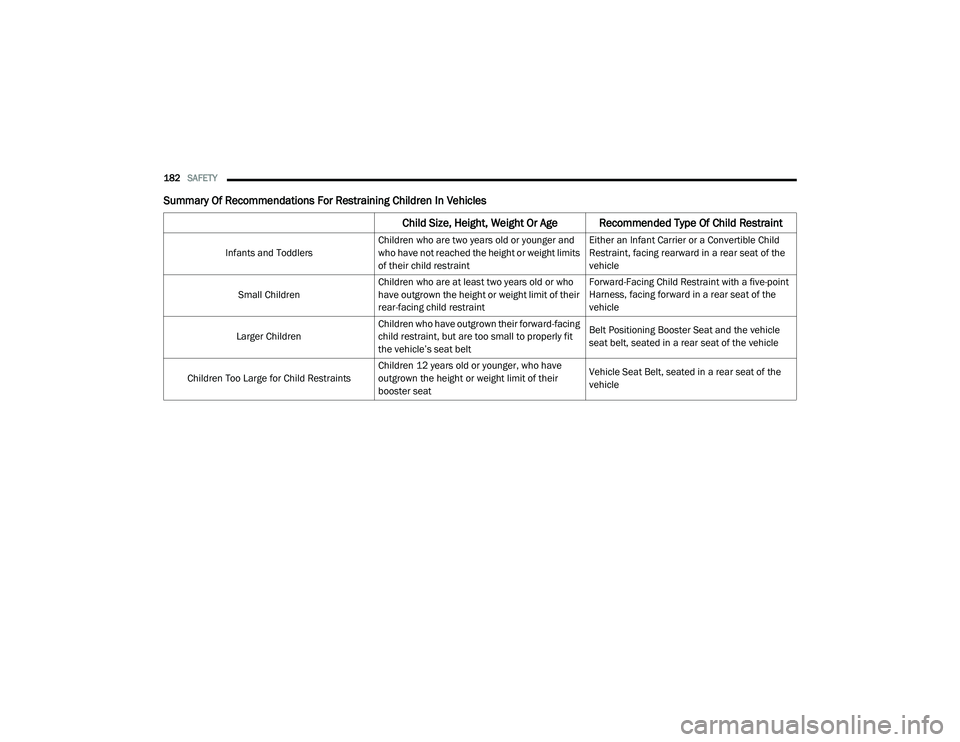
Summary Of Recommendations For Restraining Children In Vehicles
Child Size, Height, Weight Or Age Recommended Type Of Child Restraint
Infants and ToddlersChildren who are two years old or younger and
who have not reached the height or weight limits
of their child restraint Either an Infant Carrier or a Convertible Child
Restraint, facing rearward in a rear seat of the
vehicle
Small Children Children who are at least two years old or who
have outgrown the height or weight limit of their
rear-facing child restraint Forward-Facing Child Restraint with a five-point
Harness, facing forward in a rear seat of the
vehicle
Larger Children Children who have outgrown their forward-facing
child restraint, but are too small to properly fit
the vehicle’s seat belt Belt Positioning Booster Seat and the vehicle
seat belt, seated in a rear seat of the vehicle
Children Too Large for Child Restraints Children 12 years old or younger, who have
outgrown the height or weight limit of their
booster seat Vehicle Seat Belt, seated in a rear seat of the
vehicle
21_VF_OM_EN_USC_t.book Page 182
Page 185 of 288

SAFETY183
Infant And Child Restraints
Safety experts recommend that children ride
rear-facing in the vehicle until they are two years
old or until they reach either the height or
weight limit of their rear-facing child restraint.
Two types of child restraints can be used
rear-facing: infant carriers and convertible child
seats.
The infant carrier is only used rear-facing in the
vehicle. It is recommended for children from
birth until they reach the weight or height limit of
the infant carrier. Convertible child seats can be
used either rear-facing or forward-facing in the
vehicle. Convertible child seats often have a
higher weight limit in the rear-facing direction
than infant carriers do, so they can be used
rear-facing by children who have outgrown their
infant carrier but are still less than at least two
years old. Children should remain rear-facing
until they reach the highest weight or height
allowed by their convertible child seat.
Older Children And Child Restraints
Children who are two years old or who have
outgrown their rear-facing convertible child seat
can ride forward-facing in the vehicle.
Forward-facing child seats and convertible child
seats used in the forward-facing direction are
for children who are over two years old or who
have outgrown the rear-facing weight or height
limit of their rear-facing convertible child seat.
Children should remain in a forward-facing child
seat with a harness for as long as possible, up
to the highest weight or height allowed by the
child seat.
All children whose weight or height is above the
forward-facing limit for the child seat should use
a belt-positioning booster seat until the
vehicle’s seat belts fit properly. If the child
cannot sit with knees bent over the vehicle’s
seat cushion while the child’s back is against
the seatback, they should use a belt-positioning
booster seat. The child and belt-positioning
booster seat are held in the vehicle by the
seat belt.WARNING!
Never place a rear-facing child restraint in
front of an air bag. A deploying passenger front
air bag can cause death or serious injury to a
child 12 years or younger, including a child in
a rear-facing child restraint.
Never install a rear-facing child restraint in
the front seat of a vehicle. Only use a
rear-facing child restraint in the rear seat. If
the vehicle does not have a rear seat, do
not transport a rear-facing child restraint in
that vehicle.
6
21_VF_OM_EN_USC_t.book Page 183
Page 187 of 288

SAFETY185
(Continued)
the passenger seat should be moved to the full
rearward position and the child must be in a
proper restraint system based on its age, size
and weight. Follow the instructions below to
secure the child restraint using the seat belt.
Installing Child Restraints Using The
Vehicle Seat Belt
Child restraint systems are designed to be
secured in vehicle seats by lap belts or the lap
belt portion of a lap/shoulder belt. The seat belts in the passenger seating
positions are equipped with a Switchable
Automatic Locking Retractor (ALR). This seat
belt is designed to keep the lap portion of the
seat belt tight around the child restraint so that
it is not necessary to use a locking clip. The ALR
retractor can be “switched” into a locked mode
by pulling all of the webbing out of the retractor
and then letting the webbing retract back into
the retractor. If it is locked, the ALR will make a
clicking noise while the webbing is pulled back
into the retractor. See the “Automatic Locking
Mode” description in “Switchable Automatic
Locking Retractors (ALR)” Ú
page 171 for
additional information on ALR.
Front Bucket Seat Automatic Locking Retractor (ALR)
Location
Front Bench Seat Automatic Locking Retractor (ALR) Locations
WARNING!
Rear-facing infant restraints must never be
secured in the passenger seat of a vehicle
with a passenger air bag. In a collision, a
passenger air bag may deploy causing severe
injury or death to infants riding in rear-facing
infant restraints.
WARNING!
Improper installation or failure to properly
secure a child restraint can lead to failure
of the restraint. The child could be badly
injured or killed.
Follow the child restraint manufacturer’s
directions exactly when installing an infant
or child restraint.
WARNING! (Continued)
ALR — Switchable Automatic Locking Retractor
ALR — Switchable Automatic Locking Retractor
6
21_VF_OM_EN_USC_t.book Page 185
Page 247 of 288
SERVICING AND MAINTENANCE245
Tire Loading And Tire Pressure
NOTE:
The proper cold tire inflation pressure is listed
on the driver’s side B-Pillar or the rear edge of
the driver's side door.
Check the inflation pressure of each tire,
including the spare tire (if equipped), at least
monthly and inflate to the recommended
pressure for your vehicle.
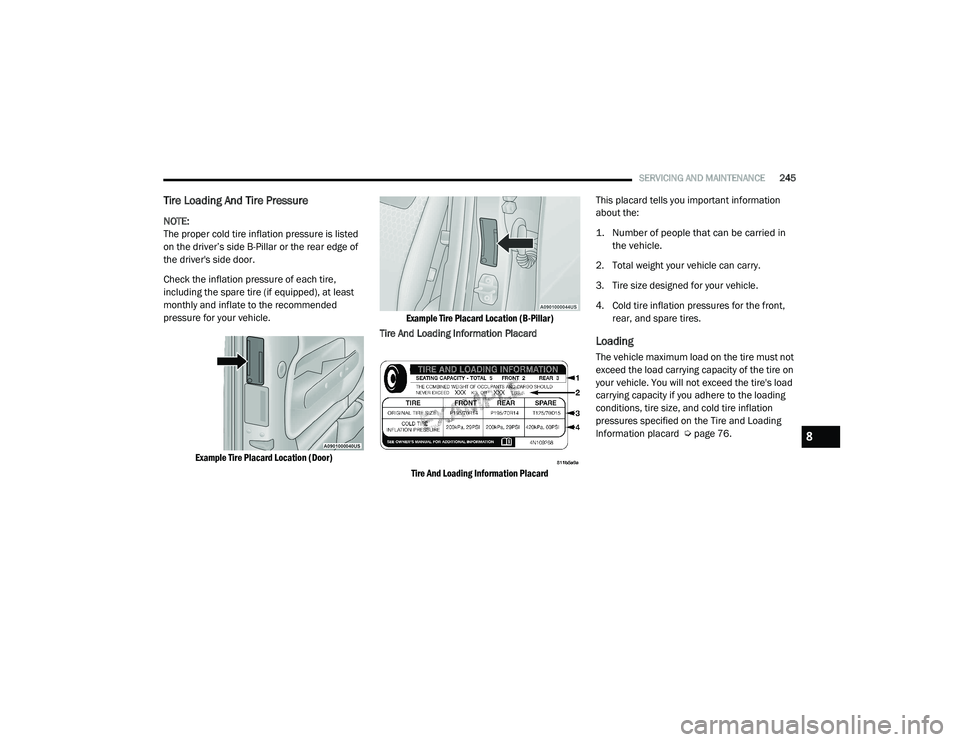
Example Tire Placard Location (Door) Example Tire Placard Location (B-Pillar)
Tire And Loading Information Placard
Tire And Loading Information Placard
This placard tells you important information
about the:
1. Number of people that can be carried in
the vehicle.
2. Total weight your vehicle can carry.
3. Tire size designed for your vehicle.
4. Cold tire inflation pressures for the front, rear, and spare tires.
Loading
The vehicle maximum load on the tire must not
exceed the load carrying capacity of the tire on
your vehicle. You will not exceed the tire's load
carrying capacity if you adhere to the loading
conditions, tire size, and cold tire inflation
pressures specified on the Tire and Loading
Information placard Ú page 76.
8
21_VF_OM_EN_USC_t.book Page 245
Page 248 of 288

246SERVICING AND MAINTENANCE
NOTE:
Under a maximum loaded vehicle condition,
gross axle weight ratings (GAWRs) for the front
and rear axles must not be exceeded.
For further information on GAWRs, vehicle
loading, and trailer towing Úpage 76.
To determine the maximum loading conditions
of your vehicle, locate the statement “The
combined weight of occupants and cargo
should never exceed XXX kg or XXX lbs” on the
Tire and Loading Information placard. The
combined weight of occupants, cargo/luggage
and trailer tongue weight (if applicable) should
never exceed the weight referenced here.
Steps For Determining Correct Load
Limit—
(1) Locate the statement “The combined
weight of occupants and cargo should
never exceed XXX kg or XXX lbs.” on your
vehicle's placard.
(2) Determine the combined weight of
the driver and passengers that will be
riding in your vehicle. (3) Subtract the combined weight of the
driver and passengers from XXX kg or
XXX lbs.
(4) The resulting figure equals the
available amount of cargo and luggage
load capacity. For example, if “XXX”
amount equals 1400 lbs. and there will
be five 150 lb passengers in your
vehicle, the amount of available cargo
and luggage load capacity is 650 lbs.
(1400-750 (5x150) = 650 lbs.)
(5) Determine the combined weight of
luggage and cargo being loaded on the
vehicle. That weight may not safely
exceed the available cargo and luggage
load capacity calculated in Step 4.
(6) If your vehicle will be towing a trailer,
load from your trailer will be transferred
to your vehicle. Consult this manual to
determine how this reduces the
available cargo and luggage load
capacity of your vehicle.
Metric Example For Load Limit
For example, if “XXX” amount equals 635 kg
and there will be five 68 kg passengers in your
vehicle, the amount of available cargo and
luggage load capacity is 295 kg (635-340
(5x68) = 295 kg) as shown in step 4.
NOTE:
If your vehicle will be towing a trailer, load
from your trailer will be transferred to your
vehicle. The following table shows examples
on how to calculate total load, cargo/
luggage, and towing capacities of your
vehicle with varying seating configurations
and number and size of occupants. This table
is for illustration purposes only and may not
be accurate for the seating and load carry
capacity of your vehicle.
For the following example, the combined
weight of occupants and cargo should never
exceed 865 lbs (392 kg).
21_VF_OM_EN_USC_t.book Page 246
Page 279 of 288

277
Emergency, In Case Of Freeing Vehicle When Stuck
...................... 208Jacking...................................................... 190Jump Starting............................................ 203Emission Control System Maintenance........... 56Engine........................................................... 215Air Cleaner................................................. 219Block Heater............................................... 58Break-In Recommendations........................ 58Checking Oil Level..................................... 216Compartment............................................ 215Compartment Identification...................... 215Coolant (Antifreeze)......................... 223, 268Cooling...................................................... 223Exhaust Gas Caution................................. 189Fails To Start............................................... 57Flooded, Starting......................................... 57Fuel Requirements.......................... 265, 268Jump Starting............................................ 203Oil.................................................... 218, 268Oil Filler Cap.............................................. 215Oil Filter..................................................... 219Oil Selection.................................... 218, 268Oil Synthetic.............................................. 218Overheating............................................... 206Starting....................................................... 57Enhanced Accident Response Feature..........210Entry System, Illuminated................................ 30
Ethanol......................................................... 266Exhaust Gas Cautions................................... 189Exhaust System................................... 189, 221Exterior Lights.........................................26, 188
F
FiltersAir Cleaner
................................................ 219Air Conditioning..................................35, 220Engine Oil........................................ 219, 268Engine Oil Disposal................................... 218FlashersHazard Warning........................................ 190Turn Signals.......................................54, 188Flat Tire Changing................................ 240, 253Flat Tire Stowage................................. 240, 253Flooded Engine Starting................................... 57Fluid Capacities............................................ 268Fluid Leaks................................................... 189Fluid Level ChecksAutomatic Transmission........................... 227Brake........................................................ 226Cooling System......................................... 223Engine Oil................................................. 216Power Steering............................................ 67Fog Lights........................................................ 27Fold-Flat Seats................................................. 15Forward Collision Warning............................ 159
Four-Way Hazard Flasher.............................. 190Freeing A Stuck Vehicle................................. 208Fuel............................................................... 265Additives................................................... 266Clean Air................................................... 266Ethanol..................................................... 266Filler Cap (Gas Cap).....................................75Gasoline................................................... 265Materials Added....................................... 266Methanol.................................................. 266Octane Rating.................................. 265, 268Requirements.................................. 265, 268Tank Capacity........................................... 268Fuses............................................................ 228
G
Gas Cap (Fuel Filler Cap)...........................75, 76Gasoline, Clean Air........................................ 266Gasoline, Reformulated................................ 266Gear Ranges....................................................62Gear Selector Override.................................. 207Glass Cleaning.............................................. 263Gross Axle Weight Rating.......................... 76, 78Gross Vehicle Weight Rating.....................76, 78GuideBody Builders................................................. 7GVWR...............................................................7611
21_VF_OM_EN_USC_t.book Page 277
Page 283 of 288

281
Storing Your Vehicle
...................................... 260Supplemental Restraint System – Air Bag..... 174Sway Control, Trailer...................................... 154Synthetic Engine Oil....................................... 218
T
Telescoping Steering Column.......................... 15Tire And Loading Information Placard........... 245Tire Markings................................................. 240Tire Safety Information.................................. 240Tire Service Kit.................. 197, 198, 200, 202Tires................................... 188, 248, 253, 259Aging (Life Of Tires)................................... 251Air Pressure............................................... 248Chains....................................................... 257Changing................................................... 190Compact Spare......................................... 253General Information........................ 248, 253High Speed................................................ 249Inflation Pressure...................................... 249Jacking...................................................... 190Life Of Tires............................................... 251Load Capacity............................................ 245Pressure Monitoring System (TPMS)............................... 51, 161Quality Grading.......................................... 259Radial........................................................ 250Replacement............................................. 251Rotation.................................................... 258
Safety.............................................. 240, 248Sizes......................................................... 241Snow Tires................................................ 253Spare Tires...................................... 253, 255Spinning................................................... 250Trailer Towing.............................................. 82Tread Wear Indicators.............................. 251Wheel Nut Torque..................................... 264To Open Hood.................................................. 40Tongue Weight/Trailer Weight......................... 81Torque Converter Clutch.................................. 66Towing....................................................78, 209Disabled Vehicle....................................... 209Guide........................................................... 81Recreational................................................ 85Weight......................................................... 81Towing Behind A Motorhome........................... 85Traction............................................................ 86Traction Control............................................ 154Trailer Sway Control (TSC)............................. 154Trailer Towing.................................................. 78Hitches........................................................ 80Minimum Requirements.............................. 81Tips.............................................................. 84Trailer And Tongue Weight........................... 81Wiring.......................................................... 83Trailer Towing Guide........................................ 81Trailer Weight................................................... 81
TransmissionAutomatic.......................................... 60, 226Fluid.......................................................... 270Maintenance............................................ 226Transporting Pets.......................................... 187Tread Wear Indicators................................... 251Turn Signals.....................................................54
U
UconnectPhone Call Features
................................. 118Things You Should Know About YourUconnect Phone................................... 121Uconnect Phone..........................113, 114, 116Answer Or Ignore An Incoming Call — Call Currently In Progress..................... 120Answer Or Ignore An Incoming Call —No Call Currently In Progress................ 119Bluetooth Communication Link................ 124Call Continuation...................................... 121Call Controls............................................. 119Call Termination....................................... 121Cancel Command..................................... 114Connecting To A Particular Mobile Phone Or Audio Device After Pairing................ 116Help Command......................................... 114Join Calls.................................................. 12111
21_VF_OM_EN_USC_t.book Page 281