flat tire RAM PROMASTER 2021 Owner's Manual
[x] Cancel search | Manufacturer: RAM, Model Year: 2021, Model line: PROMASTER, Model: RAM PROMASTER 2021Pages: 288, PDF Size: 15.22 MB
Page 250 of 288

248SERVICING AND MAINTENANCE
TIRES — GENERAL INFORMATION
Tire Pressure
Proper tire inflation pressure is essential to the
safe and satisfactory operation of your vehicle.
Four primary areas are affected by improper tire
pressure:
Safety
Fuel Economy
Tread Wear
Ride Comfort And Vehicle Stability Safety
Both underinflation and overinflation affect the
stability of the vehicle and can produce a feeling
of sluggish response or over responsiveness in
the steering.
NOTE:
Unequal tire pressures from side to side may
cause erratic and unpredictable steering
response.
Unequal tire pressure from side to side may
cause the vehicle to drift left or right.
Fuel Economy
Underinflated tires will increase tire rolling
resistance resulting in higher fuel consumption.
Tread Wear
Improper cold tire inflation pressures can cause
abnormal wear patterns and reduced tread life,
resulting in the need for earlier tire
replacement.
Ride Comfort And Vehicle Stability
Proper tire inflation contributes to a
comfortable ride. Overinflation produces a
jarring and uncomfortable ride.
WARNING!
Overloading of your tires is dangerous.
Overloading can cause tire failure, affect
vehicle handling, and increase your stopping
distance. Use tires of the recommended load
capacity for your vehicle. Never overload
them.WARNING!
Improperly inflated tires are dangerous and
can cause collisions.
Underinflation increases tire flexing and
can result in overheating and tire failure.
Overinflation reduces a tire's ability to
cushion shock. Objects on the road and
chuckholes can cause damage that result
in tire failure.
Overinflated or underinflated tires can
affect vehicle handling and can fail
suddenly, resulting in loss of vehicle
control.
Unequal tire pressures can cause steering
problems. You could lose control of your
vehicle.
Unequal tire pressures from one side of the
vehicle to the other can cause the vehicle
to drift to the right or left.
Always drive with each tire inflated to the
recommended cold tire inflation pressure.
21_VF_OM_EN_USC_t.book Page 248
Page 251 of 288
SERVICING AND MAINTENANCE249
Tire Inflation Pressures
The proper cold tire inflation pressure is listed
on the driver's side B-pillar or rear edge of the
driver's side door.
At least once a month:
Check and adjust tire pressure with a good
quality pocket-type pressure gauge. Do not
make a visual judgment when determining
proper inflation. Tires may look properly
inflated even when they are under-inflated.
Inspect tires for signs of tire wear or visible
damage.
Inflation pressures specified on the placard
are always “cold tire inflation pressure”. Cold
tire inflation pressure is defined as the tire
pressure after the vehicle has not been driven
for at least three hours, or driven less than
1 mile (1.6 km) after sitting for a minimum of three hours. The cold tire inflation pressure
must not exceed the maximum inflation
pressure molded into the tire sidewall.
Check tire pressures more often if subject to a
wide range of outdoor temperatures, as tire
pressures vary with temperature changes.
Tire pressures change by approximately
1 psi (7 kPa) per 12°F (7°C) of air temperature
change. Keep this in mind when checking tire
pressure inside a garage, especially in the
Winter.
Example: If garage temperature = 68°F (20°C)
and the outside temperature = 32°F (0°C) then
the cold tire inflation pressure should be
increased by 3 psi (21 kPa), which equals
1 psi (7 kPa) for every 12°F (7°C) for this
outside temperature condition.
Tire pressure may increase from 2 to 6 psi
(13 to 40 kPa) during operation. DO NOT reduce
this normal pressure build-up or your tire
pressure will be too low.
Tire Pressures For High Speed Operation
The manufacturer advocates driving at safe
speeds and within posted speed limits. Where
speed limits or conditions are such that the
vehicle can be driven at high speeds,
maintaining correct tire inflation pressure is
very important. Increased tire pressure and
reduced vehicle loading may be required for
high-speed vehicle operation. Refer to an
authorized tire dealer or original equipment
vehicle dealer for recommended safe operating
speeds, loading and cold tire inflation
pressures.
CAUTION!
After inspecting or adjusting the tire pressure,
always reinstall the valve stem cap. This will
prevent moisture and dirt from entering the
valve stem, which could damage the valve
stem.
WARNING!
High speed driving with your vehicle under
maximum load is dangerous. The added
strain on your tires could cause them to fail.
You could have a serious collision. Do not
drive a vehicle loaded to the maximum
capacity at continuous speeds above
75 mph (120 km/h).
8
21_VF_OM_EN_USC_t.book Page 249
Page 252 of 288

250SERVICING AND MAINTENANCE
Radial Ply Tires
Tire Repair
If your tire becomes damaged, it may be
repaired if it meets the following criteria:
The tire has not been driven on when flat.
The damage is only on the tread section of
your tire (sidewall damage is not repairable).
The puncture is no greater than a ¼ of an
inch (6 mm).
Consult an authorized tire dealer for tire repairs
and additional information.
Damaged Run Flat tires, or Run Flat tires that
have experienced a loss of pressure should be
replaced immediately with another Run Flat tire
of identical size and service description (Load Index and Speed Symbol). Replace the tire
pressure sensor as well as it is not designed to
be reused.
Run Flat Tires — If Equipped
Run Flat tires allow you the capability to drive
50 miles (80 km) at 50 mph (80 km/h) after a
rapid loss of inflation pressure. This rapid loss
of inflation is referred to as the Run Flat mode.
A Run Flat mode occurs when the tire inflation
pressure is of/or below 14 psi (96 kPa). Once a
Run Flat tire reaches the run flat mode it has
limited driving capabilities and needs to be
replaced immediately. A Run Flat tire is not
repairable. When a run flat tire is changed after
driving with under-inflated tire condition, please
replace the TPM sensor as it is not designed to
be reused when driven under run flat mode
14 psi (96 kPa) condition.
NOTE:
TPM Sensor must be replaced after driving the
vehicle on a flat tire condition.
It is not recommended driving a vehicle loaded
at full capacity or to tow a trailer while a tire is in
the run flat mode.
See the tire pressure monitoring section for
more information.
Tire Spinning
When stuck in mud, sand, snow, or ice
conditions, do not spin your vehicle's wheels
above 30 mph (48 km/h) or for longer than
30 seconds continuously without stopping.
Refer to Freeing A Stuck Vehicle for further
information Ú
page 208.WARNING!
Combining radial ply tires with other types of
tires on your vehicle will cause your vehicle to
handle poorly. The instability could cause a
collision. Always use radial ply tires in sets of
four. Never combine them with other types of
tires.
WARNING!
Fast spinning tires can be dangerous. Forces
generated by excessive wheel speeds may
cause tire damage or failure. A tire could
explode and injure someone. Do not spin your
vehicle's wheels faster than 30 mph (48 km/h)
for more than 30 seconds continuously when
you are stuck, and do not let anyone near a
spinning wheel, no matter what the speed.
21_VF_OM_EN_USC_t.book Page 250
Page 253 of 288
SERVICING AND MAINTENANCE251
Tread Wear Indicators
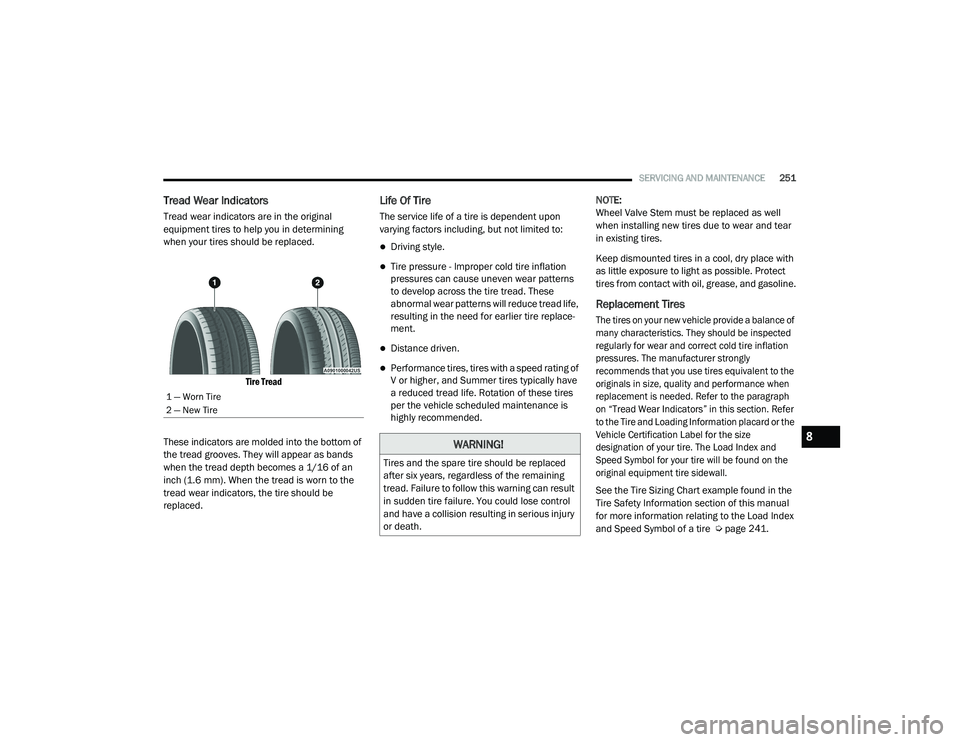
Tread wear indicators are in the original
equipment tires to help you in determining
when your tires should be replaced.
Tire Tread
These indicators are molded into the bottom of
the tread grooves. They will appear as bands
when the tread depth becomes a 1/16 of an
inch (1.6 mm). When the tread is worn to the
tread wear indicators, the tire should be
replaced.
Life Of Tire
The service life of a tire is dependent upon
varying factors including, but not limited to:
Driving style.
Tire pressure - Improper cold tire inflation
pressures can cause uneven wear patterns
to develop across the tire tread. These
abnormal wear patterns will reduce tread life,
resulting in the need for earlier tire replace -
ment.
Distance driven.
Performance tires, tires with a speed rating of
V or higher, and Summer tires typically have
a reduced tread life. Rotation of these tires
per the vehicle scheduled maintenance is
highly recommended. NOTE:
Wheel Valve Stem must be replaced as well
when installing new tires due to wear and tear
in existing tires.
Keep dismounted tires in a cool, dry place with
as little exposure to light as possible. Protect
tires from contact with oil, grease, and gasoline.
Replacement Tires
The tires on your new vehicle provide a balance of
many characteristics. They should be inspected
regularly for wear and correct cold tire inflation
pressures. The manufacturer strongly
recommends that you use tires equivalent to the
originals in size, quality and performance when
replacement is needed. Refer to the paragraph
on “Tread Wear Indicators” in this section. Refer
to the Tire and Loading Information placard or the
Vehicle Certification Label for the size
designation of your tire. The Load Index and
Speed Symbol for your tire will be found on the
original equipment tire sidewall.
See the Tire Sizing Chart example found in the
Tire Safety Information section of this manual
for more information relating to the Load Index
and Speed Symbol of a tire Ú
page 241.
1 — Worn Tire
2 — New Tire
WARNING!
Tires and the spare tire should be replaced
after six years, regardless of the remaining
tread. Failure to follow this warning can result
in sudden tire failure. You could lose control
and have a collision resulting in serious injury
or death.
8
21_VF_OM_EN_USC_t.book Page 251
Page 255 of 288

SERVICING AND MAINTENANCE253
Snow Tires
Some areas of the country require the use of
snow tires during the Winter. Snow tires can be
identified by a “mountain/snowflake” symbol
on the tire sidewall.
If you need snow tires, select tires
equivalent in size and type to the
original equipment tires. Use snow
tires only in sets of four; failure to do
so may adversely affect the safety and handling
of your vehicle.
Snow tires generally have lower speed ratings
than what was originally equipped with your
vehicle and should not be operated at
sustained speeds over 75 mph (120 km/h).
For speeds above 75 mph (120 km/h) refer to
original equipment or an authorized tire dealer
for recommended safe operating speeds,
loading and cold tire inflation pressures.
While studded tires improve performance on
ice, skid and traction capability on wet or dry
surfaces may be poorer than that of
non-studded tires. Some states prohibit
studded tires; therefore, local laws should be
checked before using these tire types.
SPARE TIRES — IF EQUIPPED
NOTE:
For vehicles equipped with Tire Service Kit instead
of a spare tire, please refer to “Tire Service Kit” in
“In Case Of Emergency” for further information.
For restrictions when towing with a spare tire
designated for temporary emergency use
Ú page 82.
Spare Tire Matching Original Equipped Tire
And Wheel — If Equipped
Your vehicle may be equipped with a spare tire
and wheel equivalent in look and function to
the original equipment tire and wheel found on
the front or rear axle of your vehicle. This spare
tire may be used in the tire rotation for your vehicle. If your vehicle has this option, refer to
an authorized tire dealer for the recommended
tire rotation pattern.
NOTE:
This spare tire may not have a tire pressure
monitor sensor.
Compact Spare Tire — If Equipped
The compact spare is for temporary emergency
use only. You can identify if your vehicle is
equipped with a compact spare by looking at
the spare tire description on the Tire and
Loading Information Placard located on the
driver’s side door opening or on the sidewall of
the tire. Compact spare tire descriptions begin
with the letter “T” or “S” preceding the size
designation. Example: T145/80D18 103M.
T, S = Temporary Spare Tire
Since this tire has limited tread life, the original
equipment tire should be repaired (or replaced)
and reinstalled on your vehicle at the first
opportunity.
CAUTION!
Because of the reduced ground clearance, do
not take your vehicle through an automatic
car wash with a compact or limited use
temporary spare installed. Damage to the
vehicle may result.
8
21_VF_OM_EN_USC_t.book Page 253
Page 256 of 288
254SERVICING AND MAINTENANCE
Do not install a wheel cover or attempt to mount
a conventional tire on the compact spare wheel,
since the wheel is designed specifically for the
compact spare tire. Do not install more than
one compact spare tire and wheel on the
vehicle at any given time.Collapsible Spare Tire — If Equipped
The collapsible spare is for temporary
emergency use only. You can identify if your
vehicle is equipped with a collapsible spare by
looking at the spare tire description on the Tire
and Loading Information Placard located on the
driver’s side door opening or on the sidewall of
the tire.
Collapsible spare tire description example:
165/80-17 101P.
Since this tire has limited tread life, the original
equipment tire should be repaired (or replaced)
and reinstalled on your vehicle at the first
opportunity.
Inflate collapsible tire only after the wheel is
properly installed to the vehicle. Inflate the
collapsible tire using the electric air pump
before lowering the vehicle. Do not install a wheel cover or attempt to mount
a conventional tire on the collapsible spare
wheel, since the wheel is designed specifically
for the collapsible spare tire.
WARNING!
Compact and collapsible spares are for
temporary emergency use only. With these
spares, do not drive more than 50 mph
(80 km/h). Temporary use spares have
limited tread life. When the tread is worn to
the tread wear indicators, the temporary use
spare tire needs to be replaced. Be sure to
follow the warnings, which apply to your
spare. Failure to do so could result in spare
tire failure and loss of vehicle control.
WARNING!
Compact and Collapsible spares are for
temporary emergency use only. With these
spares, do not drive more than 50 mph
(80 km/h). Temporary use spares have
limited tread life. When the tread is worn to
the tread wear indicators, the temporary use
spare tire needs to be replaced. Be sure to
follow the warnings, which apply to your
spare. Failure to do so could result in spare
tire failure and loss of vehicle control.
21_VF_OM_EN_USC_t.book Page 254
Page 257 of 288

SERVICING AND MAINTENANCE255
Full Size Spare — If Equipped
The full size spare is for temporary emergency
use only. This tire may look like the originally
equipped tire on the front or rear axle of your
vehicle, but it is not. This spare tire may have
limited tread life. When the tread is worn to the
tread wear indicators, the temporary use full
size spare tire needs to be replaced. Since it is
not the same as your original equipment tire,
replace (or repair) the original equipment tire
and reinstall on the vehicle at the first
opportunity.
NOTE:
This spare tire may not have a tire pressure
monitor sensor.
Limited Use Spare — If Equipped
The limited use spare tire is for temporary
emergency use only. This tire is identified by a
label located on the limited use spare wheel. This
label contains the driving limitations for this
spare. This tire may look like the original
equipped tire on the front or rear axle of your
vehicle, but it is not. Installation of this limited
use spare tire affects vehicle handling. Since it is
not the same as your original equipment tire,
replace (or repair) the original equipment tire and
reinstall on the vehicle at the first opportunity.
WHEEL AND WHEEL TRIM CARE
All wheels and wheel trim, especially aluminum
and chrome plated wheels, should be cleaned
regularly using mild (neutral Ph) soap and water
to maintain their luster and to prevent
corrosion. Wash wheels with the same soap
solution recommended for the body of the
vehicle and remember to always wash when the
surfaces are not hot to the touch.
Your wheels are susceptible to deterioration
caused by salt, sodium chloride, magnesium
chloride, calcium chloride, etc., and other road
chemicals used to melt ice or control dust on
dirt roads. Use a soft cloth or sponge and mild
soap to wipe away promptly. Do not use harsh
chemicals or a stiff brush. They can damage the
wheel’s protective coating that helps keep them
from corroding and tarnishing.
WARNING!
Limited use spares are for emergency use
only. Installation of this limited use spare tire
affects vehicle handling. With this tire, do not
drive more than the speed listed on the
limited use spare wheel. Keep inflated to the
cold tire inflation pressures listed on your Tire
and Loading Information Placard located on
the driver’s side B-Pillar or the rear edge of
the driver’s side door. Replace (or repair) the
original equipment tire at the first opportunity
and reinstall it on your vehicle. Failure to do
so could result in loss of vehicle control.
8
21_VF_OM_EN_USC_t.book Page 255
Page 261 of 288

SERVICING AND MAINTENANCE259
DEPARTMENT OF TRANSPORTATION
UNIFORM TIRE QUALITY GRADES
The following tire grading categories
were established by the National
Highway Traffic Safety Administration.
The specific grade rating assigned by the
tire's manufacturer in each category is
shown on the sidewall of the tires on
your vehicle.
All passenger vehicle tires must conform
to Federal safety requirements in
addition to these grades.
TREADWEAR
The Treadwear grade is a comparative
rating, based on the wear rate of the tire
when tested under controlled conditions on
a specified government test course. For
example, a tire graded 150 would wear one
and one-half times as well on the
government course as a tire graded 100.
The relative performance of tires depends
upon the actual conditions of their use,
however, and may depart significantly from the norm due to variations in driving habits,
service practices, and differences in road
characteristics and climate.
TRACTION GRADES
The Traction grades, from highest to
lowest, are AA, A, B, and C. These grades
represent the tire's ability to stop on wet
pavement, as measured under
controlled conditions on specified
government test surfaces of asphalt and
concrete. A tire marked C may have poor
traction performance.
TEMPERATURE GRADES
The Temperature grades are A (the
highest), B, and C, representing the tire's
resistance to the generation of heat and
its ability to dissipate heat, when tested
under controlled conditions on a
specified indoor laboratory test wheel.
Sustained high temperature can cause
the material of the tire to degenerate
and reduce tire life, and excessive
temperature can lead to sudden tire
failure. The grade C corresponds to a
level of performance, which all
passenger vehicle tires must meet
under the Federal Motor Vehicle Safety
Standard No. 109. Grades B and A
represent higher levels of performance
on the laboratory test wheel, than the
minimum required by law.
WARNING!
The traction grade assigned to this tire is
based on straight-ahead braking traction
tests, and does not include acceleration,
cornering, hydroplaning, or peak traction
characteristics.
WARNING!
The temperature grade for this tire is
established for a tire that is properly inflated
and not overloaded. Excessive speed,
underinflation, or excessive loading, either
separately or in combination, can cause heat
buildup and possible tire failure.
8
21_VF_OM_EN_USC_t.book Page 259
Page 278 of 288
276 C
Camera, Rear
.................................................. 73Capacities, Fluid............................................ 268Caps, Filler Fuel............................................................. 75Oil (Engine)................................................ 215Power Steering............................................ 67Radiator (Coolant Pressure)...................... 224Car Washes................................................... 261Carbon Monoxide Warning............................ 189Cargo Area Cover............................................. 41Cargo Compartment........................................ 41Cargo Light...................................................... 28Certification Label........................................... 76Change Oil Indicator........................................ 45Changing A Flat Tire....................................... 190Chart, Tire Sizing............................................ 241Check Engine Light
(Malfunction Indicator Light)........................... 56Checking Your Vehicle For Safety.................. 186Checks, Safety............................................... 186Child Restraint............................................... 181Child RestraintsBooster Seats............................................ 184Child Seat Installation............................... 186Infant And Child Restraints....................... 183Older Children And Child Restraints..........183Clean Air Gasoline......................................... 266CleaningWheels...................................................... 255
Climate Control................................................ 31Manual........................................................ 31Rear............................................................. 34Cold Weather Operation.................................. 57Compact Spare Tire...................................... 253Contract, Service.......................................... 272Cooling Pressure Cap (Radiator Cap)............ 224Cooling System............................................. 223Adding Coolant (Antifreeze)...................... 224Coolant Level................................... 223, 225Cooling Capacity....................................... 268Disposal Of Used Coolant......................... 225Drain, Flush, And Refill............................. 223Inspection................................................. 225Points To Remember................................ 225Pressure Cap............................................ 224Radiator Cap............................................ 224Selection Of Coolant (Antifreeze)..... 223, 268Corrosion Protection..................................... 260Cruise Control (Speed Control)........................ 67Cruise Light...................................................... 54Cupholders................................................... 263Customer Assistance.................................... 271Customer Programmable Features.................. 89Cybersecurity................................................... 88
D
Dealer Service.............................................. 218Defroster, Windshield................................... 187Deleting A Phone.......................................... 117
Diagnostic System, Onboard............................55Dimmer Control Switch....................................29Dimmer SwitchHeadlight.....................................................26DipsticksAutomatic Transmission........................... 227Oil (Engine)............................................... 216Power Steering............................................67Disable Vehicle Towing................................. 209Disconnecting............................................... 117DisposalAntifreeze (Engine Coolant)...................... 225Disturb.......................................................... 120Door Ajar..........................................................49Door Ajar Light.................................................49Door Locks.......................................................14Automatic....................................................15Doors...............................................................14Driver’s Seat Back Tilt......................................15DrivingThrough Flowing, Rising, Or Shallow Standing Water
..........................86
E
Electric Brake Control System....................... 150Electric Remote Mirrors...................................24Electrical Power Outlets...................................37Electronic Speed Control (Cruise Control)........67Electronic Stability Control (ESC)................... 150Electronic Throttle Control Warning Light.........49
21_VF_OM_EN_USC_t.book Page 276
Page 279 of 288

277
Emergency, In Case Of Freeing Vehicle When Stuck
...................... 208Jacking...................................................... 190Jump Starting............................................ 203Emission Control System Maintenance........... 56Engine........................................................... 215Air Cleaner................................................. 219Block Heater............................................... 58Break-In Recommendations........................ 58Checking Oil Level..................................... 216Compartment............................................ 215Compartment Identification...................... 215Coolant (Antifreeze)......................... 223, 268Cooling...................................................... 223Exhaust Gas Caution................................. 189Fails To Start............................................... 57Flooded, Starting......................................... 57Fuel Requirements.......................... 265, 268Jump Starting............................................ 203Oil.................................................... 218, 268Oil Filler Cap.............................................. 215Oil Filter..................................................... 219Oil Selection.................................... 218, 268Oil Synthetic.............................................. 218Overheating............................................... 206Starting....................................................... 57Enhanced Accident Response Feature..........210Entry System, Illuminated................................ 30
Ethanol......................................................... 266Exhaust Gas Cautions................................... 189Exhaust System................................... 189, 221Exterior Lights.........................................26, 188
F
FiltersAir Cleaner
................................................ 219Air Conditioning..................................35, 220Engine Oil........................................ 219, 268Engine Oil Disposal................................... 218FlashersHazard Warning........................................ 190Turn Signals.......................................54, 188Flat Tire Changing................................ 240, 253Flat Tire Stowage................................. 240, 253Flooded Engine Starting................................... 57Fluid Capacities............................................ 268Fluid Leaks................................................... 189Fluid Level ChecksAutomatic Transmission........................... 227Brake........................................................ 226Cooling System......................................... 223Engine Oil................................................. 216Power Steering............................................ 67Fog Lights........................................................ 27Fold-Flat Seats................................................. 15Forward Collision Warning............................ 159
Four-Way Hazard Flasher.............................. 190Freeing A Stuck Vehicle................................. 208Fuel............................................................... 265Additives................................................... 266Clean Air................................................... 266Ethanol..................................................... 266Filler Cap (Gas Cap).....................................75Gasoline................................................... 265Materials Added....................................... 266Methanol.................................................. 266Octane Rating.................................. 265, 268Requirements.................................. 265, 268Tank Capacity........................................... 268Fuses............................................................ 228
G
Gas Cap (Fuel Filler Cap)...........................75, 76Gasoline, Clean Air........................................ 266Gasoline, Reformulated................................ 266Gear Ranges....................................................62Gear Selector Override.................................. 207Glass Cleaning.............................................. 263Gross Axle Weight Rating.......................... 76, 78Gross Vehicle Weight Rating.....................76, 78GuideBody Builders................................................. 7GVWR...............................................................7611
21_VF_OM_EN_USC_t.book Page 277