open hood RAM PROMASTER 2021 Owners Manual
[x] Cancel search | Manufacturer: RAM, Model Year: 2021, Model line: PROMASTER, Model: RAM PROMASTER 2021Pages: 288, PDF Size: 15.22 MB
Page 4 of 288
2
INTRODUCTION
Symbols Key ............................................................ 7
WARNINGS AND CAUTIONS ................................. 7
VAN CONVERSIONS/CAMPERS ........................... 7
VEHICLE MODIFICATIONS/ALTERATIONS ........... 7
Symbol Glossary ..................................................... 8
GETTING TO KNOW YOUR VEHICLE
KEYS ......................................................................10
Key Fob......................................................... 10
SENTRY KEY ..........................................................12
IGNITION SWITCH .................................................12
VEHICLE SECURITY SYSTEM —
IF EQUIPPED .........................................................13
To Arm The System ...................................... 13
To Disarm The System................................. 13
Rearming Of The System............................. 13
Security System Manual Override .............. 13
DOORS ..................................................................14
Power Door Locks ....................................... 14
Auto Unlock Doors ....................................... 15
Automatic Door Locks ................................. 15
STEERING WHEEL.................................................15
Telescoping Steering Column ..................... 15 SEATS .................................................................... 15
Manual Adjustments ................................... 16
Heated Seats — If Equipped ....................... 19
Fold Down Tray — If Equipped..................... 20
Adjustable Armrests — If Equipped ............ 20
Head Restraints .......................................... 20
UCONNECT VOICE RECOGNITION ....................... 22
Introducing Voice Recognition .................... 22
Basic Voice Commands............................... 22
Get Started ................................................... 22
Additional Information ................................. 22
MIRRORS ............................................................. 23
Inside Rearview Mirror ................................ 23
Outside Mirrors ........................................... 24
Power Mirrors — If Equipped ....................... 24
Power Folding Outside Mirrors —
If Equipped ................................................... 25 Heated Mirrors — If Equipped ..................... 25
EXTERIOR LIGHTS ................................................ 26
Multifunction Lever ..................................... 26
Headlights ................................................... 26
Daytime Running Lights (DRLs) —
If Equipped .................................................. 26 High/Low Beam Switch .............................. 26
Flash-To-Pass .............................................. 26
Parking Lights ............................................. 26
Follow Me Home/Headlight Delay .............. 27
Fog Lights — If Equipped ............................ 27 Turn Signals ................................................. 27
Lane Change Assist ..................................... 27
Battery Saver ............................................... 27
INTERIOR LIGHTS ................................................28
Courtesy Lights ............................................ 28
Illuminated Entry ......................................... 30
WIPERS AND WASHERS .....................................30
Windshield Wiper Operation ...................... 30
CLIMATE CONTROLS ...........................................31
Manual Climate Control Descriptions
And Functions .............................................. 31 Additional Rear Climate Control —
If Equipped ................................................... 34 Operating Tips.............................................. 34
INTERIOR STORAGE AND EQUIPMENT ..............36
Storage ......................................................... 36
USB/AUX Control — If Equipped ................ 37
Power Outlets............................................... 37
Auxiliary Switches — If Equipped ................ 38
WINDOWS ............................................................39
Power Windows .......................................... 39
Window Bar Grates — If Equipped .............. 39
Wind Buffeting ............................................ 40
HOOD......................................................................40
Opening ........................................................ 40
Closing.......................................................... 41
CARGO AREA FEATURES .....................................41
21_VF_OM_EN_USC_t.book Page 2
Page 15 of 288

GETTING TO KNOW YOUR VEHICLE13
NOTE:
Opening the driver's door when the key is in the
ignition and the ignition switch position is STOP
(OFF/LOCK) sounds a signal to remove the key.
VEHICLE SECURITY SYSTEM — IF EQUIPPED
The Vehicle Security system monitors the
vehicle doors and ignition for unauthorized
operation. When the Vehicle Security system is
activated, interior switches for door locks are
disabled. The system provides both audible and
visible signals. For the first three minutes, the
horn will sound, and the turn signal lights will
flash. For an additional 15 minutes, only the
turn signal lights will flash.
TO ARM THE SYSTEM
To arm the system, the Vehicle Security system
will set when you use the key fob to lock the
doors. If a door or the hood is not properly shut,
the system will not be armed.
TO DISARM THE SYSTEM
Use the key fob to unlock the door and disarm
the system.
The Vehicle Security system will also disarm if a
programmed Sentry Key is inserted into the
ignition switch. To exit the alarming mode,
push the key fob unlock button, or insert a
programmed Sentry Key into the ignition switch. The Vehicle Security system is designed to
protect your vehicle. However, you can create
conditions where the system will give you a false
alarm. If one of the previously described arming
sequences has occurred, the Vehicle Security
system will arm regardless of whether you are in
the vehicle or not. If you remain in the vehicle
and open a door, the alarm will sound. If this
occurs, disarm the Vehicle Security system.
REARMING OF THE SYSTEM
If the system has not been disabled, the Vehicle
Security system will rearm itself after the 15
additional minutes of turn lamps flashing. If the
condition which initiated the alarm is still
present, the system will ignore that condition
and monitor the remaining doors and ignition.
SECURITY SYSTEM MANUAL OVERRIDE
The Vehicle Security system will not arm/disarm
if you lock/unlock the doors using the manual
door lock.
Allowing children to be in a vehicle unat
-
tended is dangerous for a number of
reasons. A child or others could be seriously
or fatally injured. Children should be
warned not to touch the parking brake,
brake pedal or the gear selector.
Do not leave the key fob in or near the
vehicle, or in a location accessible to chil-
dren. A child could operate power windows,
other controls, or move the vehicle.
Do not leave children or animals inside
parked vehicles in hot weather. Interior
heat build-up may cause serious injury or
death.
CAUTION!
An unlocked vehicle is an invitation. Always
remove the key from the ignition and lock all
the doors when leaving the vehicle unattended.
WARNING! (Continued)
2
21_VF_OM_EN_USC_t.book Page 13
Page 42 of 288
40GETTING TO KNOW YOUR VEHICLE
WIND BUFFETING
Wind buffeting can be described as the
perception of pressure on the ears or a
helicopter-type sound in the ears. Your vehicle
may exhibit wind buffeting with the windows
down, or the sunroof (if equipped) in certain
open or partially open positions. This is a normal
occurrence and can be minimized. If the
buffeting occurs with the rear windows open,
open the front and rear windows together to
minimize the buffeting. If the buffeting occurs
with the sunroof open, adjust the sunroof
opening to minimize the buffeting or open any
window.
HOOD
OPENING
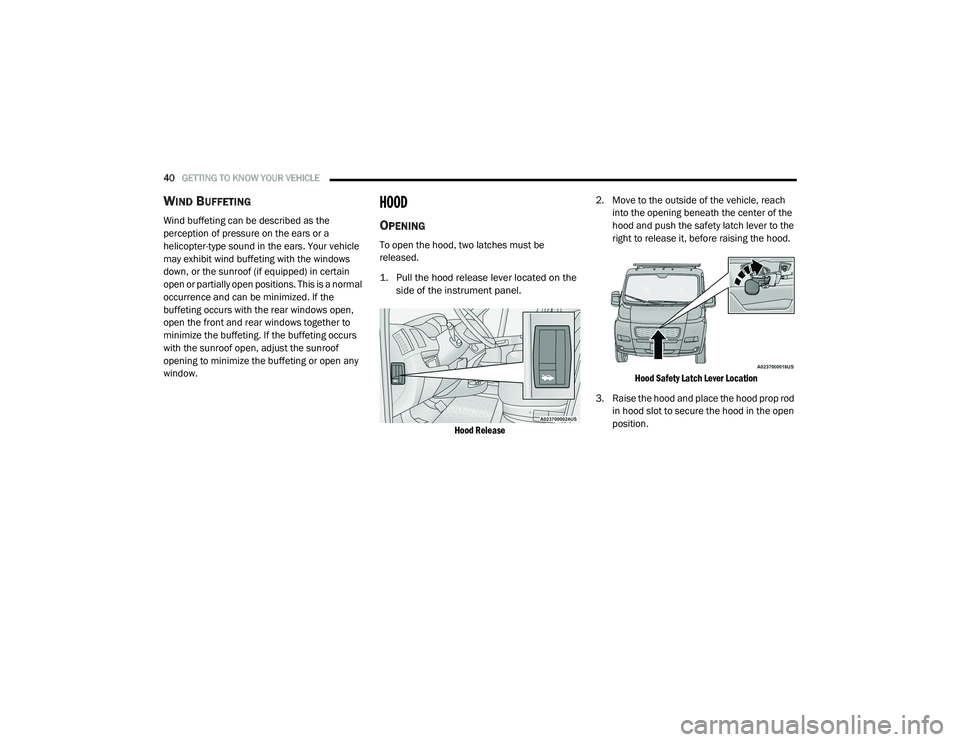
To open the hood, two latches must be
released.
1. Pull the hood release lever located on the
side of the instrument panel.
Hood Release
2. Move to the outside of the vehicle, reach
into the opening beneath the center of the
hood and push the safety latch lever to the
right to release it, before raising the hood.
Hood Safety Latch Lever Location
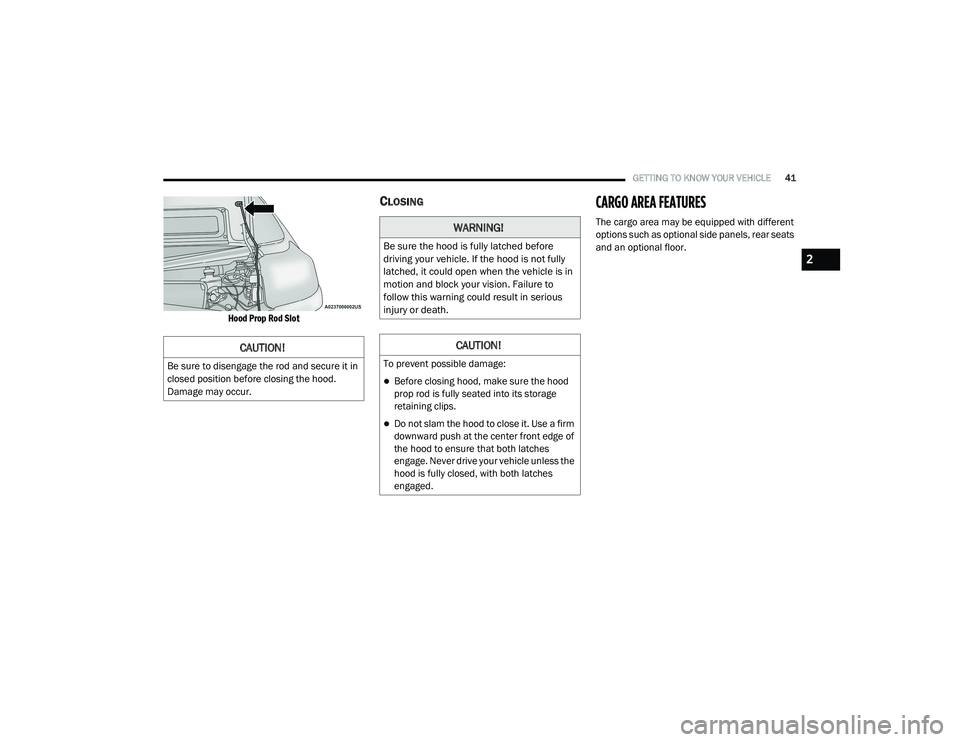
3. Raise the hood and place the hood prop rod in hood slot to secure the hood in the open
position.
21_VF_OM_EN_USC_t.book Page 40
Page 43 of 288
GETTING TO KNOW YOUR VEHICLE41
Hood Prop Rod Slot
CLOSINGCARGO AREA FEATURES
The cargo area may be equipped with different
options such as optional side panels, rear seats
and an optional floor.
CAUTION!
Be sure to disengage the rod and secure it in
closed position before closing the hood.
Damage may occur.
WARNING!
Be sure the hood is fully latched before
driving your vehicle. If the hood is not fully
latched, it could open when the vehicle is in
motion and block your vision. Failure to
follow this warning could result in serious
injury or death.
CAUTION!
To prevent possible damage:
Before closing hood, make sure the hood
prop rod is fully seated into its storage
retaining clips.
Do not slam the hood to close it. Use a firm
downward push at the center front edge of
the hood to ensure that both latches
engage. Never drive your vehicle unless the
hood is fully closed, with both latches
engaged.
2
21_VF_OM_EN_USC_t.book Page 41
Page 209 of 288

IN CASE OF EMERGENCY207
GEAR SELECTOR OVERRIDE
If a malfunction occurs and the gear selector
cannot be moved out of the PARK (P) position,
you can use the following procedure to
temporarily move the gear selector:
1. Turn the engine OFF.
2. Firmly apply the parking brake.
3. Using a small screwdriver or similar tool,
remove the gear selector override access
cover which is located below the gear
selector.
Gear Selector Release Cover
4. Press and maintain firm pressure on the brake pedal. 5. Insert the screwdriver or similar tool into the
access port, and push and hold the override
release lever forward.
Release Lever
6. Move the gear selector to the NEUTRAL (N) position.
7. The vehicle may then be started in NEUTRAL.
8. Reinstall the gear selector override access cover.
WARNING!
You or others can be badly burned by hot
engine coolant (antifreeze) or steam from
your radiator. If you see or hear steam coming
from under the hood, do not open the hood
until the radiator has had time to cool. Never
try to open a cooling system pressure cap
when the radiator or coolant bottle is hot.
CAUTION!
Driving with a hot cooling system could
damage your vehicle. If the temperature
gauge reads HOT (H), pull over and stop the
vehicle. Idle the vehicle with the air
conditioner turned off until the pointer drops
back into the normal range. If the pointer
remains on HOT (H), and you hear continuous
chimes, turn the engine off immediately and
call for service.
7
21_VF_OM_EN_USC_t.book Page 207
Page 223 of 288
SERVICING AND MAINTENANCE221
BODY LUBRICATION
Locks and all body pivot points, including such
items as seat tracks, door hinge pivot points
and rollers, liftgate, tailgate, decklid, sliding
doors and hood hinges, should be lubricated
periodically with a lithium-based grease, such
as Mopar Spray White Lube to ensure quiet,
easy operation and to protect against rust and
wear. Prior to the application of any lubricant,
the parts concerned should be wiped clean to
remove dust and grit; after lubricating, excess
oil and grease should be removed. Particular
attention should also be given to hood latching
components to ensure proper function. When
performing other underhood services, the hood
latch release mechanism, and safety catch
should be cleaned and lubricated.
The external lock cylinders should be lubricated
twice a year, preferably in the Autumn and
Spring. Apply a small amount of a high quality
lubricant, such as Mopar Lock Cylinder
Lubricant directly into the lock cylinder.
WINDSHIELD WIPER BLADES
Clean the rubber edges of the wiper blades and
the windshield periodically with a sponge or soft
cloth and a mild nonabrasive cleaner. This will
remove accumulations of salt or road film.
Operation of the wipers on dry glass for long
periods may cause deterioration of the wiper
blades. Always use washer fluid when using the
wipers to remove salt or dirt from a dry
windshield.
Avoid using the wiper blades to remove frost or
ice from the windshield. Keep the blade rubber
out of contact with petroleum products such as
engine oil, gasoline, etc.
NOTE:
Life expectancy of wiper blades varies
depending on geographical area and frequency
of use. If chattering, marks, water lines or wet
spots are present, clean the wiper blades or
replace as necessary.
EXHAUST SYSTEM
The best protection against carbon monoxide
entry into the vehicle body is a properly
maintained engine exhaust system.
If you notice a change in the sound of the
exhaust system; or if the exhaust fumes can be
detected inside the vehicle; or when the
underside or rear of the vehicle is damaged;
have an authorized technician inspect the
complete exhaust system and adjacent body
areas for broken, damaged, deteriorated, or
mispositioned parts. Open seams or loose
connections could permit exhaust fumes to
seep into the passenger compartment. In
addition, have the exhaust system inspected
each time the vehicle is raised for lubrication or
oil change. Replace as required.
8
21_VF_OM_EN_USC_t.book Page 221
Page 225 of 288
SERVICING AND MAINTENANCE223
COOLING SYSTEM Coolant Checks
Check the engine coolant (antifreeze)
protection every 12 months (before the onset of
freezing weather, where applicable). If the
engine coolant is dirty, the system should be
drained, flushed, and refilled with fresh OAT
coolant (conforming to MS-12106) only by an
authorized dealer. Check the front of the A/C
condenser for any accumulation of bugs,
leaves, etc. If dirty, clean by gently spraying
water from a garden hose vertically down the
face of the condenser.
Cooling System — Drain, Flush And Refill
NOTE:
Some vehicles require special tools to add
coolant properly. Failure to fill these systems
properly could lead to severe internal engine
damage. If any coolant is needed to be added to
the system please contact an authorized dealer.
If the engine coolant (antifreeze) is dirty or
contains visible sediment, have an authorized
dealer clean and flush with OAT coolant
(conforming to MS.90032).
For the proper maintenance intervals
Úpage 212.
Selection Of Coolant
For further information Ú page 268.
NOTE:
Mixing of engine coolant (antifreeze) other
than specified Organic Additive Technology
(OAT) engine coolant, may result in engine
damage and may decrease corrosion protec-
tion. OAT engine coolant is different and
should not be mixed with Hybrid Organic
Additive Technology (HOAT) engine coolant or
any “globally compatible” coolant. If a
non-OAT engine coolant is introduced into the
cooling system in an emergency, the cooling
system will need to be drained, flushed, and
refilled with fresh OAT coolant (conforming to
MS.90032), by an authorized dealer as soon
as possible.
Do not use water alone or alcohol-based
engine coolant products. Do not use addi-
tional rust inhibitors or antirust products, as
they may not be compatible with the radiator
engine coolant and may plug the radiator.
WARNING!
You or others can be badly burned by hot
engine coolant (antifreeze) or steam from
your radiator. If you see or hear steam
coming from under the hood, do not open
the hood until the radiator has had time to
cool. Never open a cooling system pressure
cap when the radiator or coolant bottle is
hot.
Keep hands, tools, clothing, and jewelry
away from the radiator cooling fan when
the hood is raised. The fan starts automati -
cally and may start at any time, whether the
engine is running or not.
When working near the radiator cooling fan,
disconnect the fan motor lead and turn the
ignition to the OFF mode. The fan is
temperature controlled and can start at any
time the ignition is in the ON mode.
8
21_VF_OM_EN_USC_t.book Page 223
Page 228 of 288

226SERVICING AND MAINTENANCE
(Continued)
BRAKE SYSTEM
In order to ensure brake system performance,
all brake system components should be
inspected periodically Úpage 212.
Fluid Level Check — Brake Master Cylinder
The fluid level of the master cylinder should be
checked when performing under the hood
service or immediately if the brake system
warning lamp indicates system failure. If
necessary, add fluid to bring level within the
designated marks on the side of the reservoir of
the brake master cylinder. Be sure to clean the
top of the master cylinder area before removing
cap. With disc brakes the fluid level can be
expected to fall as the brake linings wear. However, an unexpected drop in fluid level may
be caused by a leak and a system check should
be conducted Ú
page 268.
AUTOMATIC TRANSMISSION
Selection Of Lubricant
It is important to use the proper transmission
fluid to ensure optimum transmission
performance and life. Use only the
manufacturer’s specified transmission fluid
Ú
page 270. It is important to maintain the
WARNING!
Riding the brakes can lead to brake failure
and possibly a collision. Driving with your foot
resting or riding on the brake pedal can result
in abnormally high brake temperatures,
excessive lining wear, and possible brake
damage. You would not have your full braking
capacity in an emergency.
WARNING!
Use only FCA's recommended brake fluid
Ú page 268. Using the wrong type of brake
fluid can severely damage your brake
system and/or impair its performance. The
proper type of brake fluid for your vehicle is
also identified on the original factory
installed hydraulic master cylinder
reservoir.
To avoid contamination from foreign matter
or moisture, use only new brake fluid or
fluid that has been in a tightly closed
container. Keep the master cylinder reser -
voir cap secured at all times. Brake fluid in
a open container absorbs moisture from
the air resulting in a lower boiling point. This
may cause it to boil unexpectedly during
hard or prolonged braking, resulting in
sudden brake failure. This could result in a
collision.
Overfilling the brake fluid reservoir can
result in spilling brake fluid on hot engine
parts, causing the brake fluid to catch fire.
Brake fluid can also damage painted and
vinyl surfaces, care should be taken to
avoid its contact with these surfaces.
Do not allow petroleum based fluid to
contaminate the brake fluid. Brake seal
components could be damaged, causing
partial or complete brake failure. This could
result in a collision.
WARNING! (Continued)
21_VF_OM_EN_USC_t.book Page 226
Page 283 of 288

281
Storing Your Vehicle
...................................... 260Supplemental Restraint System – Air Bag..... 174Sway Control, Trailer...................................... 154Synthetic Engine Oil....................................... 218
T
Telescoping Steering Column.......................... 15Tire And Loading Information Placard........... 245Tire Markings................................................. 240Tire Safety Information.................................. 240Tire Service Kit.................. 197, 198, 200, 202Tires................................... 188, 248, 253, 259Aging (Life Of Tires)................................... 251Air Pressure............................................... 248Chains....................................................... 257Changing................................................... 190Compact Spare......................................... 253General Information........................ 248, 253High Speed................................................ 249Inflation Pressure...................................... 249Jacking...................................................... 190Life Of Tires............................................... 251Load Capacity............................................ 245Pressure Monitoring System (TPMS)............................... 51, 161Quality Grading.......................................... 259Radial........................................................ 250Replacement............................................. 251Rotation.................................................... 258
Safety.............................................. 240, 248Sizes......................................................... 241Snow Tires................................................ 253Spare Tires...................................... 253, 255Spinning................................................... 250Trailer Towing.............................................. 82Tread Wear Indicators.............................. 251Wheel Nut Torque..................................... 264To Open Hood.................................................. 40Tongue Weight/Trailer Weight......................... 81Torque Converter Clutch.................................. 66Towing....................................................78, 209Disabled Vehicle....................................... 209Guide........................................................... 81Recreational................................................ 85Weight......................................................... 81Towing Behind A Motorhome........................... 85Traction............................................................ 86Traction Control............................................ 154Trailer Sway Control (TSC)............................. 154Trailer Towing.................................................. 78Hitches........................................................ 80Minimum Requirements.............................. 81Tips.............................................................. 84Trailer And Tongue Weight........................... 81Wiring.......................................................... 83Trailer Towing Guide........................................ 81Trailer Weight................................................... 81
TransmissionAutomatic.......................................... 60, 226Fluid.......................................................... 270Maintenance............................................ 226Transporting Pets.......................................... 187Tread Wear Indicators................................... 251Turn Signals.....................................................54
U
UconnectPhone Call Features
................................. 118Things You Should Know About YourUconnect Phone................................... 121Uconnect Phone..........................113, 114, 116Answer Or Ignore An Incoming Call — Call Currently In Progress..................... 120Answer Or Ignore An Incoming Call —No Call Currently In Progress................ 119Bluetooth Communication Link................ 124Call Continuation...................................... 121Call Controls............................................. 119Call Termination....................................... 121Cancel Command..................................... 114Connecting To A Particular Mobile Phone Or Audio Device After Pairing................ 116Help Command......................................... 114Join Calls.................................................. 12111
21_VF_OM_EN_USC_t.book Page 281