hood open RAM PROMASTER 2022 User Guide
[x] Cancel search | Manufacturer: RAM, Model Year: 2022, Model line: PROMASTER, Model: RAM PROMASTER 2022Pages: 268, PDF Size: 13.26 MB
Page 213 of 268

SERVICING AND MAINTENANCE211
Coolant Level
The coolant expansion bottle provides a quick
visual method for determining that the coolant
level is adequate. With engine off and cold, the
level of the engine coolant (antifreeze) in the bottle
should be between the “MIN” and “MAX” marks.
Cooling System Notes
NOTE:
When the vehicle is stopped after a few miles/kilo -
meters of operation, you may observe vapor coming
from the front of the engine compartment. This is
normally a result of moisture from rain, snow, or high
humidity accumulating on the radiator and being
vaporized when the thermostat opens, allowing hot
engine coolant (antifreeze) to enter the radiator.
If an examination of your engine compartment
shows no evidence of radiator or hose leaks, the
vehicle may be safely driven. The vapor will soon
dissipate.
Do not overfill the coolant expansion bottle.
Check the coolant freeze point in the radiator
and in the coolant expansion bottle. If engine
coolant needs to be added, the contents of the
coolant expansion bottle must also be protected
against freezing.
If frequent engine coolant additions are
required, the cooling system should be pressure
tested for leaks.
Maintain engine coolant concentration at a
minimum of 50% OAT coolant (conforming to
MS.90032) and distilled water for proper corro -
sion protection of your engine which contains
aluminum components.
Make sure that the coolant expansion bottle
overflow hoses are not kinked or obstructed.
Keep the front of the radiator clean. If your
vehicle is equipped with air conditioning, keep
the front of the condenser clean.
Do not change the thermostat for Summer or
Winter operation. If replacement is ever neces -
sary, install ONLY the correct type thermostat.
Other designs may result in unsatisfactory
engine cooling performance, poor gas mileage,
and increased emissions.
BRAKE SYSTEM
In order to ensure brake system performance, all
brake system components should be inspected
periodically Ú page 199.
Fluid Level Check — Brake Master Cylinder
The fluid level of the master cylinder should be
checked when performing under the hood service
or immediately if the Brake System Warning Light
indicates system failure. If necessary, add fluid to
bring level within the designated marks on the side
of the reservoir of the brake master cylinder. Be
sure to clean the top of the master cylinder area
before removing cap. With disc brakes the fluid
level can be expected to fall as the brake linings
wear. However, an unexpected drop in fluid level
may be caused by a leak and a system check
should be conducted Ú page 251.
WARNING!
Riding the brakes can lead to brake failure and
possibly a collision. Driving with your foot resting
or riding on the brake pedal can result in
abnormally high brake temperatures, excessive
lining wear, and possible brake damage. You
would not have your full braking capacity in an
emergency.
8
22_VF_OM_EN_USC_t.book Page 211
Page 265 of 268
263
Starting
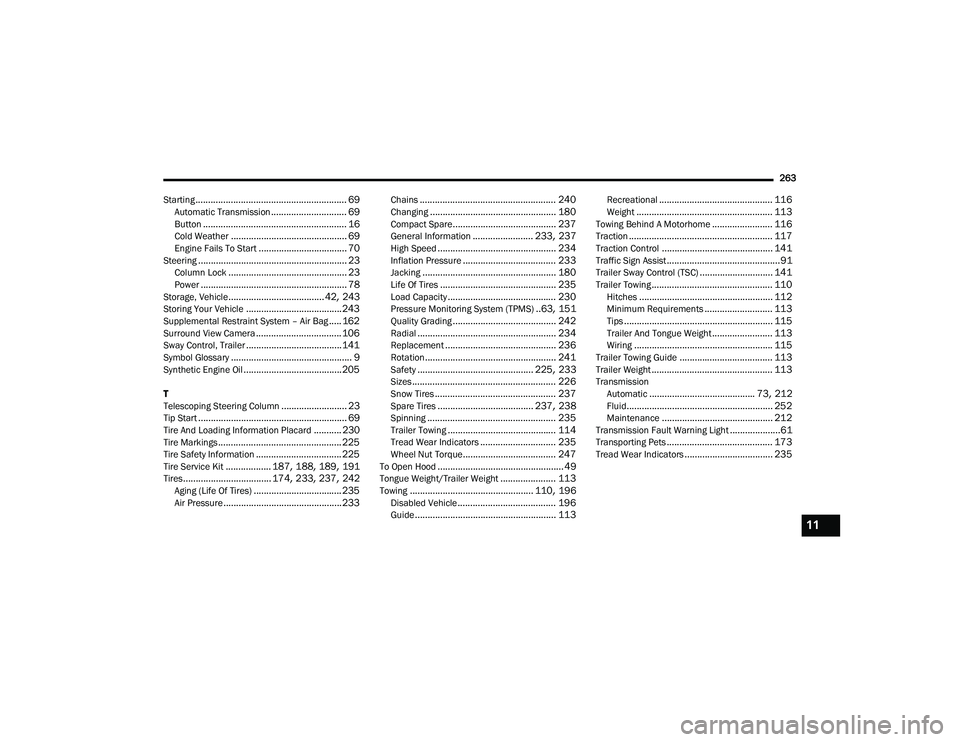
............................................................ 69Automatic Transmission.............................. 69Button......................................................... 16Cold Weather.............................................. 69Engine Fails To Start................................... 70Steering........................................................... 23Column Lock............................................... 23Power.......................................................... 78Storage, Vehicle...................................... 42, 243Storing Your Vehicle...................................... 243Supplemental Restraint System – Air Bag..... 162Surround View Camera.................................. 106Sway Control, Trailer...................................... 141Symbol Glossary................................................ 9Synthetic Engine Oil....................................... 205
T
Telescoping Steering Column.......................... 23Tip Start........................................................... 69Tire And Loading Information Placard........... 230Tire Markings................................................. 225Tire Safety Information.................................. 225Tire Service Kit.................. 187, 188, 189, 191Tires................................... 174, 233, 237, 242Aging (Life Of Tires)................................... 235Air Pressure............................................... 233
Chains...................................................... 240Changing.................................................. 180Compact Spare......................................... 237General Information........................ 233, 237High Speed............................................... 234Inflation Pressure..................................... 233Jacking..................................................... 180Life Of Tires.............................................. 235Load Capacity........................................... 230Pressure Monitoring System (TPMS)..63, 151Quality Grading......................................... 242Radial....................................................... 234Replacement............................................ 236Rotation.................................................... 241Safety.............................................. 225, 233Sizes......................................................... 226Snow Tires................................................ 237Spare Tires...................................... 237, 238Spinning................................................... 235Trailer Towing........................................... 114Tread Wear Indicators.............................. 235Wheel Nut Torque..................................... 247To Open Hood.................................................. 49Tongue Weight/Trailer Weight...................... 113Towing................................................. 110, 196Disabled Vehicle....................................... 196Guide........................................................ 113
Recreational............................................. 116Weight...................................................... 113Towing Behind A Motorhome........................ 116Traction......................................................... 117Traction Control............................................ 141Traffic Sign Assist.............................................91Trailer Sway Control (TSC)............................. 141Trailer Towing................................................ 110Hitches..................................................... 112Minimum Requirements........................... 113Tips........................................................... 115Trailer And Tongue Weight........................ 113Wiring....................................................... 115Trailer Towing Guide..................................... 113Trailer Weight................................................ 113Transmission Automatic.......................................... 73, 212Fluid.......................................................... 252Maintenance............................................ 212Transmission Fault Warning Light....................61Transporting Pets.......................................... 173Tread Wear Indicators................................... 235
11
22_VF_OM_EN_USC_t.book Page 263