trailer RAM PROMASTER 2022 Owner's Manual
[x] Cancel search | Manufacturer: RAM, Model Year: 2022, Model line: PROMASTER, Model: RAM PROMASTER 2022Pages: 268, PDF Size: 13.26 MB
Page 148 of 268

146SAFETY
Trailer Merge Assist — If Equipped
Trailer Merge Assist is a function of the Blind Spot
Monitoring (BSM) system that extends the blind
spot zone to work while pulling a trailer.
NOTE:When Trailer Merge Assist is activated, Rear Cross
Path is disabled.
Trailer Merge Assist consists of three sub
functions:
Automatic Trailer Detection
Trailer Length Detection
Trailer Merge Warning
Blind Spot Zones With Trailer Merge Assist
Automatic Trailer Detection
There are two modes of operation for the detection
of the trailer length:
Automatic Mode
— When “Auto Mode” is
selected, the system will use the blind spot
sensors to automatically determine the pres -
ence and length of a trailer. The presence of a
trailer will be detected using the blind spot radar
within 90 seconds of forward movement of the
vehicle. The vehicle must be moving above
6 mph (10 km/h) to activate the feature. Once
the trailer has been detected, the system will
default to the maximum blind spot zone until the
length has been verified. You will see “Auto” in
the instrument panel cluster .
Maximum Mode — When “Max Mode” is
selected, the system will default to the maximum
blind spot zone regardless of what size trailer is
attached .
NOTE:Selected setting is stored when the ignition is
placed in the OFF position. To change this setting,
it must be selected through the Uconnect Settings
Ú page 120. Trailer Length Detection
Once the trailer presence has been established,
the trailer length will be established (by making
a 90 degree turn) and then the trailer length
category (example 10-20 ft (3 m to 6 m)) will be
displayed. This can take up to 30 seconds after
completing the turn.
NOTE:During the same ignition cycle, if the vehicle is at a
standstill for a minimum of 90 seconds, a new
“trailer detection request” is enabled by the
system once the vehicle resumes motion.
The maximum trailer length supported by the
Trailer Merge Assist feature is 39.5 ft (12 m).
Trailer length is considered the forward most
portion of the trailer hitch to the rearward most
portion of the body, fascia/bumper, or ramp of the
trailer.
The maximum width supported by the Trailer
Merge Assist feature is 8.5 ft (2.59 m). Trailer
width is measured at the widest portion of the
trailer and may include wheels, tires, finders,
or rails.
1 — Vehicle
2 — Trailer
22_VF_OM_EN_USC_t.book Page 146
Page 149 of 268

SAFETY147
NOTE:The ability to detect a trailer may be degraded in
crowded or busy environments. Busy parking lots,
narrow areas surrounded with trees, or any other
crowded area may prevent the radar sensors
from being able to adequately detect the trailer.
The system will try to detect a trailer at every
ignition cycle or 90 seconds of standstill.
Trailer Length Detection
Trailer length will be identified and placed into one
of the following categories:
Trailer length up to 10 ft (3 m) — Blind spot zone
will be adjusted to 10 ft (3 m) .
Trailer length between 10 ft to 20 ft
(3 m to 6 m) — Blind spot zone will be adjusted
to 20 ft (6 m)
.
Trailer length between 20 ft to 30 ft (6 m to
9 m) — Blind spot zone will be adjusted to 30 ft
(9 m) .
Trailer length between 30 ft and 39.5 ft (9 m to
12 m) — Blind spot zone will be adjusted to Max
distance .
NOTE:Trailer length is determined within +/- 3 ft (1 m) of
actual length. Trailers that are the same size as the
category limit, 10/20/30 ft (3/6/9 m), could be
subject to being placed in the category above or
below the correct one.
Trailer Merge Warning
Trailer Merge Warning is the extension of the blind
spot function to cover the length of the trailer, plus
a safety margin, to warn the driver when there is a
vehicle in the adjacent lane. The driver is alerted by
the illumination of the BSM warning light located in
the outside mirror on the side the other vehicle is
detected on. In addition, an audible (chime) alert
will be heard and radio volume will be reduced
Ú page 145.
NOTE:
The Trailer Merge Alert system DOES NOT alert
the driver about rapidly approaching vehicles
that are outside the detection zones.
The Blind Spot Monitoring (BSM) system may
experience drop outs (blinking on and off) of the
side mirror warning indicator lamps when a
motorcycle or any small object remains at the
side of the vehicle for extended periods of time
(more than a couple of seconds).
Crowded areas such as parking lots, neighbor -
hoods, etc. may lead to an increased amount of
false alerts. This is normal operation.
1 — Trailer Length
2 — Trailer Hitch
3 — Trailer Width
WARNING!
The Blind Spot Monitoring system is only an aid
to help detect objects in the blind spot zones.
The BSM system is not designed to detect
pedestrians, bicyclists, or animals. Even if your
vehicle is equipped with the BSM system, always
check your vehicle’s mirrors, glance over your
shoulder, and use your turn signal before
changing lanes. Failure to do so can result in
serious injury or death.6
22_VF_OM_EN_USC_t.book Page 147
Page 198 of 268
196IN CASE OF EMERGENCY
FREEING A STUCK VEHICLE
If your vehicle becomes stuck in mud, sand, or
snow, it can often be moved using a rocking
motion. Turn the steering wheel right and left to
clear the area around the front wheels. Shift back
and forth between DRIVE (D) and REVERSE (R),
while gently pressing the accelerator. Use the least
amount of accelerator pedal pressure that will
maintain the rocking motion, without spinning the
wheels or racing the engine.
NOTE:Push the ESC OFF button, to place the Electronic
Stability Control System (ESC) in “Partial OFF”
mode, before rocking the vehicle Ú page 138.
Once the vehicle has been freed, push the ESC OFF
button again to restore “ESC ON” mode.
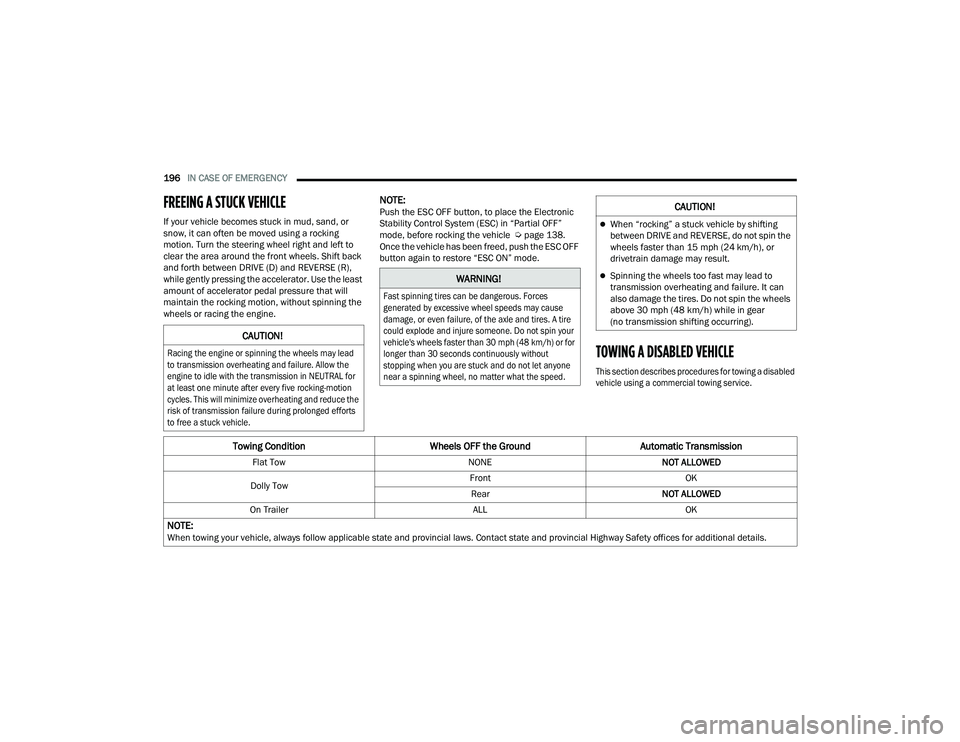
TOWING A DISABLED VEHICLE
This section describes procedures for towing a disabled
vehicle using a commercial towing service.
CAUTION!
Racing the engine or spinning the wheels may lead
to transmission overheating and failure. Allow the
engine to idle with the transmission in NEUTRAL for
at least one minute after every five rocking-motion
cycles. This will minimize overheating and reduce the
risk of transmission failure during prolonged efforts
to free a stuck vehicle.
WARNING!
Fast spinning tires can be dangerous. Forces
generated by excessive wheel speeds may cause
damage, or even failure, of the axle and tires. A tire
could explode and injure someone. Do not spin your
vehicle's wheels faster than 30 mph (48 km/h) or for
longer than 30 seconds continuously without
stopping when you are stuck and do not let anyone
near a spinning wheel, no matter what the speed.
CAUTION!
When “rocking” a stuck vehicle by shifting
between DRIVE and REVERSE, do not spin the
wheels faster than 15 mph (24 km/h), or
drivetrain damage may result.
Spinning the wheels too fast may lead to
transmission overheating and failure. It can
also damage the tires. Do not spin the wheels
above 30 mph (48 km/h) while in gear
(no transmission shifting occurring).
Towing Condition Wheels OFF the Ground Automatic Transmission
Flat Tow NONENOT ALLOWED
Dolly Tow Front
OK
Rear NOT ALLOWED
On Trailer ALLOK
NOTE:When towing your vehicle, always follow applicable state and provincial laws. Contact state and provincial Highway Safety offices for additional details.
22_VF_OM_EN_USC_t.book Page 196
Page 200 of 268

198
SERVICING AND MAINTENANCE
SCHEDULED SERVICING
Your vehicle is equipped with an automatic oil
change indicator system. The oil change indicator
system will remind you that it is time to take your
vehicle in for scheduled maintenance.
Based on engine operation conditions, the oil
change indicator message will illuminate in the
instrument cluster. This means that service is
required for your vehicle. Operating conditions such
as frequent short-trips, trailer tow, and extremely hot
or cold ambient temperatures will influence when
the “Oil Change Required” message is displayed.
Have the vehicle serviced as soon as possible, within
the next 500 miles (805 km).
An authorized dealer will reset the oil change
indicator message after completing the scheduled
oil change. If a scheduled oil change is performed
by someone other than an authorized dealer, the
message can be reset by referring to the steps
described under Instrument Cluster Display
Ú
page 56.
NOTE:Under no circumstances should oil change
intervals exceed 10,000 miles (16,000 km),
12 months or 350 hours of engine run time,
whichever comes first. The 350 hours of engine
run or idle time is generally only a concern for fleet
customers. Once A Month Or Before A Long Trip:
Check engine oil level
Check windshield washer fluid level
Check the tire pressures and look for unusual
wear or damage. Rotate at the first sign of irreg
-
ular wear, even if it occurs before the oil indi -
cator system turns on
Check the fluid levels of the coolant reservoir,
and brake master cylinder and fill as needed
Check function of all interior and exterior lights
22_VF_OM_EN_USC_t.book Page 198
Page 219 of 268

SERVICING AND MAINTENANCE217
Front PDC Additional Fuses
The additional fuse box is located inside the front
PDC Box.
Front Power Distribution Center Additional Fuses
CavityMini Fuse Description
* If Equipped
F61 30 Amp GreenVacuum Pump
F62 30 Amp GreenTransmission Power RELE
F65 15 Amp BlueTrailer Tow Mod
F66 15 Amp BlueTrailer Tow Mod
F68 5 Amp BeigeShifter Transmission Module (STM)
8
22_VF_OM_EN_USC_t.book Page 217
Page 232 of 268
230SERVICING AND MAINTENANCE
Tire Loading And Tire Pressure
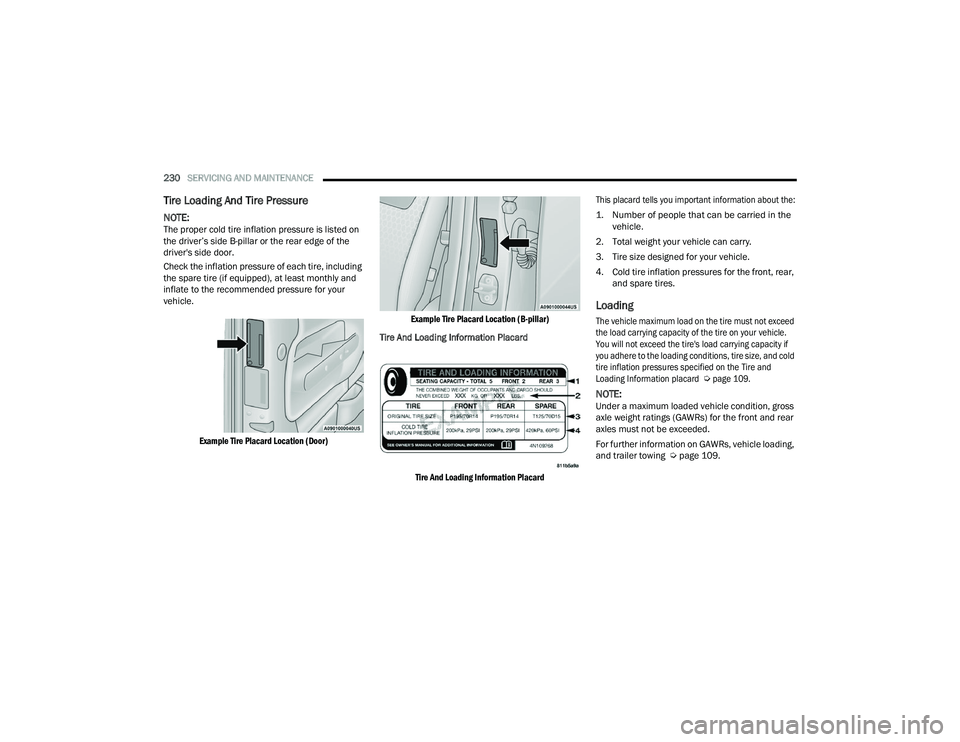
NOTE:The proper cold tire inflation pressure is listed on
the driver’s side B-pillar or the rear edge of the
driver's side door.
Check the inflation pressure of each tire, including
the spare tire (if equipped), at least monthly and
inflate to the recommended pressure for your
vehicle.
Example Tire Placard Location (Door) Example Tire Placard Location (B-pillar)
Tire And Loading Information Placard
Tire And Loading Information Placard
This placard tells you important information about the:
1. Number of people that can be carried in the
vehicle.
2. Total weight your vehicle can carry.
3. Tire size designed for your vehicle.
4. Cold tire inflation pressures for the front, rear, and spare tires.
Loading
The vehicle maximum load on the tire must not exceed
the load carrying capacity of the tire on your vehicle.
You will not exceed the tire's load carrying capacity if
you adhere to the loading conditions, tire size, and cold
tire inflation pressures specified on the Tire and
Loading Information placard
Ú
page 109.
NOTE:Under a maximum loaded vehicle condition, gross
axle weight ratings (GAWRs) for the front and rear
axles must not be exceeded.
For further information on GAWRs, vehicle loading,
and trailer towing Ú page 109.
22_VF_OM_EN_USC_t.book Page 230
Page 233 of 268
SERVICING AND MAINTENANCE231
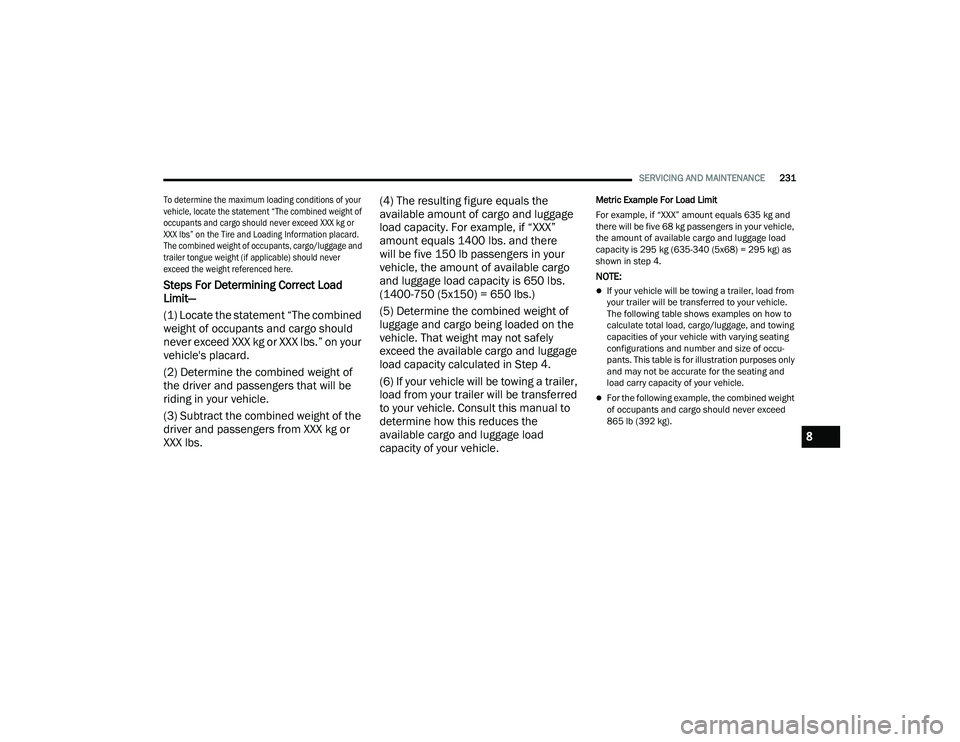
To determine the maximum loading conditions of your
vehicle, locate the statement “The combined weight of
occupants and cargo should never exceed XXX kg or
XXX lbs” on the Tire and Loading Information placard.
The combined weight of occupants, cargo/luggage and
trailer tongue weight (if applicable) should never
exceed the weight referenced here.
Steps For Determining Correct Load
Limit—
(1) Locate the statement “The combined
weight of occupants and cargo should
never exceed XXX kg or XXX lbs.” on your
vehicle's placard.
(2) Determine the combined weight of
the driver and passengers that will be
riding in your vehicle.
(3) Subtract the combined weight of the
driver and passengers from XXX kg or
XXX lbs. (4) The resulting figure equals the
available amount of cargo and luggage
load capacity. For example, if “XXX”
amount equals 1400 lbs. and there
will be five 150 lb passengers in your
vehicle, the amount of available cargo
and luggage load capacity is 650 lbs.
(1400-750 (5x150) = 650 lbs.)
(5) Determine the combined weight of
luggage and cargo being loaded on the
vehicle. That weight may not safely
exceed the available cargo and luggage
load capacity calculated in Step 4.
(6) If your vehicle will be towing a trailer,
load from your trailer will be transferred
to your vehicle. Consult this manual to
determine how this reduces the
available cargo and luggage load
capacity of your vehicle.
Metric Example For Load Limit
For example, if “XXX” amount equals 635 kg and
there will be five 68 kg passengers in your vehicle,
the amount of available cargo and luggage load
capacity is 295 kg (635-340 (5x68) = 295 kg) as
shown in step 4.
NOTE:
If your vehicle will be towing a trailer, load from
your trailer will be transferred to your vehicle.
The following table shows examples on how to
calculate total load, cargo/luggage, and towing
capacities of your vehicle with varying seating
configurations and number and size of occu
-
pants. This table is for illustration purposes only
and may not be accurate for the seating and
load carry capacity of your vehicle.
For the following example, the combined weight
of occupants and cargo should never exceed
865 lb (392 kg).
8
22_VF_OM_EN_USC_t.book Page 231
Page 237 of 268

SERVICING AND MAINTENANCE235
Run Flat Tires — If Equipped
Run Flat tires allow you the capability to drive
50 miles (80 km) at 50 mph (80 km/h) after a
rapid loss of inflation pressure. This rapid loss of
inflation is referred to as the Run Flat mode. A Run
Flat mode occurs when the tire inflation pressure is
of/or below 14 psi (96 kPa). Once a Run Flat tire
reaches the run flat mode it has limited driving
capabilities and needs to be replaced immediately.
A Run Flat tire is not repairable. When a run flat tire
is changed after driving with under-inflated tire
condition, please replace the TPMS sensor as it is
not designed to be reused when driven under run
flat mode 14 psi (96 kPa) condition.
NOTE:TPMS sensor must be replaced after driving the
vehicle on a flat tire condition.
It is not recommended driving a vehicle loaded at
full capacity or to tow a trailer while a tire is in the
run flat mode.
See the Tire Pressure Monitoring System section
for more information.
Tire Spinning
When stuck in mud, sand, snow, or ice conditions,
do not spin your vehicle's wheels above 30 mph
(48 km/h) or for longer than 30 seconds
continuously without stopping.
Refer to “Freeing A Stuck Vehicle” for further
information Úpage 196.
Tread Wear Indicators
Tread wear indicators are in the original equipment
tires to help you in determining when your tires
should be replaced.
Tire Tread
These indicators are molded into the bottom of the
tread grooves. They will appear as bands when the
tread depth becomes a 1/16 of an inch (1.6 mm).
When the tread is worn to the tread wear
indicators, the tire should be replaced.
Life Of Tire
The service life of a tire is dependent upon varying
factors including, but not limited to:
Driving style.
Tire pressure - Improper cold tire inflation pres
-
sures can cause uneven wear patterns to
develop across the tire tread. These abnormal
wear patterns will reduce tread life, resulting in
the need for earlier tire replacement.
Distance driven.
Performance tires, tires with a speed rating of V
or higher, and Summer tires typically have a
reduced tread life. Rotation of these tires per
the vehicle scheduled maintenance is highly
recommended.
WARNING!
Fast spinning tires can be dangerous. Forces
generated by excessive wheel speeds may
cause tire damage or failure. A tire could
explode and injure someone. Do not spin your
vehicle's wheels faster than 30 mph (48 km/h)
for more than 30 seconds continuously when
you are stuck, and do not let anyone near a
spinning wheel, no matter what the speed.
1 — Worn Tire
2 — New Tire
WARNING!
Tires and the spare tire should be replaced after
six years, regardless of the remaining tread.
Failure to follow this warning can result in sudden
tire failure. You could lose control and have a
collision resulting in serious injury or death.
8
22_VF_OM_EN_USC_t.book Page 235
Page 262 of 268
260 Head Restraints
............................................... 27Headlights Automatic.................................................... 33Cleaning.................................................... 243High Beam.................................................. 33High Beam/Low Beam Select Switch.......... 33Passing........................................................ 33Switch......................................................... 32Heated Mirrors................................................ 32Heated Seats................................................... 26Heater, Engine Block....................................... 70High Beam/Low Beam Select (Dimmer)
Switch.............................................................. 33Hill Start Assist.............................................. 140HitchesTrailer Towing............................................ 112Hood Prop........................................................ 49Hood Release.................................................. 49
I
Ignition............................................................ 16Switch......................................................... 16Illuminated Entry............................................. 37Immobilizer (Sentry Key).................................. 16Inside Rearview Mirror............................ 29, 176Instrument ClusterDescriptions................................................ 54Display........................................................ 55Display Controls.......................................... 55Menu Items................................................. 56
Instrument Panel Lens Cleaning................... 245Intelligent Speed Assist................................... 79Interior And Instrument Lights......................... 35Interior Appearance Care.............................. 244Interior Lights................................................... 35Intermittent Wipers (Delay Wipers).................. 38InverterPower.......................................................... 46iPod/USB/MP3 Control.................................... 44
J
Jack Location................................................ 180Jack Operation.............................................. 180Jacking And Tire Changing............................ 180Jacking And Tire Changing Instructions........ 180Jump Starting............................................... 192
K
Key Fob............................................................ 13Programming Additional Key Fobs............... 15Key Fob Battery Service (Remote
Keyless Entry).................................................. 14Key Fob Programming (Remote
Keyless Entry).................................................. 15Keyless Enter ‘n Go™....................................... 21Passive Entry............................................... 21Keys................................................................. 13Replacement............................................... 15Sentry (Immobilizer).................................... 16
L
Lane Change Assist..........................................34LaneSense.................................................... 102Lap/Shoulder Belts....................................... 155Latches......................................................... 174Hood............................................................49Lead Free Gasoline....................................... 248Leaks, Fluid................................................... 174Life Of Tires................................................... 235Light Bulbs........................................... 174, 220Lights............................................................ 174Air Bag...................................... 59, 161, 173Brake Assist Warning................................ 140Brake Warning.............................................59Bulb Replacement.................................... 220Collision Warning..................................63, 65Cruise..........................................................66Daytime Running.........................................32Dimmer Switch, Headlight.................... 32, 33Electronic Stability Program(ESP) Indicator................................. 60, 62, 140Exterior.............................................. 32, 174Fuel Cutoff Failure.......................................65Hazard Warning Flasher........................... 176Headlights...................................................32High Beam...................................................33Illuminated Entry.........................................37Instrument Cluster.......................................62
22_VF_OM_EN_USC_t.book Page 260
Page 265 of 268
263
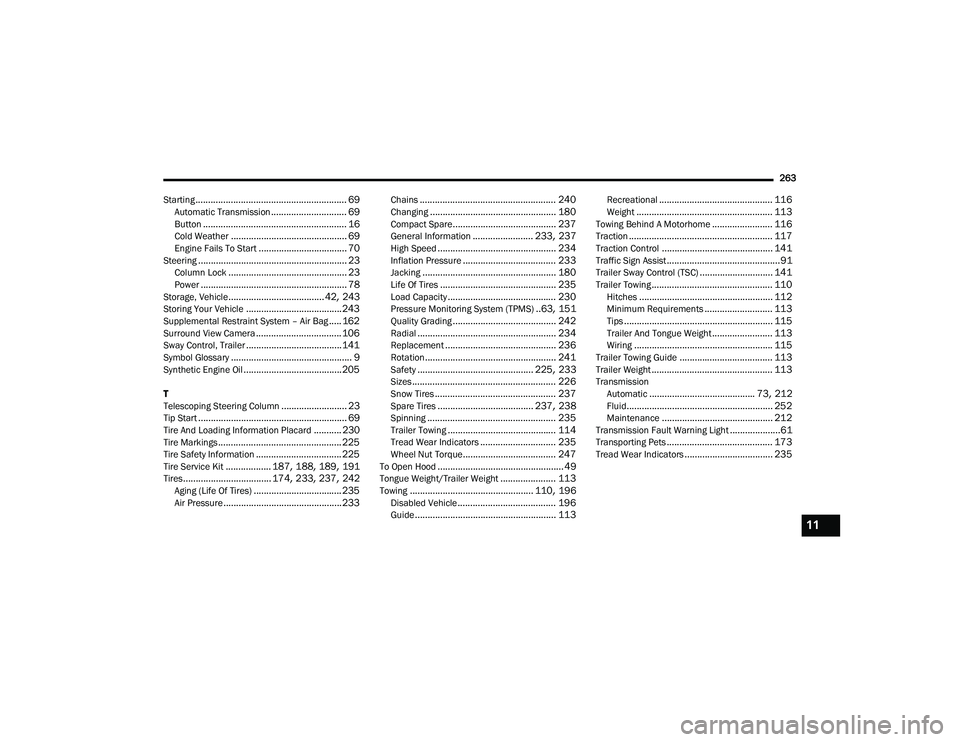
Starting
............................................................ 69Automatic Transmission.............................. 69Button......................................................... 16Cold Weather.............................................. 69Engine Fails To Start................................... 70Steering........................................................... 23Column Lock............................................... 23Power.......................................................... 78Storage, Vehicle...................................... 42, 243Storing Your Vehicle...................................... 243Supplemental Restraint System – Air Bag..... 162Surround View Camera.................................. 106Sway Control, Trailer...................................... 141Symbol Glossary................................................ 9Synthetic Engine Oil....................................... 205
T
Telescoping Steering Column.......................... 23Tip Start........................................................... 69Tire And Loading Information Placard........... 230Tire Markings................................................. 225Tire Safety Information.................................. 225Tire Service Kit.................. 187, 188, 189, 191Tires................................... 174, 233, 237, 242Aging (Life Of Tires)................................... 235Air Pressure............................................... 233
Chains...................................................... 240Changing.................................................. 180Compact Spare......................................... 237General Information........................ 233, 237High Speed............................................... 234Inflation Pressure..................................... 233Jacking..................................................... 180Life Of Tires.............................................. 235Load Capacity........................................... 230Pressure Monitoring System (TPMS)..63, 151Quality Grading......................................... 242Radial....................................................... 234Replacement............................................ 236Rotation.................................................... 241Safety.............................................. 225, 233Sizes......................................................... 226Snow Tires................................................ 237Spare Tires...................................... 237, 238Spinning................................................... 235Trailer Towing........................................... 114Tread Wear Indicators.............................. 235Wheel Nut Torque..................................... 247To Open Hood.................................................. 49Tongue Weight/Trailer Weight...................... 113Towing................................................. 110, 196Disabled Vehicle....................................... 196Guide........................................................ 113
Recreational............................................. 116Weight...................................................... 113Towing Behind A Motorhome........................ 116Traction......................................................... 117Traction Control............................................ 141Traffic Sign Assist.............................................91Trailer Sway Control (TSC)............................. 141Trailer Towing................................................ 110Hitches..................................................... 112Minimum Requirements........................... 113Tips........................................................... 115Trailer And Tongue Weight........................ 113Wiring....................................................... 115Trailer Towing Guide..................................... 113Trailer Weight................................................ 113Transmission Automatic.......................................... 73, 212Fluid.......................................................... 252Maintenance............................................ 212Transmission Fault Warning Light....................61Transporting Pets.......................................... 173Tread Wear Indicators................................... 235
11
22_VF_OM_EN_USC_t.book Page 263