instrument panel RAM PROMASTER 2022 Workshop Manual
[x] Cancel search | Manufacturer: RAM, Model Year: 2022, Model line: PROMASTER, Model: RAM PROMASTER 2022Pages: 268, PDF Size: 13.26 MB
Page 181 of 268

IN CASE OF EMERGENCY179
Even if the SOS Call system is fully functional,
factors beyond FCA US LLC’s control may prevent
or stop the SOS Call system operation. These
include, but are not limited to, the following
factors:
The ignition is in the OFF position
The vehicle’s electrical systems are not intact
The SOS Call system software and/or hardware
are damaged during a crash
The vehicle battery loses power or becomes
disconnected during a vehicle crash
LTE (voice/data) or 4G (data) network and/or
Global Positioning Satellite signals are unavail -
able or obstructed
Equipment malfunction at the SOS operator facility
Operator error by the SOS operator
LTE (voice/data) or 4G (data) network congestion
Weather
Buildings, structures, geographic terrain, or
tunnels
NOTE:
Your vehicle may be transmitting data as autho -
rized by the subscriber.
Never place anything on or near the vehicle’s
LTE (voice/data) or 4G (data) and GPS
antennas. You could prevent LTE (voice/data) or
4G (data) and GPS signal reception, which can
prevent your vehicle from placing an emergency
call. An operable LTE (voice/data) or 4G (data)
network connection and a GPS signal is
required for the SOS Call system to function
properly.
NOTE:Changes or modifications not expressly approved
by the party responsible for compliance could void
the user's authority to operate the equipment.
The Occupant Restraint Control module turns on
the air bag Warning Light on the instrument panel
if a malfunction in any part of the system is
detected. If the Air Bag Warning Light is illumi -
nated, have an authorized dealer service the
Occupant Restraint Control system immediately.
WARNING!
WARNING!
ALWAYS obey traffic laws and pay attention to
the road. ALWAYS drive safely with your hands on
the steering wheel. You have full responsibility
and assume all risks related to the use of the
features and applications in this vehicle. Only
use the features and applications when it is safe
to do so. Failure to do so may result in an
accident involving serious injury or death.
WARNING!
ALWAYS obey traffic laws and pay attention to
the road. ALWAYS drive safely with your hands on
the steering wheel. You have full responsibility
and assume all risks related to the use of the
features and applications in this vehicle. Only
use the features and applications when it is safe
to do so. Failure to do so may result in an
accident involving serious injury or death.CAUTION!
To avoid damage to the mirror during cleaning,
never spray any cleaning solution directly onto
the mirror. Apply the solution onto a clean cloth
and wipe the mirror clean.
7
22_VF_OM_EN_USC_t.book Page 179
Page 192 of 268

190IN CASE OF EMERGENCY
(C) Injecting Tire Service Kit Sealant Into
The Deflated Tire:
Always start the engine before turning ON the
Tire Service Kit.
NOTE:Manual transmission vehicles must have the
parking brake engaged and the gear selector in
NEUTRAL.
After pushing the Power Button (1), the sealant
(white fluid) will flow from the Sealant Bottle (4)
through the Sealant Hose (3) and into the tire.
NOTE:
Sealant may leak out through the puncture in the tire.
If the sealant (white fluid) does not flow within
0 – 10 seconds through the Sealant Hose (3):
1. Push the Power Button (1) to turn Off the Tire
Service Kit. Disconnect the Sealant Hose (3)
from the valve stem. Make sure the valve
stem is free of debris. Reconnect the Sealant
Hose (3) to the valve stem. Check that the
Mode Select Knob (2) is in the Sealant Mode
position and not Air Mode. Push the Power
Button (1) to turn On the Tire Service Kit.
2. Connect the Power Plug (7) to a different 12 Volt power outlet in your vehicle or another
vehicle, if available. Make sure the engine is
running before turning ON the Tire Service Kit. 3. The Sealant Bottle (4) may be empty due to
previous use. Call for assistance.
NOTE:If the Mode Select Knob (2) is on Air Mode and the
pump is operating, air will dispense from the Air
Pump Hose (5) only, not the Sealant Hose (3).
If the sealant (white fluid) does flow through the
Sealant Hose (3):
1. Continue to operate the pump until sealant is no longer flowing through the hose (typically takes
30 - 70 seconds). As the sealant flows through the
Sealant Hose (3), the Pressure Gauge (8) can read
as high as 70 psi (4.8 Bar). The Pressure Gauge (8)
will decrease quickly from approximately 70 psi
(4.8 Bar) to the actual tire pressure when the
Sealant Bottle (4) is empty.
2. The pump will start to inject air into the tire immediately after the Sealant Bottle (4) is
empty. Continue to operate the pump and
inflate the tire to the pressure indicated on the
tire pressure label on the driver-side latch
pillar (recommended pressure). Check the tire
pressure by looking at the Pressure Gauge (8).
If the tire does not inflate to at least 26 psi
(1.8 Bar) pressure within 15 minutes:
The tire is too badly damaged. Do not attempt to
drive the vehicle further. Call for assistance.
NOTE:If the tire becomes overinflated, push the Deflation
Button to reduce the tire pressure to the recom -
mended inflation pressure before continuing.
If the tire inflates to the recommended pressure or
is at least 26 psi (1.8 Bar) pressure within
15 minutes:
1. Push the Power Button (1) to turn off the Tire Service Kit.
2. Remove the Speed Limit sticker from the top of the Sealant Bottle (4) and place the sticker on
the instrument panel.
3. Immediately disconnect the Sealant Hose (3) from the valve stem, reinstall the cap on the
fitting at the end of the hose, and place the Tire
Service Kit in the vehicle storage location.
CAUTION!
The metal end fitting from Power Plug (8) may get
hot after use, so it should be handled carefully.
Failure to reinstall the cap on the fitting at the end
of the Sealant Hose (6) can result in sealant
contacting your skin, clothing, and the vehicle’s
interior. It can also result in sealant contacting
internal Tire Service Kit components which may
cause permanent damage to the kit.
22_VF_OM_EN_USC_t.book Page 190
Page 193 of 268

IN CASE OF EMERGENCY191
(D) Drive Vehicle:
Immediately after injecting sealant and inflating the
tire, drive the vehicle 5 miles (8 km) or 10 minutes to
ensure distribution of the Tire Service Kit Sealant within
the tire. Do not exceed 50 mph (80 km/h).
(E) After Driving:
Pull over to a safe location Ú page 189.
1. Push in the Mode Select Knob (2) and turn to the Air Mode position.
2. Uncoil the power plug and insert the plug into the vehicle's 12 Volt power outlet.
3. Uncoil the Air Pump Hose (5) (black in color) and screw the fitting at the end of hose onto
the valve stem.
4. Check the pressure in the tire by reading the Pressure Gauge (8). If tire pressure is less than 19 psi (1.3 Bar):
The tire is too badly damaged. Do not attempt to
drive the vehicle further. Call for assistance.
If the tire pressure is 19 psi (1.3 Bar) or higher:
1. Push the Power Button (1) to turn on Tire
Service Kit and inflate the tire to the pressure
indicated on the tire and loading information
label on the driver-side door opening.
NOTE:If the tire becomes overinflated, push the Deflation
Button to reduce the tire pressure to the recom -
mended inflation pressure before continuing.
2. Disconnect the Tire Service Kit from the valve stem, reinstall the cap on the valve stem and
unplug from 12 Volt outlet.
3. Place the Tire Service Kit in its proper storage area in the vehicle.
4. Have the tire inspected and repaired or replaced at the earliest opportunity at an
authorized dealer or tire service center.
5. Remove the Speed Limit sticker from the instrument panel after the tire has been
repaired.
6. Replace the Sealant Bottle (4) and Sealant Hose (3) assembly at an authorized dealer as
soon as possible Ú page 191.
NOTE:When having the tire serviced, advise the autho -
rized dealer or service center that the tire has been
sealed using the Tire Service Kit.
(F) Sealant Bottle And Hose Replacement:
1. Uncoil the Sealant Hose (3) (clear in color).
2. Locate the red colored round Sealant Bottle release button at the lower right hand corner
of the kit.
3. Push and hold the Sealant Bottle release button, then pull out the bottle holding the
button.
4. Clean any remaining sealant from the Tire Service Kit housing.
5. Position the new Sealant Bottle (4) in the housing so that the Sealant Hose (3) aligns
with the hose slot in the front of the housing.
Push and hold the Sealant Bottle release
button, then push the bottle into the housing
by holding the button. An audible click will be
heard indicating the bottle is locked into place.
Release the button.
6. Verify that the cap is installed on the fitting at the end of the Sealant Hose (3) and return the
hose to its storage area (located on top of the
housing).
7. Return the Tire Service Kit to its storage location in the vehicle.WARNING!
Tire Service Kit is not a permanent flat tire repair.
Have the tire inspected and repaired or replaced
after using Tire Service Kit. Do not exceed 50 mph
(80 km/h) until the tire is repaired or replaced.
Failure to follow this warning can result in injuries
that are serious or fatal to you, your passengers, and
others around you.
7
22_VF_OM_EN_USC_t.book Page 191
Page 220 of 268

218SERVICING AND MAINTENANCE
Interior Fuses
The interior fuse panel is part of the Body Control
Module (BCM) and is located on the driver's side
under the instrument panel.
NOTE:Please contact an authorized dealer for BCM fuse
replacement.
Fuse PanelFuse Panel Cavity Locations
CavityMini Fuse Description
F315 Amp BeigeINT/A
F33 7.5 Amp Brown+30 TTM
F34 7.5 Amp BrownClearance Lights
F36 15 Amp Blue+30 (ACM / USB Power Out / USB Recharge / TBM / RRM / DLC)
F37 7.5 Amp BrownINT (IPC – DASM / AEB)
F38 20 Amp YellowCentral Locking
F42 5 Amp BeigeINT (BSM / BRAKE NC) / EPS
F43 20 Amp YellowBi-Directional Washer Pump
F47 20 Amp YellowDriver Power Window
F48 20 Amp YellowPassenger Power Window
F49 5 Amp BeigeINT (RRM / TTM / SBDU / XAN / JHC / RFX)
F50 7.5 Amp BrownINT (ORC)
22_VF_OM_EN_USC_t.book Page 218
Page 248 of 268

246SERVICING AND MAINTENANCE
NOTE:If equipped with light colored leather, it tends to
show any foreign material, dirt, and fabric dye
transfer more so than darker colors. The leather is
designed for easy cleaning, and FCA recommends
Mopar® total care leather cleaner applied on a
cloth to clean the leather seats as needed.GLASS SURFACES
All glass surfaces should be cleaned on a regular
basis with Mopar® Glass Cleaner, or any
commercial household-type glass cleaner. Never
use an abrasive type cleaner. Use caution when
cleaning the inside rear window equipped with
electric defrosters or windows equipped with radio
antennas. Do not use scrapers or other sharp
instruments that may scratch the elements.
When cleaning the rear view mirror, spray cleaner
on the towel or cloth that you are using. Do not
spray cleaner directly on the mirror.
CLEANING THE INSTRUMENT PANEL
C
UPHOLDERS
Removal
Pull the flexible liner from the cupholder drawer
starting at one edge to ease removal.
Cleaning
The liner is top shelf dishwasher safe, or you may
follow the cleaning procedure below.
Soak the liner in a mixture of medium hot tap
water and one teaspoon of mild liquid dish soap.
Let soak for approximately 30 minutes. After
30 minutes, pull the liner from the water and dip it
back into the water about six times. This will loosen
any remaining debris. Rinse the liner thoroughly
under warm running water. Shake the excess
water from the liner and dry the outer surfaces with
a clean soft cloth.
Installation
Place the liner into the cupholder drawer and push
the liner into place so that the retention tabs seat
into the corresponding openings in the drawer.
CAUTION!
Do not use Alcohol and Alcohol-based and/or
Ketone based cleaning products to clean leather
upholstery, as damage to the upholstery may
result.
22_VF_OM_EN_USC_t.book Page 246
Page 249 of 268

247
TECHNICAL SPECIFICATIONS
VEHICLE IDENTIFICATION NUMBER (VIN)
The VIN is found on the left front corner of the
instrument panel, visible through the windshield.
Vehicle Identification Number
NOTE:It is illegal to remove or alter the VIN.
BRAKE SYSTEM
Your vehicle is equipped with dual hydraulic brake
systems. If either of the two hydraulic systems lose
normal capability, the remaining system will still
function. However, there will be some loss of
overall braking effectiveness. You may notice
increased pedal travel during application, greater
pedal force required to slow or stop, and potential
activation of the Brake System Warning Light.
In the event power assist is lost for any reason (i.e.,
repeated brake applications with the engine off),
the brakes will still function. However, the effort
required to brake the vehicle will be much greater
than that required with the power system
operating.
WHEEL AND TIRE TORQUE SPECIFICATIONS
Proper lug nut/bolt torque is very important to
ensure that the wheel is properly mounted to the
vehicle. Any time a wheel has been removed and
reinstalled on the vehicle, the lug nuts/bolts
should be torqued using a properly calibrated
torque wrench using a six-sided (hex) deep wall
socket.
TORQUE SPECIFICATIONS
**Use only authorized dealer recommended lug
nuts/bolts and clean or remove any dirt or oil
before tightening.
Lug Nut/Bolt Torque **Lug Nut/
Bolt Size Lug Nut/Bolt
Socket Size
145 Ft-Lb
(197 N·m) M16 x 1.50 21 mm
9
22_VF_OM_EN_USC_t.book Page 247
Page 262 of 268
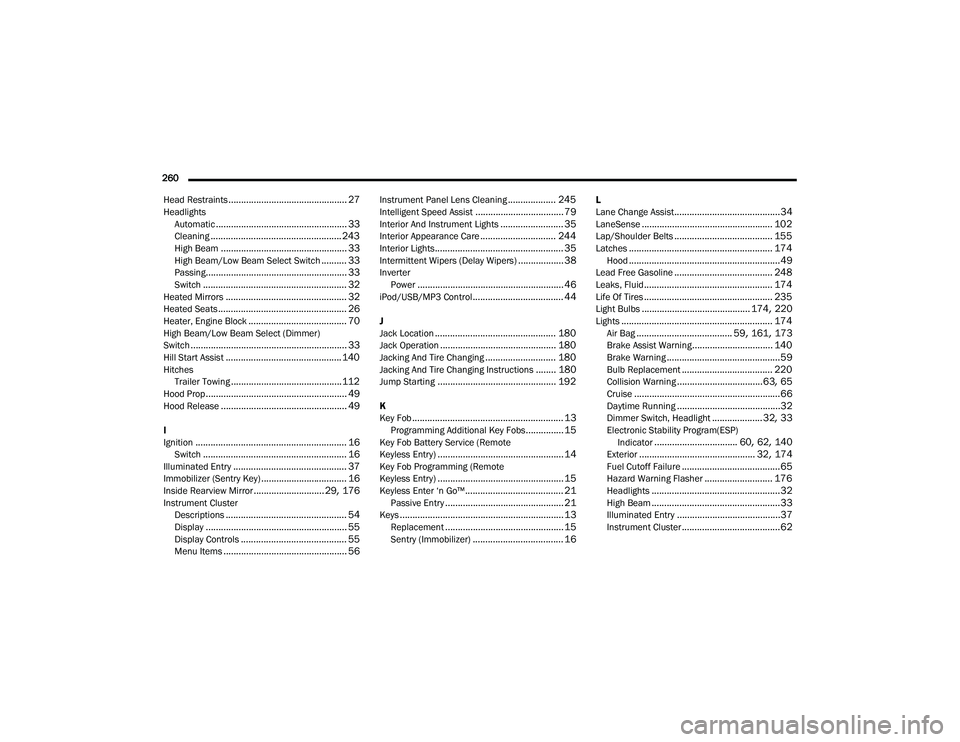
260 Head Restraints
............................................... 27Headlights Automatic.................................................... 33Cleaning.................................................... 243High Beam.................................................. 33High Beam/Low Beam Select Switch.......... 33Passing........................................................ 33Switch......................................................... 32Heated Mirrors................................................ 32Heated Seats................................................... 26Heater, Engine Block....................................... 70High Beam/Low Beam Select (Dimmer)
Switch.............................................................. 33Hill Start Assist.............................................. 140HitchesTrailer Towing............................................ 112Hood Prop........................................................ 49Hood Release.................................................. 49
I
Ignition............................................................ 16Switch......................................................... 16Illuminated Entry............................................. 37Immobilizer (Sentry Key).................................. 16Inside Rearview Mirror............................ 29, 176Instrument ClusterDescriptions................................................ 54Display........................................................ 55Display Controls.......................................... 55Menu Items................................................. 56
Instrument Panel Lens Cleaning................... 245Intelligent Speed Assist................................... 79Interior And Instrument Lights......................... 35Interior Appearance Care.............................. 244Interior Lights................................................... 35Intermittent Wipers (Delay Wipers).................. 38InverterPower.......................................................... 46iPod/USB/MP3 Control.................................... 44
J
Jack Location................................................ 180Jack Operation.............................................. 180Jacking And Tire Changing............................ 180Jacking And Tire Changing Instructions........ 180Jump Starting............................................... 192
K
Key Fob............................................................ 13Programming Additional Key Fobs............... 15Key Fob Battery Service (Remote
Keyless Entry).................................................. 14Key Fob Programming (Remote
Keyless Entry).................................................. 15Keyless Enter ‘n Go™....................................... 21Passive Entry............................................... 21Keys................................................................. 13Replacement............................................... 15Sentry (Immobilizer).................................... 16
L
Lane Change Assist..........................................34LaneSense.................................................... 102Lap/Shoulder Belts....................................... 155Latches......................................................... 174Hood............................................................49Lead Free Gasoline....................................... 248Leaks, Fluid................................................... 174Life Of Tires................................................... 235Light Bulbs........................................... 174, 220Lights............................................................ 174Air Bag...................................... 59, 161, 173Brake Assist Warning................................ 140Brake Warning.............................................59Bulb Replacement.................................... 220Collision Warning..................................63, 65Cruise..........................................................66Daytime Running.........................................32Dimmer Switch, Headlight.................... 32, 33Electronic Stability Program(ESP) Indicator................................. 60, 62, 140Exterior.............................................. 32, 174Fuel Cutoff Failure.......................................65Hazard Warning Flasher........................... 176Headlights...................................................32High Beam...................................................33Illuminated Entry.........................................37Instrument Cluster.......................................62
22_VF_OM_EN_USC_t.book Page 260