belt RAM PROMASTER 2023 Owner's Guide
[x] Cancel search | Manufacturer: RAM, Model Year: 2023, Model line: PROMASTER, Model: RAM PROMASTER 2023Pages: 296, PDF Size: 12.31 MB
Page 188 of 296
186SAFETY
(Continued)
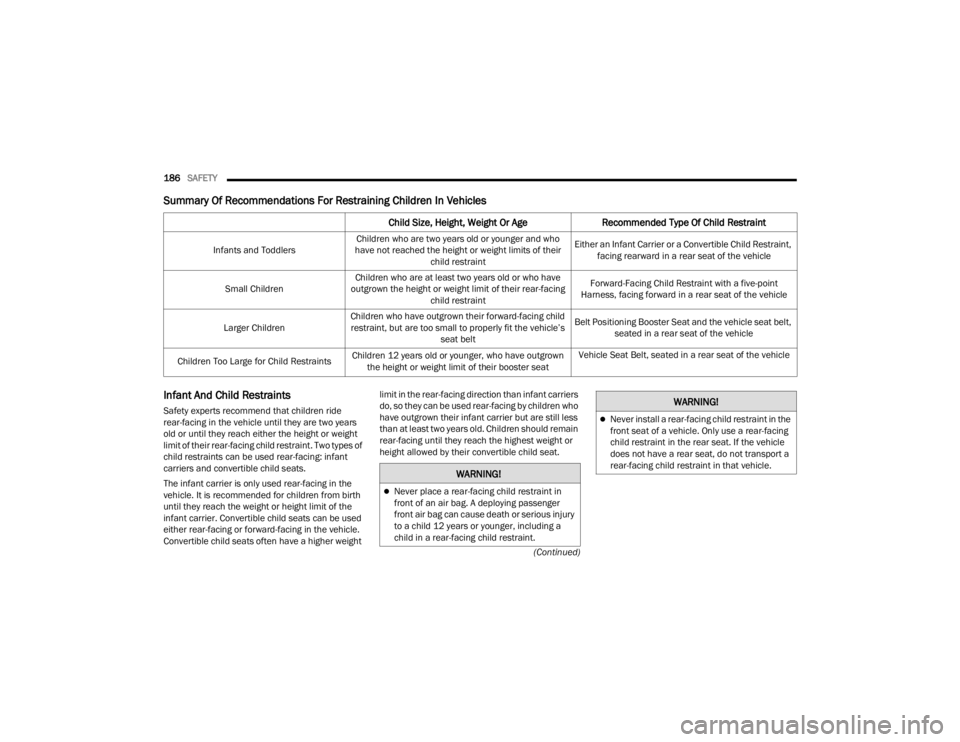
Summary Of Recommendations For Restraining Children In Vehicles
Infant And Child Restraints
Safety experts recommend that children ride
rear-facing in the vehicle until they are two years
old or until they reach either the height or weight
limit of their rear-facing child restraint. Two types of
child restraints can be used rear-facing: infant
carriers and convertible child seats.
The infant carrier is only used rear-facing in the
vehicle. It is recommended for children from birth
until they reach the weight or height limit of the
infant carrier. Convertible child seats can be used
either rear-facing or forward-facing in the vehicle.
Convertible child seats often have a higher weight limit in the rear-facing direction than infant carriers
do, so they can be used rear-facing by children who
have outgrown their infant carrier but are still less
than at least two years old. Children should remain
rear-facing until they reach the highest weight or
height allowed by their convertible child seat.
Child Size, Height, Weight Or Age
Recommended Type Of Child Restraint
Infants and ToddlersChildren who are two years old or younger and who
have not reached the height or weight limits of their child restraint Either an Infant Carrier or a Convertible Child Restraint,
facing rearward in a rear seat of the vehicle
Small Children Children who are at least two years old or who have
outgrown the height or weight limit of their rear-facing child restraint Forward-Facing Child Restraint with a five-point
Harness, facing forward in a rear seat of the vehicle
Larger Children Children who have outgrown their forward-facing child
restraint, but are too small to properly fit the vehicle’s seat belt Belt Positioning Booster Seat and the vehicle seat belt,
seated in a rear seat of the vehicle
Children Too Large for Child Restraints Children 12 years old or younger, who have outgrown
the height or weight limit of their booster seat Vehicle Seat Belt, seated in a rear seat of the vehicle
WARNING!
Never place a rear-facing child restraint in
front of an air bag. A deploying passenger
front air bag can cause death or serious injury
to a child 12 years or younger, including a
child in a rear-facing child restraint.
Never install a rear-facing child restraint in the
front seat of a vehicle. Only use a rear-facing
child restraint in the rear seat. If the vehicle
does not have a rear seat, do not transport a
rear-facing child restraint in that vehicle.
WARNING!
23_VF_OM_EN_USC_t.book Page 186
Page 189 of 296

SAFETY187
(Continued)
Older Children And Child Restraints
Children who are two years old or who have
outgrown their rear-facing convertible child
seat can ride forward-facing in the vehicle.
Forward-facing child seats and convertible child
seats used in the forward-facing direction are for
children who are over two years old or who have
outgrown the rear-facing weight or height limit of
their rear-facing convertible child seat. Children
should remain in a forward-facing child seat with a
harness for as long as possible, up to the highest
weight or height allowed by the child seat.
All children whose weight or height is above the
forward-facing limit for the child seat should use a
belt-positioning booster seat until the vehicle’s seat
belts fit properly. If the child cannot sit with knees bent
over the vehicle’s seat cushion while the child’s back is
against the seatback, they should use a belt-positioning
booster seat. The child and belt-positioning booster
seat are held in the vehicle by the seat belt.
Children Too Large For Booster Seats
Children who are large enough to wear the
shoulder belt comfortably, and whose legs are long
enough to bend over the front of the seat when
their back is against the seatback, should use the
seat belt in a rear seat. Use this simple 5-step test
to decide whether the child can use the vehicle’s
seat belt alone:
1. Can the child sit all the way back against the back of the vehicle seat?
2. Do the child’s knees bend comfortably over the front of the vehicle seat while the child is
still sitting all the way back? 3. Does the shoulder belt cross the child’s
shoulder between the neck and arm?
4. Is the lap part of the belt as low as possible, touching the child’s thighs and not the
stomach?
5. Can the child stay seated like this for the whole trip?
If the answer to any of these questions was “no,”
then the child still needs to use a booster seat in
this vehicle. If the child is using the lap/shoulder
belt, check seat belt fit periodically and make sure
the seat belt buckle is latched. A child’s squirming
or slouching can move the belt out of position.
If the shoulder belt contacts the face or neck, move
the child closer to the center of the vehicle, or use
a booster seat to position the seat belt on the child
correctly.
WARNING!
Improper installation can lead to failure of an
infant or child restraint. It could come loose in
a collision. The child could be badly injured or
killed. Follow the child restraint manufac -
turer’s directions exactly when installing an
infant or child restraint.
After a child restraint is installed in the
vehicle, do not move the vehicle seat forward
or rearward because it can loosen the child
restraint attachments. Remove the child
restraint before adjusting the vehicle seat
position. When the vehicle seat has been
adjusted, reinstall the child restraint.
When your child restraint is not in use, secure it in
the vehicle with the seat belt or LATCH anchor-
ages, or remove it from the vehicle. Do not leave it
loose in the vehicle. In a sudden stop or accident,
it could strike the occupants or seatbacks and
cause serious personal injury.
WARNING!
WARNING!
Never allow a child to put the shoulder belt
under an arm or behind their back. In a crash,
the shoulder belt will not protect a child properly,
which may result in serious injury or death.
A child must always wear both the lap and
shoulder portions of the seat belt correctly.
6
23_VF_OM_EN_USC_t.book Page 187
Page 190 of 296
188SAFETY
Installing Child Restraints In Commercial
Vehicles
This commercial vehicle is not designed for use as a
family vehicle and is not intended for carrying children
in the front passenger seat(s). Never install rear-facing
child restraints in this vehicle. Although the seat belt
can be locked to secure a child restraint, there are no
tether anchorages to complete the proper installation
of a forward-facing child restraint. If you must carry a
child in a forward-facing child restraint, the passenger
seat should be moved to the full rearward position and
the child must be in a proper restraint system based on
its age, size and weight. Follow the instructions below
to secure the child restraint using the seat belt.
Installing Child Restraints Using The
Vehicle Seat Belt
Child restraint systems are designed to be secured
in vehicle seats by lap belts or the lap belt portion
of a lap/shoulder belt.
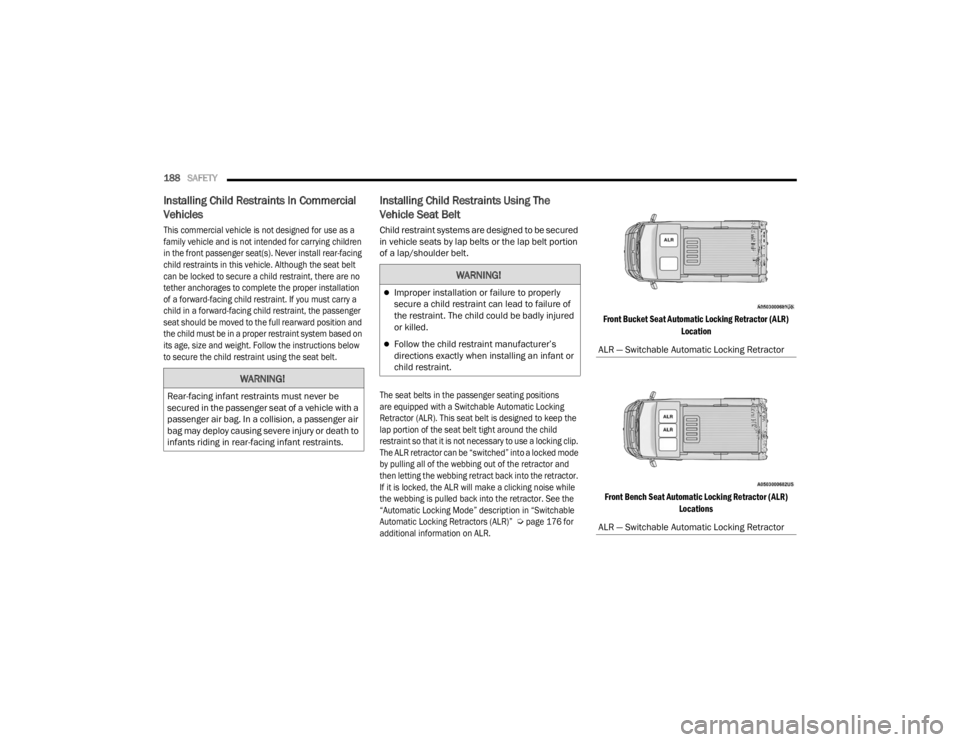
The seat belts in the passenger seating positions
are equipped with a Switchable Automatic Locking
Retractor (ALR). This seat belt is designed to keep the
lap portion of the seat belt tight around the child
restraint so that it is not necessary to use a locking clip.
The ALR retractor can be “switched” into a locked mode
by pulling all of the webbing out of the retractor and
then letting the webbing retract back into the retractor.
If it is locked, the ALR will make a clicking noise while
the webbing is pulled back into the retractor. See the
“Automatic Locking Mode” description in “Switchable
Automatic Locking Retractors (ALR)”
Ú
page 176 for
additional information on ALR.
Front Bucket Seat Automatic Locking Retractor (ALR)
Location
Front Bench Seat Automatic Locking Retractor (ALR) Locations
WARNING!
Rear-facing infant restraints must never be
secured in the passenger seat of a vehicle with a
passenger air bag. In a collision, a passenger air
bag may deploy causing severe injury or death to
infants riding in rear-facing infant restraints.
WARNING!
Improper installation or failure to properly
secure a child restraint can lead to failure of
the restraint. The child could be badly injured
or killed.
Follow the child restraint manufacturer’s
directions exactly when installing an infant or
child restraint.ALR — Switchable Automatic Locking Retractor
ALR — Switchable Automatic Locking Retractor
23_VF_OM_EN_USC_t.book Page 188
Page 191 of 296

SAFETY189
Installing A Child Restraint With A
Switchable Automatic Locking
Retractor (ALR)
Child restraint systems are designed to be secured
in vehicle seats by lap belts or the lap belt portion
of a lap/shoulder belt.
1. Place the child seat in the center of the
seating position.
2. Pull enough of the seat belt webbing from the retractor to pass it through the belt path of the
child restraint. Do not twist the belt webbing in
the belt path.
3. Slide the latch plate into the buckle until you hear a “click.” 4. Pull on the webbing to make the lap portion
tight against the child seat.
5. To lock the seat belt, pull down on the shoulder part of the belt until you have pulled all the
seat belt webbing out of the retractor. Then,
allow the webbing to retract back into the
retractor. As the webbing retracts, you will hear
a clicking sound. This means the seat belt is
now in the Automatic Locking mode.
6. Try to pull the webbing out of the retractor. If it is locked, you should not be able to pull out any
webbing. If the retractor is not
locked, repeat
step 5.
7. Finally, pull up on any excess webbing to tighten the lap portion around the child
restraint while you push the child restraint
rearward and downward into the vehicle seat.
8. Test that the child restraint is installed tightly by pulling back and forth on the child seat at
the belt path. It should not move more than
1 inch (25.4 mm) in any direction.
Any seat belt system will loosen with time, so check
the belt occasionally, and pull it tight if necessary.
SAFETY TIPS
TRANSPORTING PASSENGERS
NEVER TRANSPORT PASSENGERS IN THE CARGO
AREA.
WARNING!
Improper installation or failure to properly
secure a child restraint can lead to failure of
the restraint. The child could be badly injured
or killed.
Follow the child restraint manufacturer’s
directions exactly when installing an infant or
child restraint.
WARNING!
Do not leave children or animals inside parked
vehicles in hot weather. Interior heat buildup
may cause serious injury or death.
It is extremely dangerous to ride in a cargo
area, inside or outside of a vehicle. In a colli -
sion, people riding in these areas are more
likely to be seriously injured or killed.
Do not allow people to ride in any area of your
vehicle that is not equipped with seats and
seat belts.
Be sure everyone in your vehicle is in a seat
and using a seat belt properly.
6
23_VF_OM_EN_USC_t.book Page 189
Page 192 of 296

190SAFETY
(Continued)
TRANSPORTING PETS
Air Bags deploying in the front seat could harm
your pet. An unrestrained pet will be thrown about
and possibly injured, or injure a passenger during
panic braking or in a collision.
Pets should be restrained in the rear seat
(if equipped) in pet harnesses or pet carriers
that are secured by seat belts.
CONNECTED VEHICLES
Privacy of any wireless and wired communications
cannot be assured. Third parties may unlawfully
intercept information and private communications
without your consent. For further information, refer to
“Data Collection & Privacy” in your Uconnect Owner’s
Manual Supplement or “Onboard Diagnostic System
(OBD II) Cybersecurity”
Ú
page 133.
SAFETY CHECKS YOU SHOULD MAKE
I
NSIDE THE VEHICLE
Seat Belts
Inspect the seat belt system periodically, checking
for cuts, frays, and loose parts. Damaged parts
must be replaced immediately. Do not
disassemble or modify the system.
If your vehicle is involved in a collision, or if you
have questions regarding the seat belt or retractor
conditions, take your vehicle to an authorized FCA
dealer or authorized FCA Certified Collision Care
Program facility for inspection.
Air Bag Warning Light
The Air Bag Warning Light will turn on for
four to eight seconds as a bulb check
when the ignition switch is first placed in
the MAR (ACC/ON/RUN) position. If the
light is either not on during starting, stays on, or
turns on while driving, have the system inspected
at an authorized dealer as soon as possible. After
the bulb check, this light will illuminate with a
single chime when a fault with the Air Bag System
has been detected. It will stay on until the fault is
removed. If the light comes on intermittently or
remains on while driving, have an authorized
dealer service the vehicle immediately
Ú page 170.
Defroster
Check operation by selecting the defrost mode and
place the blower control on high speed. You should
be able to feel the air directed against the windshield.
See an authorized dealer for service if your defroster is
inoperable.
Floor Mat Safety Information
Always use floor mats designed to fit your vehicle.
Only use a floor mat that does not interfere with the
operation of the accelerator, brake or clutch pedals.
Only use a floor mat that is securely attached using the
floor mat fasteners so it cannot slip out of position and
interfere with the accelerator, brake or clutch pedals or
impair safe operation of your vehicle in other ways.
WARNING!
It is not possible to know or to predict all of the
possible outcomes if your vehicle’s systems
are breached. It may be possible that vehicle
systems, including safety related systems, could
be impaired or a loss of vehicle control could
occur that may result in an accident involving
serious injury or death.
WARNING!
An improperly attached, damaged, folded,
or stacked floor mat, or damaged floor mat
fasteners may cause your floor mat to interfere
with the accelerator, brake, or clutch pedals and
cause a loss of vehicle control. To prevent
SERIOUS INJURY or DEATH:
ALWAYS securely attach your floor
mat using the floor mat fasteners.
DO NOT install your floor mat upside
down or turn your floor mat over.
Lightly pull to confirm mat is secured using the
floor mat fasteners on a regular basis.
23_VF_OM_EN_USC_t.book Page 190
Page 231 of 296

SERVICING AND MAINTENANCE229
Engine Air Cleaner Filter Selection
The quality of replacement filters varies
considerably. Only high quality Mopar® certified
filters should be used.
Engine Air Cleaner Filter Inspection and
Replacement
Engine Air Cleaner Filter Removal
1. With a suitable tool, loosen the clamps and remove the engine air duct supply hose.
Engine Air Duct Supply Hose
2. With a suitable tool, fully loosen fasteners on the engine air cleaner filter cover and remove
the cover.
Engine Air Cleaner Filter Cover
3. Remove the engine air cleaner filter from the housing assembly.
Engine Air Cleaner Filter
Engine Air Cleaner Filter Installation
NOTE:Inspect and clean the housing assembly if signif
-
icant dirt or debris is present before replacing the
engine air cleaner filter.
1. Install the engine air cleaner filter into the housing assembly.
2. Install the engine air cleaner filter cover onto the housing assembly.
3. Tighten the fasteners on the engine air cleaner filter assembly.
4. Install the engine air duct supply hose and tighten the clamps
AIR CONDITIONER MAINTENANCE
For best possible performance, your air conditioner
should be checked and serviced by an authorized
dealer at the start of each warm season. This
service should include cleaning of the condenser
fins and a performance test. Drive belt tension
should also be checked at this time.
1 — Clamps
2 — Engine Air Duct Supply Hose
1 — Fasteners
2 — Engine Air Cleaner Filter Cover
1 — Engine Air Cleaner Filter
8
23_VF_OM_EN_USC_t.book Page 229
Page 269 of 296

SERVICING AND MAINTENANCE267
Stain Repel Fabric Cleaning Procedure —
If Equipped
Stain Repel seats may be cleaned in the following
manner:
Remove as much of the stain as possible by
blotting with a clean, dry towel.
Blot any remaining stain with a clean, damp
towel.
For tough stains, apply Mopar® Total Clean, or
a mild soap solution to a clean, damp cloth and
remove stain. Use a fresh, damp towel to
remove soap residue.
For grease stains, apply Mopar® Multi-Purpose
Cleaner to a clean, damp cloth and remove
stain. Use a fresh, damp towel to remove soap
residue.
Do not use any harsh solvents or any other form
of protectants on Stain Repel products.
Seat Belt Maintenance
Do not bleach, dye or clean the belts with chemical
solvents or abrasive cleaners. This will weaken the
fabric.
If the belts need cleaning, use a mild soap solution
or lukewarm water. Do not remove the belts from
the vehicle to wash them. Dry with a soft cloth.
Sun damage can also weaken the fabric. Replace
the belts if they appear frayed or worn or if the
buckles do not work properly.
PLASTIC AND COATED PARTS
Use Mopar® Total Clean to clean vinyl upholstery.
Cleaning Plastic Instrument Cluster
Lenses
The lenses in front of the instruments in this
vehicle are molded in clear plastic. When cleaning
the lenses, care must be taken to avoid scratching
the plastic.
Clean with a wet soft cloth. A mild soap solution
may be used, but do not use high alcohol content
or abrasive cleaners. If soap is used, wipe clean
with a clean damp cloth. Dry with a soft cloth.
WARNING!
A frayed or torn seat belt could rip apart in a collision
and leave you with no protection. Inspect the seat
belt system periodically, checking for cuts, frays, or
loose parts. Damaged parts must be replaced
immediately. Do not disassemble or modify the seat
belt system. If your vehicle is involved in a collision,
or if you have questions regarding seat belt or
retractor conditions, take your vehicle to an
authorized FCA dealer or authorized FCA Certified
Collision Care Program facility for inspection.
CAUTION!
Direct contact of air fresheners, insect repel -
lents, suntan lotions, or hand sanitizers to the
plastic, painted, or decorated surfaces of the
interior may cause permanent damage. Wipe
away immediately.
Damage caused by these type of products
may not be covered by your New Vehicle
Limited Warranty.
8
23_VF_OM_EN_USC_t.book Page 267
Page 285 of 296

283
INDEX
A
Active Driving Assist....................................... 100Active Speed Limiter........................................ 86Adaptive Cruise Control (ACC)
(Cruise Control)................................................ 87Adding Engine Coolant (Antifreeze)............... 233Adding Washing Fluid.................................... 226Additives, Fuel............................................... 271Air Bag........................................................... 179Air Bag Operation...................................... 180Air Bag Warning Light................................ 178Enhanced Accident Response...................220Event Data Recorder (EDR)....................... 220If Deployment Occurs................................ 183Maintaining Your Air Bag System.............. 184Maintenance............................................. 184Side Air Bags............................................. 180Transporting Pets...................................... 190Air Bag Light..................................65, 178, 190Air Cleaner, Engine (Engine Air
Cleaner Filter)...................................... 228, 229Air Conditioner Maintenance......................... 229Air Conditioner Refrigerant.................. 229, 230Air Conditioner System.................................. 229Air Conditioning Filter............................. 43, 230Air Conditioning, Operating Tips................ 43, 44
Air Filter........................................................ 228Air PressureTires......................................................... 256AlarmSecurity Alarm...................................... 20, 68Alarm SystemSecurity Alarm............................................. 20Alterations/ModificationsVehicle........................................................... 8Antifreeze (Engine Coolant)................. 233, 273Disposal................................................... 234Anti-Lock Brake System (ABS)...................... 152Anti-Lock Warning Light................................... 68Assist, Hill Start............................................. 155Audio Systems (Radio).................................. 133Auto Down Power Windows............................. 49Auto Up Power Windows.................................. 49Automatic Door Locks...................................... 23Automatic Headlights....................................... 34Automatic High Beams.................................... 34Automatic Transmission.........................81, 236Adding Fluid.............................................. 236Fluid And Filter Change............................ 236Fluid Change............................................ 236Fluid Level Check..................................... 236
Fluid Type........................................ 236, 274Special Additives...................................... 236AUX Cord..........................................................45Auxiliary Driving Systems.............................. 158
B
Base / Midline Instrument Cluster
S
............53Battery................................................... 66, 227Charging System Light.................................66Keyless Key Fob Replacement....................14Belts, Seat.................................................... 190Blind Spot Monitoring................................... 158Body Builders Guide........................................... 8Body Mechanism Lubrication........................ 231B-Pillar Location............................................ 253Brake Assist System..................................... 153Brake Control System, Electronic.................. 153Brake Fluid........................................... 235, 274Brake System....................................... 235, 269Anti-Lock (ABS)......................................... 152Fluid Check............................................... 235Master Cylinder........................................ 235Parking........................................................78Warning Light...............................................6611
23_VF_OM_EN_USC_t.book Page 283
Page 288 of 296

286 Gauges Fuel
............................................................. 69Gear Ranges.................................................... 82Gear Selector Override.................................. 217Glass Cleaning............................................... 268Gross Axle Weight Rating..................... 123, 125Gross Vehicle Weight Rating................ 123, 124GuideBody Builders................................................ 8GVWR............................................................ 123
H
HazardDriving Through Flowing, Rising, Or Shallow Standing Water
..................................... 131Hazard Warning Flashers.............................. 193Head Restraints............................................... 28HeadlightsAutomatic.................................................... 34Cleaning.................................................... 266High Beam.................................................. 34High Beam/Low Beam Select Switch.......... 34Passing........................................................ 34Switch......................................................... 33Heated Mirrors................................................ 33Heated Seats................................................... 26Heater, Engine Block....................................... 77High Beam/Low Beam Select (Dimmer)
Switch.............................................................. 34Hill Start Assist.............................................. 155
HitchesTrailer Towing........................................... 126Hood Prop........................................................ 50Hood Release.................................................. 50
I
Ignition............................................................. 16Switch.......................................................... 16Illuminated Entry.............................................. 38Immobilizer (Sentry Key).................................. 16Inside Rearview Mirror............................30, 193Instrument ClusterDescriptions................................................ 55Display......................................................... 56Display Controls........................................... 56Menu Items................................................. 57Instrument Panel Lens Cleaning................... 267Intelligent Speed Assist................................... 87Interior And Instrument Lights......................... 36Interior Appearance Care.............................. 266Interior Lights................................................... 36Intermittent Wipers (Delay Wipers).................. 39InverterPower.......................................................... 47iPod/USB/MP3 Control.................................... 45
J
Jack Location................................................ 196Jack Operation.............................................. 196Jacking And Tire Changing............................ 196
Jacking And Tire Changing
S
..................... 196Jacking And Tire Changing Instructions......... 197Jump Starting................................................ 214
K
Key Fob............................................................13Programming Additional Key Fobs...............15Key Fob Battery Service (Remote
Keyless Entry)..................................................14Key Fob Programming (Remote
Keyless Entry)..................................................15Keyless Enter ‘n Go™.......................................22Passive Entry...............................................22Keys.................................................................13Replacement...............................................15Sentry (Immobilizer).....................................16
L
Lane Change Assist..........................................35LaneSense.................................................... 116Lap/Shoulder Belts....................................... 172Latches......................................................... 191Hood............................................................50Lead Free Gasoline....................................... 270Leaks, Fluid................................................... 191Life Of Tires................................................... 258Light Bulbs........................................... 191, 244
23_VF_OM_EN_USC_t.book Page 286
Page 289 of 296

287
Lights
............................................................. 191Air Bag.......................................65, 178, 190Brake Assist Warning................................ 155Brake Warning............................................ 66Bulb Replacement..................................... 244Collision Warning................................. 70, 72Cruise.......................................................... 72Daytime Running......................................... 33Dimmer Switch, Headlight.................... 33, 34Electronic Stability Program(ESP) Indicator.................................. 67, 69, 155Exterior............................................... 33, 191Fuel Cutoff Failure....................................... 72Hazard Warning Flasher............................ 193Headlights................................................... 33High Beam.................................................. 34Illuminated Entry......................................... 38Instrument Cluster...................................... 67Interior........................................................ 36Malfunction Indicator (Check Engine)......... 69Park...................................................... 34, 73Passing........................................................ 34Rear Cargo Door Open Warning Light.......... 68Seat Belt Reminder..................................... 68Security Alarm............................................. 68Service...................................................... 244Tire Pressure Monitoring (TPMS)............... 168Tow Haul..................................................... 72
TowingHookBreakdown............................... 71Traction Control........................................ 155Turn Signals.......................................33, 191Warning Instrument Cluster Descriptions.... 67Loading Vehicle................................... 123, 124Capacities................................................. 124Tires......................................................... 253LocksAutomatic Door..................................... 21, 23Low Tire Pressure System............................. 168Lubrication, Body.......................................... 231Lug Nuts/Bolts.............................................. 269
M
Maintenance Free Battery............................ 227Maintenance Schedule................................. 221Malfunction Indicator Light (Check Engine)..... 69ManualService..................................................... 279Methanol...................................................... 271Mirrors............................................................. 30Electric Remote........................................... 32Exterior Folding............................................ 31Heated......................................................... 33Outside........................................................ 31Rearview.............................................30, 193Modifications/AlterationsVehicle........................................................... 8Monitor, Tire Pressure System...................... 168Mopar Parts.................................................. 278
MP3 Control.....................................................45Multi-Function Control Lever............................33
N
New Vehicle Break-In Period............................78
O
Occupant Restraints..................................... 170Octane Rating, Gasoline (Fuel)...................... 270Oil Change Indicator.........................................57Reset...........................................................57Oil Filter, Change........................................... 228Oil Filter, Selection........................................ 228Oil Pressure Light.............................................68Oil, Engine............................................ 228, 273Capacity.................................................... 273Checking................................................... 226Dipstick..................................................... 226Disposal.................................................... 228Filter......................................................... 228Filter Disposal........................................... 228Identification Logo.................................... 228Materials Added To................................... 228Pressure Warning Light................................68Recommendation............................ 228, 273Synthetic................................................... 228Viscosity.................................................... 273Onboard Diagnostic System.............................74Operating Precautions.....................................74
11
23_VF_OM_EN_USC_t.book Page 287