coolant Ram ProMaster City 2016 User Guide
[x] Cancel search | Manufacturer: RAM, Model Year: 2016, Model line: ProMaster City, Model: Ram ProMaster City 2016Pages: 438, PDF Size: 3.26 MB
Page 373 of 438
engine coolant in open containers or allow it to remain in
puddles on the ground. If ingested by a child or pet, seek
emergency assistance immediately. Clean up any ground
spills immediately.
Coolant Level
The coolant expansion bottle provides a quick visual
method for determining that the coolant level is ad-
equate. With the engine OFF and cold, the level of the
engine coolant (antifreeze) in the bottle should be be-
tween the “MIN” and “MAX” marks.
The radiator normally remains completely full, so there is
no need to remove the radiator/coolant pressure cap
unless checking for engine coolant (antifreeze) freeze
point or replacing coolant. Advise your service attendant
of this. As long as the engine operating temperature is
satisfactory, the coolant bottle need only be checked once
a month.When additional engine coolant (antifreeze) is needed to
maintain the proper level, only OAT coolant that meets
the requirements of FCA Material Standard MS.90032
should be added to the coolant bottle. Do not overfill.
Points To Remember
NOTE:
When the vehicle is stopped after a few miles/
kilometers of operation, you may observe vapor coming
from the front of the engine compartment. This is nor-
mally a result of moisture from rain, snow, or high
humidity accumulating on the radiator and being vapor-
ized when the thermostat opens, allowing hot engine
coolant (antifreeze) to enter the radiator.
If an examination of your engine compartment shows no
evidence of radiator or hose leaks, the vehicle may be
safely driven. The vapor will soon dissipate.
• Do not overfill the coolant expansion bottle.
7
MAINTAINING YOUR VEHICLE 371
Page 374 of 438
•Check the coolant freeze point in the radiator and in
the coolant expansion bottle. If engine coolant (anti-
freeze) needs to be added, the contents of the coolant
expansion bottle must also be protected against freez-
ing.
• If frequent engine coolant (antifreeze) additions are
required, the cooling system should be pressure tested
for leaks.
• Maintain engine coolant (antifreeze) concentration at a
minimum of 50% OAT coolant (conforming to
MS.90032) and distilled water for proper corrosion
protection of your engine which contains aluminum
components.
• Make sure that the coolant expansion bottle overflow
hoses are not kinked or obstructed.
• Keep the front of the radiator clean. If your vehicle is
equipped with air conditioning, keep the front of the
condenser clean. •
Do not change the thermostat for Summer or Winter
operation. If replacement is ever necessary, install
ONLY the correct type thermostat. Other designs may
result in unsatisfactory engine coolant (antifreeze)
performance, poor gas mileage, and increased emis-
sions.
Brake System
In order to assure brake system performance, all brake
system components should be inspected periodically.
Refer to the “Maintenance Schedule” for the proper
maintenance intervals.
WARNING!
Riding the brakes can lead to brake failure and
possibly a collision. Driving with your foot resting or
riding on the brake pedal can result in abnormally
(Continued)
372 MAINTAINING YOUR VEHICLE
Page 398 of 438
License Plate Lights
Proceed as follows to replace the bulbs:
1. Disengage the holding tabs and remove the lens bylifting to the left. 2. Remove the bulbs by releasing them from the side
contacts; insert the new bulbs and make sure they are
correctly clamped between these contacts.
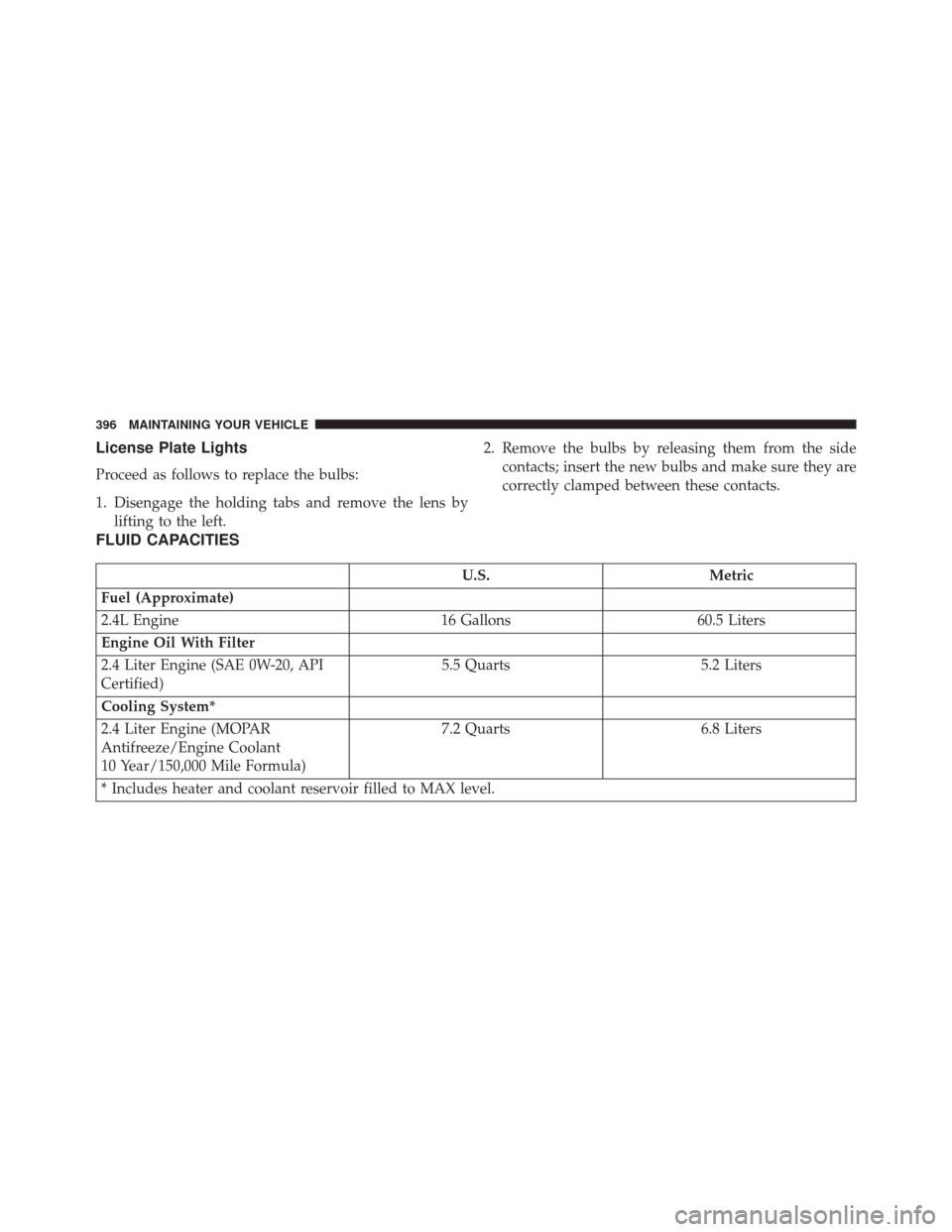
FLUID CAPACITIES
U.S. Metric
Fuel (Approximate)
2.4L Engine 16 Gallons60.5 Liters
Engine Oil With Filter
2.4 Liter Engine (SAE 0W-20, API
Certified) 5.5 Quarts
5.2 Liters
Cooling System*
2.4 Liter Engine (MOPAR
Antifreeze/Engine Coolant
10 Year/150,000 Mile Formula) 7.2 Quarts
6.8 Liters
* Includes heater and coolant reservoir filled to MAX level.
396 MAINTAINING YOUR VEHICLE
Page 399 of 438
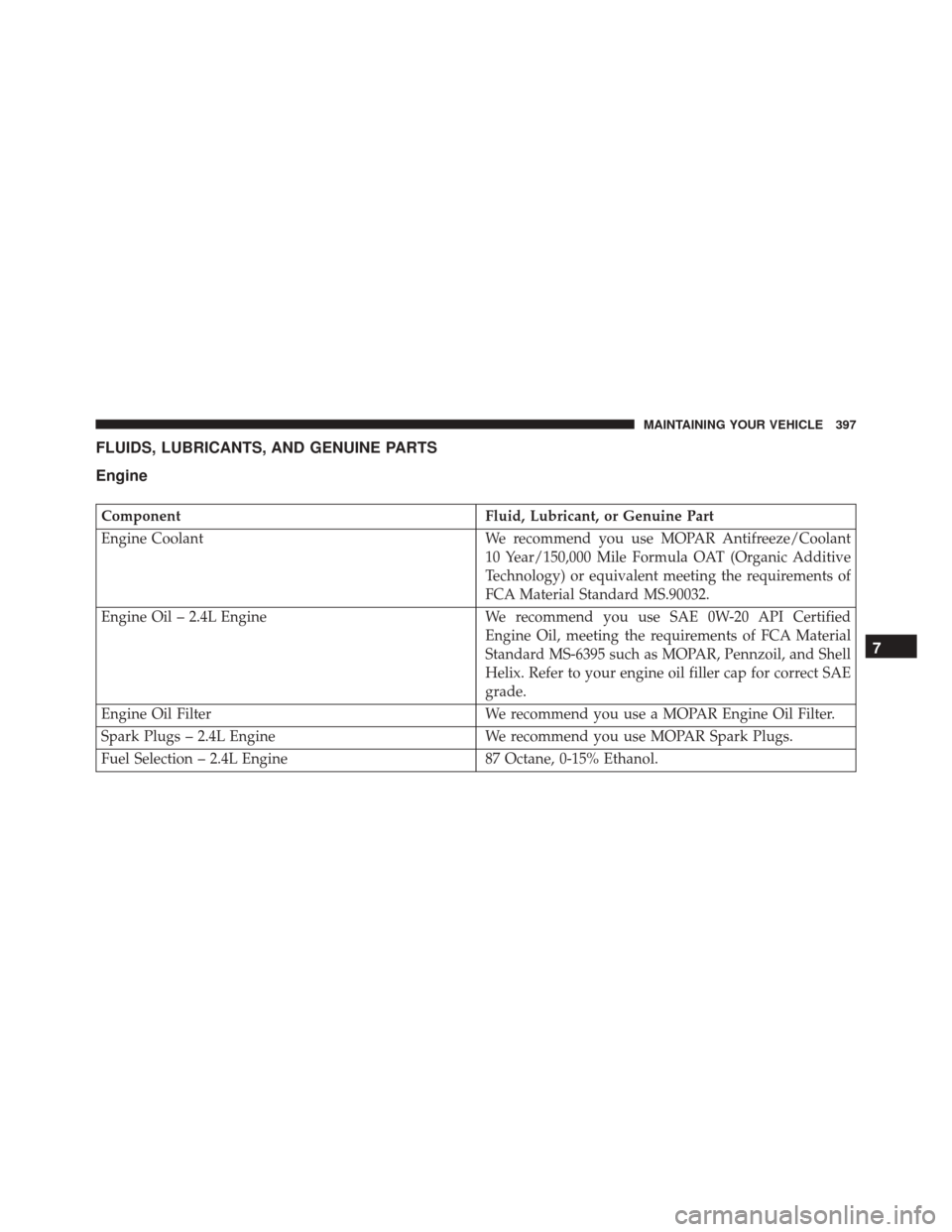
FLUIDS, LUBRICANTS, AND GENUINE PARTS
Engine
ComponentFluid, Lubricant, or Genuine Part
Engine Coolant We recommend you use MOPAR Antifreeze/Coolant
10 Year/150,000 Mile Formula OAT (Organic Additive
Technology) or equivalent meeting the requirements of
FCA Material Standard MS.90032.
Engine Oil – 2.4L Engine We recommend you use SAE 0W-20 API Certified
Engine Oil, meeting the requirements of FCA Material
Standard MS-6395 such as MOPAR, Pennzoil, and Shell
Helix. Refer to your engine oil filler cap for correct SAE
grade.
Engine Oil Filter We recommend you use a MOPAR Engine Oil Filter.
Spark Plugs – 2.4L Engine We recommend you use MOPAR Spark Plugs.
Fuel Selection – 2.4L Engine 87 Octane, 0-15% Ethanol.
7
MAINTAINING YOUR VEHICLE 397
Page 400 of 438
CAUTION!
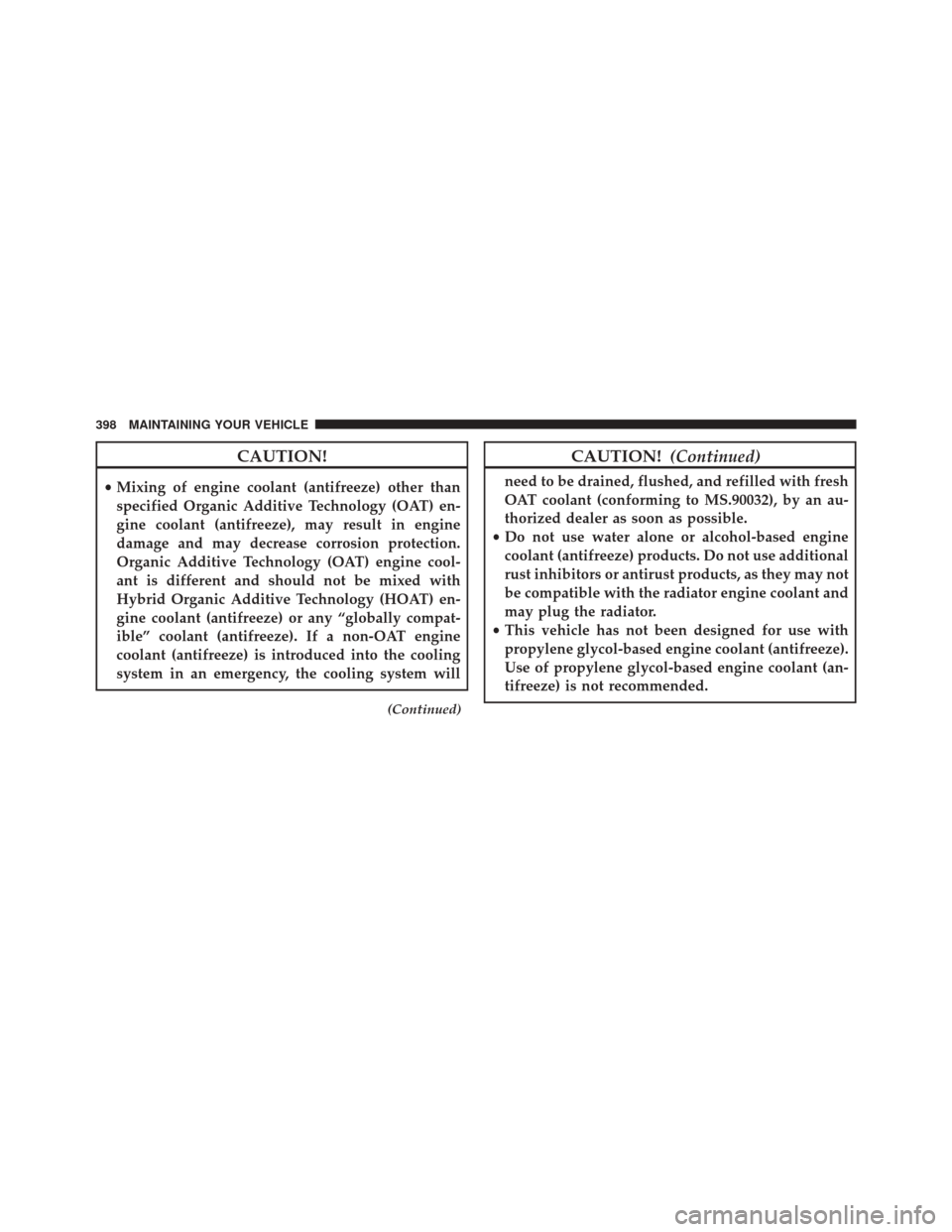
•Mixing of engine coolant (antifreeze) other than
specified Organic Additive Technology (OAT) en-
gine coolant (antifreeze), may result in engine
damage and may decrease corrosion protection.
Organic Additive Technology (OAT) engine cool-
ant is different and should not be mixed with
Hybrid Organic Additive Technology (HOAT) en-
gine coolant (antifreeze) or any “globally compat-
ible” coolant (antifreeze). If a non-OAT engine
coolant (antifreeze) is introduced into the cooling
system in an emergency, the cooling system will
(Continued)
CAUTION! (Continued)
need to be drained, flushed, and refilled with fresh
OAT coolant (conforming to MS.90032), by an au-
thorized dealer as soon as possible.
• Do not use water alone or alcohol-based engine
coolant (antifreeze) products. Do not use additional
rust inhibitors or antirust products, as they may not
be compatible with the radiator engine coolant and
may plug the radiator.
• This vehicle has not been designed for use with
propylene glycol-based engine coolant (antifreeze).
Use of propylene glycol-based engine coolant (an-
tifreeze) is not recommended.
398 MAINTAINING YOUR VEHICLE
Page 405 of 438
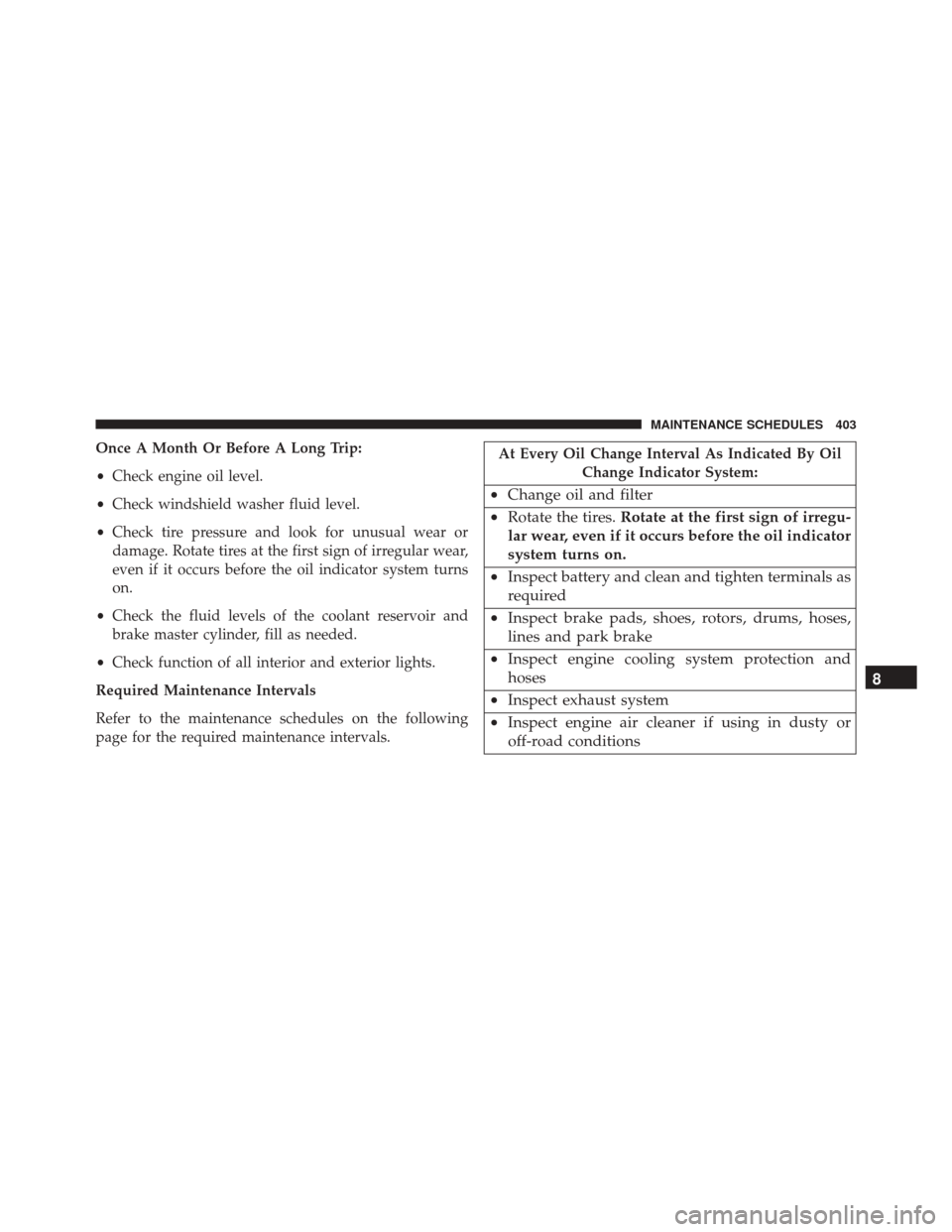
Once A Month Or Before A Long Trip:
•Check engine oil level.
• Check windshield washer fluid level.
• Check tire pressure and look for unusual wear or
damage. Rotate tires at the first sign of irregular wear,
even if it occurs before the oil indicator system turns
on.
• Check the fluid levels of the coolant reservoir and
brake master cylinder, fill as needed.
• Check function of all interior and exterior lights.
Required Maintenance Intervals
Refer to the maintenance schedules on the following
page for the required maintenance intervals.At Every Oil Change Interval As Indicated By Oil Change Indicator System:
•Change oil and filter
• Rotate the tires. Rotate at the first sign of irregu-
lar wear, even if it occurs before the oil indicator
system turns on.
• Inspect battery and clean and tighten terminals as
required
• Inspect brake pads, shoes, rotors, drums, hoses,
lines and park brake
• Inspect engine cooling system protection and
hoses
• Inspect exhaust system
• Inspect engine air cleaner if using in dusty or
off-road conditions 8
MAINTENANCE SCHEDULES 403
Page 407 of 438
Mileage:20,000
30,000
40,000
50,000
60,000
70,000
80,000
90,000
100,000
110,000
120,000
130,000
140,000
150,000
Or Years: 2 3 4 5 6 7 8 9 10 11 12 13 14 15
Or Kilometers:
32,000
48,000
64,000
80,000
96,000
112,000
128,000
144,000
160,000
176,000
192,000
208,000
224,000
240,000
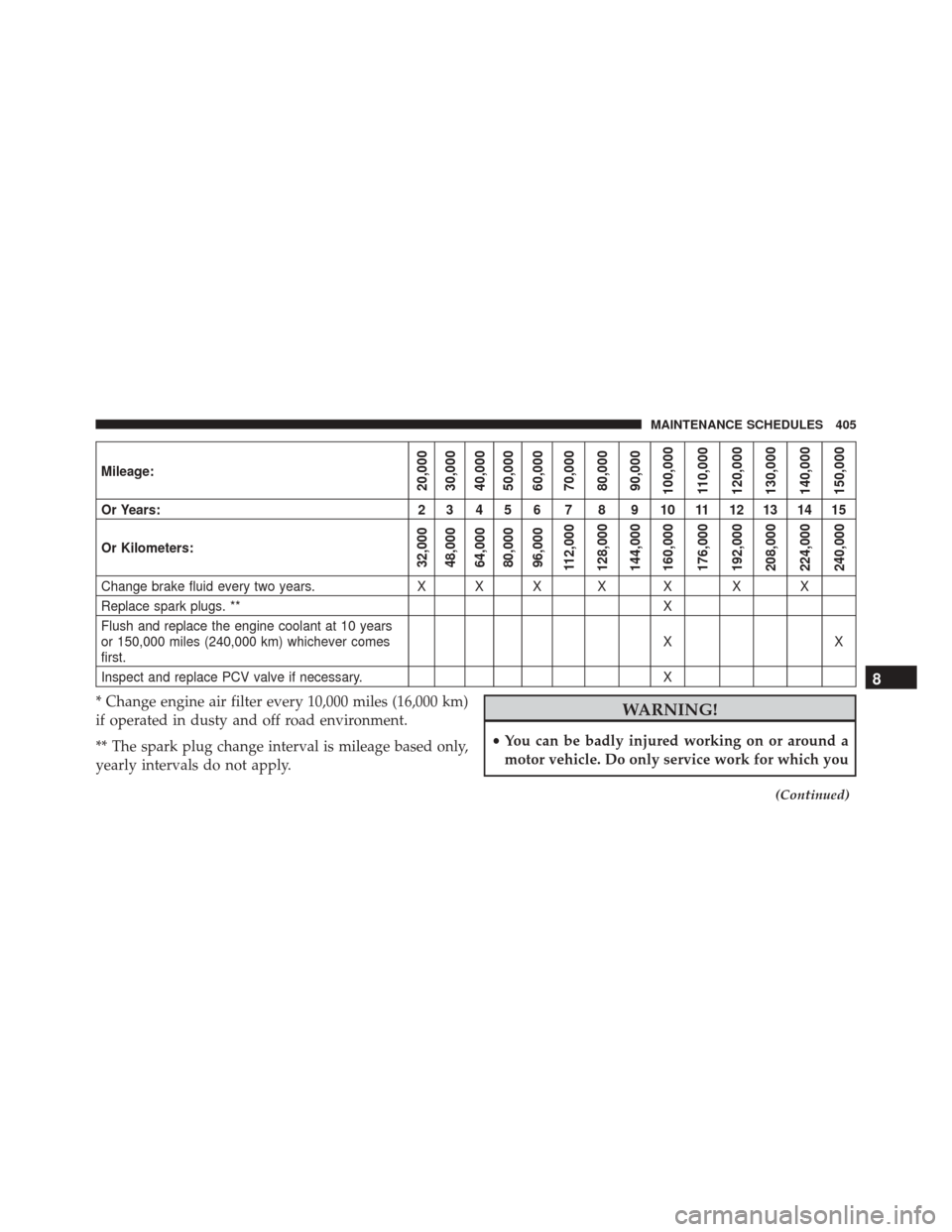
Change brake fluid every two years. X X X X X X X
Replace spark plugs. ** X
Flush and replace the engine coolant at 10 years
or 150,000 miles (240,000 km) whichever comes
first. XX
Inspect and replace PCV valve if necessary. X
* Change engine air filter every 10,000 miles (16,000 km)
if operated in dusty and off road environment.
** The spark plug change interval is mileage based only,
yearly intervals do not apply.WARNING!
•You can be badly injured working on or around a
motor vehicle. Do only service work for which you
(Continued)
8
MAINTENANCE SCHEDULES 405
Page 422 of 438
Adding Engine Coolant (Antifreeze)............368
Additives, Fuel .......................... .286
AirBag.................................47 Advance Front Air Bag ....................49
Air Bag Operation .......................50
Air Bag Warning Light ....................58
Driver Knee Air Bag ......................51
Enhanced Accident Response ................57
Event Data Recorder (EDR) .................60
FrontAirBag...........................47
If A Deployment Occurs ...................56
Knee Impact Bolsters .....................51
Maintaining Your Air Bag System ............59
Transporting Pets ........................85
Air Bag Deployment ........................47
Air Bag Light ...................... .58, 88, 154
Air Bag Maintenance .......................59
Air Cleaner, Engine (Engine Air Cleaner Filter) . . . .358
Air Conditioner Maintenance .................360Air Conditioning Refrigerant
..............360, 361
Air Conditioning System ....................360
Air Filter .............................. .358
Air Pressure, Tires ........................ .266
Air Recirculation ......................... .208
Alarm (Security Alarm) ......................16
Alarm System (Security Alarm) ................16
Alterations/Modifications, Vehicle ...............7
Antifreeze (Engine Coolant) ...............367, 396
Disposal ............................. .370
Anti-Lock Brake System (ABS) ................244
Appearance Care ........................ .377
Ashtray ............................... .134
Audio Systems (Radio) .....................201
Auto Down Power Windows ..................27
Automatic Transaxle .....................12, 223
Automatic Transmission ..............226, 228, 376
Adding Fluid ...................... .376, 399
Fluid And Filter Changes ..................376
420 INDEX
Page 423 of 438
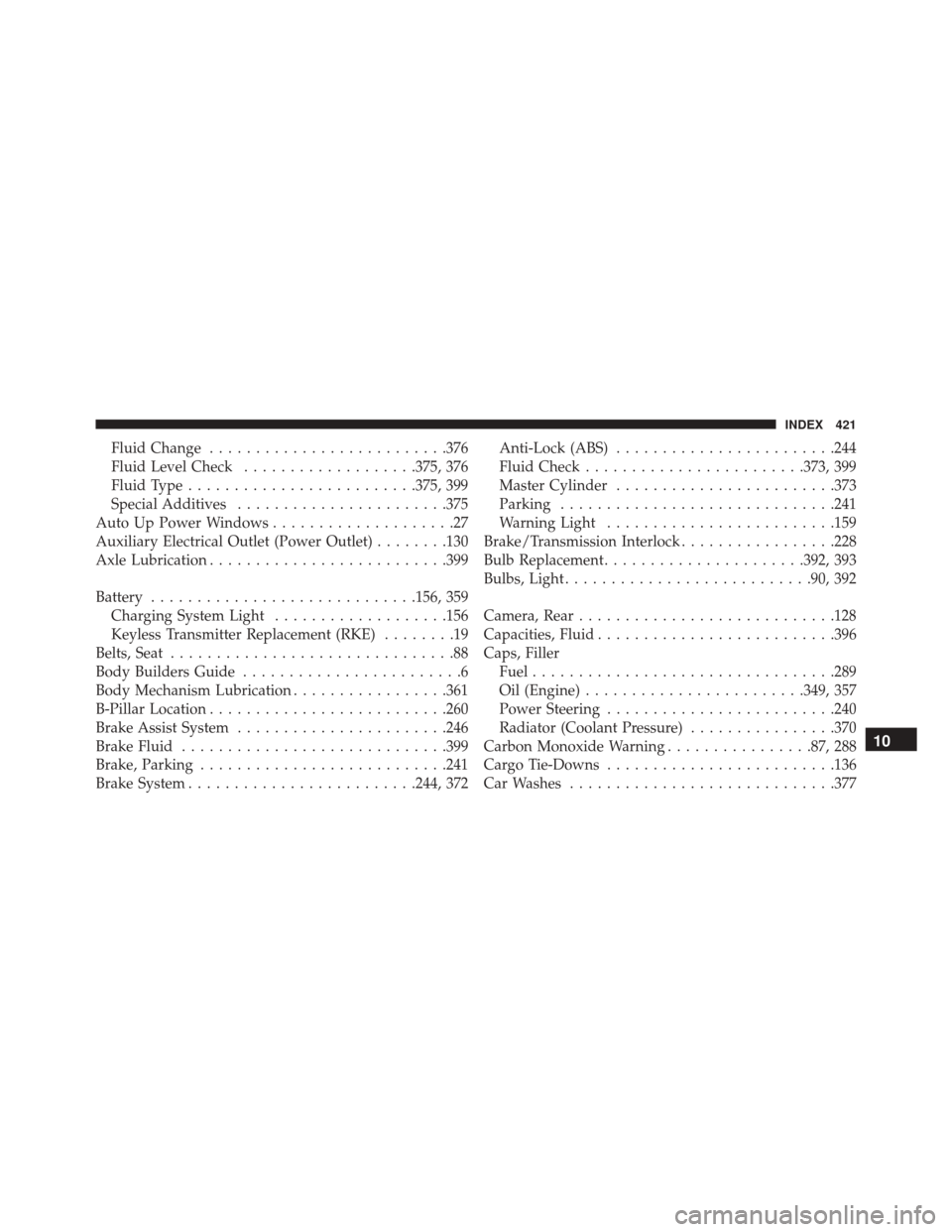
Fluid Change......................... .376
Fluid Level Check ...................375, 376
Fluid Type ........................ .375, 399
Special Additives ...................... .375
Auto Up Power Windows ....................27
Auxiliary Electrical Outlet (Power Outlet) ........130
Axle Lubrication ......................... .399
Battery ............................ .156, 359
Charging System Light ...................156
Keyless Transmitter Replacement (RKE) ........19
Belts, Seat ...............................88
Body Builders Guide ........................6
Body Mechanism Lubrication .................361
B-Pillar Location ......................... .260
Brake Assist System ...................... .246
Brake Fluid ............................ .399
Brake, Parking .......................... .241
Brake System ........................ .244, 372Anti-Lock (ABS)
....................... .244
Fluid Check ....................... .373, 399
Master Cylinder ....................... .373
Parking ............................. .241
Warning Light ........................ .159
Brake/Transmission Interlock .................228
Bulb Replacement ..................... .392, 393
Bulbs, Light .......................... .90, 392
Camera, Rear ........................... .128
Capacities, Fluid ......................... .396
Caps, Filler Fuel ................................ .289
Oil (Engine) ....................... .349, 357
Power Steering ........................ .240
Radiator (Coolant Pressure) ................370
Carbon Monoxide Warning ................87, 288
Cargo Tie-Downs ........................ .136
Car Washes ............................ .377
10
INDEX 421
Page 424 of 438
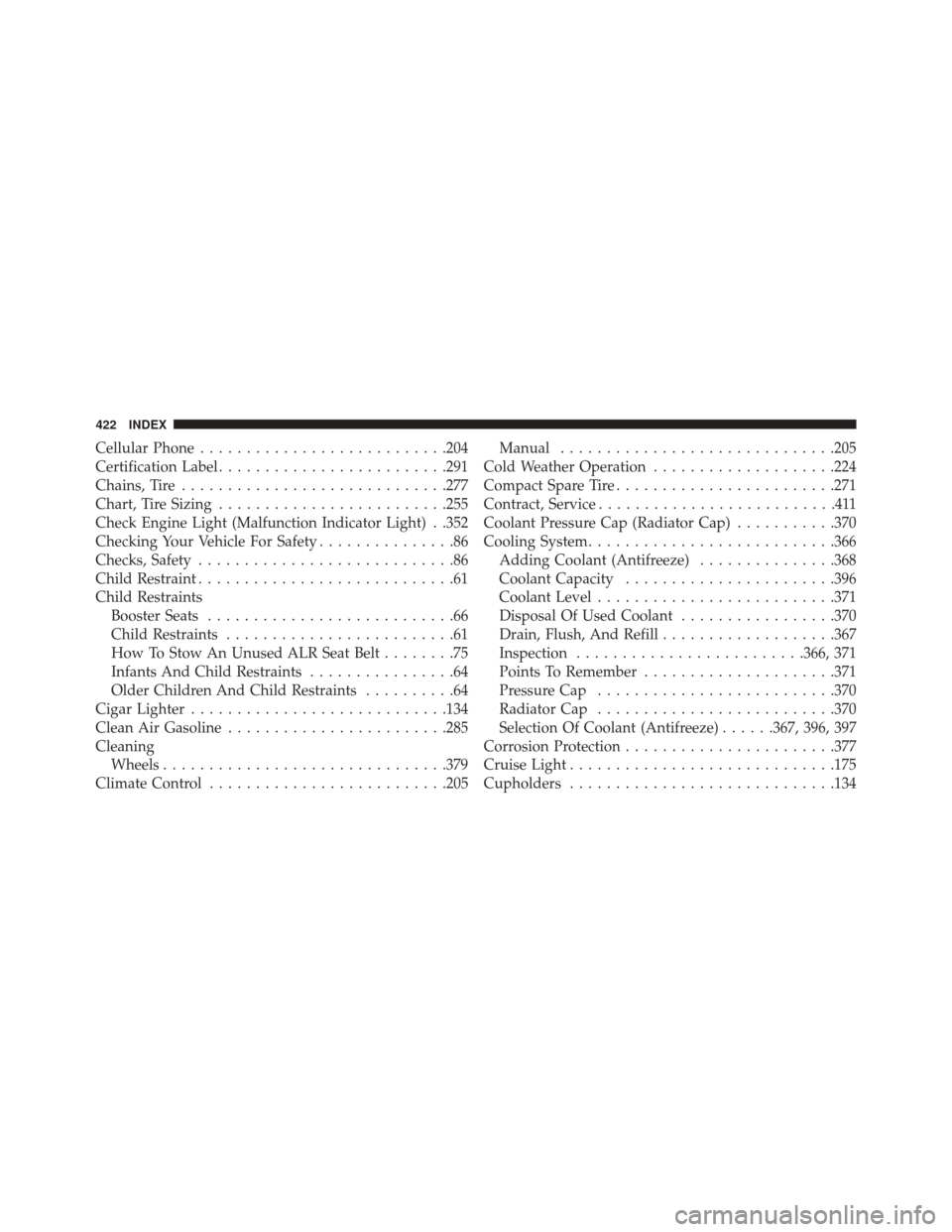
Cellular Phone.......................... .204
Certification Label ........................ .291
Chains, Tire ............................ .277
Chart, Tire Sizing ........................ .255
Check Engine Light (Malfunction Indicator Light) . .352
Checking Your Vehicle For Safety ...............86
Checks, Safety ............................86
Child Restraint ............................61
Child Restraints Booster Seats ...........................66
Child Restraints .........................61
How To Stow An Unused ALR Seat Belt ........75
Infants And Child Restraints ................64
Older Children And Child Restraints ..........64
Cigar Lighter ........................... .134
Clean Air Gasoline ....................... .285
Cleaning Wheels .............................. .379
Climate Control ......................... .205Manual
............................. .205
Cold Weather Operation ....................224
Compact Spare Tire ....................... .271
Contract, Service ..........................411
Coolant Pressure Cap (Radiator Cap) ...........370
Cooling System .......................... .366
Adding Coolant (Antifreeze) ...............368
Coolant Capacity ...................... .396
Coolant Level ......................... .371
Disposal Of Used Coolant .................370
Drain, Flush, And Refill ...................367
Inspection ........................ .366, 371
Points To Remember .....................371
Pressure Cap ......................... .370
Radiator Cap ......................... .370
Selection Of Coolant (Antifreeze) ......367, 396, 397
Corrosion Protection ...................... .377
Cruise Light ............................ .175
Cupholders ............................ .134
422 INDEX