battery Ram ProMaster City 2017 Owner's Guide
[x] Cancel search | Manufacturer: RAM, Model Year: 2017, Model line: ProMaster City, Model: Ram ProMaster City 2017Pages: 345, PDF Size: 3.25 MB
Page 280 of 345
3. Approximately 15 seconds later, one of two things willhappen:
• The MIL will flash for about 10 seconds and then return
to being fully illuminated until you turn OFF the igni-
tion or start the engine. This means that your vehicle’s
OBD II system is not readyand you should notproceed
to the I/M station.
• The MIL will not flash at all and will remain fully
illuminated until you place the ignition in the off posi-
tion or start the engine. This means that your vehicle’s
OBD II system is readyand you can proceed to the I/M
station.
If your OBD II system is not ready,you should see your
authorized dealer or repair facility. If your vehicle was
recently serviced or had a battery failure or replacement,
you may need to do nothing more than drive your vehicle
as you normally would in order for your OBD II system to
update. A recheck with the above test routine may then
indicate that the system is now ready.
Regardless of whether your vehicle’s OBD II system is
ready or not, if the MIL is illuminated during normal
vehicle operation you should have your vehicle serviced before going to the I/M station. The I/M station can fail
your vehicle because the MIL is on with the engine
running.
REPLACEMENT PARTS
Use of genuine MOPAR parts for normal/scheduled main-
tenance and repairs is highly recommended to ensure the
designed performance. Damage or failures caused by the
use of non-MOPAR parts for maintenance and repairs will
not be covered by the New Vehicle Limited Warranty.
DEALER SERVICE
Your authorized dealer has the qualified service personnel,
special tools, and equipment to perform all service opera-
tions in an expert manner. Service Manuals are available
which include detailed service information for your ve-
hicle. Refer to these Service Manuals before attempting any
procedure yourself.
NOTE:
Intentional tampering with emissions control sys-
tems may void your warranty and could result in civil
penalties being assessed against you.
278 MAINTAINING YOUR VEHICLE
Page 284 of 345
Engine Oil Filter
The engine oil filter should be replaced with a new filter at
every engine oil change.
Engine Oil Filter Selection
This manufacturer’s engines have a full-flow type dispos-
able oil filter. Use a filter of this type for replacement. The
quality of replacement filters varies considerably. Only
high quality filters should be used to assure most efficient
service. MOPAR engine oil filters are high quality oil filters
and are recommended.
Engine Air Cleaner Filter
Refer to the “Maintenance Schedule” for the proper main-
tenance intervals.
NOTE:Be sure to follow the “Severe Duty Conditions”
maintenance interval if applicable.
WARNING!
The air induction system (air cleaner, hoses, etc.) can
provide a measure of protection in the case of engine
backfire. Do not remove the air induction system (air
cleaner, hoses, etc.) unless such removal is necessary
for repair or maintenance. Make sure that no one is
near the engine compartment before starting the ve-
hicle with the air induction system (air cleaner, hoses,
etc.) removed. Failure to do so can result in serious
personal injury.
Engine Air Cleaner Filter Selection
The quality of replacement engine air cleaner filters varies
considerably. Only high quality filters should be used to
assure most efficient service. MOPAR engine air cleaner
filters are a high quality filter and are recommended.
Maintenance-Free Battery
Your vehicle is equipped with a maintenance-free battery.
You will never have to add water, nor is periodic mainte-
nance required.
282 MAINTAINING YOUR VEHICLE
Page 285 of 345
WARNING!
•Battery fluid is a corrosive acid solution and can
burn or even blind you. Do not allow battery fluid to
contact your eyes, skin, or clothing. Do not lean over
a battery when attaching clamps. If acid splashes in
eyes or on skin, flush the area immediately with
large amounts of water. Refer to “Jump-Starting
Procedures” in “What To Do In Emergencies” for
further information.
• Battery gas is flammable and explosive. Keep flame
or sparks away from the battery. Do not use a booster
battery or any other booster source with an output
greater than 12 Volts. Do not allow cable clamps to
touch each other.
• Battery posts, terminals, and related accessories con-
tain lead and lead compounds. Wash hands after
handling.
CAUTION!
• It is essential when replacing the cables on the
battery that the positive cable is attached to the
positive post and the negative cable is attached to the
negative post. Battery posts are marked positive (+)
and negative (-) and are identified on the battery
case. Cable clamps should be tight on the terminal
posts and free of corrosion.
• If a “fast charger” is used while the battery is in the
vehicle, disconnect both vehicle battery cables before
connecting the charger to the battery. Do not use a
“fast charger” to provide starting voltage.
Air Conditioner Maintenance
For best possible performance, your air conditioner should
be checked and serviced by an authorized dealer at the
start of each warm season. This service should include
cleaning of the condenser fins and a performance test.
Drive belt tension should also be checked at this time.
7
MAINTAINING YOUR VEHICLE 283
Page 303 of 345
WARNING!(Continued)
•Before replacing a fuse, make sure that the ignition is
off and that all the other services are switched off
and/or disengaged.
• If the replaced fuse blows again, contact an autho-
rized dealer.
• If a general protection fuse for safety systems (air
bag system, braking system), power unit systems
(engine system, gearbox system) or steering system
blows, contact an authorized dealer.
Underhood Fuses
The Front Distribution Unit is located on the right side of
the engine compartment, next to the battery. To access the
fuses, remove fasteners and remove the cover. The ID number of the electrical component corresponding
to each fuse can be found on the back of the cover.
Cavity
Maxi Fuse Mini Fuse Description
F01 60 Amp Blue –Body Controller
F02 40 Amp Orange –Rear Power Windows, Fog Lamps, Front
Heated Seats (If Equipped)
F02 30 Amp Green –Rear Power Windows, Front Heated Seats
(If Equipped)
F02 30 Amp Green –Fog Lamps, Front Heated Seats (If
Equipped)
Front Distribution Unit
7
MAINTAINING YOUR VEHICLE 301
Page 309 of 345
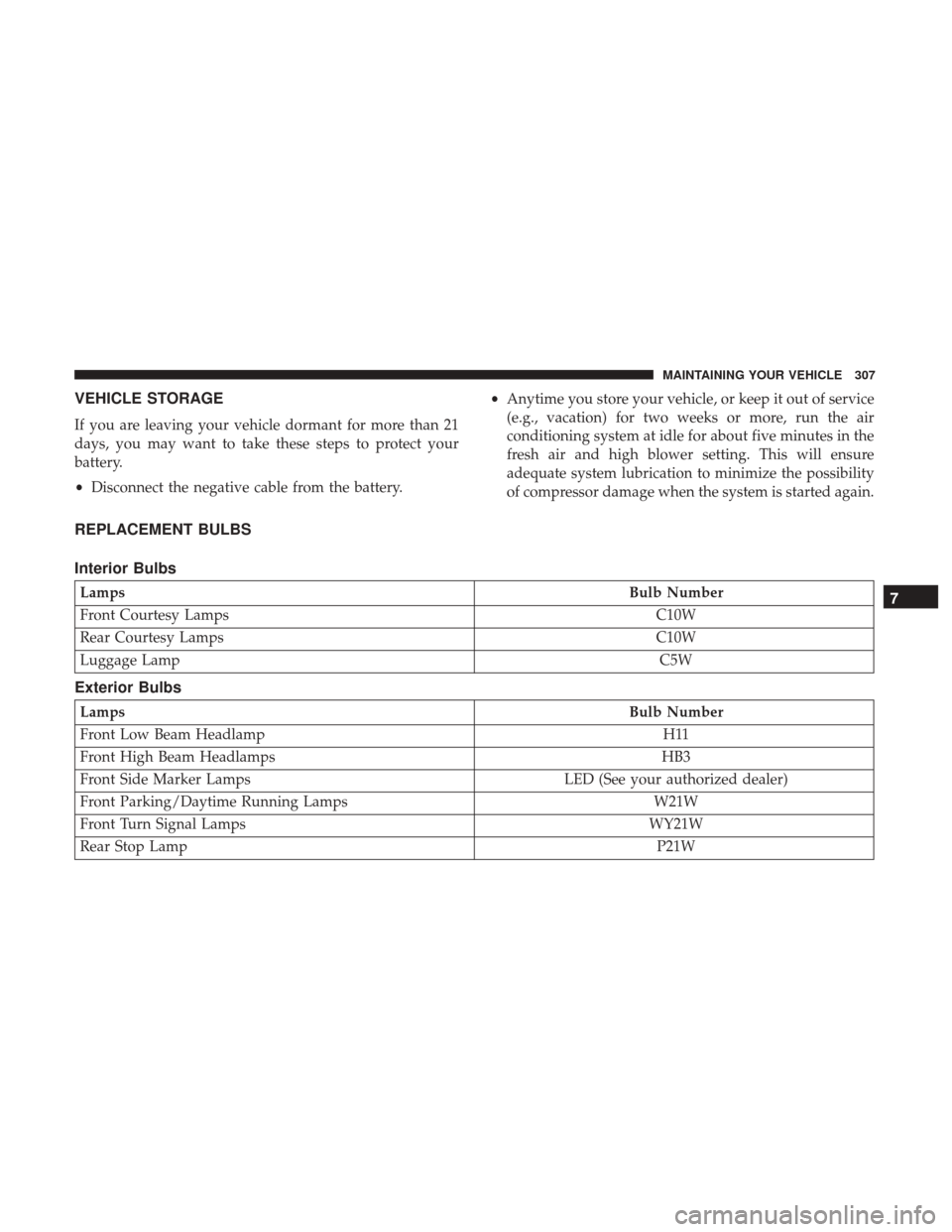
VEHICLE STORAGE
If you are leaving your vehicle dormant for more than 21
days, you may want to take these steps to protect your
battery.
•Disconnect the negative cable from the battery. •
Anytime you store your vehicle, or keep it out of service
(e.g., vacation) for two weeks or more, run the air
conditioning system at idle for about five minutes in the
fresh air and high blower setting. This will ensure
adequate system lubrication to minimize the possibility
of compressor damage when the system is started again.
REPLACEMENT BULBS
Interior Bulbs
Lamps Bulb Number
Front Courtesy Lamps C10W
Rear Courtesy Lamps C10W
Luggage Lamp C5W
Exterior Bulbs
LampsBulb Number
Front Low Beam Headlamp H11
Front High Beam Headlamps HB3
Front Side Marker Lamps LED (See your authorized dealer)
Front Parking/Daytime Running Lamps W21W
Front Turn Signal Lamps WY21W
Rear Stop Lamp P21W
7
MAINTAINING YOUR VEHICLE 307
Page 321 of 345
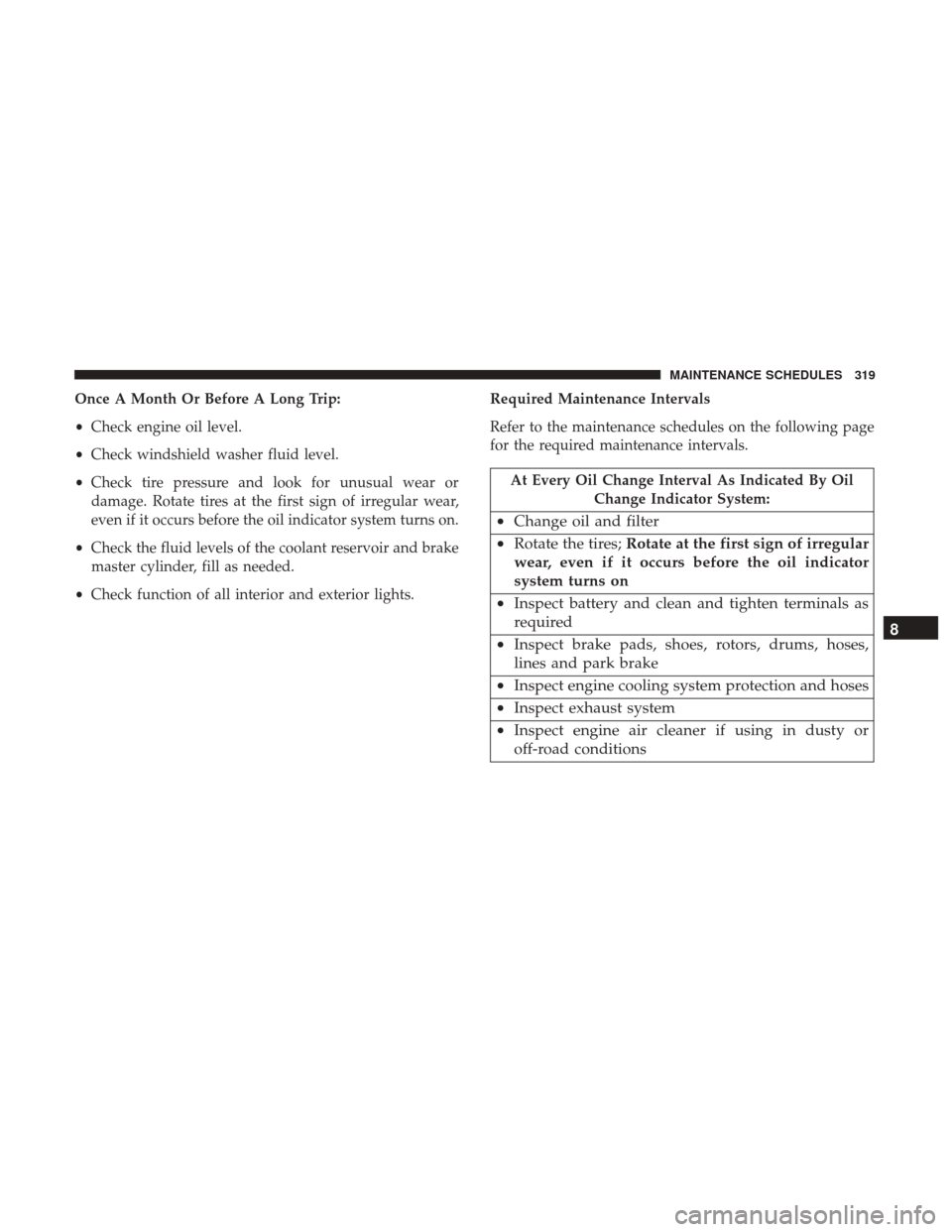
Once A Month Or Before A Long Trip:
•Check engine oil level.
• Check windshield washer fluid level.
• Check tire pressure and look for unusual wear or
damage. Rotate tires at the first sign of irregular wear,
even if it occurs before the oil indicator system turns on.
• Check the fluid levels of the coolant reservoir and brake
master cylinder, fill as needed.
• Check function of all interior and exterior lights. Required Maintenance Intervals
Refer to the maintenance schedules on the following page
for the required maintenance intervals.
At Every Oil Change Interval As Indicated By Oil
Change Indicator System:
•Change oil and filter
• Rotate the tires; Rotate at the first sign of irregular
wear, even if it occurs before the oil indicator
system turns on
• Inspect battery and clean and tighten terminals as
required
• Inspect brake pads, shoes, rotors, drums, hoses,
lines and park brake
• Inspect engine cooling system protection and hoses
• Inspect exhaust system
• Inspect engine air cleaner if using in dusty or
off-road conditions 8
MAINTENANCE SCHEDULES 319
Page 332 of 345
Adding Engine Coolant (Antifreeze).............290
Additives, Fuel ........................... .228
AirBag ..................................38 Air Bag Operation .........................40
Driver Knee Air Bag .......................40
Enhanced Accident Response ................271
Event Data Recorder (EDR) .................271
If A Deployment Occurs ....................44
Knee Impact Bolsters .......................40
Maintaining Your Air Bag System ..............47
Transporting Pets .........................66
Air Bag Light .......................... .68, 132
Air Bag Maintenance .........................47
Air Cleaner, Engine (Engine Air Cleaner Filter) ......282
Air Conditioner Maintenance ..................283
Air Conditioning Filter ...................... .167
Air Conditioning, Operating Tips ............166, 168
Air Conditioning Refrigerant ...............283, 284
Air Conditioning System .....................283
Air Filter ............................... .282
Air Pressure, Tires ..........................211
Alarm (Security Alarm) .......................14
Alarm System (Security Alarm) .................14
Alterations/Modifications, Vehicle ................7
Antifreeze (Engine Coolant) ................289, 313 Disposal
.............................. .291
Anti-Lock Brake System (ABS) .................194
Appearance Care .......................... .296
Ashtray ................................ .106
Audio Systems (Radio) ...................... .159
Auto Down Power Windows ...................22
Automatic Transaxle ......................11,178
Automatic Transmission ...............181, 182, 295
Adding Fluid ....................... .295, 316
Fluid And Filter Changes ...................295
Fluid Change .......................... .295
Fluid Level Check .....................294, 295
Fluid Type ......................... .294, 316
Special Additives ........................ .295
Auto
Up Power Windows .....................22
Auxiliary Electrical Outlet (Power Outlet) .........104
Axle Lubrication .......................... .316
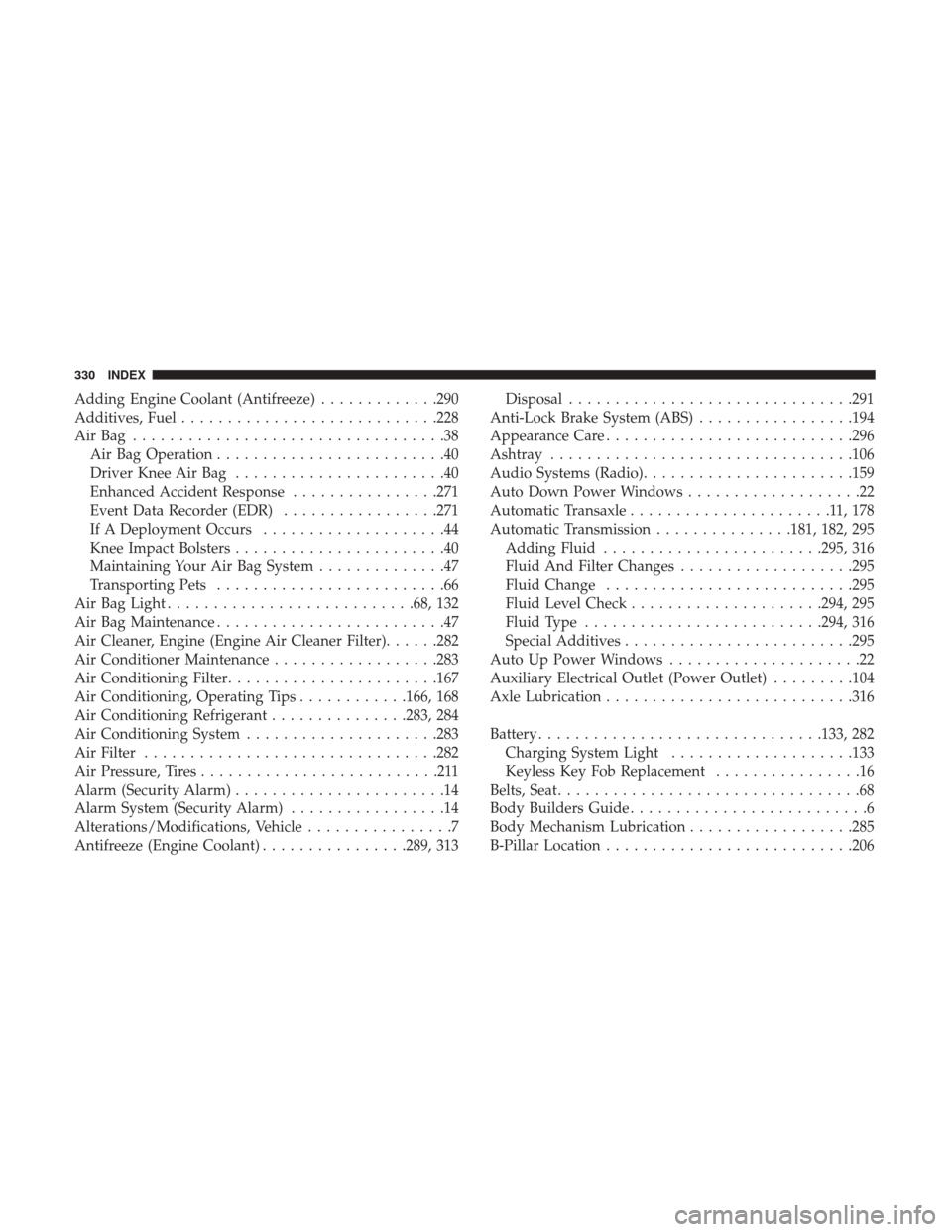
Battery .............................. .133, 282
Charging System Light ....................133
Keyless Key Fob Replacement ................16
Belts, Seat .................................68
Body Builders Guide ..........................6
Body Mechanism Lubrication ..................285
B-Pillar Location .......................... .206
330 INDEX
Page 337 of 345
Ignition Key Removal........................11
Immobilizer (Sentry Key) ......................13
Inside Rearview Mirror .......................75
Instrument Cluster ................118,119, 130, 144
Instrument Cluster Display Instrument Cluster Display ..................120
Instrument Panel And Controls .................117
Instrument Panel Lens Cleaning ................300
Interior Appearance Care .....................298
Introduction ................................4
iPod Control ............................. .159
iPod/USB/MP3 Control ..................... .159
Bluetooth Streaming Audio .................159
Jump Starting ............................ .263
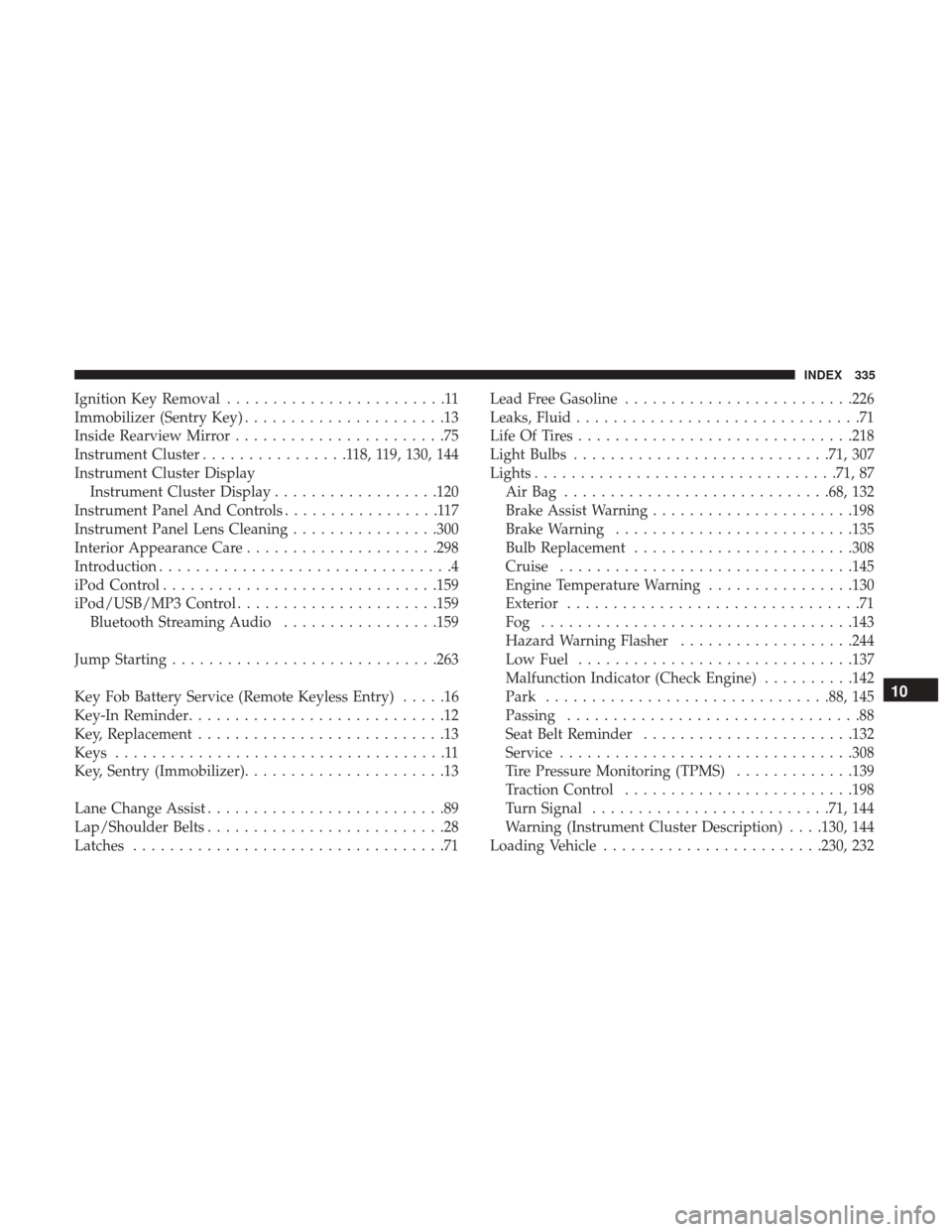
Key Fob Battery Service (Remote Keyless Entry) .....16
Key-In Reminder ............................12
Key, Replacement ...........................13
Keys ....................................11
Key, Sentry (Immobilizer) ......................13
Lane Change Assist ..........................89
Lap/Shoulder Belts ..........................28
Latches ..................................71 Lead Free Gasoline
........................ .226
Leaks, Fluid ...............................71
Life Of Tires ............................. .218
Light Bulbs ........................... .71, 307
Lights ................................ .71, 87
AirBag ............................ .68, 132
Brake Assist Warning ..................... .198
Brake Warning ......................... .135
Bulb Replacement ....................... .308
Cruise ............................... .145
Engine Temperature Warning ................130
Exterior ................................71
Fog ................................. .143
Hazard Warning Flasher ...................244
Low Fuel ............................. .137
Malfunction Indicator (Check Engine) ..........142
Park .............................. .88, 145
Passing ................................88
Seat Belt Reminder ...................... .132
Service ............................... .308
T
ire Pressure Monitoring (TPMS) .............139
Traction Control ........................ .198
Turn Signal ......................... .71, 144
Warning (Instrument Cluster Description) . . . .130, 144
Loading Vehicle ....................... .230, 232
10
INDEX 335
Page 338 of 345
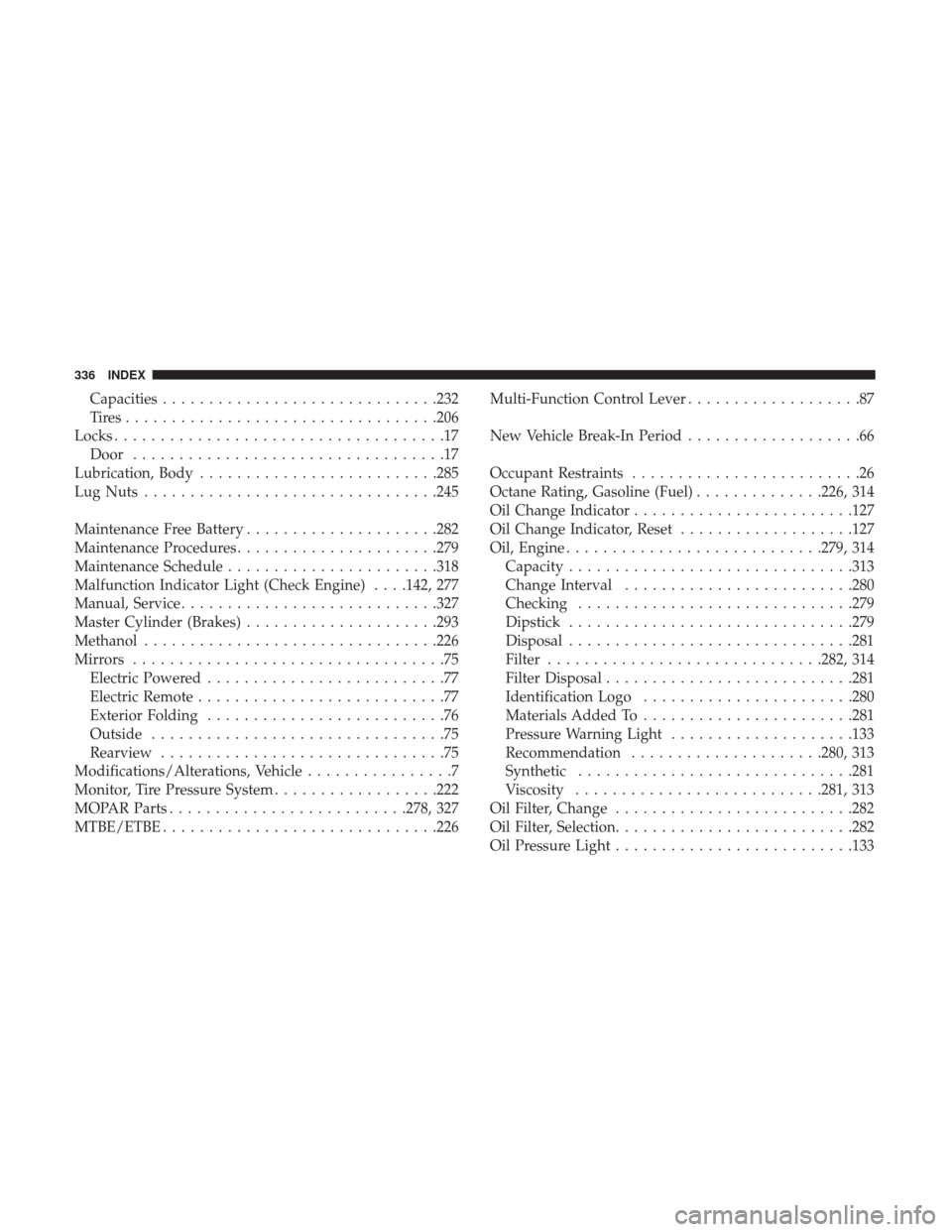
Capacities............................. .232
Tires................................. .206
Locks ....................................17
Door ..................................17
Lubrication, Body ......................... .285
Lug Nuts ............................... .245
Maintenance Free Battery .....................282
Maintenance Procedures ..................... .279
Maintenance Schedule ...................... .318
Malfunction Indicator Light (Check Engine) . . . .142, 277
Manual, Service ........................... .327
Master Cylinder (Brakes) .....................293
Methanol ............................... .226
Mirrors ..................................75
Electric Powered ..........................77
Electric Remote ...........................77
Exterior Folding ..........................76
Outside ................................75
Rearview ...............................75
Modifications/Alterations, Vehicle ................7
Monitor, Tire Pressure System ..................222
MOPAR Parts ......................... .278, 327
MTBE/ETBE ............................. .226Multi-Function Control Lever
...................87
New Vehicle Break-In Period ...................66
Occupant Restraints .........................26
Octane Rating, Gasoline (Fuel) ..............226, 314
Oil Change Indicator ....................... .127
Oil Change Indicator, Reset ...................127
Oil, Engine ........................... .279, 314
Capacity .............................. .313
Change Interval ........................ .280
Checking ............................. .279
Dipstick .............................. .279
Disposal .............................. .281
Filter ............................. .282, 314
Filter Disposal .......................... .281
Identification Logo ...................... .280
Materials Added To ...................... .281
Pr
essure Warning Light ....................133
Recommendation .....................280, 313
Synthetic ............................. .281
Viscosity .......................... .281, 313
Oil Filter, Change ......................... .282
Oil Filter, Selection ......................... .282
Oil Pressure Light ......................... .133
336 INDEX
Page 344 of 345

INSTALLATION OF RADIO TRANSMITTING
EQUIPMENT
Special design considerations are incorporated into this
vehicle’s electronic system to provide immunity to radio
frequency signals. Mobile two-way radios and telephone
equipment must be installed properly by trained person-
nel. The following must be observed during installation.
The positive power connection should be made directly
to the battery and fused as close to the battery as possible.
The negative power connection should be made to body
sheet metal adjacent to the negative battery connection.
This connection should not be fused.
Antennas for two-way radios should be mounted on the
roof or the rear area of the vehicle. Care should be used
in mounting antennas with magnet bases. Magnets may
affect the accuracy or operation of the compass on
vehicles so equipped.The antenna cable should be as short as practical and
routed away from the vehicle wiring when possible. Use
only fully shielded coaxial cable.
Carefully match the antenna and cable to the radio to
ensure a low Standing Wave Ratio (SWR).
Mobile radio equipment with output power greater than
normal may require special precautions.
All installations should be checked for possible interfer-
ence between the communications equipment and the
vehicle’s electronic systems.