radio Ram ProMaster City 2017 Owner's Guide
[x] Cancel search | Manufacturer: RAM, Model Year: 2017, Model line: ProMaster City, Model: Ram ProMaster City 2017Pages: 345, PDF Size: 3.25 MB
Page 226 of 345
Sensors, mounted to each wheel as part of the valve stem,
transmit tire pressure readings to the Receiver Module.
NOTE:It is particularly important for you to check the tire
pressure in all of the tires on your vehicle regularly and to
maintain the proper pressure.
The TPMS consists of the following components:
• Receiver Module.
• Five Tire Pressure Monitoring Sensors. (If Equipped
with Spare Tire)
• Tire Pressure Monitoring Telltale Light.
Tire Pressure Monitoring Low Pressure Warnings
The Tire Pressure Monitoring Telltale Light will illuminate
in the instrument cluster, an audible chime will be acti-
vated, and a proper text message will be displayed when
one or more of the four active road tire pressures are low.
Should this occur, you should stop as soon as possible,
check the inflation pressure of each tire on your vehicle,
and inflate each tire to the vehicle’s recommended cold
placard pressure value. The system will automatically
update and the Tire Pressure Monitoring Light will extin-
guish once the updated tire pressures have been received. The vehicle may need to be driven for up to 20 minutes
above 15 mph (24 km/h) to receive this information.
Check TPMS Warnings
The Tire Pressure Monitoring Telltale Light will flash on
and off for 75 seconds and remain on solid when a system
fault is detected, an audible chime will be activated and a
proper text message will be displayed. If the ignition key is
cycled, this sequence will repeat providing the system fault
still exists. The Tire Pressure Monitoring Telltale Light will
turn off when the fault condition no longer exists. A system
fault can occur with any of the following scenarios:
1. Jamming due to electronic devices or driving next to
facilities emitting the same radio frequencies as the TPM
sensors.
2. Installing some form of aftermarket window tinting that affects radio wave signals.
3. Snow or ice around the wheels or wheel housings.
4. Using tire chains on the vehicle.
5. Using wheels/tires not equipped with TPM sensors.
NOTE: Your vehicle can be equipped with either Tire
Service Kit, compact spare tire or regular size spare tire
(with or without original TPMS sensor).
224 STARTING AND OPERATING
Page 266 of 345

Preparations For Jump-Start
The battery in your vehicle is located in the front of the
engine compartment, behind the left headlight assembly.
NOTE:The positive battery post is covered with a protec-
tive cap. Lift up on the cap to gain access to the positive
battery post.
WARNING!
• Take care to avoid the radiator cooling fan whenever
the hood is raised. It can start anytime the ignition
switch is ON. You can be injured by moving fan
blades.
• Remove any metal jewelry such as rings, watch
bands and bracelets that could make an inadvertent
electrical contact. You could be seriously injured.
• Batteries contain sulfuric acid that can burn your
skin or eyes and generate hydrogen gas which is
flammable and explosive. Keep open flames or
sparks away from the battery.
1. Set the parking brake, shift the automatic transmission into PARK and turn the ignition to LOCK.
2. Turn off the heater, radio, and all unnecessary electrical accessories.
3. If using another vehicle to jump-start the battery, park the vehicle within the jumper cables reach, set the
parking brake and make sure the ignition is OFF.
Positive Battery Post
264 WHAT TO DO IN EMERGENCIES
Page 301 of 345
WARNING!
Do not use volatile solvents for cleaning purposes.
Many are potentially flammable, and if used in closed
areas they may cause respiratory harm.
CAUTION!
Direct contact of air fresheners, insect repellents, sun-
tan lotions, or hand sanitizers to the plastic, painted, or
decorated surfaces of the interior may cause permanent
damage. Wipe away immediately.
CAUTION!
Damage caused by these type of products may not be
covered by your New Vehicle Limited Warranty.
CAUTION!
Do not use Alcohol and Alcohol-based and/or Keton
based cleaning products to clean leather seats, as
damage to the seat may result.
Cleaning Headlights
Your vehicle is equipped with plastic headlights and fog
lights that are lighter and less susceptible to stone breakage
than glass headlights.
Plastic is not as scratch resistant as glass and therefore
different lens cleaning procedures must be followed.
To minimize the possibility of scratching the lenses and
reducing light output, avoid wiping with a dry cloth. To
remove road dirt, wash with a mild soap solution followed
by rinsing.
Do not use abrasive cleaning components, solvents, steel
wool or other aggressive material to clean the lenses.
Glass Surfaces
All glass surfaces should be cleaned on a regular basis with
MOPAR Glass Cleaner, or any commercial household-type
glass cleaner. Never use an abrasive type cleaner. Use
caution when cleaning the inside rear window equipped
with electric defrosters or windows equipped with radio
antennas. Do not use scrapers or other sharp instrument
that may scratch the elements.
7
MAINTAINING YOUR VEHICLE 299
Page 306 of 345
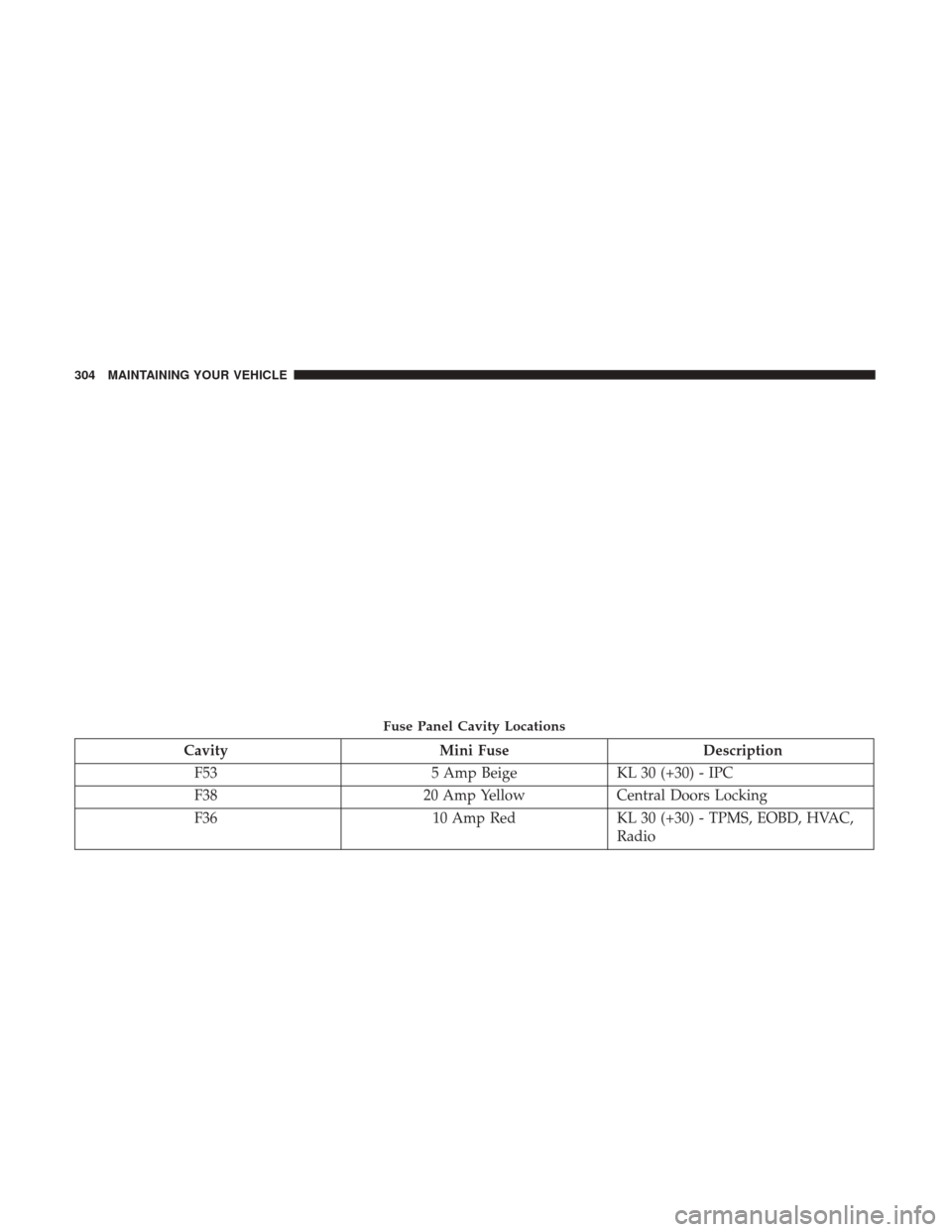
CavityMini Fuse Description
F53 5 Amp BeigeKL 30 (+30) - IPC
F38 20 Amp YellowCentral Doors Locking
F36 10 Amp RedKL 30 (+30) - TPMS, EOBD, HVAC,
Radio
Fuse Panel Cavity Locations
304 MAINTAINING YOUR VEHICLE
Page 332 of 345
Adding Engine Coolant (Antifreeze).............290
Additives, Fuel ........................... .228
AirBag ..................................38 Air Bag Operation .........................40
Driver Knee Air Bag .......................40
Enhanced Accident Response ................271
Event Data Recorder (EDR) .................271
If A Deployment Occurs ....................44
Knee Impact Bolsters .......................40
Maintaining Your Air Bag System ..............47
Transporting Pets .........................66
Air Bag Light .......................... .68, 132
Air Bag Maintenance .........................47
Air Cleaner, Engine (Engine Air Cleaner Filter) ......282
Air Conditioner Maintenance ..................283
Air Conditioning Filter ...................... .167
Air Conditioning, Operating Tips ............166, 168
Air Conditioning Refrigerant ...............283, 284
Air Conditioning System .....................283
Air Filter ............................... .282
Air Pressure, Tires ..........................211
Alarm (Security Alarm) .......................14
Alarm System (Security Alarm) .................14
Alterations/Modifications, Vehicle ................7
Antifreeze (Engine Coolant) ................289, 313 Disposal
.............................. .291
Anti-Lock Brake System (ABS) .................194
Appearance Care .......................... .296
Ashtray ................................ .106
Audio Systems (Radio) ...................... .159
Auto Down Power Windows ...................22
Automatic Transaxle ......................11,178
Automatic Transmission ...............181, 182, 295
Adding Fluid ....................... .295, 316
Fluid And Filter Changes ...................295
Fluid Change .......................... .295
Fluid Level Check .....................294, 295
Fluid Type ......................... .294, 316
Special Additives ........................ .295
Auto
Up Power Windows .....................22
Auxiliary Electrical Outlet (Power Outlet) .........104
Axle Lubrication .......................... .316
Battery .............................. .133, 282
Charging System Light ....................133
Keyless Key Fob Replacement ................16
Belts, Seat .................................68
Body Builders Guide ..........................6
Body Mechanism Lubrication ..................285
B-Pillar Location .......................... .206
330 INDEX
Page 339 of 345
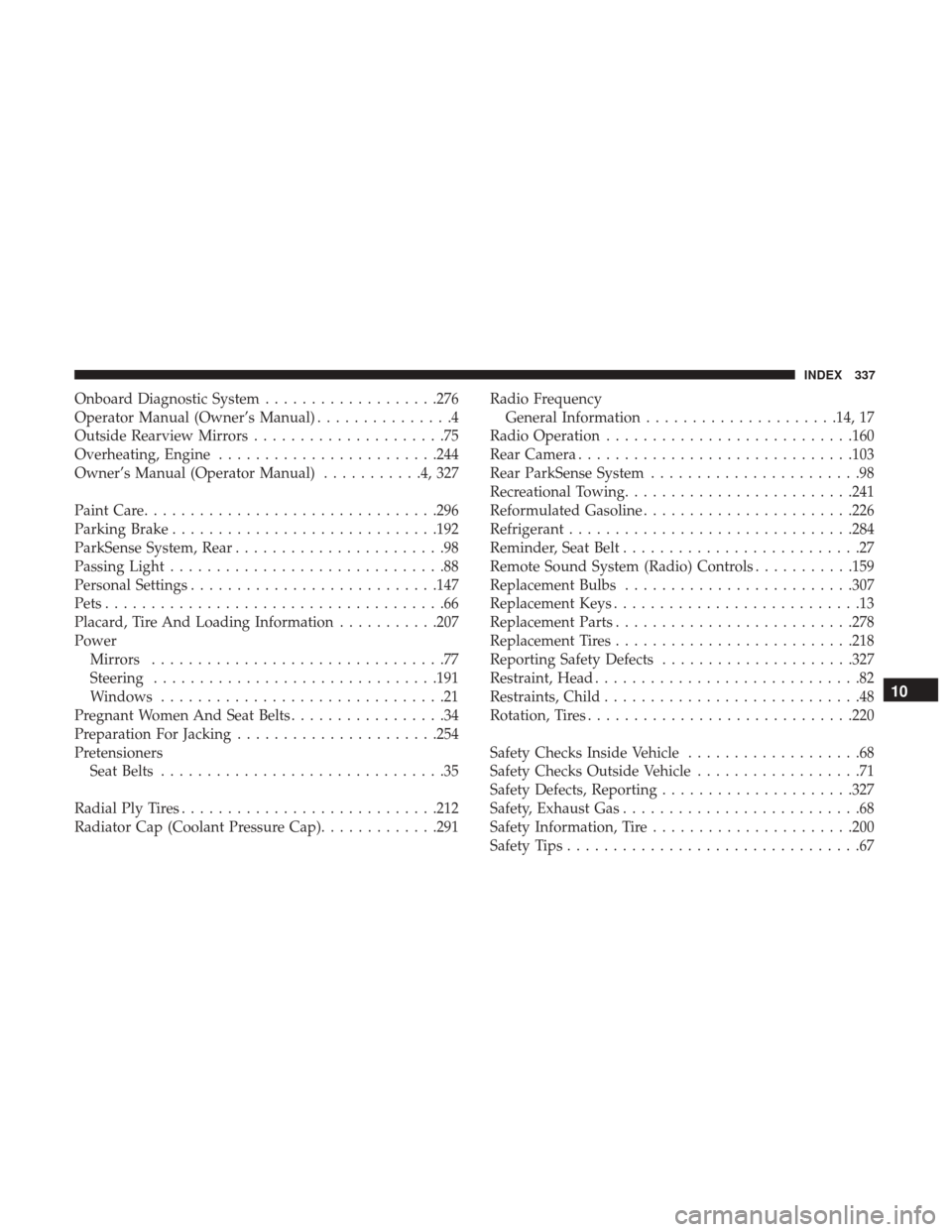
Onboard Diagnostic System...................276
Operator Manual (Owner’s Manual) ...............4
Outside Rearview Mirrors .....................75
Overheating, Engine ....................... .244
Owner’s Manual (Operator Manual) ...........4,327
Paint Care ............................... .296
Parking Brake ............................ .192
ParkSense System, Rear .......................98
Passing Light ..............................88
Personal Settings .......................... .147
Pets .....................................66
Placard, Tire And Loading Information ...........207
Power Mirrors ................................77
Steering .............................. .191
Windows ...............................21
Pregnant Women And Seat Belts .................34
Preparation For Jacking ..................... .254
Pretensioners Seat Belts ...............................35
Radial Ply Tires ........................... .212
Radiator Cap (Coolant Pressure Cap) .............291Radio Frequency
General Information .....................14, 17
Radio Operation .......................... .160
Rear Camera ............................. .103
Rear ParkSense System .......................98
Recreational Towing ........................ .241
Reformulated Gasoline ...................... .226
Refrigerant .............................. .284
Reminder, Seat Belt ..........................27
Remote Sound System (Radio) Controls ...........159
Replacement Bulbs ........................ .307
Replacement Keys ...........................13
Replacement Parts ......................... .278
Replacement Tires ......................... .218
Reporting Safety Defects .....................327
Restraint, Head .............................82
Restraints, Child ............................48
Rotation, Tires ............................ .220
Safety Checks Inside Vehicle ...................68
Safety Checks Outside Vehicle ..................
71
Safety Defects, Reporting .....................327
Safety, Exhaust Gas ..........................68
Safety Information, Tire ..................... .200
Safety Tips ................................67
10
INDEX 337
Page 344 of 345

INSTALLATION OF RADIO TRANSMITTING
EQUIPMENT
Special design considerations are incorporated into this
vehicle’s electronic system to provide immunity to radio
frequency signals. Mobile two-way radios and telephone
equipment must be installed properly by trained person-
nel. The following must be observed during installation.
The positive power connection should be made directly
to the battery and fused as close to the battery as possible.
The negative power connection should be made to body
sheet metal adjacent to the negative battery connection.
This connection should not be fused.
Antennas for two-way radios should be mounted on the
roof or the rear area of the vehicle. Care should be used
in mounting antennas with magnet bases. Magnets may
affect the accuracy or operation of the compass on
vehicles so equipped.The antenna cable should be as short as practical and
routed away from the vehicle wiring when possible. Use
only fully shielded coaxial cable.
Carefully match the antenna and cable to the radio to
ensure a low Standing Wave Ratio (SWR).
Mobile radio equipment with output power greater than
normal may require special precautions.
All installations should be checked for possible interfer-
ence between the communications equipment and the
vehicle’s electronic systems.