engine overheat Ram ProMaster City 2018 User Guide
[x] Cancel search | Manufacturer: RAM, Model Year: 2018, Model line: ProMaster City, Model: Ram ProMaster City 2018Pages: 347, PDF Size: 4.08 MB
Page 252 of 347
CAUTION!(Continued)
the event of engine malfunction, particularly involv-
ing engine misfire or other apparent loss of perfor-
mance, have your vehicle serviced promptly. Contin-
ued operation of your vehicle with a severe
malfunction could cause the converter to overheat,
resulting in possible damage to the converter and
vehicle.
Under normal operating conditions, the catalytic converter
will not require maintenance. However, it is important to
keep the engine properly tuned to assure proper catalyst
operation and prevent possible catalyst damage.
NOTE: Intentional tampering with emissions control sys-
tems can result in civil penalties being assessed against
you.
In unusual situations involving grossly malfunctioning
engine operation, a scorching odor may suggest severe and
abnormal catalyst overheating. If this occurs, stop the
vehicle, turn off the engine and allow it to cool. Service,
including a tune-up to manufacturer’s specifications,
should be obtained immediately. To minimize the possibility of catalytic converter damage:
•
Do not interrupt the ignition when the transmission is in
gear and the vehicle is in motion.
• Do not try to start the vehicle by pushing or towing the
vehicle.
• Do not idle the engine with any ignition components
disconnected or removed, such as when diagnostic
testing, or for prolonged periods during very rough idle
or malfunctioning operating conditions.
Cooling System
WARNING!
• You or others can be badly burned by hot engine
coolant (antifreeze) or steam from your radiator. If
you see or hear steam coming from under the hood,
do not open the hood until the radiator has had time
to cool. Never open a cooling system pressure cap
when the radiator or coolant bottle is hot.
(Continued)
250 SERVICING AND MAINTENANCE
Page 256 of 347
WARNING!(Continued)
overheated engine. Heat causes pressure to build up
in the cooling system. To prevent scalding or injury,
do not remove the pressure cap while the system is
hot or under pressure.
• Do not use a pressure cap other than the one speci-
fied for your vehicle. Personal injury or engine
damage may result.
Disposal Of Used Coolant
Used ethylene glycol-based coolant (antifreeze) is a regu-
lated substance requiring proper disposal. Check with your
local authorities to determine the disposal rules for your
community. To prevent ingestion by animals or children,
do not store ethylene glycol-based coolant in open contain-
ers or allow it to remain in puddles on the ground. If
ingested by a child or pet, seek emergency assistance
immediately. Clean up any ground spills immediately.
Coolant Level
The coolant expansion bottle provides a quick visual
method for determining that the coolant level is adequate.
With the engine OFF and cold, the level of the engine
coolant (antifreeze) in the bottle should be between the
“MIN” and “MAX” marks. The radiator normally remains completely full, so there is
no need to remove the radiator/coolant pressure cap
unless checking for engine coolant (antifreeze) freeze point
or replacing coolant. Advise your service attendant of this.
As long as the engine operating temperature is satisfactory,
the coolant bottle need only be checked once a month.
When additional engine coolant (antifreeze) is needed to
maintain the proper level, only OAT coolant that meets the
requirements of FCA Material Standard MS.90032 should
be added to the coolant bottle. Do not overfill.
Points To Remember
NOTE:
When the vehicle is stopped after a few miles/
kilometers of operation, you may observe vapor coming
from the front of the engine compartment. This is normally
a result of moisture from rain, snow, or high humidity
accumulating on the radiator and being vaporized when
the thermostat opens, allowing hot engine coolant (anti-
freeze) to enter the radiator.
If an examination of your engine compartment shows no
evidence of radiator or hose leaks, the vehicle may be
safely driven. The vapor will soon dissipate.
• Do not overfill the coolant expansion bottle.
254 SERVICING AND MAINTENANCE
Page 297 of 347
Fuel System Cautions
CAUTION!
Follow these guidelines to maintain your vehicle’s
performance:
•The use of leaded gasoline is prohibited by Federal
law. Using leaded gasoline can impair engine perfor-
mance and damage the emissions control system.
• An out-of-tune engine or certain fuel or ignition
malfunctions can cause the catalytic converter to
overheat. If you notice a pungent burning odor or
some light smoke, your engine may be out of tune or
malfunctioning and may require immediate service.
Contact your authorized dealer for service assistance.
• The use of fuel additives, which are now being sold
as octane enhancers, is not recommended. Most of
these products contain high concentrations of metha-
nol. Fuel system damage or vehicle performance
problems resulting from the use of such fuels or
additives is not the responsibility of the manufac-
turer and may void or not be covered under the New
Vehicle Limited Warranty. NOTE:
Intentional tampering with the emissions control
system can result in civil penalties being assessed against
you.Carbon Monoxide Warnings
WARNING!
Carbon monoxide (CO) in exhaust gases is deadly.
Follow the precautions below to prevent carbon mon-
oxide poisoning:
• Do not inhale exhaust gases. They contain carbon
monoxide, a colorless and odorless gas, which can
kill. Never run the engine in a closed area, such as a
garage, and never sit in a parked vehicle with the
engine running for an extended period. If the vehicle
is stopped in an open area with the engine running
for more than a short period, adjust the ventilation
system to force fresh, outside air into the vehicle.
• Guard against carbon monoxide with proper main-
tenance. Have the exhaust system inspected every
time the vehicle is raised. Have any abnormal condi-
tions repaired promptly. Until repaired, drive with
all side windows fully open.
9
TECHNICAL SPECIFICATIONS 295
Page 337 of 347
Emergency, In Case OfFreeing Vehicle When Stuck .................231
Jacking ........................... .209, 261
Jump Starting .......................... .225
Towing ............................... .233
Emission Control System Maintenance ............93
Engine ................................. .241
Air Cleaner ............................ .246
Block Heater ........................... .157
Break-In Recommendations .................157
Checking Oil Level ...................... .242
Coolant (Antifreeze) ..................... .297
Cooling .............................. .250
Exhaust Gas Caution ...................148, 295
Fails To Start ........................... .156
Flooded, Starting ........................ .156
Jump Starting .......................... .225
Oil ........................... .244, 296, 297
Oil Filler Cap ....................... .241, 245
Oil Filter .............................. .246
Oil Selection ........................ .244, 296
Oil Synthetic ........................... .245
Overheating ........................... .230
Starting .............................. .155
Engine Oil Viscosity ........................ .245Engine Oil Viscosity Chart
....................245
Enhanced Accident Response Feature ............234
Ethanol ................................. .293
Exhaust Gas Caution .....................148, 295
Exhaust System ....................... .148, 249
Exterior Lights ......................... .41, 151
Filters Air Cleaner ............................ .246
Air Conditioning ..........................55
Engine Oil ......................... .246, 297
Engine Oil Disposal ...................... .245
Flashers Hazar
d Warning ........................ .197
Turn Signal ......................... .91, 151
Flooded Engine Starting ..................... .156
Fluid, Brake ............................. .298
Fluid Capacities ........................... .296
Fluid Leaks .............................. .151
Fluid Level Checks Brake ................................ .255
Engine Oil ............................ .242
Power Steering ......................... .169
Fluids And Lubricants ...................... .297
Fog Lights ................................43
12
INDEX 335
Page 341 of 347
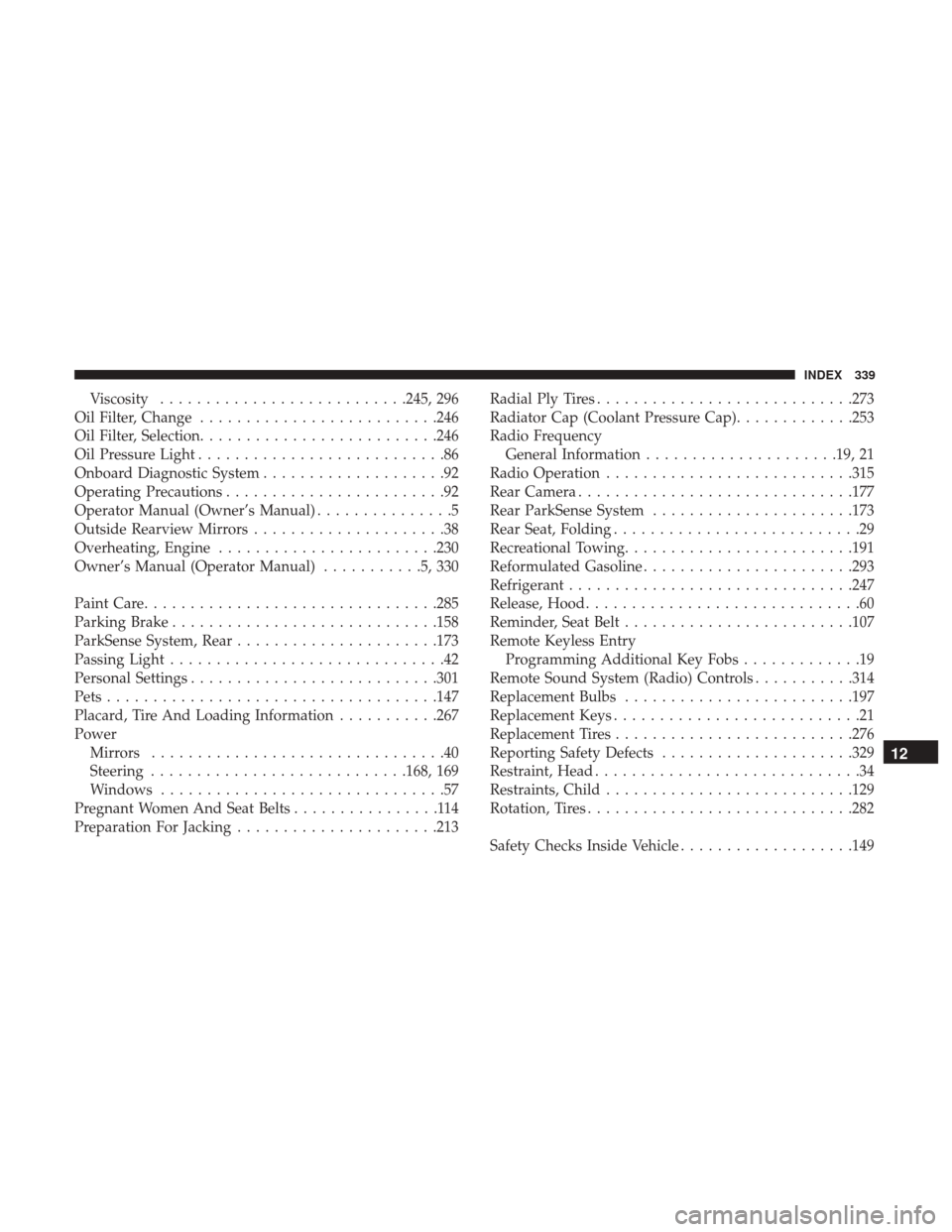
Viscosity.......................... .245, 296
Oil Filter, Change ......................... .246
Oil Filter, Selection ......................... .246
Oil Pressure Light ...........................86
Onboard Diagnostic System ....................92
Operating Precautions ........................92
Operator Manual (Owner’s Manual) ...............5
Outside Rearview Mirrors .....................38
Overheating, Engine ....................... .230
Owner’s Manual (Operator Manual) ...........5,330
Paint Care ............................... .285
Parking Brake ............................ .158
ParkSense System, Rear ..................... .173
Passing Light ..............................42
Personal Settings .......................... .301
Pets ................................... .147
Placard, Tire And Loading Information ...........267
Power Mirrors ................................40
Steering ........................... .168, 169
Windows ...............................57
Pregnant Women And Seat Belts ................114
Preparation For Jacking ..................... .213Radial Ply Tires
........................... .273
Radiator Cap (Coolant Pressure Cap) .............253
Radio Frequency General Information .....................19, 21
Radio Operation .......................... .315
Rear Camera ............................. .177
Rear ParkSense System ..................... .173
Rear Seat, Folding ...........................29
Recreational Towing ........................ .191
Reformulated Gasoline ...................... .293
Refrigerant .............................. .247
Release, Hood ..............................60
Reminder, Seat Belt ........................ .107
Remote Keyless Entry Programming Additional Key Fobs .............19
Remote Sound System (Radio) Controls ...........314
Replacement Bulbs ........................ .197
Replacement Keys ...........................
21
Replacement Tires ......................... .276
Reporting Safety Defects .....................329
Restraint, Head .............................34
Restraints, Child .......................... .129
Rotation, Tires ............................ .282
Safety Checks Inside Vehicle ...................149
12
INDEX 339