warning Ram ProMaster City 2018 User Guide
[x] Cancel search | Manufacturer: RAM, Model Year: 2018, Model line: ProMaster City, Model: Ram ProMaster City 2018Pages: 347, PDF Size: 4.08 MB
Page 36 of 347
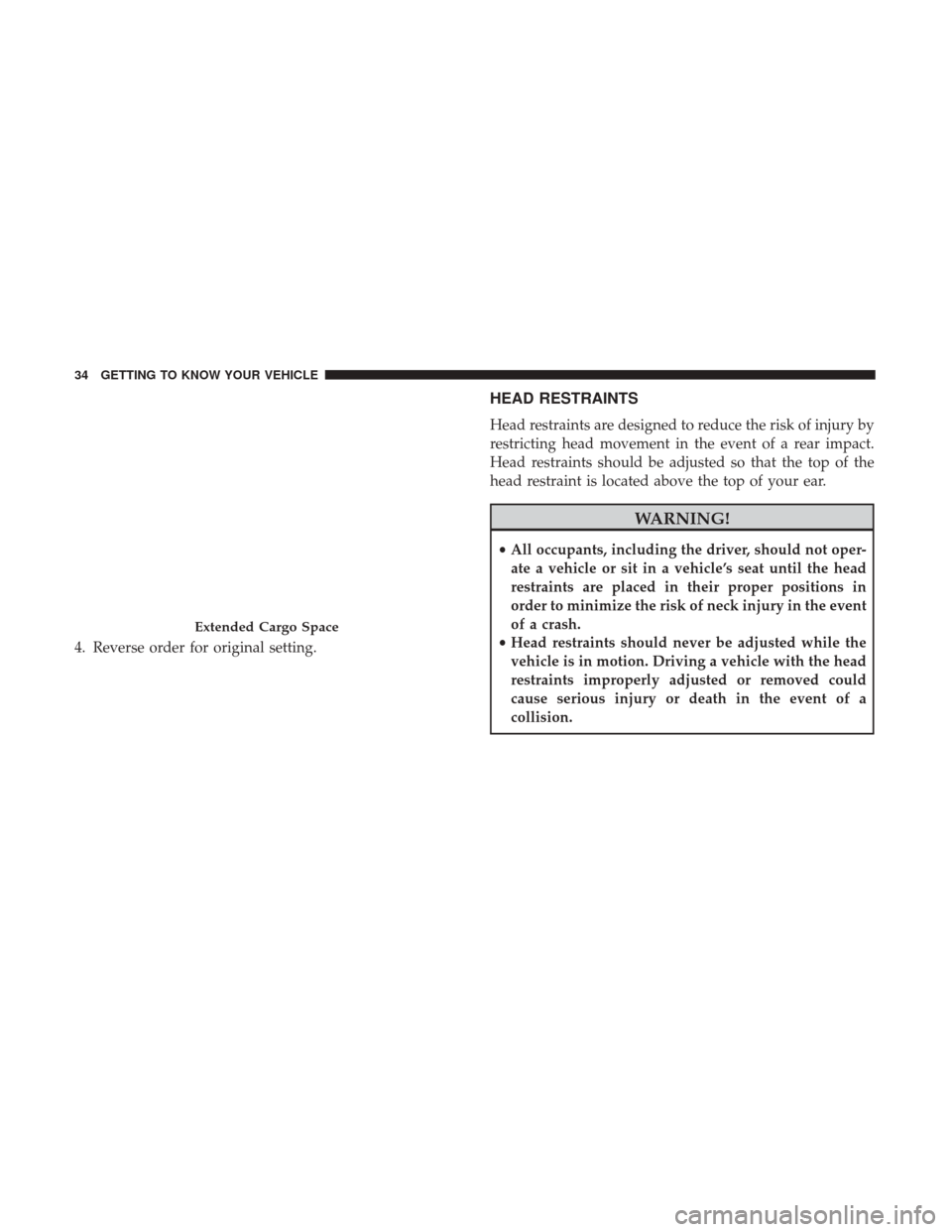
4. Reverse order for original setting.
HEAD RESTRAINTS
Head restraints are designed to reduce the risk of injury by
restricting head movement in the event of a rear impact.
Head restraints should be adjusted so that the top of the
head restraint is located above the top of your ear.
WARNING!
•All occupants, including the driver, should not oper-
ate a vehicle or sit in a vehicle’s seat until the head
restraints are placed in their proper positions in
order to minimize the risk of neck injury in the event
of a crash.
• Head restraints should never be adjusted while the
vehicle is in motion. Driving a vehicle with the head
restraints improperly adjusted or removed could
cause serious injury or death in the event of a
collision.
Extended Cargo Space
34 GETTING TO KNOW YOUR VEHICLE
Page 38 of 347
WARNING!
A loose head restraint thrown forward in a collision or
hard stop could cause serious injury or death to occupants
of the vehicle. Always securely stow removed head re-
straints in a location outside the occupant compartment.
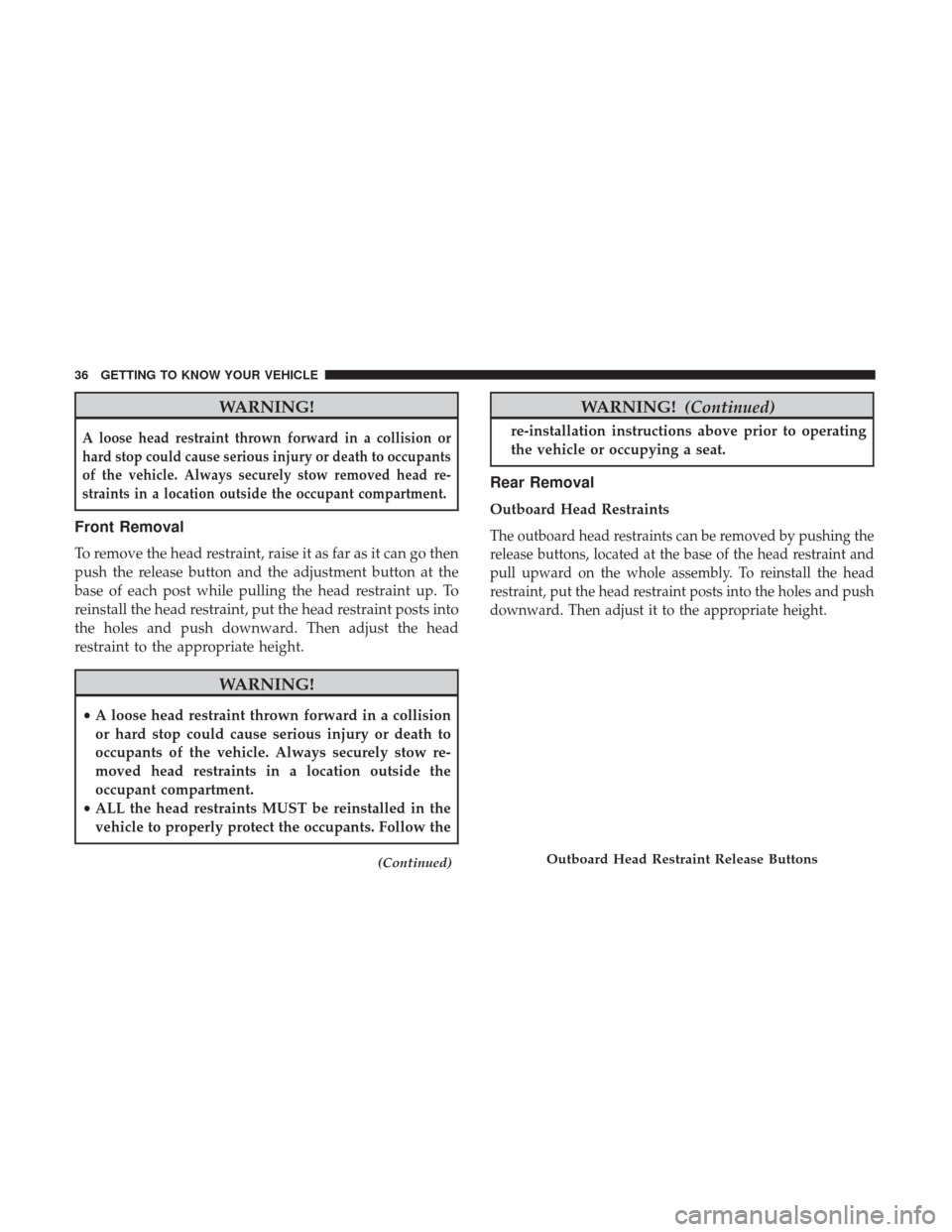
Front Removal
To remove the head restraint, raise it as far as it can go then
push the release button and the adjustment button at the
base of each post while pulling the head restraint up. To
reinstall the head restraint, put the head restraint posts into
the holes and push downward. Then adjust the head
restraint to the appropriate height.
WARNING!
•A loose head restraint thrown forward in a collision
or hard stop could cause serious injury or death to
occupants of the vehicle. Always securely stow re-
moved head restraints in a location outside the
occupant compartment.
• ALL the head restraints MUST be reinstalled in the
vehicle to properly protect the occupants. Follow the
(Continued)
WARNING! (Continued)
re-installation instructions above prior to operating
the vehicle or occupying a seat.
Rear Removal
Outboard Head Restraints
The outboard head restraints can be removed by pushing the
release buttons, located at the base of the head restraint and
pull upward on the whole assembly. To reinstall the head
restraint, put the head restraint posts into the holes and push
downward. Then adjust it to the appropriate height.
Outboard Head Restraint Release Buttons
36 GETTING TO KNOW YOUR VEHICLE
Page 39 of 347
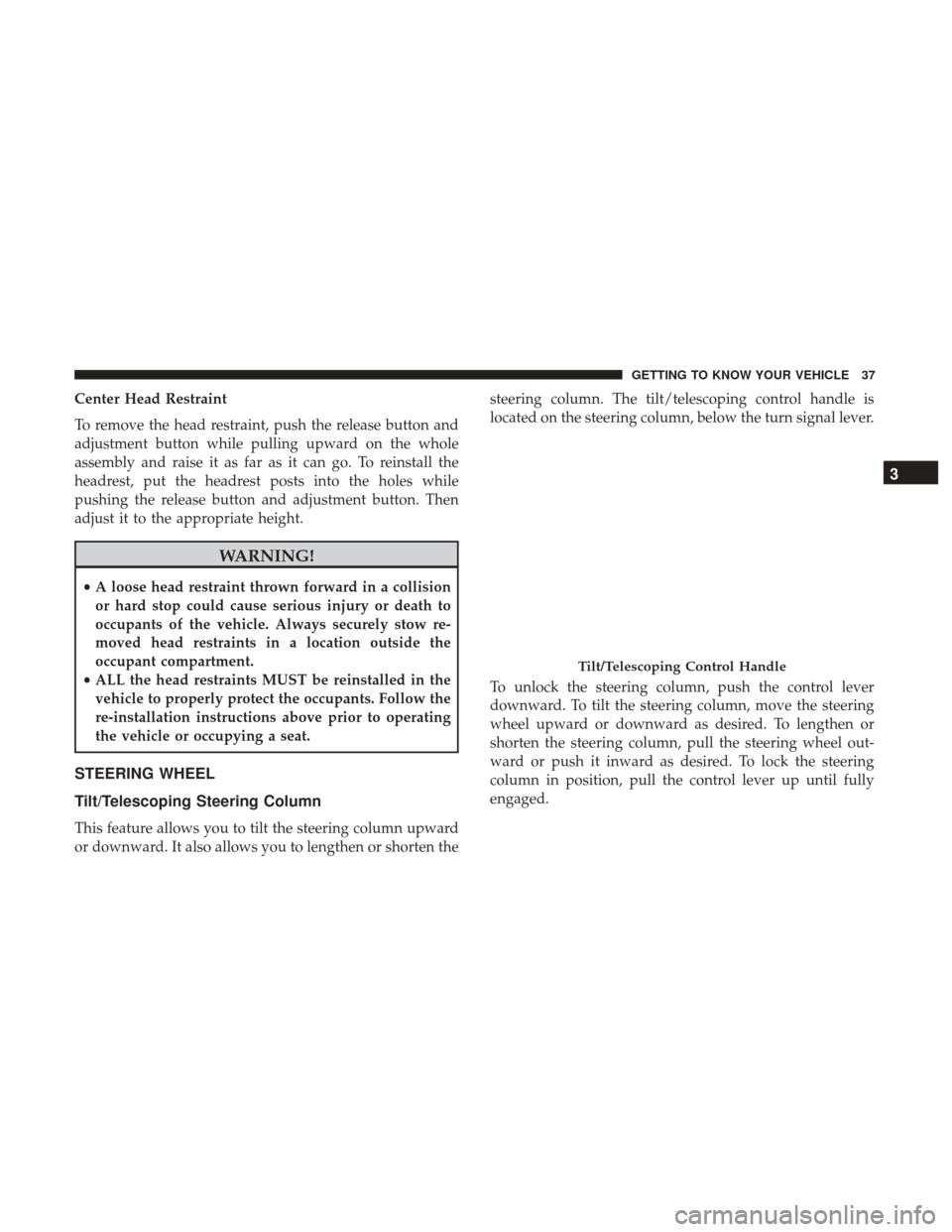
Center Head Restraint
To remove the head restraint, push the release button and
adjustment button while pulling upward on the whole
assembly and raise it as far as it can go. To reinstall the
headrest, put the headrest posts into the holes while
pushing the release button and adjustment button. Then
adjust it to the appropriate height.
WARNING!
•A loose head restraint thrown forward in a collision
or hard stop could cause serious injury or death to
occupants of the vehicle. Always securely stow re-
moved head restraints in a location outside the
occupant compartment.
• ALL the head restraints MUST be reinstalled in the
vehicle to properly protect the occupants. Follow the
re-installation instructions above prior to operating
the vehicle or occupying a seat.
STEERING WHEEL
Tilt/Telescoping Steering Column
This feature allows you to tilt the steering column upward
or downward. It also allows you to lengthen or shorten the steering column. The tilt/telescoping control handle is
located on the steering column, below the turn signal lever.
To unlock the steering column, push the control lever
downward. To tilt the steering column, move the steering
wheel upward or downward as desired. To lengthen or
shorten the steering column, pull the steering wheel out-
ward or push it inward as desired. To lock the steering
column in position, pull the control lever up until fully
engaged.
Tilt/Telescoping Control Handle
3
GETTING TO KNOW YOUR VEHICLE 37
Page 40 of 347
WARNING!
Do not adjust the steering column while driving.
Adjusting the steering column while driving or driv-
ing with the steering column unlocked, could cause the
driver to lose control of the vehicle. Failure to follow
this warning may result in serious injury or death.
MIRRORS
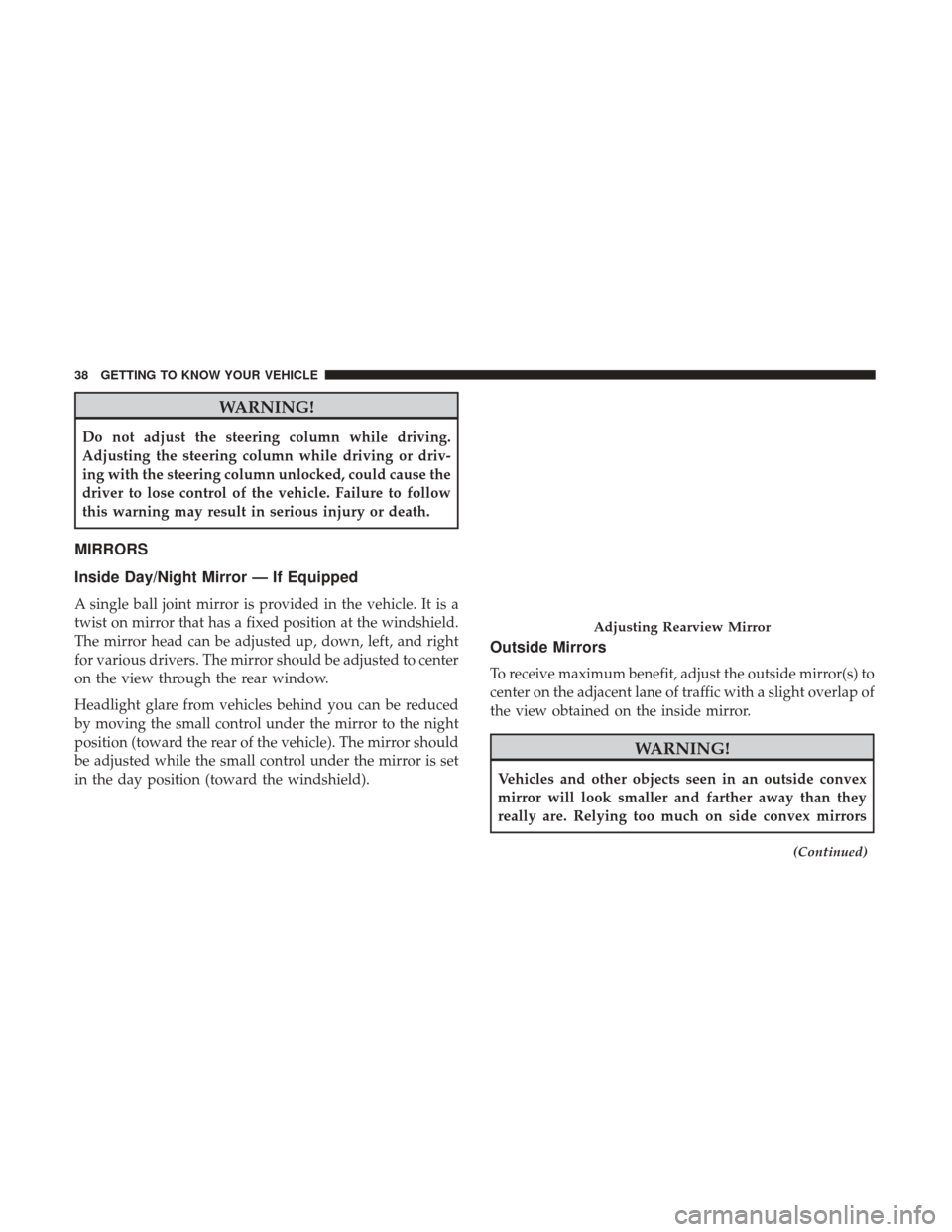
Inside Day/Night Mirror — If Equipped
A single ball joint mirror is provided in the vehicle. It is a
twist on mirror that has a fixed position at the windshield.
The mirror head can be adjusted up, down, left, and right
for various drivers. The mirror should be adjusted to center
on the view through the rear window.
Headlight glare from vehicles behind you can be reduced
by moving the small control under the mirror to the night
position (toward the rear of the vehicle). The mirror should
be adjusted while the small control under the mirror is set
in the day position (toward the windshield).
Outside Mirrors
To receive maximum benefit, adjust the outside mirror(s) to
center on the adjacent lane of traffic with a slight overlap of
the view obtained on the inside mirror.
WARNING!
Vehicles and other objects seen in an outside convex
mirror will look smaller and farther away than they
really are. Relying too much on side convex mirrors
(Continued)
Adjusting Rearview Mirror
38 GETTING TO KNOW YOUR VEHICLE
Page 41 of 347
WARNING!(Continued)
could cause you to collide with another vehicle or other
object. Use your inside mirror when judging the size or
distance of a vehicle seen in a side convex mirror.
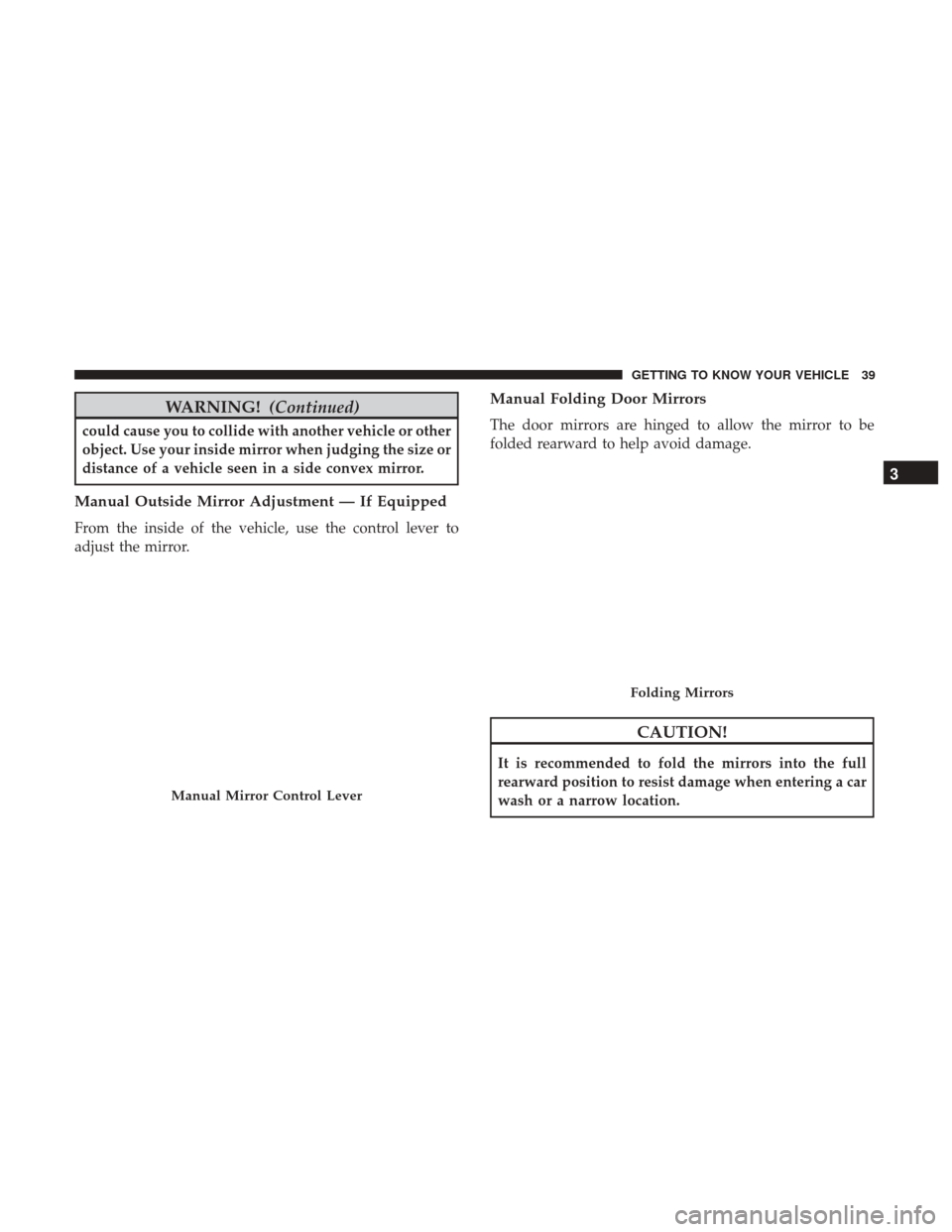
Manual Outside Mirror Adjustment — If Equipped
From the inside of the vehicle, use the control lever to
adjust the mirror.
Manual Folding Door Mirrors
The door mirrors are hinged to allow the mirror to be
folded rearward to help avoid damage.
CAUTION!
It is recommended to fold the mirrors into the full
rearward position to resist damage when entering a car
wash or a narrow location.
Manual Mirror Control Lever
Folding Mirrors
3
GETTING TO KNOW YOUR VEHICLE 39
Page 59 of 347
WINDOWS
Power Windows — If Equipped
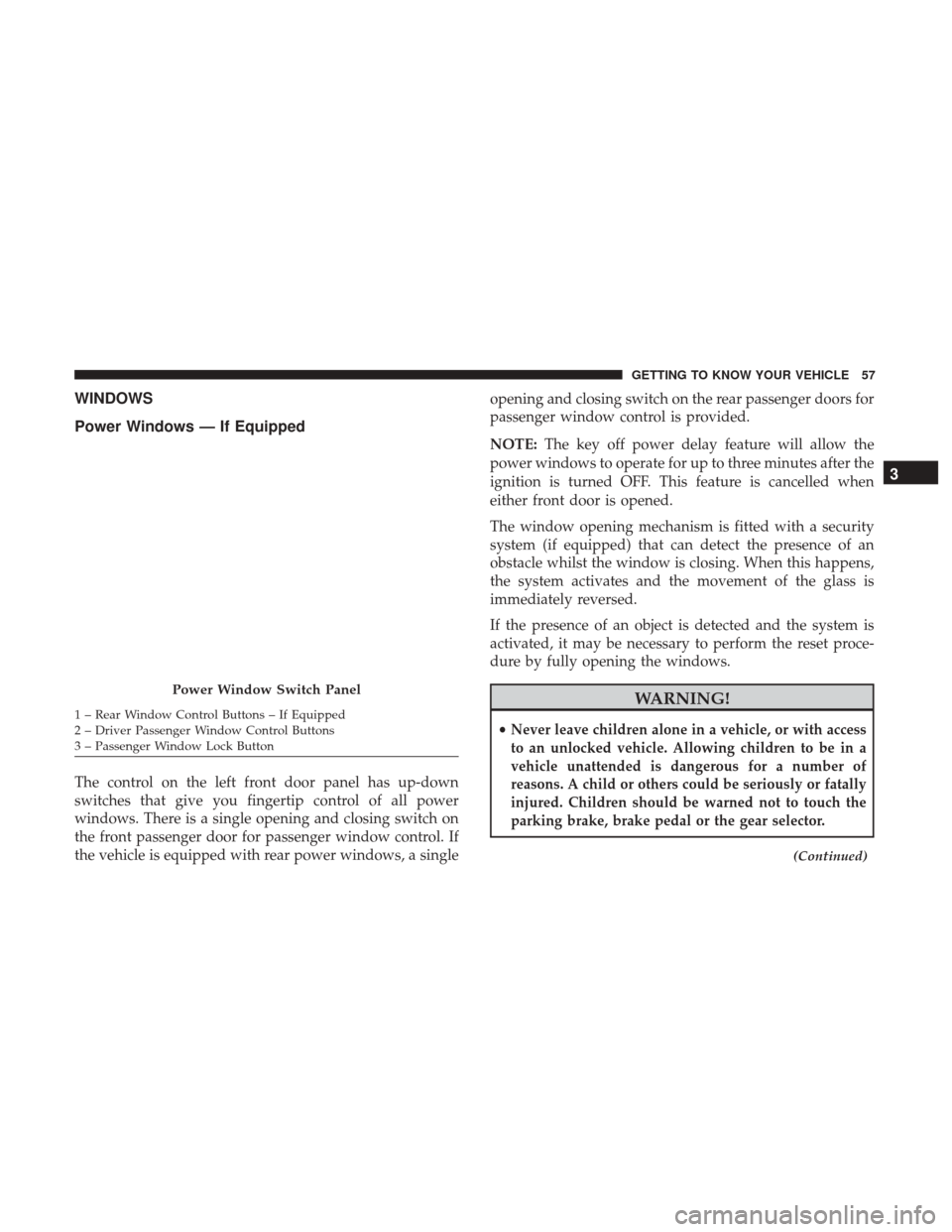
The control on the left front door panel has up-down
switches that give you fingertip control of all power
windows. There is a single opening and closing switch on
the front passenger door for passenger window control. If
the vehicle is equipped with rear power windows, a singleopening and closing switch on the rear passenger doors for
passenger window control is provided.
NOTE:
The key off power delay feature will allow the
power windows to operate for up to three minutes after the
ignition is turned OFF. This feature is cancelled when
either front door is opened.
The window opening mechanism is fitted with a security
system (if equipped) that can detect the presence of an
obstacle whilst the window is closing. When this happens,
the system activates and the movement of the glass is
immediately reversed.
If the presence of an object is detected and the system is
activated, it may be necessary to perform the reset proce-
dure by fully opening the windows.
WARNING!
•Never leave children alone in a vehicle, or with access
to an unlocked vehicle. Allowing children to be in a
vehicle unattended is dangerous for a number of
reasons. A child or others could be seriously or fatally
injured. Children should be warned not to touch the
parking brake, brake pedal or the gear selector.
(Continued)
Power Window Switch Panel
1 – Rear Window Control Buttons – If Equipped
2 – Driver Passenger Window Control Buttons
3 – Passenger Window Lock Button
3
GETTING TO KNOW YOUR VEHICLE 57
Page 60 of 347
WARNING!(Continued)
•Do not leave the key fob in or near the vehicle or in
a location accessible to children. A child could oper-
ate power windows, other controls, or move the
vehicle.
Auto-Down Feature — If Equipped
The window switches are equipped with an Auto-Down
feature. Push the window switch for half a second, release,
and the window will go down automatically.
To open the window part way, lift the window switch to
the detent for less than half a second and release it to stop
the window.
NOTE: The power window switches remain active for up
to three minutes (depending on the accessory delay set-
ting) after the ignition switch has been turned OFF. Open-
ing either of the vehicle’s front doors will cancel this
feature.
Auto-Up Feature
Lift the window switch to the detent for half a second,
release, and the window will go up automatically. To stop the window from going all the way up during the
auto-up operation, pull up/push down on the switch
briefly.
To close the window part way, lift the window switch to
the detent for less than half a second and release it when
you want the window to stop.
WARNING!
There is no auto-reverse protection when the window
is almost closed. Be sure to clear all objects from the
window before closing.
Power Windows System Initialization
The power windows may be reset if any of the following
occurs:
•
On the front doors
• Fuse or battery are disconnected when the window is
moving.
• 50 window movements without ever closing the win-
dow.
• On the rear doors (in addition to the condition for the
front doors)
58 GETTING TO KNOW YOUR VEHICLE
Page 61 of 347
•Fuse or battery are disconnected when the window is
moving.
• The auto-revese system is activated while the window
is moving and the door is opening.
• 50 window movements without ever closing the win-
dow.
• One door opening movements with the window mov-
ing, without ever closing the door.
• Three door opening with the window in motion.
During these maneuvers, the upper stop position is
never reached.
Proceed as follows for initialization:
1. Completely close the driver’s door window, keeping the operating button pushed for at least five seconds after
the (upper) end of travel position.
2. Proceed in the same way on the passenger’s side door button and on the buttons of rear doors.
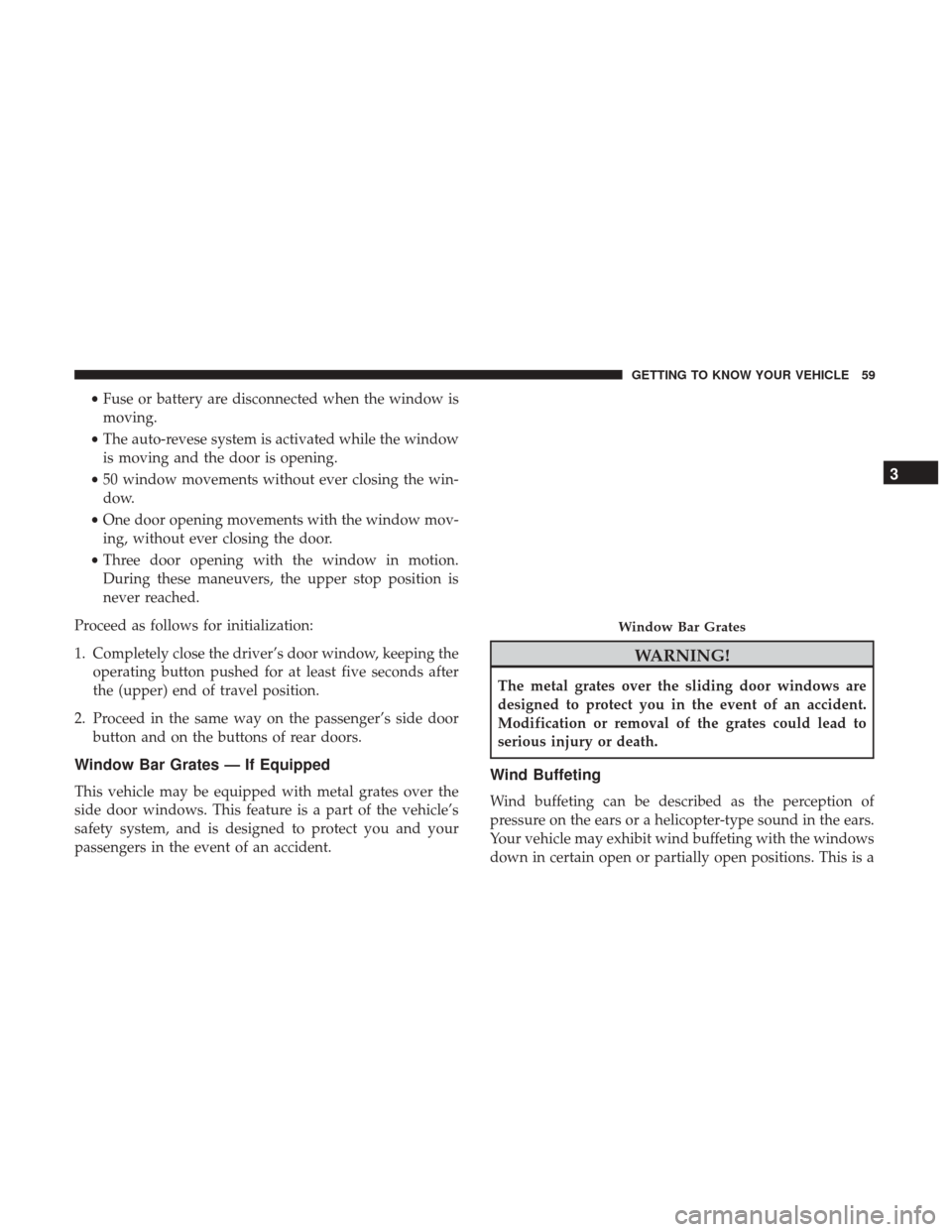
Window Bar Grates — If Equipped
This vehicle may be equipped with metal grates over the
side door windows. This feature is a part of the vehicle’s
safety system, and is designed to protect you and your
passengers in the event of an accident.
WARNING!
The metal grates over the sliding door windows are
designed to protect you in the event of an accident.
Modification or removal of the grates could lead to
serious injury or death.
Wind Buffeting
Wind buffeting can be described as the perception of
pressure on the ears or a helicopter-type sound in the ears.
Your vehicle may exhibit wind buffeting with the windows
down in certain open or partially open positions. This is a
Window Bar Grates
3
GETTING TO KNOW YOUR VEHICLE 59
Page 63 of 347
3. Raise the hood and place the hood prop rod in hood slotto secure the hood in the open position.
CAUTION!
Be sure to disengage the rod and secure it in close
position before closing the hood. Damage may occur.
Closing
WARNING!
Be sure the hood is fully latched before driving your
vehicle. If the hood is not fully latched, it could open
when the vehicle is in motion and block your vision.
Failure to follow this warning could result in serious
injury or death.
CAUTION!
To prevent possible damage, do not slam the hood to
close it. Lower hood to approximately 12 inches (30 cm)
and drop the hood to close. Make sure hood is fully
closed for both latches. Never drive vehicle unless
hood is fully closed, with both latches engaged.
Hood Prop Rod
3
GETTING TO KNOW YOUR VEHICLE 61
Page 64 of 347
CARGO AREA FEATURES
Rear Cargo Tie-Downs
To make it easier to secure your load, there are hooks (if
equipped) fixed to the floor.NOTE:Power washing is not allowed inside the cargo
area.
WARNING!
• To help protect against personal injury, passengers
should not be seated in the rear cargo area. The rear
cargo space is intended for load carrying purposes
only, not for passengers, who should sit in seats and
use seat belts.
(Continued)
Rear Cargo Tie-Downs (Cargo Version)
Rear Cargo Tie-Downs (Passenger Version)
62 GETTING TO KNOW YOUR VEHICLE