COOL RENAULT CAPTUR 2016 1.G User Guide
[x] Cancel search | Manufacturer: RENAULT, Model Year: 2016, Model line: CAPTUR, Model: RENAULT CAPTUR 2016 1.GPages: 246, PDF Size: 2.55 MB
Page 172 of 246
4.12
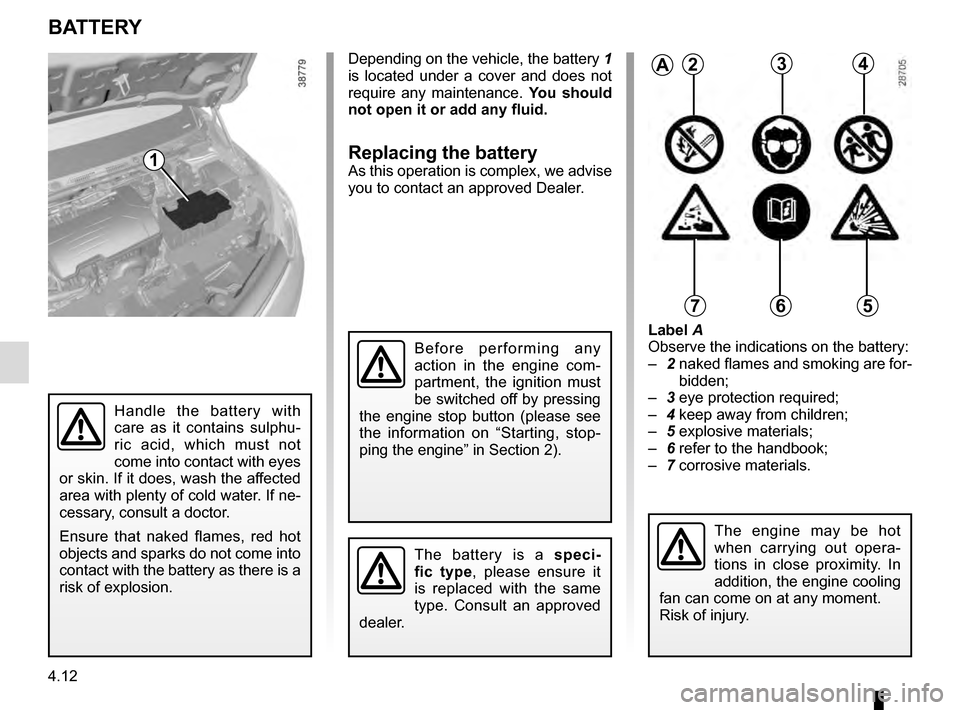
Label A
Observe the indications on the battery:
– 2 naked flames and smoking are for-
bidden;
– 3 eye protection required;
– 4 keep away from children;
– 5 explosive materials;
– 6 refer to the handbook;
– 7 corrosive materials.
BATTERY
1
2
Handle the battery with
care as it contains sulphu-
ric acid, which must not
come into contact with eyes
or skin. If it does, wash the affected
area with plenty of cold water. If ne-
cessary, consult a doctor.
Ensure that naked flames, red hot
objects and sparks do not come into
contact with the battery as there is a
risk of explosion.
The battery is a speci-
fic type, please ensure it
is replaced with the same
type. Consult an approved
dealer.
A234
567
The engine may be hot
when carrying out opera-
tions in close proximity. In
addition, the engine cooling
fan can come on at any moment.
Risk of injury.
Depending on the vehicle, the battery 1
is located under a cover and does not
require any maintenance. You should
not open it or add any fluid.
Replacing the battery
As this operation is complex, we advise
you to contact an approved Dealer.
Before performing any
action in the engine com-
partment, the ignition must
be switched off by pressing
the engine stop button (please see
the information on “Starting, stop-
ping the engine” in Section 2).
Page 195 of 246
5.13
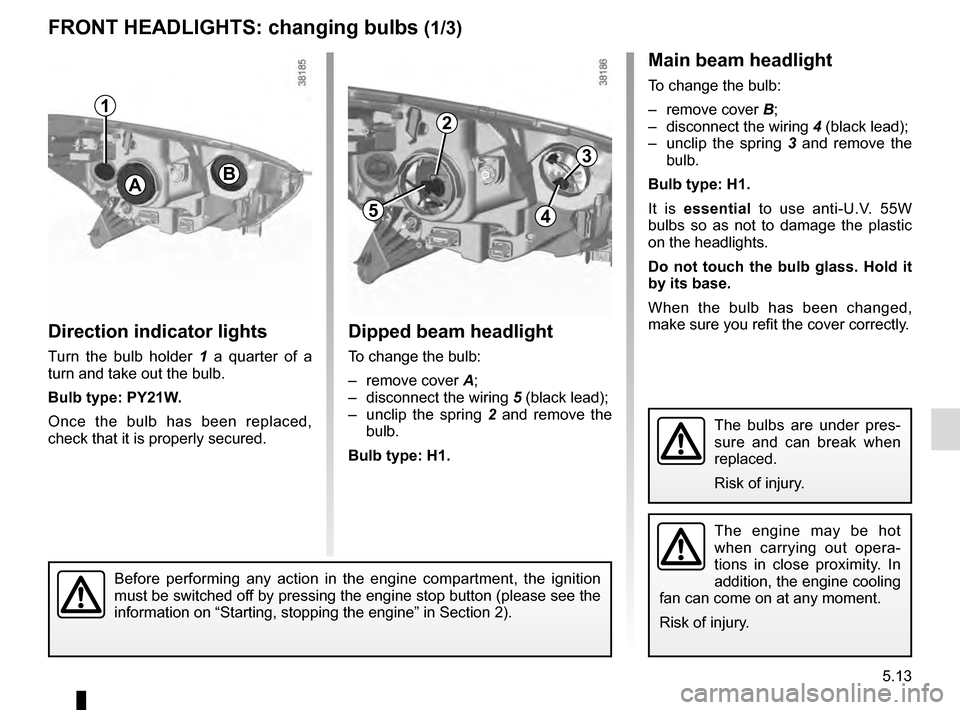
Direction indicator lights
Turn the bulb holder 1 a quarter of a
turn and take out the bulb.
Bulb type: PY21W.
Once the bulb has been replaced,
check that it is properly secured.
Dipped beam headlight
To change the bulb:
– remove cover A;
– disconnect the wiring 5 (black lead);
– unclip the spring 2 and remove the
bulb.
Bulb type: H1.
FRONT HEADLIGHTS: changing bulbs (1/3)
The engine may be hot
when carrying out opera-
tions in close proximity. In
addition, the engine cooling
fan can come on at any moment.
Risk of injury.
B
Main beam headlight
To change the bulb:
– remove cover B;
– disconnect the wiring 4 (black lead);
– unclip the spring 3 and remove the
bulb.
Bulb type: H1.
It is essential to use anti-U.V. 55W
bulbs so as not to damage the plastic
on the headlights.
Do not touch the bulb glass. Hold it
by its base.
When the bulb has been changed,
make sure you refit the cover correctly.
A
1
2
54
3
The bulbs are under pres-
sure and can break when
replaced.
Risk of injury.
Before performing any action in the engine compartment, the ignition
must be switched off by pressing the engine stop button (please see the
information on “Starting, stopping the engine” in Section 2).
Page 196 of 246
5.14
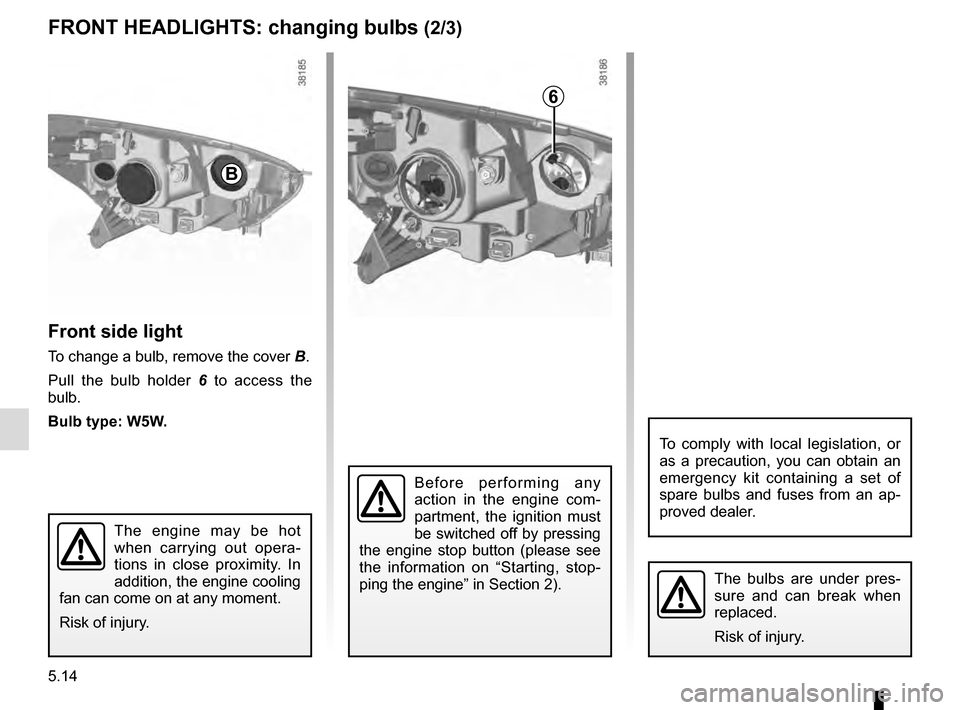
Front side light
To change a bulb, remove the cover B.
Pull the bulb holder 6 to access the
bulb.
Bulb type: W5W.
The bulbs are under pres-
sure and can break when
replaced.
Risk of injury.
FRONT HEADLIGHTS: changing bulbs (2/3)
The engine may be hot
when carrying out opera-
tions in close proximity. In
addition, the engine cooling
fan can come on at any moment.
Risk of injury.
To comply with local legislation, or
as a precaution, you can obtain an
emergency kit containing a set of
spare bulbs and fuses from an ap-
proved dealer.
6
B
Before performing any
action in the engine com-
partment, the ignition must
be switched off by pressing
the engine stop button (please see
the information on “Starting, stop-
ping the engine” in Section 2).
Page 206 of 246

5.24
BATTERY: breakdown recovery (1/2)
To avoid all risk of sparks:
– Ensure that any electrical consumers (courtesy lights, etc.) are switched
off before disconnecting or recon-
necting the battery.
– When charging, stop the charger before connecting or disconnecting
the battery.
– Do not place metal objects on the battery to avoid creating a short cir-
cuit between the terminals.
– Always wait at least one minute after the engine has been switched off
before disconnecting a battery.
– Make sure that you reconnect the battery terminals after refitting.
Connecting a battery charger
The battery charger must be com-
patible with a battery with nominal
voltage of 12 volts.
Do not disconnect the battery when the
engine is running. Follow the instruc-
tions given by the manufacturer of
the battery charger you are using.
Special procedures may be
required to charge some
batteries. Contact your ap-
proved dealer.
Avoid all risk of sparks which may
cause an immediate explosion, and
charge the battery in a well-venti-
lated area. Risk of serious injury.
Handle the battery with care
as it contains sulphuric acid,
which must not come into
contact with eyes or skin. If
it does, wash the affected area with
plenty of cold water. If necessary,
consult a doctor.
Ensure that naked flames, red hot
objects and sparks do not come into
contact with the battery as there is a
risk of explosion.
The engine may be hot when car-
rying out operations in close prox-
imity. In addition, the engine cooling
fan can come on at any moment.
Risk of injury.
Before performing any
action in the engine com-
partment, the ignition must
be switched off by pressing
the engine stop button (please see
the information on “Starting, stop-
ping the engine” in Section 2).
Page 216 of 246
5.34
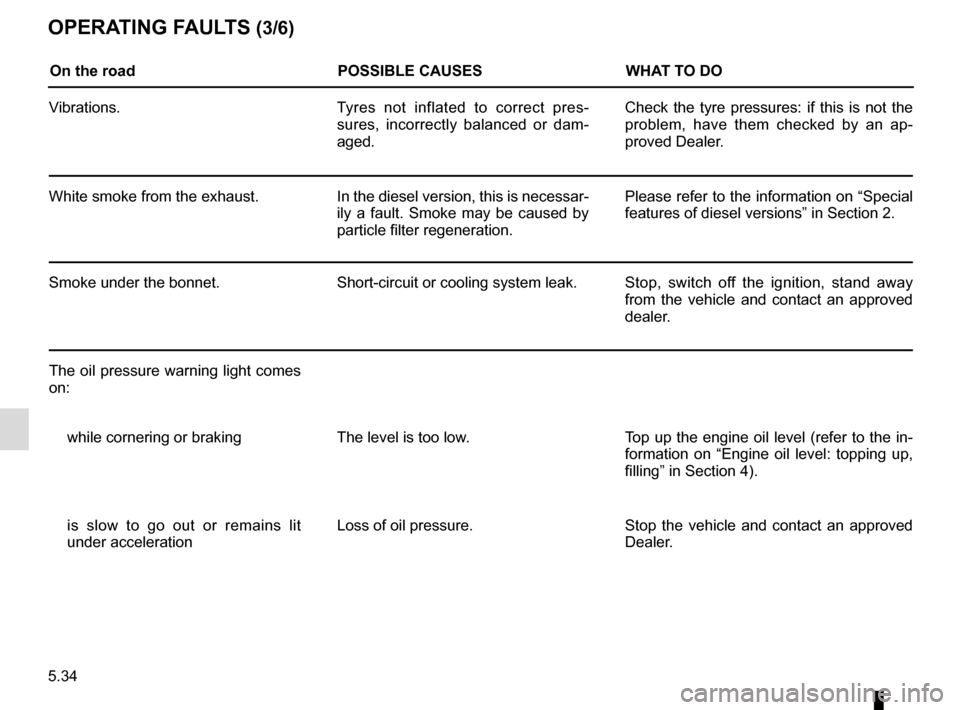
OPERATING FAULTS (3/6)
On the roadPOSSIBLE CAUSESWHAT TO DO
Vibrations. Tyres not inflated to correct pres-
sures, incorrectly balanced or dam-
aged. Check the tyre pressures: if this is not the
problem, have them checked by an ap-
proved Dealer.
White smoke from the exhaust. In the diesel version, this is necessar-
ily a fault. Smoke may be caused by
particle filter regeneration. Please refer to the information on “Special
features of diesel versions” in Section 2.
Smoke under the bonnet. Short-circuit or cooling system leak. Stop, switch off the ignition, stand away
from the vehicle and contact an approved
dealer.
The oil pressure warning light comes
on: while cornering or braking The level is too low. Top up the engine oil level (refer to the in-
formation on “Engine oil level: topping up,
filling” in Section 4).
is slow to go out or remains lit
under acceleration Loss of oil pressure.
Stop the vehicle and contact an approved
Dealer.
Page 217 of 246
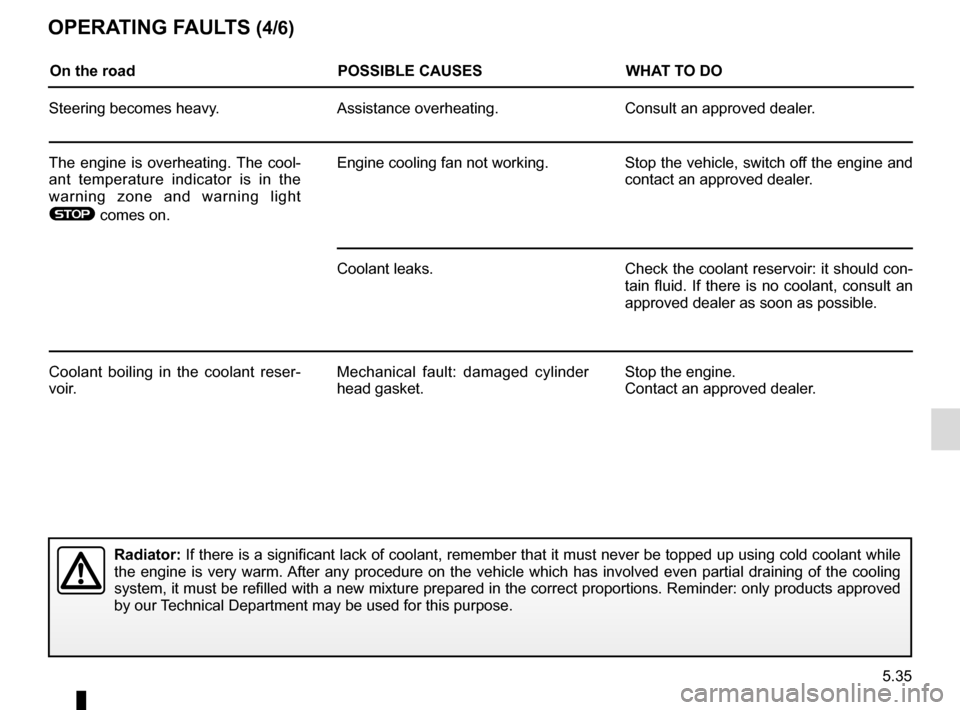
5.35
OPERATING FAULTS (4/6)
On the roadPOSSIBLE CAUSESWHAT TO DO
Steering becomes heavy. Assistance overheating.Consult an approved dealer.
The engine is overheating. The cool-
ant temperature indicator is in the
warning zone and warning light
® comes on. Engine cooling fan not working. Stop the vehicle, switch off the engine and
contact an approved dealer.
Coolant leaks. Check the coolant reservoir: it should con- tain fluid. If there is no coolant, consult an
approved dealer as soon as possible.
Coolant boiling in the coolant reser-
voir. Mechanical fault: damaged cylinder
head gasket.Stop the engine.
Contact an approved dealer.
Radiator:
If there is a significant lack of coolant, remember that it must never b\
e topped up using cold coolant while
the engine is very warm. After any procedure on the vehicle which has involved even partial drain\
ing of the cooling
system, it must be refilled with a new mixture prepared in the correct p\
roportions. Reminder: only products approved
by our Technical Department may be used for this purpose.
Page 240 of 246
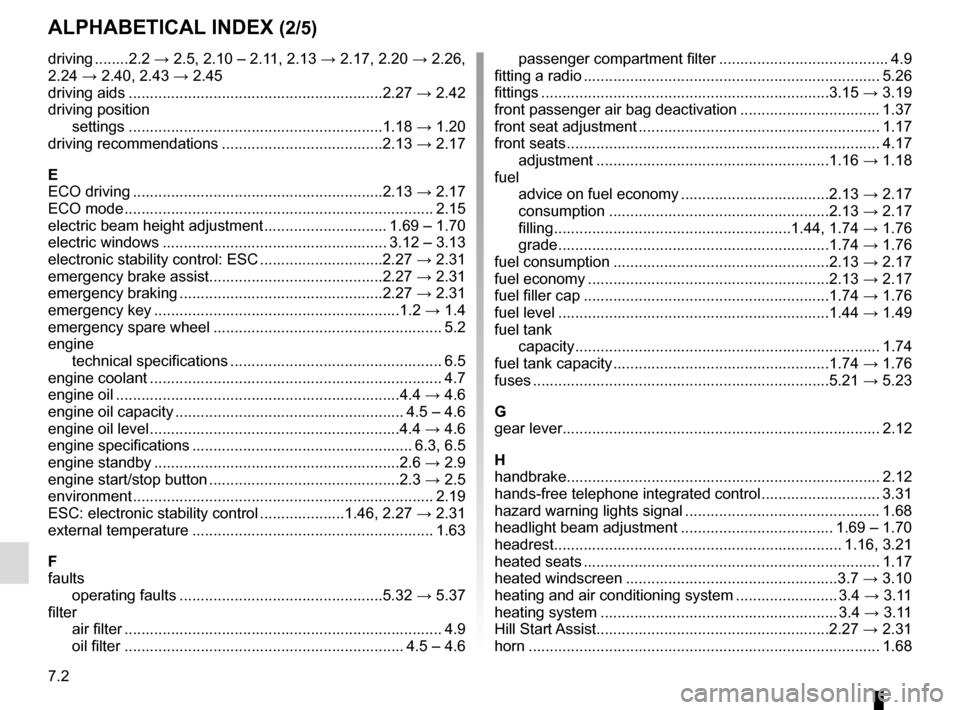
7.2
ALPHABETICAL INDEX (2/5)
driving ........2.2 → 2.5, 2.10 – 2.11, 2.13 → 2.17, 2.20 → 2.26,
2.24 → 2.40, 2.43 → 2.45
driving aids ............................................................2.27 → 2.42
driving position settings ............................................................1.1\
8 → 1.20
driving recommendations ......................................2.13 → 2.17
E
ECO driving ...........................................................2.13 → 2.17
ECO mode ........................................................................\
. 2.15
electric beam height adjustment ............................. 1.69 – 1.70
electric windows ..................................................... 3.12 – 3.13
electronic stability control: ESC .............................2.27 → 2.31
emergency brake assist.........................................2.27 → 2.31
emergency braking ................................................2.27 → 2.31
emergency key ..........................................................1.2 → 1.4
emergency spare wheel ...................................................... 5.2
engine technical specifications .................................................. 6.5
engine coolant ..................................................................... 4.7
engine oil ...................................................................4.4 → 4.6
engine oil capacity ...................................................... 4.5 – 4.6
engine oil level ...........................................................4.4 → 4.6
engine specifications .................................................... 6.3, 6.5
engine standby ..........................................................2.6 → 2.9
engine start/stop button .............................................2.3 → 2.5
environment ............................................................\
........... 2.19
ESC: electronic stability control ....................1.46, 2.27 → 2.31
external temperature ......................................................... 1.63
F
faults operating faults ................................................5.32 → 5.37
filter air filter ........................................................................\
... 4.9
oil filter .................................................................. 4.5 – 4.6 passenger compartment filter ........................................ 4.9
fitting a radio ...................................................................... 5.26
fittings ...............................................................\
.....3.15 → 3.19
front passenger air bag deactivation ................................. 1.37
front seat adjustment ......................................................... 1.17
front seats ........................................................................\
.. 4.17 adjustment .......................................................1.16 → 1.18
fuel advice on fuel economy ...................................2.13 → 2.17
consumption ....................................................2.13 → 2.17
filling ........................................................1.44, 1.74 → 1.76
grade ................................................................1.\
74 → 1.76
fuel consumption ...................................................2.13 → 2.17
fuel economy .........................................................2.13 → 2.17
fuel filler cap ..........................................................1.74 → 1.76
fuel level ................................................................1.44 → 1.49
fuel tank capacity ...............................................................\
......... 1.74
fuel tank capacity ...................................................1.74 → 1.76
fuses ..................................................................\
....5.21 → 5.23
G
gear lever..............................................................\
............. 2.12
H
handbrake...............................................................\
........... 2.12
hands-free telephone integrated control ............................
3.31
hazard warning lights signal .............................................. 1.68
headlight beam adjustment .................................... 1.69 – 1.70
headrest................................................................\
.... 1.16, 3.21
heated seats ...................................................................... 1.17
heated windscreen ..................................................3.7 → 3.10
heating and air conditioning system ........................ 3.4 → 3.11
heating system ........................................................ 3.4 → 3.11
Hill Start Assist.......................................................2.27 → 2.31
horn ...................................................................\
................ 1.68
Page 241 of 246

horn:flash ..................................................................\
........... 1.68
hubcap tool ...............................................................")
7.3
ALPHABETICAL INDEX (3/5)
horn:flash ..................................................................\
........... 1.68
hubcap tool ................................................................. 5.6 – 5.7
I
indicators ......................................................1.68, 5.13 → 5.17
indicators: direction indicators ....................................................... 1.68
instrument panel ..............................................1.44 → 1.52
instrument panel ....................................................1.44 → 1.60
instrument panel messages...................................1.51 → 1.60
interior trim maintenance ..................................................... 4.15 – 4.16
Isofix ....................................................................... 1.31 – 1.32
J
jack ...................................................................\
................... 5.6
L
levels .................................................................\
........4.7 → 4.9
levels: brake fluid ...................................................................... 4.8
coolant ................................................................\
........... 4.7
windscreen washer reservoir ......................................... 4.9
lifting the vehicle changing a wheel .................................................. 5.8 – 5.9
lighting: exterior .............................................................1.\
65 → 1.70
instrument panel .......................................................... 1.65
interior ...................................................... 3.14, 5.18 – 5.19
lights adjustment ........................................................ 1.69 – 1.70
changing bulbs .................................................5.13 → 5.15
front ..................................................................\
5.13 → 5.15
lights: adjusting ........................................................... 1.69 – 1.70 brake lights ....................................................... 5.16 – 5.17
dipped beam headlights .................1.44, 1.65, 5.13
→ 5.15
direction indicators .........................1.44, 1.68, 5.13 → 5.16
fog lights .................................................... 1.44, 1.67, 5.17
hazard warning ............................................................ 1.68
main beam headlights ................................ 1.44, 1.65, 5.13
reversing lights ............................................................. 5.17
side lights ................................................1.65, 5.13 → 5.16
load permitted on the roof..............................................\
...... 6.6
locking the doors .....................................................1.2 → 1.15
M
maintenance ............................................................\
.......... 2.18
maintenance: bodywork .......................................................... 4.13 – 4.14
interior trim ........................................................ 4.15 – 4.16
mechanical .........................................4.4, 4.12, 6.8 → 6.13
map reading lights ............................................................. 3.14
methods of restraint in addition to the seat belts ...1.21 → 1.27
mobile floor ........................................................................\
3.26
multimedia equipment .............................................. 3.31, 5.26
N
navigation system .............................................................. 3.31
O
oil change ................................................................... 4.5 – 4.6
opening the doors .................................................. 1.11 → 1.14
operating faults ................................ 1.44 → 1.48, 5.32 → 5.37
P
paintwork maintenance ..................................................... 4.13 – 4.14
parking distance control.......................................... 2.39 – 2.40
power-assisted steering.................................................\
.... 1.61
pretensioners .........................................................1\
.21 → 1.24
Page 242 of 246

puncture........................................................ 5.2, 5.6, 5.8 – 5.9
R
radio...................................................................\
........")
7.4
ALPHABETICAL INDEX (4/5)
puncture........................................................ 5.2, 5.6, 5.8 – 5.9
R
radio...................................................................\
................ 3.31
rear bench seat................................... 3.22 – 3.23, 4.20 – 4.21
rear parcel shelf ................................................................. 3.25
rear seat ................................................................. 4.20 – 4.21
rear seats..............................................................\
............. 1.20functions ........................................................... 3.22 – 3.23
rear view camera .................................................... 2.41 – 2.42
rear view mirrors ................................................................ 1.64
RENAULT ANTI-INTRUDER DEVICE (RAID) ................... 1.15
RENAULT card battery ................................................................\
.......... 5.20
use ................................................... 1.2 → 1.10, 2.3 → 2.5
RENAULT card battery ...................................................... 5.20
replacement parts ................................................................ 6.7
reverse gear selecting ..................................................2.12, 2.43 → 2.45
reversing sensor ..................................................... 2.39 – 2.40
roof bars ........................................................................\
.... 3.30
roof rack roof bars ....................................................................... 3.30
running in ........................................................................\
..... 2.2
S
seat belt pretensioners front seat belt ...................................................1.21 → 1.24
seat belts ......................................................1.18 → 1.24, 1.27
seat trim .................................................................4.17 → 4.21
seats: trim ..............................................................4.17 → 4.21
service sheets..........................................................\
6.8 → 6.13
side protection devices ...................................................... 1.26
signals and lights ...................................................1.65 → 1.70
speakers location ...............................................................\
......... 5.26 special features of diesel versions.....................................\
2.11
special features of petrol vehicles ..................................... 2.10
speed limiter .................................................1.47, 2.32 → 2.34
starting the engine .....................................................2.3 → 2.9
steering wheel adjustment .............................................................\
...... 1.61
Stop & Start ......................................................1.47, 2.6 → 2.9
Stop & Start function..................................................2.6 → 2.9
stopping the engine ...................................................2.3 → 2.5
storage compartment.............................................3.15 → 3.19
storage compartments ...........................................3.15 → 3.19
sun visor ........................................................................\
.... 3.19
switching on the vehicle ignition ................................2.3 → 2.5
T
tailgate ..........................................................3.24,\
3.26 → 3.28
tanks and reservoirs brake fluid ...................................................................... 4.8
coolant ................................................................\
........... 4.7
tanks and reservoirs: windscreen washer ........................................................ 4.9
technical specifications ..............................................6.4 → 6.7
telephone ..............................................................\
............. 3.31
temperature regulation ............................................ 3.7 → 3.11
tool kit ........................................................................\
.......... 5.6
towing breakdown ........................................................ 5.30 – 5.31
towing equipment ......................................................... 3.29
towing a caravan ........................................................ 3.29, 6.6
towing equipment fitting ................................................................\
............ 3.29
towing hitch...................................................... 5.6, 5.30 – 5.31
towing rings ....................................................................... 3.28
towing weights ..................................................................... 6.6
traction control: ASR ..............................................2.27 → 2.31
transporting children ..........................1.28 – 1.29, 1.31 → 1.37