lever RENAULT CAPTUR 2016 1.G User Guide
[x] Cancel search | Manufacturer: RENAULT, Model Year: 2016, Model line: CAPTUR, Model: RENAULT CAPTUR 2016 1.GPages: 246, PDF Size: 2.55 MB
Page 113 of 246
2.31
DRIVING CORRECTION DEVICES AND AIDS (5/5)
Hill start assistance
Depending on the gradient of the in-
cline, this system assists the driver
when starting on a hill. It prevents the
vehicle from rolling backwards, de-
pending on the slope, by automatically
applying the brakes when the driver lifts
his/her foot off the brake pedal to de-
press the accelerator pedal.
System operation
It only operates when the gear lever is
in a position other than neutral (other
than N or P for automatic transmis-
sions) and the vehicle is completely
stationary (brake pedal depressed)
The system holds the vehicle for ap-
proximately 2 seconds. The brakes are
then gradually released (the vehicle will
move according to the slope).The hill start assistance
system cannot completely
prevent the vehicle from
rolling backwards in all sit-
uations (extremely steep gradients,
etc.).
In all cases, the driver may depress
the brake pedal to prevent the ve-
hicle from rolling forwards or back-
wards.
The hill start assistance function
should not be used for prolonged
stops: use the brake pedal.
This function is not designed to im-
mobilise the vehicle permanently.
If necessary, use the brake pedal to
stop the vehicle.
The driver must remain particularly
vigilant when driving on slippery or
low-grip surfaces and/or on hills.
Risk of serious injury.
Page 125 of 246
2.43
AUTOMATIC TRANSMISSION (1/3)
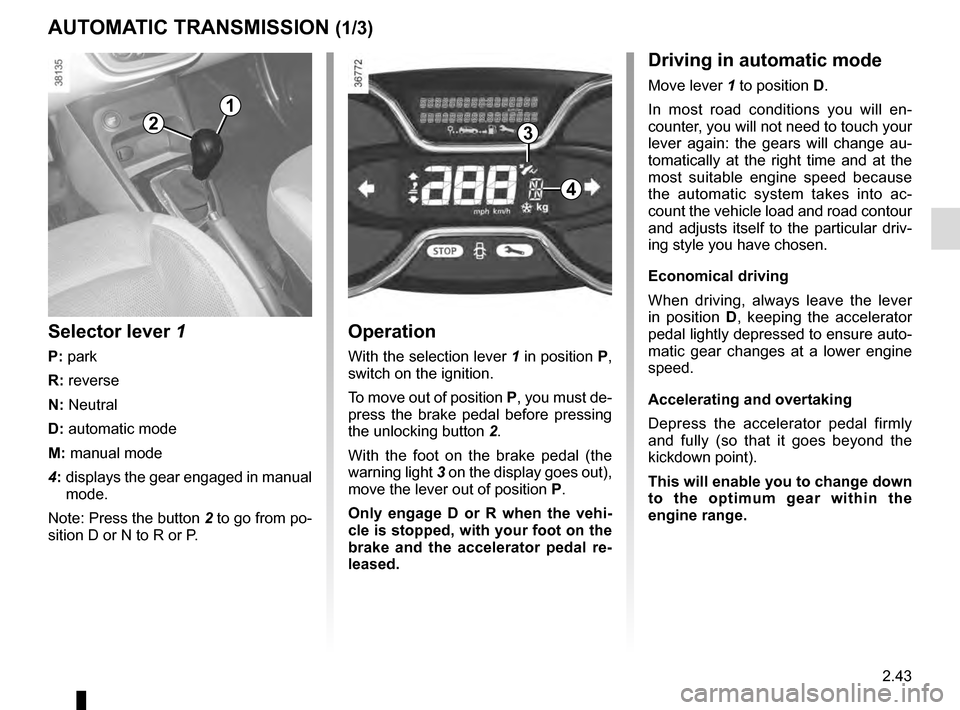
Operation
With the selection lever 1 in position P,
switch on the ignition.
To move out of position P, you must de-
press the brake pedal before pressing
the unlocking button 2.
With the foot on the brake pedal (the
warning light 3 on the display goes out),
move the lever out of position P.
Only engage D or R when the vehi-
cle is stopped, with your foot on the
brake and the accelerator pedal re-
leased.
Selector lever 1
P: park
R: reverse
N: Neutral
D: automatic mode
M: manual mode
4: displays the gear engaged in manual
mode.
Note: Press the button 2 to go from po-
sition D or N to R or P.
1
4
32
Driving in automatic mode
Move lever 1 to position D.
In most road conditions you will en-
counter, you will not need to touch your
lever again: the gears will change au-
tomatically at the right time and at the
most suitable engine speed because
the automatic system takes into ac-
count the vehicle load and road contour
and adjusts itself to the particular driv-
ing style you have chosen.
Economical driving
When driving, always leave the lever
in position D, keeping the accelerator
pedal lightly depressed to ensure auto-
matic gear changes at a lower engine
speed.
Accelerating and overtaking
Depress the accelerator pedal firmly
and fully (so that it goes beyond the
kickdown point).
This will enable you to change down
to the optimum gear within the
engine range.
Page 126 of 246
2.44
AUTOMATIC TRANSMISSION (2/3)
Special cases
In certain driving conditions (for exam-
ple, engine protection, operation of the
Electronic Stability Programme: the au-
tomatic system may change gear auto-
matically.
Likewise, to prevent incorrect manoeu-
vres, a gear change may be refused by
the automatic system: in this case the
gear display flashes for a few seconds
as a warning.
Special circumstances
– If the bends and road surface do
not allow you to stay in automatic
mode (e.g. in the mountains), we
recommend that you change to
manual mode. This will prevent the
automatic gearbox from changing
gear repeatedly when climbing, and
permit engine braking on long de-
scents.
– In cold weather , start the engine
and wait a few seconds before
moving the selector lever from posi-
tion P or N and engaging it in D or R
to prevent the engine stalling.
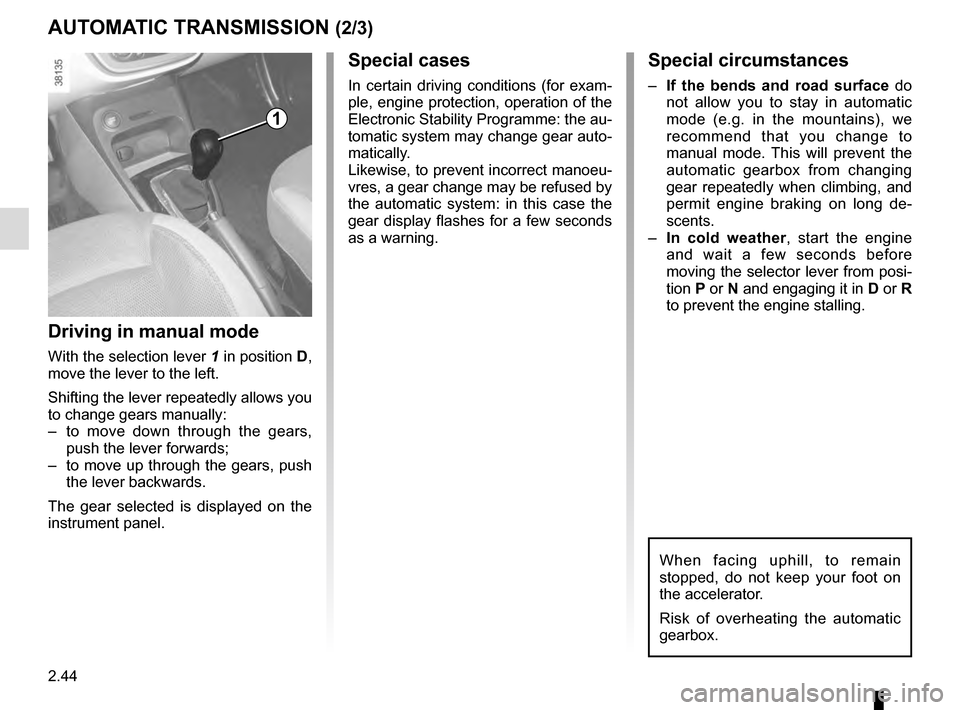
Driving in manual mode
With the selection lever 1 in position D,
move the lever to the left.
Shifting the lever repeatedly allows you
to change gears manually:
– to move down through the gears, push the lever forwards;
– to move up through the gears, push the lever backwards.
The gear selected is displayed on the
instrument panel.
1
When facing uphill, to remain
stopped, do not keep your foot on
the accelerator.
Risk of overheating the automatic
gearbox.
Page 127 of 246
2.45
AUTOMATIC TRANSMISSION (3/3)
Parking the vehicle
When the vehicle is stopped, move the
lever to position P while keeping your
foot on the brake pedal: the gearbox is
in neutral and the drive wheels are me-
chanically locked by the driveshaft.
Apply the handbrake.
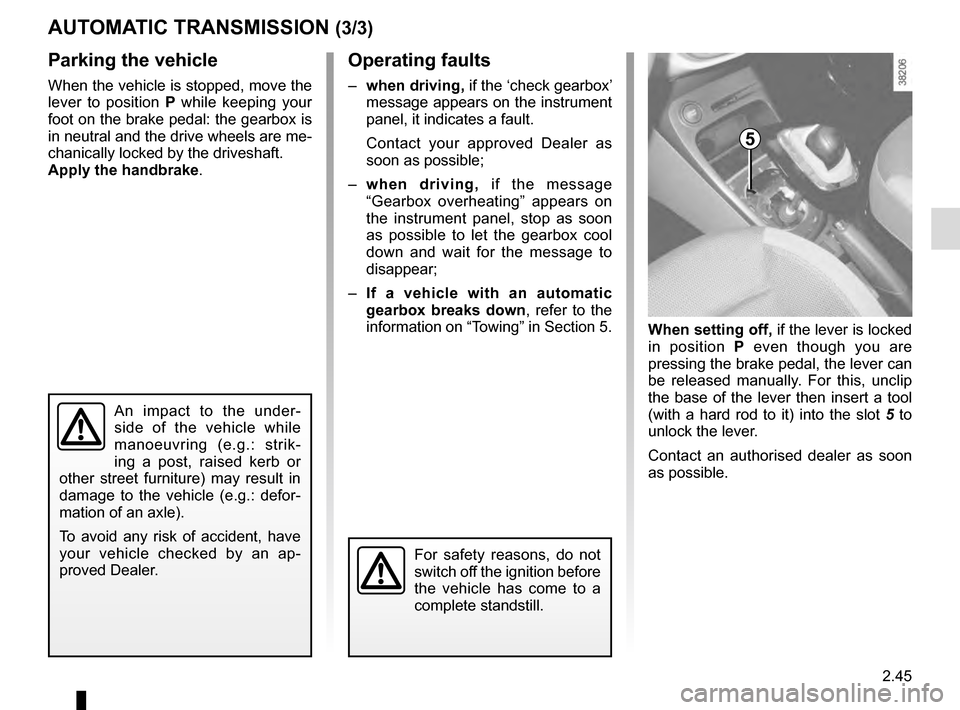
When setting off, if the lever is locked
in position P even though you are
pressing the brake pedal, the lever can
be released manually. For this, unclip
the base of the lever then insert a tool
(with a hard rod to it) into the slot 5 to
unlock the lever.
Contact an authorised dealer as soon
as possible.
Operating faults
– when driving, if the ‘check gearbox’
message appears on the instrument
panel, it indicates a fault.
Contact your approved Dealer as
soon as possible;
– when driving, if the message
“Gearbox overheating” appears on
the instrument panel, stop as soon
as possible to let the gearbox cool
down and wait for the message to
disappear;
– If a vehicle with an automatic
gearbox breaks down, refer to the
information on “Towing” in Section 5.
5
For safety reasons, do not
switch off the ignition before
the vehicle has come to a
complete standstill.
An impact to the under-
side of the vehicle while
manoeuvring (e.g.: strik-
ing a post, raised kerb or
other street furniture) may result in
damage to the vehicle (e.g.: defor-
mation of an axle).
To avoid any risk of accident, have
your vehicle checked by an ap-
proved Dealer.
Page 140 of 246
3.12
ELECTRIC WINDOWS (1/2)
1
2
34
5
6
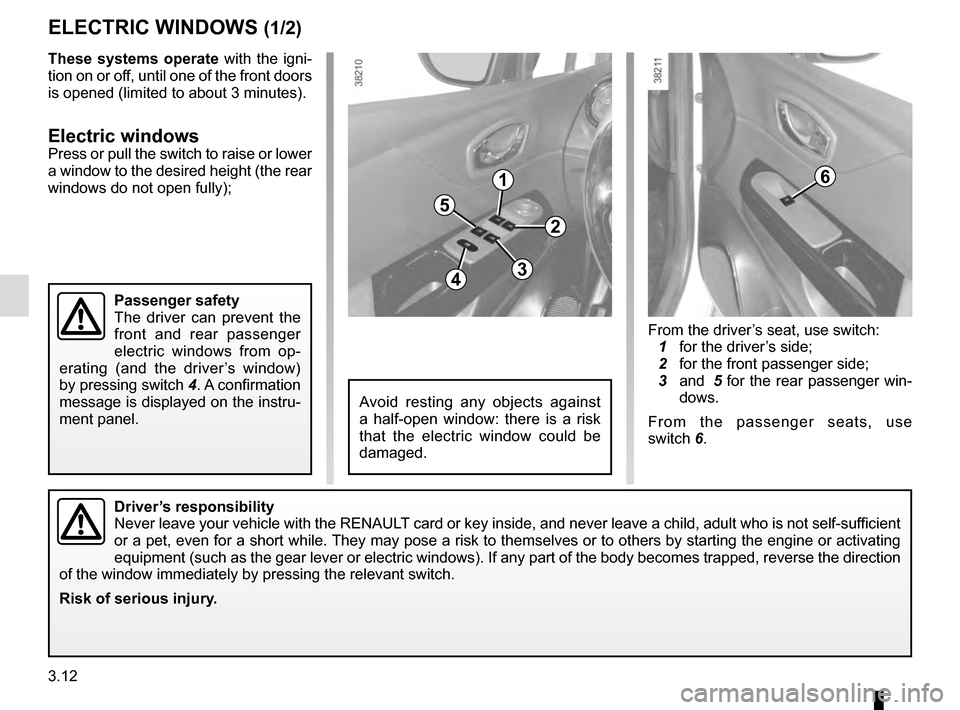
From the driver’s seat, use switch:
1 for the driver’s side;
2 for the front passenger side;
3 and 5 for the rear passenger win-
dows.
From the passenger seats, use
switch 6.
Avoid resting any objects against
a half-open window: there is a risk
that the electric window could be
damaged.
Driver’s responsibility
Never leave your vehicle with the RENAULT card or key inside, and never leave a child, adult who is not self-sufficient
or a pet, even for a short while. They may pose a risk to themselves or to others by starting the engine o\
r activating
equipment (such as the gear lever or electric windows). If any part of\
the body becomes trapped, reverse the direction
of the window immediately by pressing the relevant switch.
Risk of serious injury.
These systems operate with the igni-
tion on or off, until one of the front doors
is opened (limited to about 3 minutes).
Electric windowsPress or pull the switch to raise or lower
a window to the desired height (the rear
windows do not open fully);
Passenger safety
The driver can prevent the
front and rear passenger
electric windows from op-
erating (and the driver’s window)
by pressing switch 4. A confirmation
message is displayed on the instru-
ment panel.
Page 150 of 246
3.22
SLIDING REAR BENCH SEAT (1/2)
To move forwards or
backwards
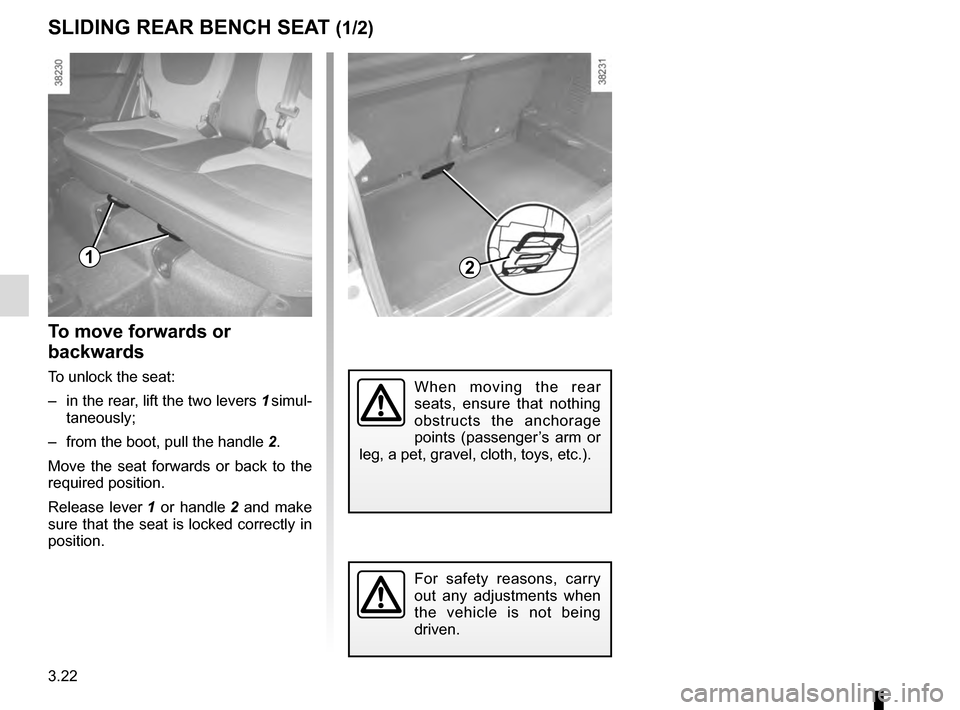
To unlock the seat:
– in the rear, lift the two levers 1 simul-taneously;
– from the boot, pull the handle 2.
Move the seat forwards or back to the
required position.
Release lever 1 or handle 2 and make
sure that the seat is locked correctly in
position.
For safety reasons, carry
out any adjustments when
the vehicle is not being
driven.
1
When moving the rear
seats, ensure that nothing
obstructs the anchorage
points (passenger’s arm or
leg, a pet, gravel, cloth, toys, etc.).
2
Page 188 of 246
5.6
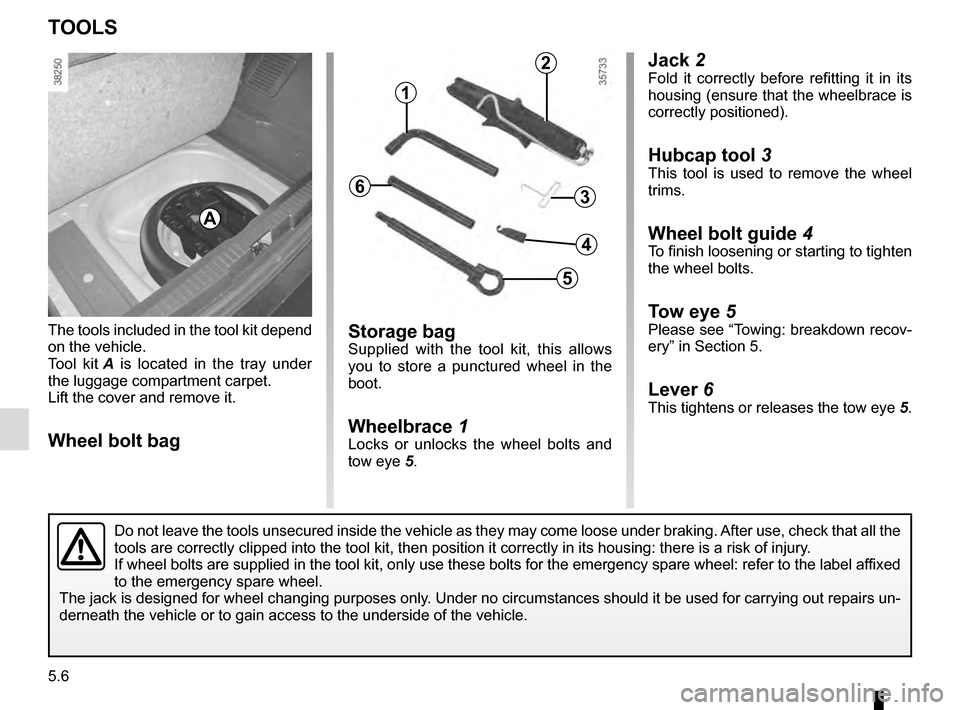
Jack 2Fold it correctly before refitting it in its
housing (ensure that the wheelbrace is
correctly positioned).
Hubcap tool 3
This tool is used to remove the wheel
trims.
Wheel bolt guide 4To finish loosening or starting to tighten
the wheel bolts.
Tow eye 5Please see “Towing: breakdown recov-
ery” in Section 5.
Lever 6This tightens or releases the tow eye 5.
Storage bagSupplied with the tool kit, this allows
you to store a punctured wheel in the
boot.
Wheelbrace 1Locks or unlocks the wheel bolts and
tow eye 5.
The tools included in the tool kit depend
on the vehicle.
Tool kit
A is located in the tray under
the luggage compartment carpet.
Lift the cover and remove it.Wheel bolt bag
TOOLS
A
Do not leave the tools unsecured inside the vehicle as they may come loo\
se under braking. After use, check that all the
tools are correctly clipped into the tool kit, then position it correctl\
y in its housing: there is a risk of injury.
If wheel bolts are supplied in the tool kit, only use these bolts for th\
e emergency spare wheel: refer to the label affixed
to the emergency spare wheel.
The jack is designed for wheel changing purposes only. Under no circumstances should it be used for carrying out repairs un-
derneath the vehicle or to gain access to the underside of the vehicle.
2
1
3
5
4
6
Page 212 of 246
5.30
TOWING: breakdown recovery (1/2)
Before towing, unlock the steering
column: with the clutch depressed,
engage first gear (lever in position N
or R for vehicles with automatic gear-
boxes), insert the RENAULT card in the
card reader, then press the engine start
button for two seconds.
Reposition the lever to neutral (posi-
tion N for vehicles fitted with an auto-
matic gearbox).
The column is unlocked, the acces-
sory functions are supplied: the vehi-
cle lights can be used (indicators, brake
lights etc.). At night the vehicle must
have its lights on.
Once you have finished towing, press
the engine start button twice (risk of
running down the battery). The speed specified by current legis-
lation for towing must always be ob-
served. If your vehicle is the towing
vehicle, do not exceed the maximum
towing weight for your vehicle (refer to
the information on “Weights” in Section
6).
Towing a vehicle with an
automatic gearbox
With the engine switched off, the trans-
mission is no longer lubricated. It is
preferable to tow this type of vehicle on
a trailer or tow it with the front wheels
off the ground.
Under
exceptional circumstances, you
may tow the vehicle with all four wheels
on the ground, only going forward, with
the gear lever in the neutral N position,
and for a distance not exceeding
30 miles (50 km).
Do not remove the
RENAULT card from the
reader when the vehicle is
being towed.
1
2
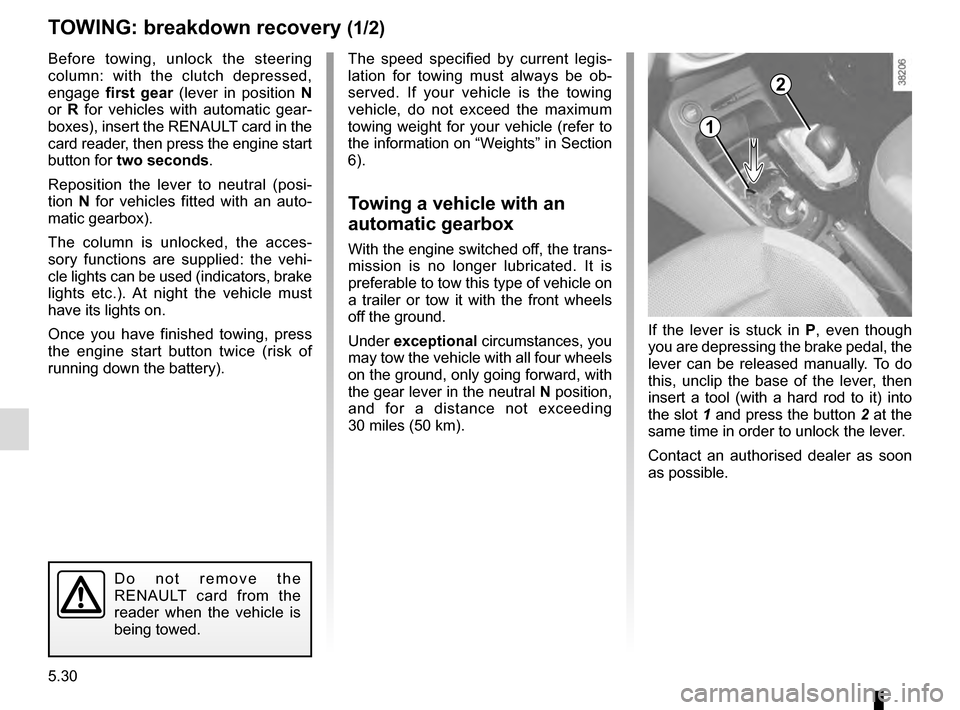
If the lever is stuck in P , even though
you are depressing the brake pedal, the
lever can be released manually. To do
this, unclip the base of the lever, then
insert a tool (with a hard rod to it) into
the slot 1 and press the button 2 at the
same time in order to unlock the lever.
Contact an authorised dealer as soon
as possible.
Page 213 of 246
5.31
TOWING: breakdown recovery (2/2)
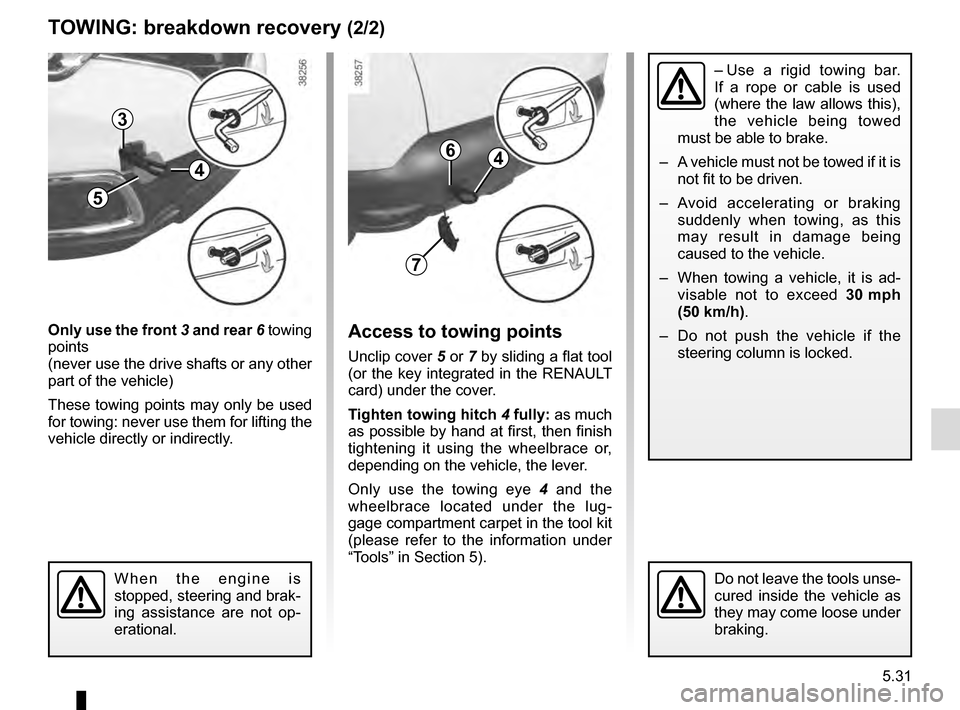
Only use the front 3 and rear 6 towing
points
(never use the drive shafts or any other
part of the vehicle)
These towing points may only be used
for towing: never use them for lifting the
vehicle directly or indirectly.Access to towing points
Unclip cover 5 or 7 by sliding a flat tool
(or the key integrated in the RENAULT
card) under the cover.
Tighten towing hitch 4 fully: as much
as possible by hand at first, then finish
tightening it using the wheelbrace or,
depending on the vehicle, the lever.
Only use the towing eye 4 and the
wheelbrace located under the lug-
gage compartment carpet in the tool kit
(please refer to the information under
“Tools” in Section 5).
When the engine is
stopped, steering and brak-
ing assistance are not op-
erational.Do not leave the tools unse-
cured inside the vehicle as
they may come loose under
braking.
6
7
4
– Use a rigid towing bar.
If a rope or cable is used
(where the law allows this),
the vehicle being towed
must be able to brake.
– A vehicle must not be towed if it is not fit to be driven.
– Avoid accelerating or braking suddenly when towing, as this
may result in damage being
caused to the vehicle.
– When towing a vehicle, it is ad- visable not to exceed 30 mph
(50 km/h).
– Do not push the vehicle if the steering column is locked.
5
4
3
Page 239 of 246

A
ABS ..............................................................1.46, \
2.27 → 2.31
accessories.............................................................\
......")
7.1
ALPHABETICAL INDEX (1/5)
A
ABS ..............................................................1.46, \
2.27 → 2.31
accessories.............................................................\
........... 5.27
accessories socket ............................................................ 3.20
additional methods of restraint .......................................... 1.27 side protection ............................................................. 1.26
to the front seat belts .......................................1.21 → 1.24
to the rear seat belts .................................................... 1.25
adjusting your driving position ......................1.16 → 1.20, 3.21
advice on antipollution ....................................................... 2.18
air bag...........................................................1.21 → 1.27, 1.44
activating the front passenger air bags ........................ 1.39
deactivating the front passenger air bags .................... 1.37
air conditioning ........................................................ 3.4 → 3.11
air vents ...................................................................... 3.2 – 3.3
anti-corrosion check ..............................................6.14 → 6.18
anti-corrosion protection .................................................... 4.13
anti-lock braking system: ABS ...............................2.27 → 2.31
antipollution advice .................................................................\
......... 2.18
armrest: front ..................................................................\
............ 3.16
ashtray ................................................................\
............... 3.20
ASR (traction control) ............................................2.27 → 2.31
audible and visual signals.................................................. 1.68
automatic gearbox (use) ........................................2.43 → 2.45
automatic gearbox selector lever...........................2.43 → 2.45
B
battery............................................................ 4.12, 5.24 – 5.25 troubleshooting ................................................. 5.24 – 5.25
bonnet..................................................................\
....... 4.2 – 4.3
brake fluid ........................................................................\
.... 4.8
bulbs changing ..........................................................5.13 \
→ 5.19C
catalytic converter................................................... 2.10 – 2.11
central door locking ........................... 1.5
→ 1.10, 1.13 → 1.15
changing a bulb .....................................................5.13 → 5.19
changing a wheel........................................................\
5.8 – 5.9
changing gear ...............................................2.12, 2.43 → 2.45
child restraint/seat .............................1.28 – 1.29, 1.31 → 1.37
child safety......1.8 – 1.9, 1.12, 1.24, 1.28 – 1.29, 1.31 → 1.37,
2.3, 3.12 – 3.13
child seats..........................................1.28 – 1.29, 1.3\
1 → 1.36
children ........................ 1.2, 1.8 – 1.9, 1.28 – 1.29, 3.12 – 3.13
children (safety) .......................................................... 1.2, 1.12
cigar lighter ........................................................................\
3.20
cleaning: inside the vehicle .............................................. 4.15 – 4.16
clock ....................................................................... 1.62 – 1.63
closing the doors ................................................... 1.11 → 1.15
control instruments ............................1.44 → 1.52, 1.62 – 1.63
controls ...............................................................\
...1.40 → 1.43
courtesy light ............................................................ 3.14, 5.18
courtesy mirrors ................................................................. 3.19
cruise control ................................................1.47, 2.35 → 2.38
cruise control-speed limiter....................................2.32 → 2.38
D
dashboard..............................................................1\
.40 → 1.43
deadlocking the doors ....................................................... 1.10
demisting rear screen ..................................................3.4, 3.7 → 3.10
windscreen ..................................................3.5, 3.7 → 3.10
dimensions .............................................................\
............. 6.4
dipstick................................................................\
................. 4.4
display ................................................................\
...1.44 → 1.50
doors/tailgate .........................................................\
..1.2 → 1.15
driver assistance....................................................2.2\
7 → 2.42
driver’s position .....................................................1.40 →
1.48