change RENAULT CAPTUR 2016 1.G Owner's Manual
[x] Cancel search | Manufacturer: RENAULT, Model Year: 2016, Model line: CAPTUR, Model: RENAULT CAPTUR 2016 1.GPages: 246, PDF Size: 2.55 MB
Page 166 of 246
4.6
Engine oil grade
Refer to the Maintenance Service
Booklet for your vehicle.
ENGINE OIL LEVEL: topping up, filling (2/2)OIL CHANGE
Never run the engine in an
enclosed space as exhaust
gases are poisonous.
Engine oil change: if you
are changing the oil when
the engine is hot, be careful
not to scald yourself if the
oil overflows.
Filling: take care when
topping up the oil that
no oil drips onto engine
components - risk of fire.
Remember to refit the cap securely
as there is a risk of fire if oil splashes
onto hot engine components.
When working in the engine
compartment, ensure that
the windscreen wiper stalk
is in the park position.
Risk of injury.
The engine may be hot
when carrying out opera-
tions in close proximity. In
addition, the engine cooling
fan can come on at any moment.
Risk of injury.
Oil change
Service interval: refer to the
Maintenance Service Booklet for your
vehicle.
Oil change capacity
Please refer to the maintenance docu-
ment for your vehicle, or contact an au-
thorised dealer.
Always check the engine oil level using
the dipstick, as explained previously (it
should never fall below the minimum
level, or be over the maximum level on
the dipstick).
Consult your approved dealer at
once if you notice an abnormal or
repeated drop in any of the fluid
levels.Exceeding the maximum
engine oil level
Under no circumstances
must the maximum fill level
be exceeded: risk of damage to the
engine and catalytic converter.
If the oil level exceeds the maximum
level, do not start your vehicle and
contact an approved Dealer.
Page 194 of 246
5.12
Use in winter
Chains
For safety reasons, fitting snow
chains to the rear axle is strictly for-
bidden.
Chains cannot be fitted to tyres which
are larger than those originally fitted to
the vehicle.
TYRES (3/3)
Snow or Winter tyres
We would recommend that these be
fitted to all four wheels to ensure that
your vehicle retains maximum adhe-
sion.
Warning : These tyres sometimes have
a specific direction of rotation and a
maximum speed index which may be
lower than the maximum speed of your
vehicle.
Studded tyres
This type of equipment may only be
used for a limited period and as laid
down by local legislation. It is neces-
sary to observe the speed specified by
current legislation.
These tyres must, at a minimum, be
fitted to the two front wheels.
Chains may only be fitted
to tyres of the same size
as those originally fitted to
your vehicle.
In all cases, we would recommend
that you contact an approved dealer
who will be able to advise you on
the choice of equipment which is
most suitable for your vehicle.
17” wheels cannot be
fitted with chains.
If you wish to fit snow
chains, you must use spe-
cial equipment .
Consult an approved Dealer.
Emergency spare wheel
Refer to the information on the
“Emergency spare wheel” and in-
structions on “Changing a wheel” in
Section 5.
Changing wheels around
This practice is not recommended.
Fitting new tyres
For safety reasons, this op-
eration must be carried out
by a specialist.
Fitting different tyres may
change your vehicle as follows:
– it may mean that your vehicle no longer conforms to current regu-
lations;
– it may change the way it handles when cornering;
– it may cause the steering to be heavy;
– it may affect the use of snow chains.
Page 195 of 246
5.13
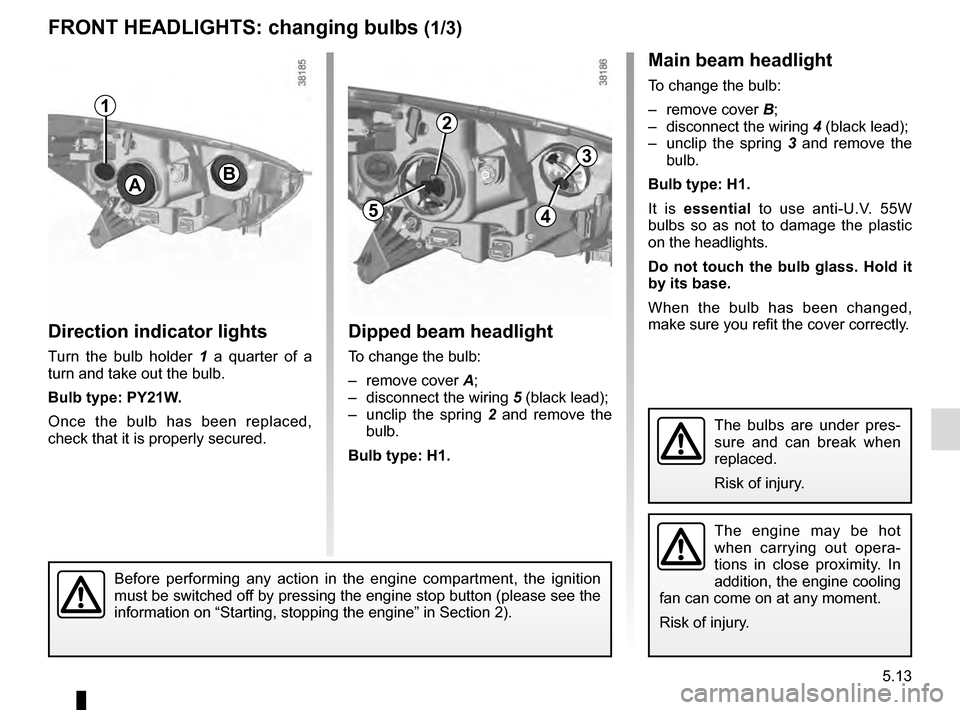
Direction indicator lights
Turn the bulb holder 1 a quarter of a
turn and take out the bulb.
Bulb type: PY21W.
Once the bulb has been replaced,
check that it is properly secured.
Dipped beam headlight
To change the bulb:
– remove cover A;
– disconnect the wiring 5 (black lead);
– unclip the spring 2 and remove the
bulb.
Bulb type: H1.
FRONT HEADLIGHTS: changing bulbs (1/3)
The engine may be hot
when carrying out opera-
tions in close proximity. In
addition, the engine cooling
fan can come on at any moment.
Risk of injury.
B
Main beam headlight
To change the bulb:
– remove cover B;
– disconnect the wiring 4 (black lead);
– unclip the spring 3 and remove the
bulb.
Bulb type: H1.
It is essential to use anti-U.V. 55W
bulbs so as not to damage the plastic
on the headlights.
Do not touch the bulb glass. Hold it
by its base.
When the bulb has been changed,
make sure you refit the cover correctly.
A
1
2
54
3
The bulbs are under pres-
sure and can break when
replaced.
Risk of injury.
Before performing any action in the engine compartment, the ignition
must be switched off by pressing the engine stop button (please see the
information on “Starting, stopping the engine” in Section 2).
Page 196 of 246
5.14
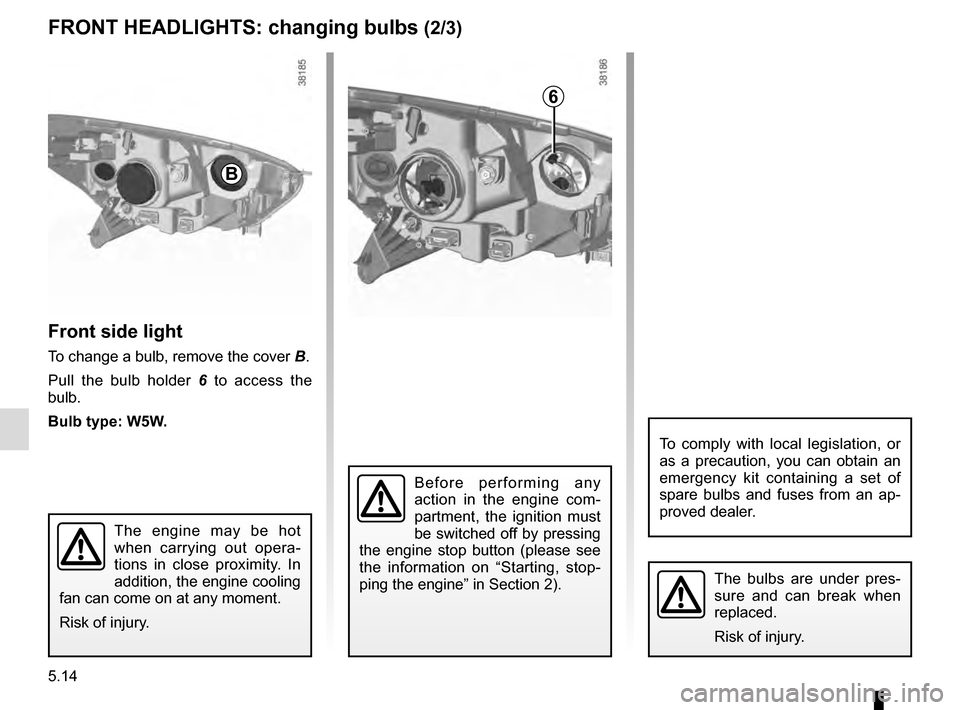
Front side light
To change a bulb, remove the cover B.
Pull the bulb holder 6 to access the
bulb.
Bulb type: W5W.
The bulbs are under pres-
sure and can break when
replaced.
Risk of injury.
FRONT HEADLIGHTS: changing bulbs (2/3)
The engine may be hot
when carrying out opera-
tions in close proximity. In
addition, the engine cooling
fan can come on at any moment.
Risk of injury.
To comply with local legislation, or
as a precaution, you can obtain an
emergency kit containing a set of
spare bulbs and fuses from an ap-
proved dealer.
6
B
Before performing any
action in the engine com-
partment, the ignition must
be switched off by pressing
the engine stop button (please see
the information on “Starting, stop-
ping the engine” in Section 2).
Page 198 of 246
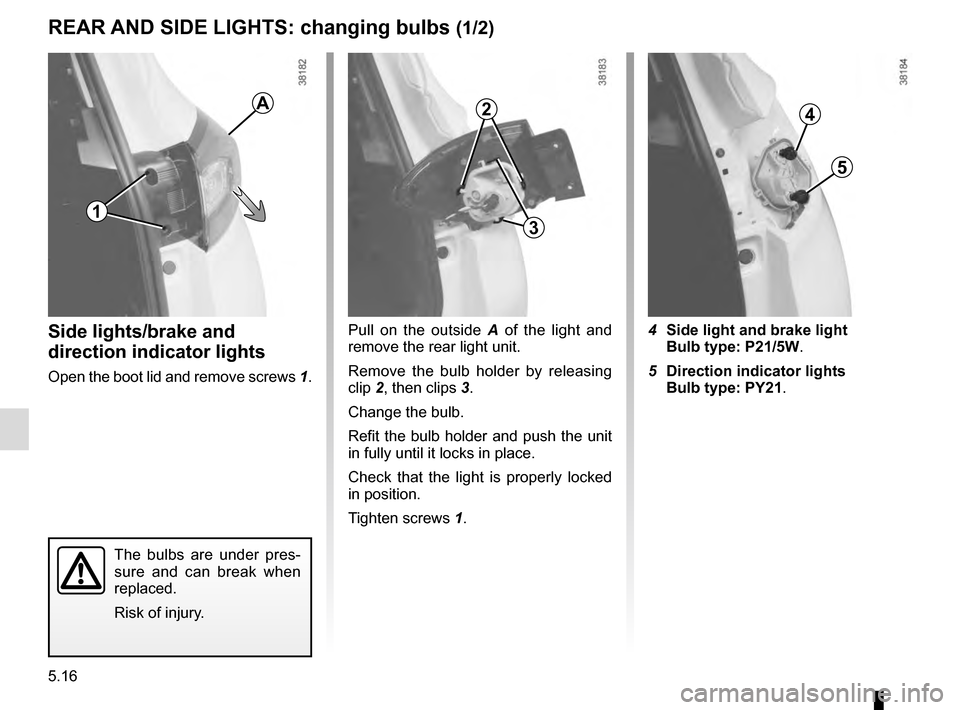
5.16
Pull on the outside A of the light and
remove the rear light unit.
Remove the bulb holder by releasing
clip 2, then clips 3.
Change the bulb.
Refit the bulb holder and push the unit
in fully until it locks in place.
Check that the light is properly locked
in position.
Tighten screws 1.
The bulbs are under pres-
sure and can break when
replaced.
Risk of injury.
4 Side light and brake light
Bulb type: P21/5W.
5 Direction indicator lights
Bulb type: PY21.Side lights/brake and
direction indicator lights
Open the boot lid and remove screws 1.
REAR AND SIDE LIGHTS: changing bulbs (1/2)
4
5
1
A2
3
Page 241 of 246

horn:flash ..................................................................\
........... 1.68
hubcap tool ...............................................................")
7.3
ALPHABETICAL INDEX (3/5)
horn:flash ..................................................................\
........... 1.68
hubcap tool ................................................................. 5.6 – 5.7
I
indicators ......................................................1.68, 5.13 → 5.17
indicators: direction indicators ....................................................... 1.68
instrument panel ..............................................1.44 → 1.52
instrument panel ....................................................1.44 → 1.60
instrument panel messages...................................1.51 → 1.60
interior trim maintenance ..................................................... 4.15 – 4.16
Isofix ....................................................................... 1.31 – 1.32
J
jack ...................................................................\
................... 5.6
L
levels .................................................................\
........4.7 → 4.9
levels: brake fluid ...................................................................... 4.8
coolant ................................................................\
........... 4.7
windscreen washer reservoir ......................................... 4.9
lifting the vehicle changing a wheel .................................................. 5.8 – 5.9
lighting: exterior .............................................................1.\
65 → 1.70
instrument panel .......................................................... 1.65
interior ...................................................... 3.14, 5.18 – 5.19
lights adjustment ........................................................ 1.69 – 1.70
changing bulbs .................................................5.13 → 5.15
front ..................................................................\
5.13 → 5.15
lights: adjusting ........................................................... 1.69 – 1.70 brake lights ....................................................... 5.16 – 5.17
dipped beam headlights .................1.44, 1.65, 5.13
→ 5.15
direction indicators .........................1.44, 1.68, 5.13 → 5.16
fog lights .................................................... 1.44, 1.67, 5.17
hazard warning ............................................................ 1.68
main beam headlights ................................ 1.44, 1.65, 5.13
reversing lights ............................................................. 5.17
side lights ................................................1.65, 5.13 → 5.16
load permitted on the roof..............................................\
...... 6.6
locking the doors .....................................................1.2 → 1.15
M
maintenance ............................................................\
.......... 2.18
maintenance: bodywork .......................................................... 4.13 – 4.14
interior trim ........................................................ 4.15 – 4.16
mechanical .........................................4.4, 4.12, 6.8 → 6.13
map reading lights ............................................................. 3.14
methods of restraint in addition to the seat belts ...1.21 → 1.27
mobile floor ........................................................................\
3.26
multimedia equipment .............................................. 3.31, 5.26
N
navigation system .............................................................. 3.31
O
oil change ................................................................... 4.5 – 4.6
opening the doors .................................................. 1.11 → 1.14
operating faults ................................ 1.44 → 1.48, 5.32 → 5.37
P
paintwork maintenance ..................................................... 4.13 – 4.14
parking distance control.......................................... 2.39 – 2.40
power-assisted steering.................................................\
.... 1.61
pretensioners .........................................................1\
.21 → 1.24