lock RENAULT CAPTUR 2016 1.G Repair Manual
[x] Cancel search | Manufacturer: RENAULT, Model Year: 2016, Model line: CAPTUR, Model: RENAULT CAPTUR 2016 1.GPages: 246, PDF Size: 2.55 MB
Page 202 of 246
5.20
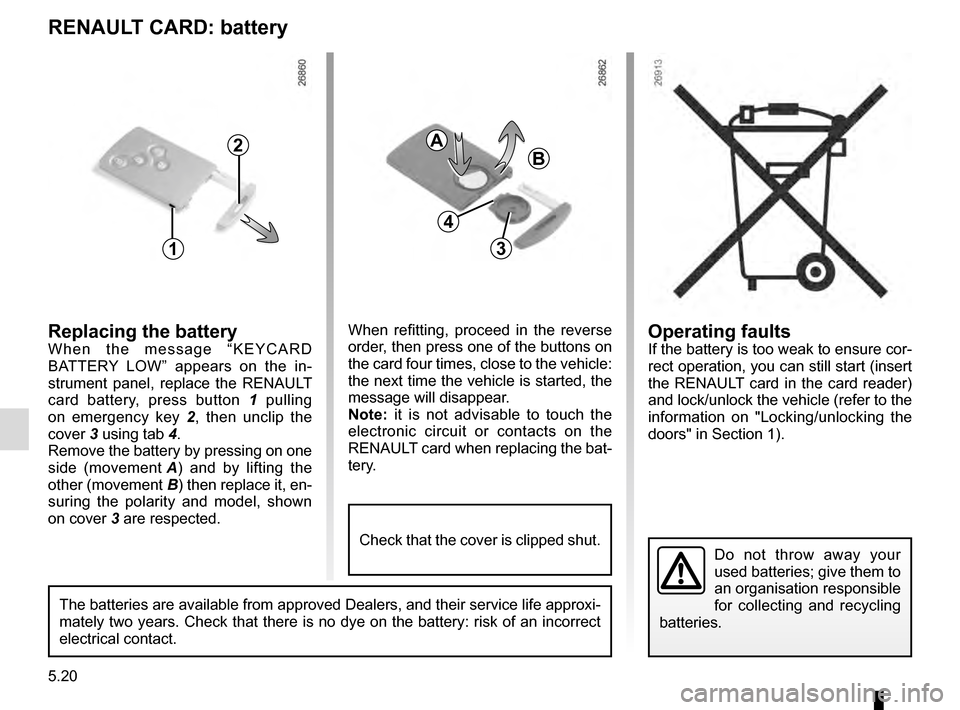
Operating faultsIf the battery is too weak to ensure cor-
rect operation, you can still start (insert
the RENAULT card in the card reader)
and lock/unlock the vehicle (refer to the
information on "Locking/unlocking the
doors" in Section 1).
RENAULT CARD: battery
Replacing the batteryWhen the message “KEYCARD
BATTERY LOW” appears on the in-
strument panel, replace the RENAULT
card battery, press button 1 pulling
on emergency key 2 , then unclip the
cover 3 using tab 4.
Remove the battery by pressing on one
side (movement A) and by lifting the
other (movement B) then replace it, en-
suring the polarity and model, shown
on cover 3 are respected.
Do not throw away your
used batteries; give them to
an organisation responsible
for collecting and recycling
batteries.
1
2
When refitting, proceed in the reverse
order, then press one of the buttons on
the card four times, close to the vehicle:
the next time the vehicle is started, the
message will disappear.
Note: it is not advisable to touch the
electronic circuit or contacts on the
RENAULT card when replacing the bat-
tery.
A
B
3
The batteries are available from approved Dealers, and their service lif\
e approxi-
mately two years. Check that there is no dye on the battery: risk of an \
incorrect
electrical contact.
4
Check that the cover is clipped shut.
Page 205 of 246
5.23
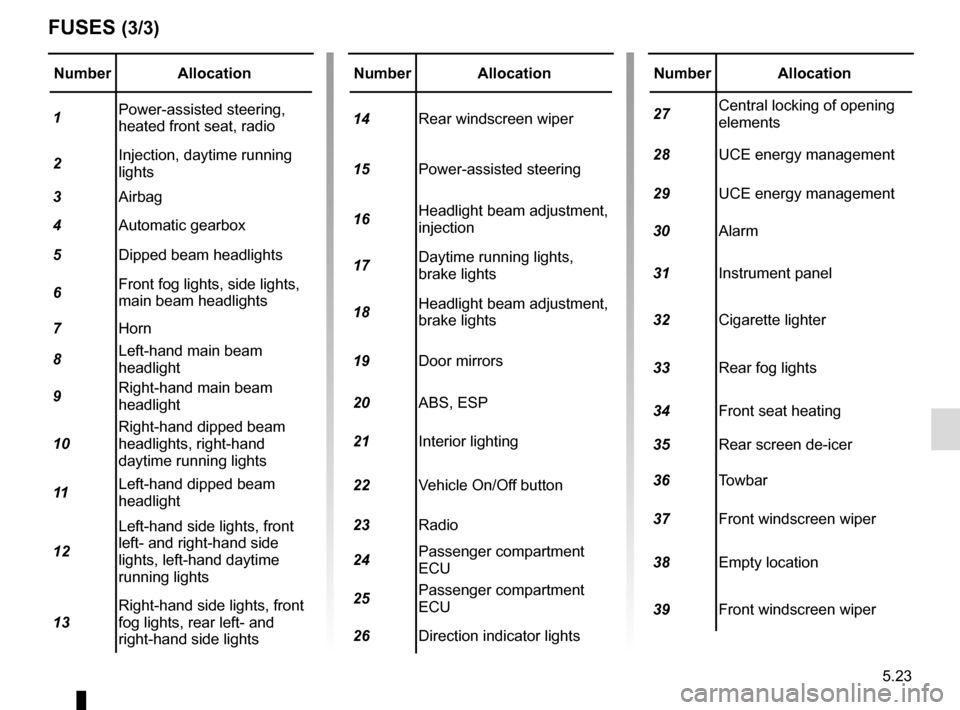
Number Allocation
1 Power-assisted steering,
heated front seat, radio
2 Injection, daytime running
lights
3 Airbag
4 Automatic gearbox
5 Dipped beam headlights
6 Front fog lights, side lights,
main beam headlights
7 Horn
8 Left-hand main beam
headlight
9 Right-hand main beam
headlight
10 Right-hand dipped beam
headlights, right-hand
daytime running lights
11 Left-hand dipped beam
headlight
12 Left-hand side lights, front
left- and right-hand side
lights, left-hand daytime
running lights
13 Right-hand side lights, front
fog lights, rear left- and
right-hand side lights
FUSES (3/3)
Number Allocation
14 Rear windscreen wiper
15 Power-assisted steering
16 Headlight beam adjustment,
injection
17 Daytime running lights,
brake lights
18 Headlight beam adjustment,
brake lights
19 Door mirrors
20 ABS, ESP
21 Interior lighting
22 Vehicle On/Off button
23 Radio
24 Passenger compartment
ECU
25 Passenger compartment
ECU
26 Direction indicator lightsNumber Allocation
27 Central locking of opening
elements
28 UCE energy management
29 UCE energy management
30 Alarm
31 Instrument panel
32 Cigarette lighter
33 Rear fog lights
34 Front seat heating
35 Rear screen de-icer
36 Towbar
37 Front windscreen wiper
38 Empty location
39 Front windscreen wiper
Page 210 of 246
5.28
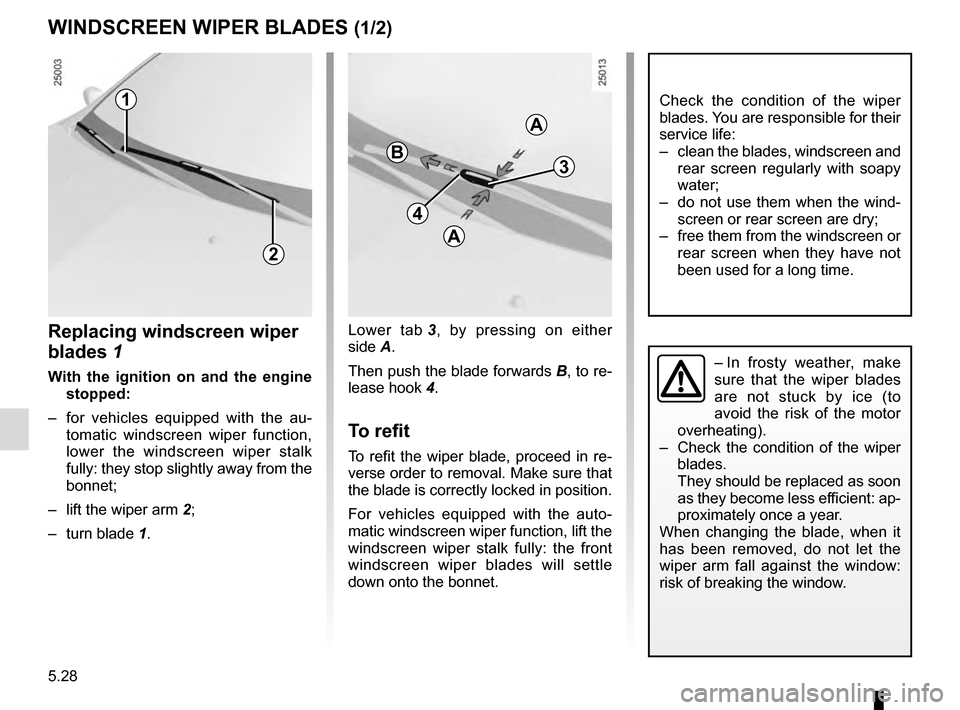
Lower tab 3, by pressing on either
side A.
Then push the blade forwards B, to re-
lease hook 4.
To refit
To refit the wiper blade, proceed in re-
verse order to removal. Make sure that
the blade is correctly locked in position.
For vehicles equipped with the auto-
matic windscreen wiper function, lift the
windscreen wiper stalk fully: the front
windscreen wiper blades will settle
down onto the bonnet.
Replacing windscreen wiper
blades 1
With the ignition on and the engine
stopped:
– for vehicles equipped with the au- tomatic windscreen wiper function,
lower the windscreen wiper stalk
fully: they stop slightly away from the
bonnet;
– lift the wiper arm 2;
– turn blade 1.
WINDSCREEN WIPER BLADES (1/2)
2
1
4
3B
A
A
Check the condition of the wiper
blades. You are responsible for their
service life:
– clean the blades, windscreen and
rear screen regularly with soapy
water;
– do not use them when the wind- screen or rear screen are dry;
– free them from the windscreen or rear screen when they have not
been used for a long time.
– In frosty weather, make
sure that the wiper blades
are not stuck by ice (to
avoid the risk of the motor
overheating).
– Check the condition of the wiper
blades.
They should be replaced as soon
as they become less efficient: ap-
proximately once a year.
When changing the blade, when it
has been removed, do not let the
wiper arm fall against the window:
risk of breaking the window.
Page 211 of 246
5.29
To refit
To refit the wiper blade, proceed in re-
verse order to removal. Make sure that
the blade is correctly locked in position.
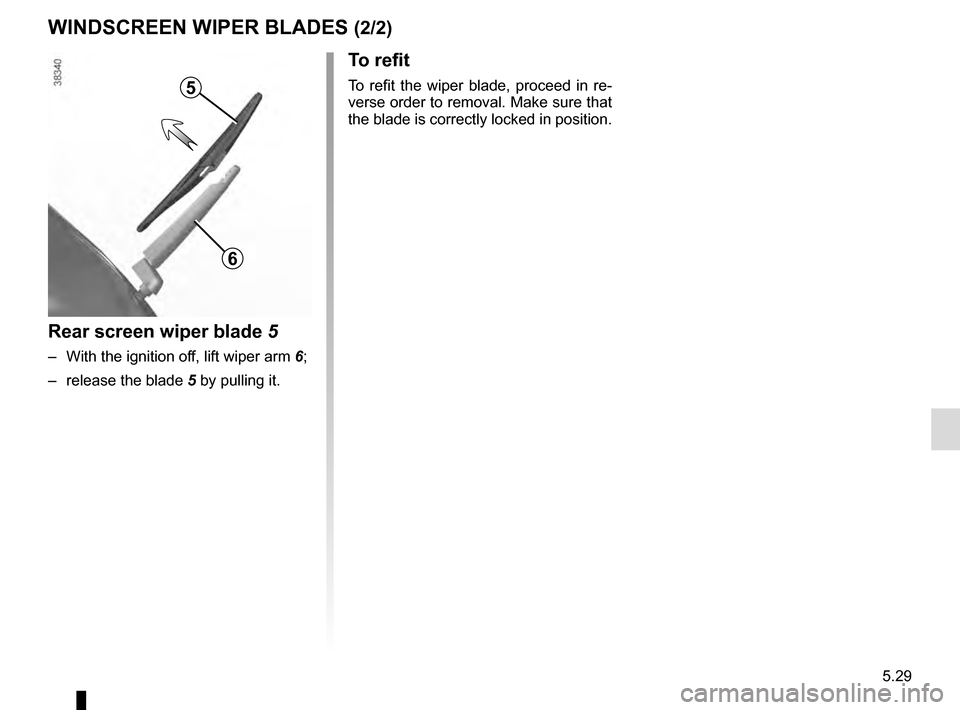
Rear screen wiper blade 5
– With the ignition off, lift wiper arm 6;
– release the blade 5 by pulling it.
WINDSCREEN WIPER BLADES (2/2)
5
6
Page 212 of 246
5.30
TOWING: breakdown recovery (1/2)
Before towing, unlock the steering
column: with the clutch depressed,
engage first gear (lever in position N
or R for vehicles with automatic gear-
boxes), insert the RENAULT card in the
card reader, then press the engine start
button for two seconds.
Reposition the lever to neutral (posi-
tion N for vehicles fitted with an auto-
matic gearbox).
The column is unlocked, the acces-
sory functions are supplied: the vehi-
cle lights can be used (indicators, brake
lights etc.). At night the vehicle must
have its lights on.
Once you have finished towing, press
the engine start button twice (risk of
running down the battery). The speed specified by current legis-
lation for towing must always be ob-
served. If your vehicle is the towing
vehicle, do not exceed the maximum
towing weight for your vehicle (refer to
the information on “Weights” in Section
6).
Towing a vehicle with an
automatic gearbox
With the engine switched off, the trans-
mission is no longer lubricated. It is
preferable to tow this type of vehicle on
a trailer or tow it with the front wheels
off the ground.
Under
exceptional circumstances, you
may tow the vehicle with all four wheels
on the ground, only going forward, with
the gear lever in the neutral N position,
and for a distance not exceeding
30 miles (50 km).
Do not remove the
RENAULT card from the
reader when the vehicle is
being towed.
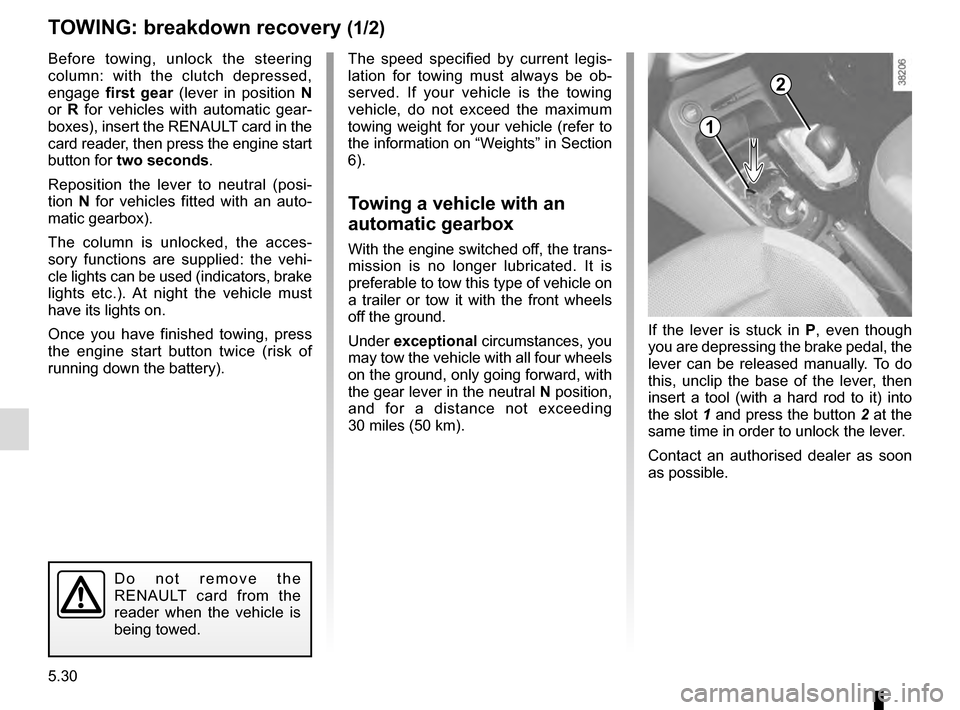
1
2
If the lever is stuck in P , even though
you are depressing the brake pedal, the
lever can be released manually. To do
this, unclip the base of the lever, then
insert a tool (with a hard rod to it) into
the slot 1 and press the button 2 at the
same time in order to unlock the lever.
Contact an authorised dealer as soon
as possible.
Page 213 of 246
5.31
TOWING: breakdown recovery (2/2)
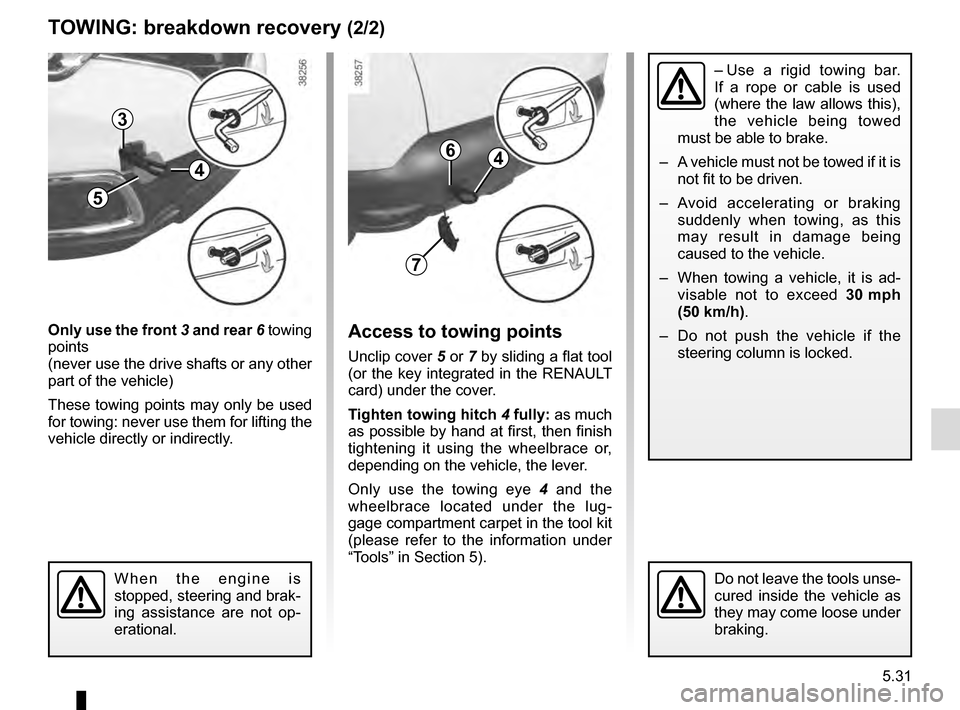
Only use the front 3 and rear 6 towing
points
(never use the drive shafts or any other
part of the vehicle)
These towing points may only be used
for towing: never use them for lifting the
vehicle directly or indirectly.Access to towing points
Unclip cover 5 or 7 by sliding a flat tool
(or the key integrated in the RENAULT
card) under the cover.
Tighten towing hitch 4 fully: as much
as possible by hand at first, then finish
tightening it using the wheelbrace or,
depending on the vehicle, the lever.
Only use the towing eye 4 and the
wheelbrace located under the lug-
gage compartment carpet in the tool kit
(please refer to the information under
“Tools” in Section 5).
When the engine is
stopped, steering and brak-
ing assistance are not op-
erational.Do not leave the tools unse-
cured inside the vehicle as
they may come loose under
braking.
6
7
4
– Use a rigid towing bar.
If a rope or cable is used
(where the law allows this),
the vehicle being towed
must be able to brake.
– A vehicle must not be towed if it is not fit to be driven.
– Avoid accelerating or braking suddenly when towing, as this
may result in damage being
caused to the vehicle.
– When towing a vehicle, it is ad- visable not to exceed 30 mph
(50 km/h).
– Do not push the vehicle if the steering column is locked.
5
4
3
Page 214 of 246

The following advice will enable you to carry out quick, temporary repai\
rs. For safety reasons you should always contact
an approved Dealer as soon as possible.
Using th")
5.32
OPERATING FAULTS (1/6)
The following advice will enable you to carry out quick, temporary repai\
rs. For safety reasons you should always contact
an approved Dealer as soon as possible.
Using the RENAULT cardPOSSIBLE CAUSESWHAT TO DO
The RENAULT card does not lock or
unlock the doors. Card battery is flat.
Replace the battery. You can still lock/
unlock and start your vehicle (refer to the in-
formation on “Locking, unlocking the open-
ing elements” in Section 1 and “Starting,
stopping the engine” in Section 2).
Use of appliances operating on the
same frequency as the card (mobile
phone, etc.). Stop using the equipment or use the in-
tegrated key (refer to the information on
“Locking, unlocking the opening elements”
in Section 1).
Vehicle located in a high electromag-
netic radiation zone.
Vehicle battery flat. Use the key integrated in the card (refer to
the information on “Locking, unlocking the
opening elements” in Section 1).
The vehicle is started. With the engine running, the card’s locking/
unlocking device is blocked. Turn off the ig-
nition.
Page 215 of 246
5.33
OPERATING FAULTS (2/6)
The starter is activatedPOSSIBLE CAUSES WHAT TO DO
The instrument panel indicator lights are
weak or fail to light up and the starter
does not turn. Battery terminals not tight,
battery terminals discon-
nected or oxidised.Retighten or reconnect the terminals, or clean them if
they are oxidised.
Discharged battery or not
operational. Connect another battery to the faulty battery. Refer to
information on “Battery: troubleshooting” in Section 5
or replace the battery if necessary.
Do not push the vehicle if the steering column is
locked.
Faulty circuit. Consult an approved dealer.
The engine will not start. Starting conditions are not
fulfilled.Please refer to the information on “Starting, stopping
the engine” in Section 2.
The RENAULT “hands-free”
card does not work. Insert the card in the card reader in order to start the
engine.
Please refer to the information on “Starting, stopping
the engine” in Section 2.
The engine cannot be switched off. Card not detected. Insert the card in card reader.
Electronic fault. Press the starter button quickly five times.
The steering column remains locked. Steering wheel locked. Move the steering wheel while pressing the engine
start button (please refer to Section 2 “Starting, stop-
ping the engine”).
Faulty circuit. Consult an approved dealer.
Page 239 of 246

A
ABS ..............................................................1.46, \
2.27 → 2.31
accessories.............................................................\
......")
7.1
ALPHABETICAL INDEX (1/5)
A
ABS ..............................................................1.46, \
2.27 → 2.31
accessories.............................................................\
........... 5.27
accessories socket ............................................................ 3.20
additional methods of restraint .......................................... 1.27 side protection ............................................................. 1.26
to the front seat belts .......................................1.21 → 1.24
to the rear seat belts .................................................... 1.25
adjusting your driving position ......................1.16 → 1.20, 3.21
advice on antipollution ....................................................... 2.18
air bag...........................................................1.21 → 1.27, 1.44
activating the front passenger air bags ........................ 1.39
deactivating the front passenger air bags .................... 1.37
air conditioning ........................................................ 3.4 → 3.11
air vents ...................................................................... 3.2 – 3.3
anti-corrosion check ..............................................6.14 → 6.18
anti-corrosion protection .................................................... 4.13
anti-lock braking system: ABS ...............................2.27 → 2.31
antipollution advice .................................................................\
......... 2.18
armrest: front ..................................................................\
............ 3.16
ashtray ................................................................\
............... 3.20
ASR (traction control) ............................................2.27 → 2.31
audible and visual signals.................................................. 1.68
automatic gearbox (use) ........................................2.43 → 2.45
automatic gearbox selector lever...........................2.43 → 2.45
B
battery............................................................ 4.12, 5.24 – 5.25 troubleshooting ................................................. 5.24 – 5.25
bonnet..................................................................\
....... 4.2 – 4.3
brake fluid ........................................................................\
.... 4.8
bulbs changing ..........................................................5.13 \
→ 5.19C
catalytic converter................................................... 2.10 – 2.11
central door locking ........................... 1.5
→ 1.10, 1.13 → 1.15
changing a bulb .....................................................5.13 → 5.19
changing a wheel........................................................\
5.8 – 5.9
changing gear ...............................................2.12, 2.43 → 2.45
child restraint/seat .............................1.28 – 1.29, 1.31 → 1.37
child safety......1.8 – 1.9, 1.12, 1.24, 1.28 – 1.29, 1.31 → 1.37,
2.3, 3.12 – 3.13
child seats..........................................1.28 – 1.29, 1.3\
1 → 1.36
children ........................ 1.2, 1.8 – 1.9, 1.28 – 1.29, 3.12 – 3.13
children (safety) .......................................................... 1.2, 1.12
cigar lighter ........................................................................\
3.20
cleaning: inside the vehicle .............................................. 4.15 – 4.16
clock ....................................................................... 1.62 – 1.63
closing the doors ................................................... 1.11 → 1.15
control instruments ............................1.44 → 1.52, 1.62 – 1.63
controls ...............................................................\
...1.40 → 1.43
courtesy light ............................................................ 3.14, 5.18
courtesy mirrors ................................................................. 3.19
cruise control ................................................1.47, 2.35 → 2.38
cruise control-speed limiter....................................2.32 → 2.38
D
dashboard..............................................................1\
.40 → 1.43
deadlocking the doors ....................................................... 1.10
demisting rear screen ..................................................3.4, 3.7 → 3.10
windscreen ..................................................3.5, 3.7 → 3.10
dimensions .............................................................\
............. 6.4
dipstick................................................................\
................. 4.4
display ................................................................\
...1.44 → 1.50
doors/tailgate .........................................................\
..1.2 → 1.15
driver assistance....................................................2.2\
7 → 2.42
driver’s position .....................................................1.40 →
1.48
Page 241 of 246

horn:flash ..................................................................\
........... 1.68
hubcap tool ...............................................................")
7.3
ALPHABETICAL INDEX (3/5)
horn:flash ..................................................................\
........... 1.68
hubcap tool ................................................................. 5.6 – 5.7
I
indicators ......................................................1.68, 5.13 → 5.17
indicators: direction indicators ....................................................... 1.68
instrument panel ..............................................1.44 → 1.52
instrument panel ....................................................1.44 → 1.60
instrument panel messages...................................1.51 → 1.60
interior trim maintenance ..................................................... 4.15 – 4.16
Isofix ....................................................................... 1.31 – 1.32
J
jack ...................................................................\
................... 5.6
L
levels .................................................................\
........4.7 → 4.9
levels: brake fluid ...................................................................... 4.8
coolant ................................................................\
........... 4.7
windscreen washer reservoir ......................................... 4.9
lifting the vehicle changing a wheel .................................................. 5.8 – 5.9
lighting: exterior .............................................................1.\
65 → 1.70
instrument panel .......................................................... 1.65
interior ...................................................... 3.14, 5.18 – 5.19
lights adjustment ........................................................ 1.69 – 1.70
changing bulbs .................................................5.13 → 5.15
front ..................................................................\
5.13 → 5.15
lights: adjusting ........................................................... 1.69 – 1.70 brake lights ....................................................... 5.16 – 5.17
dipped beam headlights .................1.44, 1.65, 5.13
→ 5.15
direction indicators .........................1.44, 1.68, 5.13 → 5.16
fog lights .................................................... 1.44, 1.67, 5.17
hazard warning ............................................................ 1.68
main beam headlights ................................ 1.44, 1.65, 5.13
reversing lights ............................................................. 5.17
side lights ................................................1.65, 5.13 → 5.16
load permitted on the roof..............................................\
...... 6.6
locking the doors .....................................................1.2 → 1.15
M
maintenance ............................................................\
.......... 2.18
maintenance: bodywork .......................................................... 4.13 – 4.14
interior trim ........................................................ 4.15 – 4.16
mechanical .........................................4.4, 4.12, 6.8 → 6.13
map reading lights ............................................................. 3.14
methods of restraint in addition to the seat belts ...1.21 → 1.27
mobile floor ........................................................................\
3.26
multimedia equipment .............................................. 3.31, 5.26
N
navigation system .............................................................. 3.31
O
oil change ................................................................... 4.5 – 4.6
opening the doors .................................................. 1.11 → 1.14
operating faults ................................ 1.44 → 1.48, 5.32 → 5.37
P
paintwork maintenance ..................................................... 4.13 – 4.14
parking distance control.......................................... 2.39 – 2.40
power-assisted steering.................................................\
.... 1.61
pretensioners .........................................................1\
.21 → 1.24